
Purchasing a Mailing List can look like a simple procurement task. You define an audience, ask a supplier for a count, agree a price and receive a file of names and addresses. In reality, the decision affects far more than the cost of the data. It shapes who receives the campaign, how much you spend on print and postage, how relevant the message feels, how much returned mail you create and whether the results are meaningful enough to guide the next campaign.
That is why a mailing list should be judged as part of the economics of direct mail, not as a spreadsheet bought in isolation. Every inaccurate address can waste production and postage. Every poorly chosen prospect can consume budget without having a realistic chance of responding. Every missing suppression can damage trust. A well-selected list does the opposite. It lets the business invest more confidently because the campaign starts with a clearer audience.
This article takes a different approach from a general explanation of postal data or a step-by-step direct mail campaign guide. Its focus is the buying decision itself. It explains when Purchasing a Mailing List is sensible, when it is better to build or improve your own data, how B2B and B2C postal lists differ, how to identify reliable suppliers, how to assess data accuracy, why the Mailing Preference Service matters, what should be checked before a file reaches the printer, and how purchased mailing lists compare with email and telemarketing lists.
It also looks at alternatives to buying. A strong mailing audience can be built from customer records, lapsed buyers, enquiries, events, membership files, public business information, lead generation and carefully managed first-party sources. External data is most useful when it solves a defined gap rather than replacing sound data management.
AccuraData supports both sides of that decision. Businesses can source targeted B2B Data and B2B Postal Data for business campaigns, or use B2C Data and B2C Postal Data for consumer acquisition. Where an existing database already contains valuable records but needs repair, Data Cleansing & Enrichment can help improve accuracy before more data is bought.
A short compliance note is important. This article provides practical marketing and data-management information, not legal advice. The correct approach depends on whether the records relate to individuals or organisations, the source of the data, the targeting fields, the campaign purpose and the relationship with the recipient. Current regulatory guidance should be checked where the position is uncertain.
What Does Purchasing a Mailing List Actually Mean?
Purchasing a Mailing List usually means obtaining the right to use a structured set of postal records for marketing. The commercial arrangement may be described as a purchase, rental or licence. Those words matter because they can affect how long the data may be used, whether it can be loaded into a CRM, whether it can be used for more than one campaign and whether the buyer is allowed to retain or enrich the records after the original mailing.
A mailing list can contain far more than postal addresses. In a B2B campaign, the file may include company name, trading address, postcode, industry, SIC code, turnover band, employee count, site type, company status and named decision-maker information. In a B2C campaign, it may include individual or household name, postal address, postcode, age band, household composition, property indicators, location, lifestyle variables and other permitted targeting attributes.
The useful part is not simply that the addresses exist. The list needs to answer three questions. First, why is this record relevant to the campaign? Second, is the address sufficiently accurate to justify spending money on print and postage? Third, are there any reasons the record should be removed before use?
A supplier that only talks about volume is therefore missing most of the buying decision. Ten thousand records are not automatically better than five thousand. If the larger file contains weaker audience fit, stale addresses or records with unclear provenance, the smaller file can produce a better commercial result.
Purchase, rental and licence are not always the same
Before committing to a file, ask what the agreement actually permits. A one-use rental may be priced differently from a twelve-month licence. A supplier may allow repeated mailings but prohibit resale or onward sharing. Some contracts may restrict the use of appended fields or the creation of derived audiences.
The buyer should know whether the data can be stored internally, whether it can be matched to an existing CRM, whether returned mail can be used to update the database and whether the list can support future campaigns. If the commercial rights are unclear, the apparent price per record tells you very little.
A mailing list is an audience definition, not just a delivery file
The strongest way to think about Purchasing a Mailing List is as purchasing access to a defined market segment. The address is the route to the recipient. The targeting fields explain why that recipient belongs in the campaign.
For example, a commercial cleaning company may want offices within a specific travel radius, with more than 50 employees, excluding home-based companies. A home-improvement business may want homeowners in selected postcode areas with particular property characteristics. A training provider may want HR or health and safety decision-makers at companies above a defined employee threshold.
The supplier should be able to turn that commercial description into clear list logic. If the supplier immediately responds with a record count before understanding the campaign, that is a warning sign.
When Is Purchasing a Mailing List the Right Decision?
Purchasing a Mailing List makes most sense when the business knows who it wants to reach but does not hold enough accurate records to reach that market efficiently. The purchase should close a coverage gap.
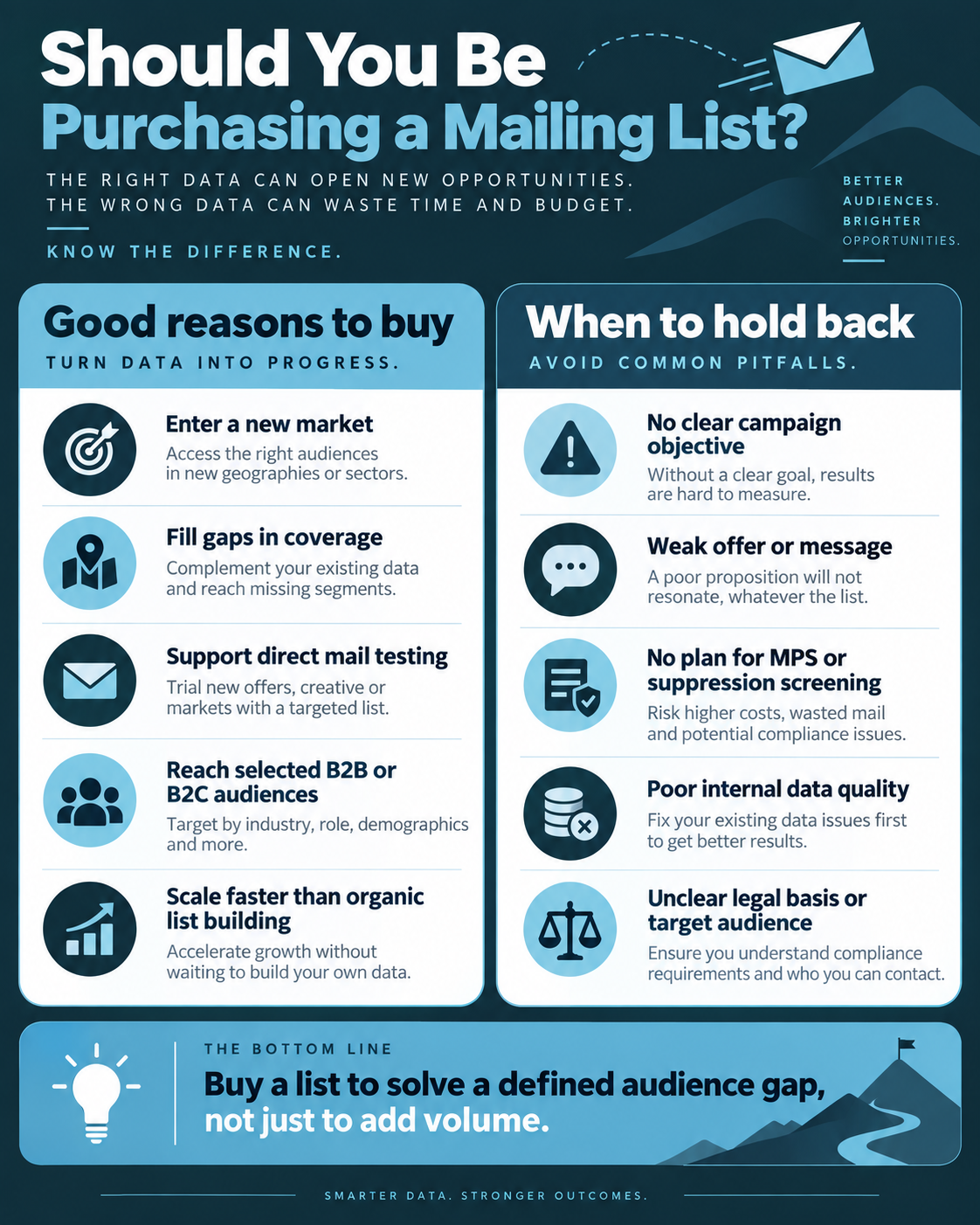
That gap can appear for several reasons. A new business may have almost no first-party prospect database. An established company may be moving into a new region. A B2B organisation may know the target sectors but lack the relevant companies or decision-makers. A consumer brand may want to test a new geographic market before investing in a permanent branch or wider media campaign.
External postal data can also be useful where the business wants to compare a cold acquisition audience against existing customer segments. It can support test-and-learn campaigns, event invitations, local launches, catalogue acquisition, fundraising, property-related marketing, professional services prospecting and other situations where a defined physical audience is valuable.
Buying is useful when speed matters
Building a substantial first-party mailing database takes time. You need customers, enquiries, registrations, event contacts, referrals or other legitimate sources. If the commercial opportunity exists now, Purchasing a Mailing List can provide faster access to the market.
Speed should not become an excuse to skip due diligence. A list that arrives quickly but needs extensive cleansing, has poor source information or contains the wrong audience may delay the campaign rather than accelerate it.
Buying is useful when your CRM has strong customers but weak market coverage
Many businesses have good customer data and poor prospect data. Their CRM can describe people who have already bought, but not the wider market. This is especially common in B2B organisations that have grown through referrals or account relationships.
In that situation, external B2B Postal Data can expand the market view. The company can compare target accounts with its existing CRM, suppress customers and open opportunities, then mail only the genuine acquisition gap.
For consumer campaigns, B2C Postal Data can help a business reach relevant households outside its customer base without relying entirely on broad unaddressed distribution.
Buying may be the wrong decision when the real problem is data quality
If the business already owns enough records but the addresses are inconsistent, duplicated or out of date, buying more may make the problem worse. The better first step may be Data Cleansing & Enrichment.
A database containing 80,000 records can sound impressive. If 20,000 are duplicated, gone away, incomplete or no longer relevant, the actual usable audience may be much smaller. Adding another 50,000 records without fixing the base creates a larger mess, not a stronger asset.
Buying may be the wrong decision when the audience is not yet defined
If the brief is simply “give us as many local households as possible” or “send us all businesses in the South East”, the campaign probably needs more planning before data is purchased.
Direct mail has a tangible cost per item. The business should be able to explain why each segment has a plausible reason to respond. If the targeting logic cannot be described in plain language, the creative team will struggle to make the message relevant and the finance team will struggle to justify the spend.
Purchasing a Mailing List for B2B Campaigns
B2B mailing lists are built around organisations, locations and professional roles. The company is often the stable unit, while individual contacts can change more frequently. Good B2B list design therefore starts with the account and then decides whether named contacts are required.
A simple company-level list may be enough for a broad office, branch or site mailing. A higher-value campaign may justify named decision-makers because the creative needs to reach a particular function such as finance, operations, procurement, HR, IT, facilities or marketing.
Define the company before the person
The most reliable B2B buying sequence is usually to define company fit first. Useful filters can include industry, SIC code, geography, turnover, employee count, number of sites, company type, trading status and location type.
Only then should you define the contact role. This prevents the campaign from buying impressive job titles at companies that were never a good commercial fit.
AccuraData’s wider B2B Data can help organisations define the company universe before selecting the postal audience.
Decide whether you need a registered office, trading site or branch
Address type matters. A registered office may be appropriate for formal company communication, but it may be poor for a campaign aimed at a local operational team. A logistics supplier may need depots. A facilities service may need occupied commercial sites. A national software provider may care more about head offices.
Ask the supplier what each address represents. Do not assume every “business address” is operationally equivalent.
Named B2B mail needs accurate decision-maker data
If the mail is addressed to a named person, data accuracy becomes particularly important. A letter to “Operations Director” at the right company may still find its way to the correct team. A letter addressed to someone who left two years ago makes the campaign look stale before the envelope is opened.
For named B2B campaigns, ask when the contact was last verified, how role changes are handled and whether the supplier can replace or update invalid named contacts. The higher the value of the mail piece, the stronger the case for recent verification.
The same principle applies to company status. A beautiful pack sent to a dissolved company or an empty former office wastes more than postage. It wastes print, personalisation, fulfilment and the opportunity to reach a better prospect.
Purchasing a Mailing List for B2C Campaigns
B2C mailing lists are centred on individuals or households. That changes the targeting model, the privacy considerations and the importance of preference management.
A consumer list might be built around geography, age band, household composition, property type, home ownership, affluence indicators, interests or other lawful and appropriate variables. The buyer should understand whether an attribute is observed, supplied directly, modelled or inferred. A field that looks precise may actually be a statistical estimate.
Person-level and household-level data are different
Ask whether the list targets named individuals, households or addresses. A household characteristic should not be presented as a fact about a specific person unless the source supports that interpretation.
This distinction affects creative. A mailing based on household-level indicators should use language appropriate to the household or area, rather than implying the sender knows an individual fact that it does not actually know.
Do not buy more consumer attributes than the campaign needs
Additional fields can improve segmentation, but they also create more complexity and potentially more privacy risk. Buy data because it changes a decision, not because the field is available.
A local retail campaign may need postcode, distance, household type and one or two relevant profile variables. A home-services campaign may need property-related indicators. A charity appeal may use a different audience model. The list specification should follow the offer.
Consumer prospect data should be prepared for responsible postal use
For consumer acquisition, the business should check internal objections and relevant preference files before mailing. The Mailing Preference Service is the UK’s official register for people who do not want unsolicited personally addressed marketing mail.
The corporate MPS guidance states that non-customer mailing lists should be screened against the MPS file before use. MPS is not itself a statutory legal requirement, but it is a central part of the UK direct mail self-regulatory framework. As a practical standard, relevant consumer prospect files should be screened against MPS before the campaign is released.
The Mailing Preference Service Must Be Built into the Process
The Mail Preference Service is easy to treat as a final production check. It is better treated as part of list governance.
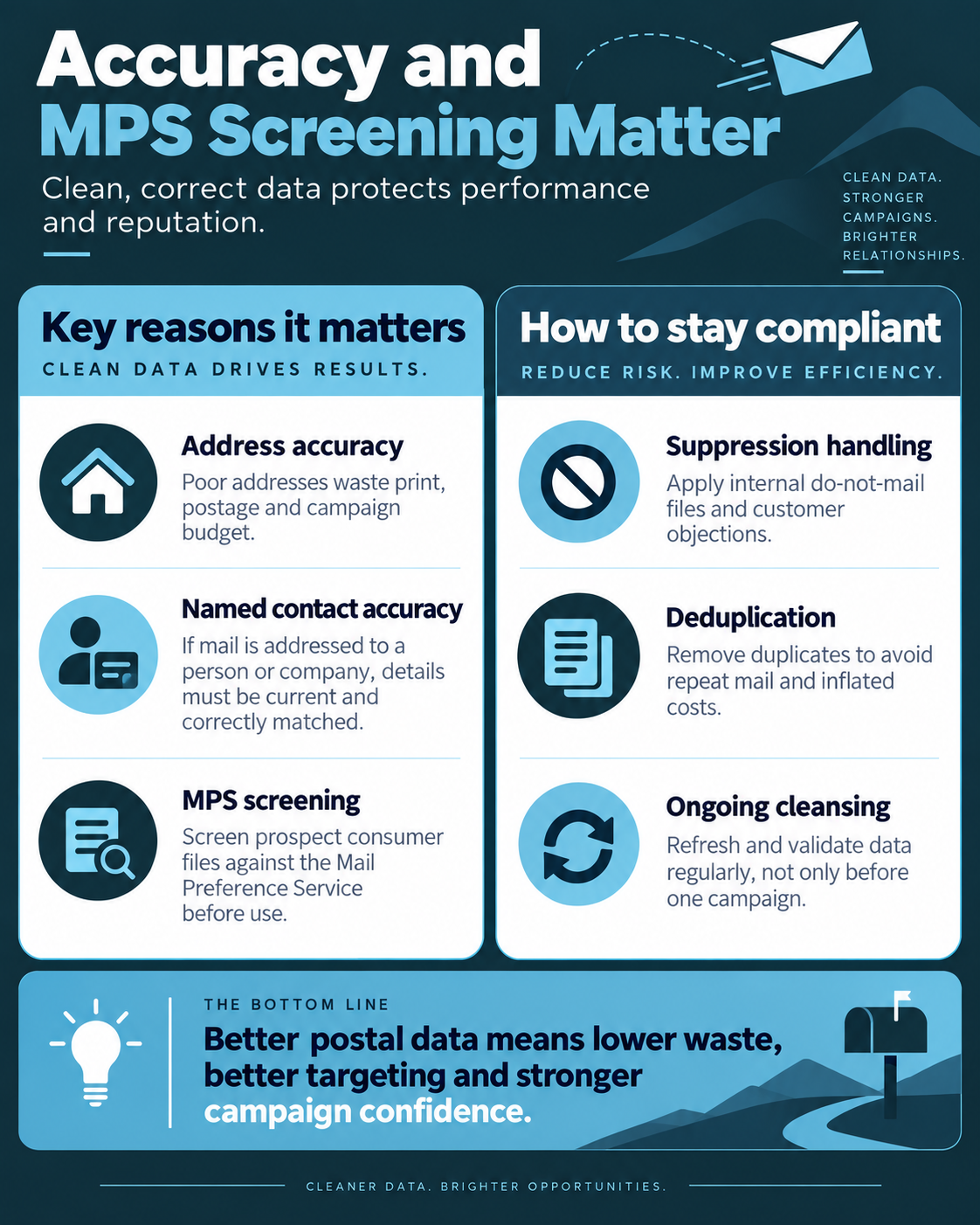
The MPS register contains consumers who have expressed a preference not to receive unsolicited personally addressed advertising mail. Screening helps prevent spend on recipients who have already indicated that they do not want this type of contact. It also supports trust in the channel.
The DMA preference-services guidance explains that MPS is the UK’s official do-not-mail list and forms part of the direct marketing industry’s self-regulatory framework. The DMA Code also expects cold marketing data to be screened against relevant preference services.
MPS is not the same as an internal suppression list
A business needs both. MPS captures an external preference. Your own suppression file records people who have directly asked your organisation to stop marketing to them.
Never delete internal opt-outs simply to make the database look cleaner. Keep enough information to ensure the person is not accidentally re-added from a future list purchase.
Relevant consumer data should be screened before every campaign release
A list can change between purchase and use. Your own suppression file can change as people object. MPS registrations can change too. Screening should therefore be part of the final audience preparation, not a one-time assumption inherited from the supplier.
Where a supplier says the file is already MPS screened, ask when the screening took place. If the campaign is being executed later, refresh the check before use.
MPS does not replace wider data-protection responsibilities
The ICO direct marketing guidance makes clear that postal marketing is not covered by PECR in the same way as electronic mail or telephone marketing, but data-protection law still applies where personal information is used.
If you are sending to a named individual, you need an appropriate lawful basis and must respect the person’s absolute right to object to direct marketing. Postal marketing often relies on legitimate interests, but that is not a blanket exemption from fairness, transparency or objection handling.
Data Accuracy Is More Important in Postal Marketing Than Many Buyers Expect
Email and telephone campaigns can waste time on bad records. Direct mail adds physical production cost. That makes address accuracy unusually visible in the budget.
A bad postal record can consume data cost, creative personalisation, paper, print, envelope, fulfilment and postage before the failure is discovered. If the piece is premium or dimensional, the wasted amount per record can be substantial.
Validate the address itself
The buyer should expect standard address fields such as premise, street, locality, post town and postcode to be consistent and usable. Royal Mail’s Postcode Finder explains that UK address and postcode information is maintained in the Postcode Address File, commonly known as PAF.
Ask whether the supplier standardises addresses against recognised postal structures and how it handles incomplete addresses, flats, business units, rural properties and recent changes.
Accuracy means more than a deliverable postcode
A record can have a valid postcode and still be wrong for the campaign. A company may have moved. A named decision-maker may have left. A consumer may no longer live at the address. A head office may be valid while the target team works elsewhere.
Good data quality combines technical address validity with recipient relevance.
Named mail magnifies the effect of stale data
Personalisation can increase relevance, but it also makes errors more obvious. “Dear Sarah” sent to a person who left the company eighteen months ago undermines credibility. Mail addressed to a deceased consumer can cause distress and serious reputational harm.
For higher-value addressed campaigns, ask what deceased and gone-away checks are available, when they were last applied and whether they are included in the base price or charged separately.
Data cleansing should happen before print quantity is locked
Do not approve the final print run from the raw purchased count. First match against existing customers, internal suppressions, duplicates, MPS where relevant, address-quality checks and any other exclusions.
AccuraData’s Data Cleansing & Enrichment can help organisations clean existing and acquired records before production. The objective is simple: spend print and postage only on records that survive the final campaign rules.
How to Vet a Mailing List Supplier
Purchasing a Mailing List is partly a data transaction and partly a trust decision. The supplier is making claims about source, quality, recency, targeting and permitted use. The buyer should be able to test those claims.
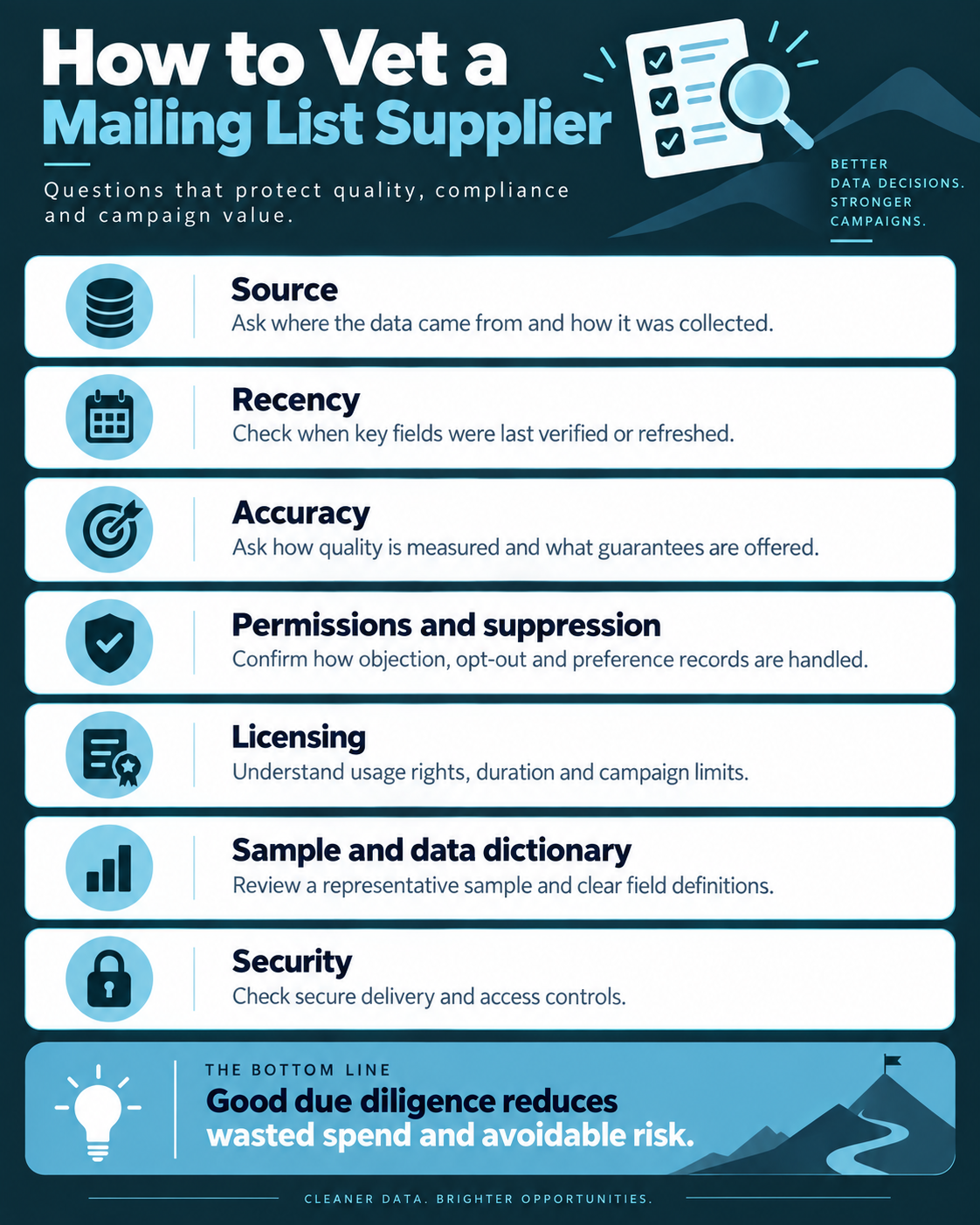
A reliable provider should be comfortable explaining the data, not just selling the count.
Ask where the data came from
“Proprietary database” is not a useful source description. Ask how the records were obtained, how they are maintained, what third-party sources are involved and what processing or validation takes place before delivery.
For consumer data, ask how the intended use was explained to individuals where relevant. For B2B data, ask how company and decision-maker information is maintained.
The ICO’s guidance on using marketing lists says organisations should check the origin and accuracy of bought-in lists rather than simply accepting a supplier’s assurance.
Ask how often the data is refreshed
Different fields decay at different rates. Business names and addresses can change. Decision-makers move jobs. Consumers move home. New-build addresses appear. Companies dissolve. Postcodes can be reorganised.
A supplier should be able to explain the refresh process rather than only quote a general “accuracy percentage”.
Ask for a representative sample
A useful sample should resemble the data you will actually receive. It should contain the same types of fields, the same selection logic and realistic values.
Use the sample to test field completeness, address formatting, company relevance, named-contact quality, duplicate risk and whether the targeting logic makes sense.
A hand-picked sample of perfect records proves very little.
Ask what “accuracy” means
A supplier may claim 95% or 98% accuracy. Ask how that figure is calculated. Is it address accuracy, company-live status, named-contact accuracy or some blended measure? Over what period? Against what outcome?
The most useful guarantee is often not a vague percentage but a clear process for invalid records, replacement criteria and dispute handling.
Ask how suppressions are applied
For consumer mail, confirm MPS screening and the screening date. Ask how your internal suppression file can be matched before delivery. Ask whether customer exclusions can be applied so acquisition mail is not sent to existing customers.
For B2B mail, ask how closed companies, duplicates and invalid named contacts are handled.
Ask about licensing and reuse
Clarify whether the list is single-use, multi-use or time-limited. Ask whether it can be loaded into your CRM, whether it can be shared with a mailing house, whether campaign responses can be retained and whether enriched records can be kept after the licence ends.
These details affect the true cost of the data.
Ask how the file will be delivered securely
A mailing list may contain personal information. Secure transfer, access controls and retention rules matter. Avoid informal delivery methods that expose data unnecessarily.
Ask what support exists after delivery
The best providers remain useful after the invoice. They can help explain fields, refine targeting, replace qualifying invalid records and interpret the audience when the campaign team has questions.
This is one reason AccuraData positions its service around targeted data rather than anonymous list downloads. Clients can define the audience, review counts and use wider cleansing support rather than treating the transaction as a one-click file purchase.
Red Flags When Purchasing a Mailing List
Some supplier behaviour should slow the buying process immediately.
A provider that cannot describe data sources in meaningful terms is a risk. A provider that offers every conceivable audience at an implausibly low price may be prioritising volume over quality. A supplier that discourages sampling or due diligence is asking the buyer to take too much on trust.
“GDPR compliant” without explaining what that means
Compliance is not a property that can be stamped onto a spreadsheet permanently. The lawfulness of processing depends on source, purpose, transparency, audience and use.
A trustworthy supplier should explain the controls around the data and the buyer’s responsibilities. It should not suggest that purchasing the file transfers all compliance responsibility away from the user.
Impossible levels of precision
Be cautious of data fields that appear extremely precise without an obvious source. Household or lifestyle variables may be modelled. That can still be useful, but the buyer should know whether a field is factual, declared, observed or inferred.
No date information
A supplier that cannot say when important records were last refreshed leaves the buyer unable to assess likely decay.
No replacement policy
Postal data is never frozen in time. Some records will change. A serious provider should have a clear position on what counts as invalid and what remedies are available.
Pressure to buy the largest volume
A good supplier should be willing to reduce the count when targeting improves. If the commercial conversation is always about increasing rows, the incentives are misaligned.
Purchasing a Mailing List: Work Out the True Cost Per Usable Record
Price per thousand is convenient, but it can hide the economics that matter.
Suppose Supplier A charges less per thousand but the list contains more duplicates, irrelevant records and invalid addresses. Supplier B costs more but produces a cleaner campaign-ready audience. The cheaper file can create a higher total campaign cost once print, fulfilment and postage are included.
The useful metric is cost per usable record after cleansing.
Add downstream costs to the comparison
Include the cost of data, cleansing, print, personalisation, envelopes, fulfilment, postage and any specialist production. Then divide by the number of records that actually survive the campaign rules.
This makes the value of data accuracy visible.
Think about value per response, not only cost per record
The correct list price also depends on what a new customer is worth. A premium B2B service may justify expensive, highly researched named contacts. A low-margin consumer offer may need a lower acquisition cost and broader but still relevant audience.
Use small tests when the market is uncertain
If you are entering a new sector or targeting model, do not assume the largest available list is the best first step. Buy or licence a controlled test segment, measure the response and use the result to decide whether to expand.
The current JICMAIL Response Rate Tracker provides industry benchmarks for response, ROI, CPA and average order value across mail formats. Benchmarks are useful for planning, but your own campaign data should become the most important reference over time.
Other Ways to Generate a Mailing List Without Buying One
Purchasing a Mailing List is only one route to an addressable postal audience. Many businesses can build valuable lists from information they already collect or can collect directly.
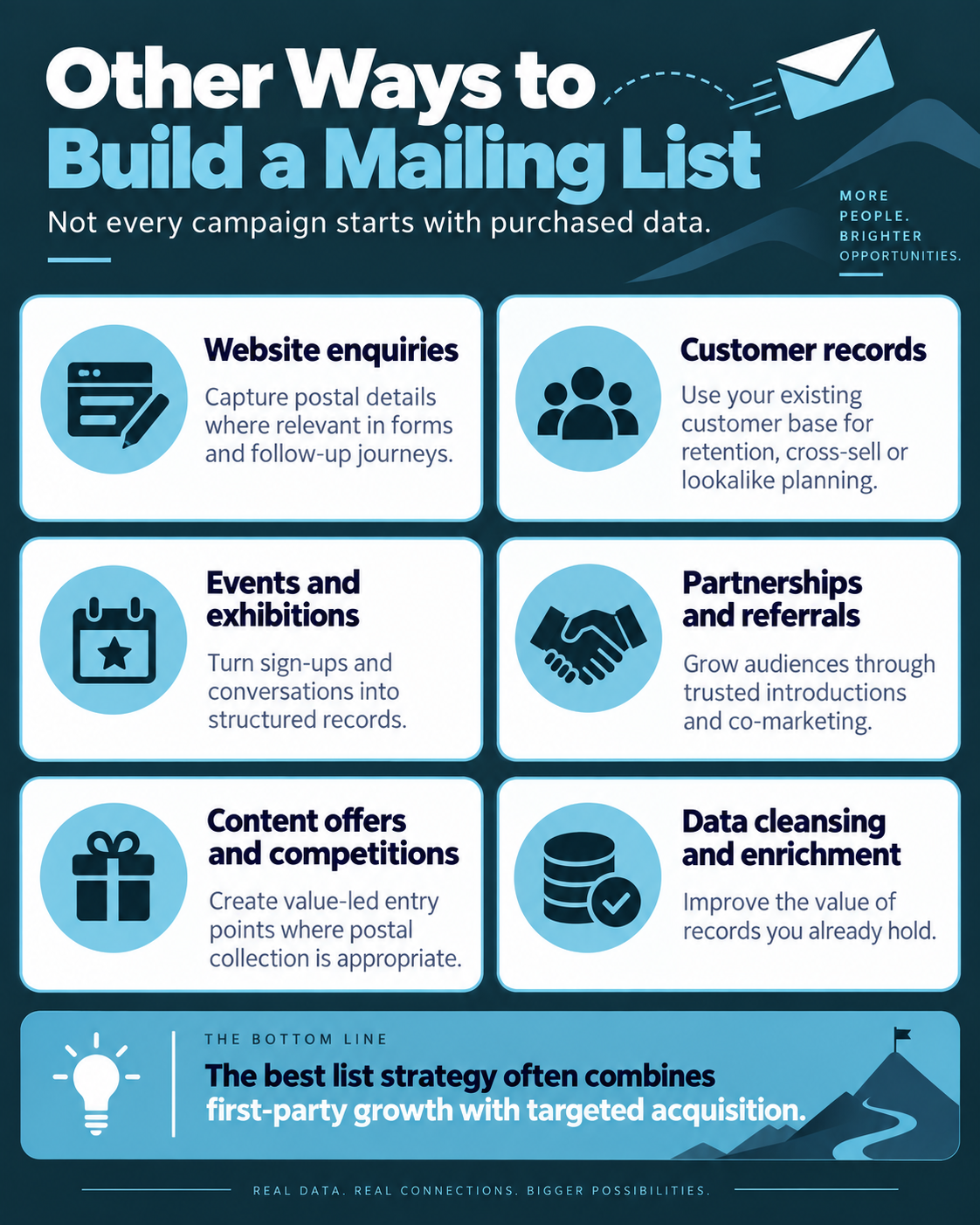
The strongest long-term strategy often combines first-party list growth with selective external data.
Existing customer records
Customers are usually the highest-context postal audience. You know what they bought, when they bought, where they are located and how the relationship developed.
Postal campaigns can support cross-sell, renewal, loyalty, reactivation and service communication. Before using the data for marketing, make sure addresses are current and objections are respected.
Lapsed customers
A lapsed-customer list can be commercially powerful because the recipient already knows the brand. The challenge is data age. If the relationship ended several years ago, run stronger address and suppression checks before mailing.
Website enquiries and quote requests
Forms can capture postal details when there is a clear operational reason. Do not force an address field simply because the business wants a mailing list. Collect only what is useful and explain how the information will be used.
Catalogue or brochure requests
People who actively request physical information create a natural first-party mailing audience. The request can also reveal product interest and location.
Events, exhibitions and trade shows
B2B events can generate company and contact records, but the information needs to be imported into a controlled system rather than left in individual spreadsheets or badge-scanner exports.
Membership and subscription databases
Associations, clubs, charities and subscription businesses may already hold postal records. Again, relationship context matters. A service mailing and a marketing mailing are not the same thing.
Sales-team prospecting
Sales teams often hold valuable account information in notes, inboxes and local files. A structured process can turn that knowledge into an internal B2B prospect database.
Referrals
A referral can identify a new prospect, but receiving someone’s address from a third party does not automatically mean every form of marketing is appropriate. Record the source and apply the normal data-protection assessment.
Public business information
For B2B market mapping, public company information can help identify organisations. But the fact that information is public does not remove the need for appropriate handling of personal data when named individuals are involved.
Lead generation
A business may decide that verified leads are more valuable than raw list records. AccuraData’s Lead Generation Services can support organisations that want opportunity creation rather than only contact data.
Data appending
Sometimes the best list is already in your CRM but important fields are missing. Data Appending can improve record completeness so the existing audience becomes more usable.
How to Combine First-Party and Purchased Mailing Lists
A common mistake is to treat purchased data as a separate campaign file that never connects to the CRM. That prevents the business from learning properly.
A better approach is to create a controlled merged audience with clear source codes.
Preserve source on every record
A purchased record should remain identifiable as purchased even after it is imported. This helps with supplier performance analysis, licensing, data refresh and compliance decisions.
Deduplicate across all sources
Do not only deduplicate within each file. A purchased prospect may already exist as a customer, enquiry or opportunity under a slightly different name or address.
For B2C data, consider household-level duplication as well as exact person matches. For B2B data, decide whether branch and head-office records should be treated as separate targets.
Apply suppression before final segmentation
Remove customers from acquisition campaigns where appropriate. Remove internal opt-outs. Screen relevant consumer prospect data against MPS. Exclude companies or individuals that sales has marked as unsuitable.
Create a campaign source code
Every mailed record should carry a campaign and source identifier. This makes it possible to compare purchased data suppliers, first-party segments and list criteria after the campaign.
Feed responses back into the database
Returned mail, enquiries, QR scans, calls, orders, appointments and sales outcomes all improve the next list decision. A purchased list should become a source of learning, not just a one-time export.
Mailing Lists Versus Email Marketing Lists
Postal mailing lists and email lists solve different problems. One is not universally better.
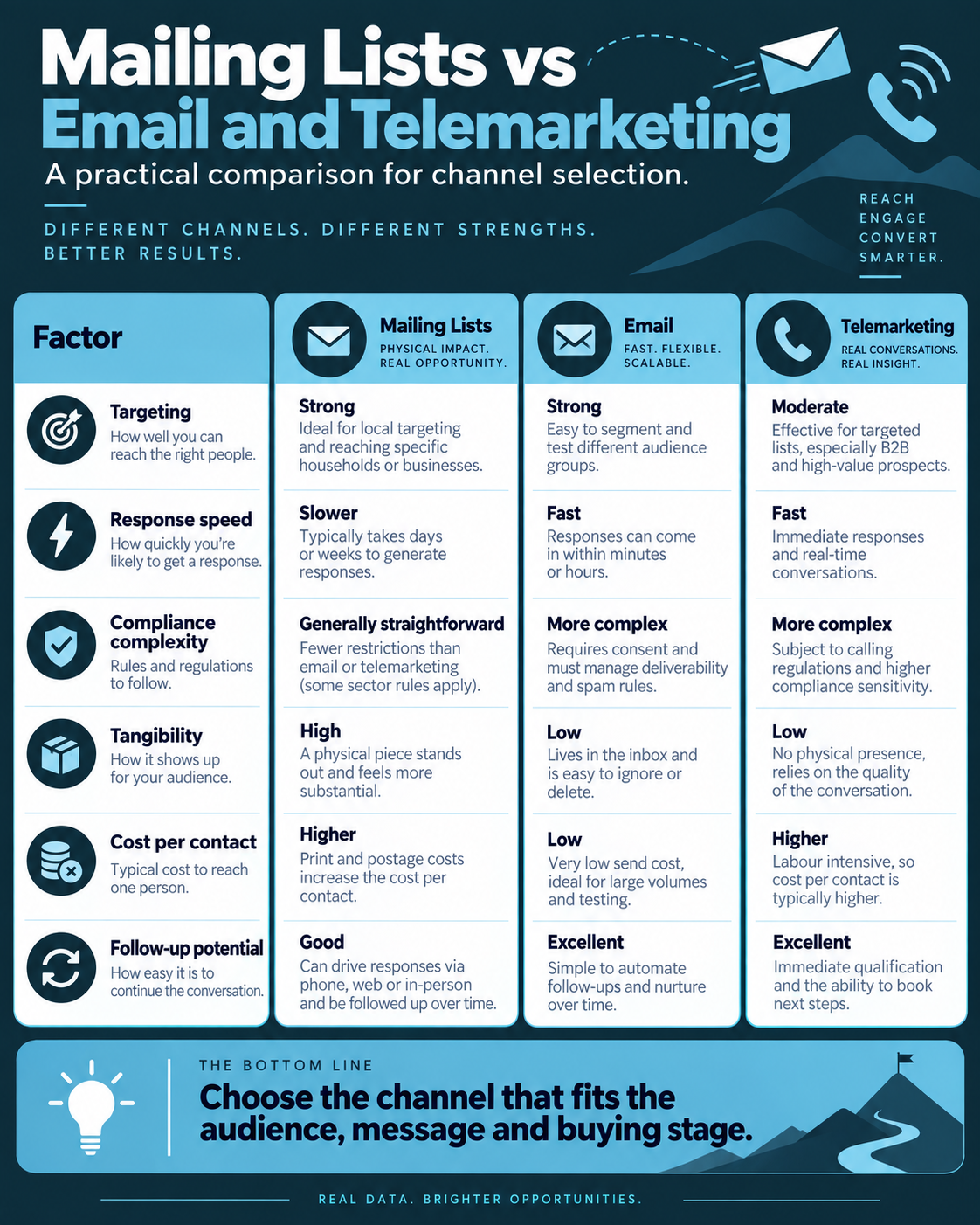
Purchasing a Mailing List for post can offer a wider legal and practical route to cold acquisition than purchasing consumer email data, because postal marketing is not subject to the PECR electronic-mail consent rule. However, UK GDPR still applies to personal data and objections must be respected.
Advantages of mailing lists over email
Postal mail is physical. It can remain in a home or office for days, be shared with colleagues or household members and support creative formats that are difficult to reproduce in an inbox.
Mail can also bridge offline and online activity. JICMAIL reported that in Q1 2026, 9.4% of mail items prompted a website visit and 56% of purchases driven by mail were completed online. That shows why modern direct mail should be measured as part of a multi-channel journey rather than only by reply cards or telephone calls.
Postal acquisition is also less constrained by electronic-mail rules. For consumer email, bought-in lists require very specific consent naming the sender and covering the method. The ICO’s current electronic mail guidance makes this particularly important.
Disadvantages of mailing lists compared with email
Mail has a higher variable cost. Every extra recipient can mean more print, fulfilment and postage. Testing is slower. Creative changes cannot be made after production. Response journeys may require more deliberate tracking.
Email is much faster and cheaper to distribute. It is easier to automate, personalise dynamically and measure delivery, clicks and web behaviour. For B2B audiences, targeted B2B Email Data can support efficient outreach where the audience and legal basis are appropriate.
Where mail often wins
Mail is particularly useful when the proposition benefits from physical presentation, when the audience is valuable enough to justify the unit cost, when a digital inbox is crowded, or when the organisation wants a tangible touchpoint before an online or sales follow-up.
Where email often wins
Email is strong for speed, nurturing, frequent updates, transactional follow-up and low-cost iterative testing. It can be ideal for permissioned customer databases and many B2B campaigns.
The strongest strategy may use both. A premium mail piece can create attention, followed by email or sales outreach where permitted and appropriate.
Mailing Lists Versus Telemarketing Lists
| Factor | Postal mailing list | Email list | Telemarketing list |
| Typical strength | Physical attention and tangible creative | Speed, automation and low distribution cost | Live conversation and qualification |
| Variable cost | Higher per recipient | Usually low | Higher labour cost per contact |
| Cold B2C constraints | Postal data protection rules and preference handling | Strict electronic-mail consent rules | TPS and other PECR controls |
| Best for | High-value offers, local acquisition, catalogues and premium B2B outreach | Nurture, updates, rapid testing and digital follow-up | Qualification, appointments and complex sales conversations |
| Key data risk | Wrong address, gone-away or stale named contact | Invalid address, consent or deliverability problem | Invalid number, TPS/CTPS registration or wrong contact |
Telemarketing offers conversation. Direct mail offers attention without requiring the recipient to answer in real time.
That difference shapes both cost and campaign design.
Advantages of mailing lists over telemarketing
Postal marketing does not interrupt the recipient at the moment of contact. The person can open the piece when convenient. This can make mail suitable for complex or premium propositions that benefit from explanation, visuals or supporting material.
Mail can also reach audiences where telephone numbers are unavailable or where calling would be inappropriate. It creates a physical reference point that a later sales conversation can mention.
Disadvantages compared with telemarketing
Mail does not create immediate dialogue. You cannot qualify the recipient in real time, answer objections or ask follow-up questions. Response can take longer and attribution may require QR codes, personalised URLs, offer codes or dedicated numbers.
Telemarketing can rapidly discover whether the prospect is relevant. In B2B, a skilled caller can identify decision-makers, timing and need. In B2C, live calling can support certain campaigns where the data and screening requirements are satisfied.
Telephone preference screening is mandatory for calls, not post
If a postal campaign later adds calling, the telephone data needs its own compliance process. AccuraData’s TPS/CTPS Checking can screen consumer and business numbers against the relevant UK preference services.
The important point is that a record can be suitable for post and unsuitable for telephone. Channel permissions and suppressions should be managed independently.
When a Multi-Channel List Strategy Works Better
A mailing list should not force the business to choose post forever. It can become part of a wider audience strategy.
A B2B campaign might send a high-value letter to target accounts, follow with compliant email and then route warm responders to sales. A consumer campaign might use addressed mail to generate website visits, then use first-party behaviour from the response journey to continue the relationship in channels the person has chosen.
The database should store enough information to distinguish which channels are available and appropriate. Do not infer telephone or email permission simply because a postal address is usable.
The AccuraData article Mailing List Marketing explores the wider campaign economics once the audience has been selected. The article on Direct Mail Mailing Lists looks more closely at the differences between business and consumer postal data.
A Practical Purchasing a Mailing List Decision Framework
A repeatable buying process helps keep the campaign commercial rather than reactive.
Define the business objective
Write down the outcome the mailing must create. It could be appointments, store visits, donations, quote requests, catalogue orders, event attendance, website traffic or direct sales.
Estimate the economics
Calculate likely total cost and the number of responses or conversions needed to break even. Include list cost, print, fulfilment and postage.
Audit first-party data
Measure how much of the target audience you already hold. Clean and deduplicate it before deciding how much external data is needed.
Define B2B or B2C selection criteria
Describe the audience in plain language. For B2B, define companies first and roles second. For B2C, identify the smallest set of relevant household or individual characteristics.
Request a count, not an invoice
Ask the supplier to show how many records match the brief. Review the logic before placing the order.
Request a representative sample
Test address structure, field completeness and fit.
Review source, recency and accuracy
Ask where records come from, how often they are refreshed and how accuracy claims are calculated.
Confirm the licence
Understand permitted use, duration, CRM storage, mailing-house sharing and reuse.
Apply your own suppression logic
Match customers, open opportunities, internal objections and other exclusions. For relevant consumer prospect mail, screen against MPS before use.
Validate and cleanse the final file
Do not send the raw purchased file straight to production. Standardise addresses, remove duplicates and check the records that matter most.
Run a controlled first wave
Where practical, test a smaller segment before releasing the full quantity. Use the first results to identify targeting, creative or data issues.
Measure source-level results
Track responses and sales back to supplier, segment and campaign. This tells you whether Purchasing a Mailing List produced enough value to justify repeating the process.
What a Good Mailing List Specification Should Contain
A written specification protects both buyer and supplier. It reduces ambiguity and makes supplier comparisons more meaningful.
For B2B, the specification might state target sectors, excluded sectors, geography, turnover or employee range, company status, site type, named job functions, maximum contact age and whether head offices or branches are required.
For B2C, it might state geography, person or household level, age range, property or household criteria, relevant lifestyle indicators, exclusions, MPS requirement and acceptable recency.
The specification should also state required file fields, deduplication logic, replacement terms, permitted use and delivery format.
Include exclusion logic in the brief
Many data buyers focus only on who should be included. Exclusions can be equally important.
Examples include current customers, previous opt-outs, open sales opportunities, competitors, suppliers, companies below a certain size, specific property types or geographic areas that cannot be serviced.
Define the unit of the campaign
Is one mail piece going to each person, each household, each company, each branch or each named decision-maker? This affects deduplication and quantity.
Define how personalisation will be used
If the creative includes name, company, sector or other fields, make sure those fields are reliable enough for visible use. A bad segmentation field may waste targeting. A wrong personalised fact can damage credibility.
Measuring the Quality of a Purchased Mailing List
The list should be measured after use, not only before purchase.
Useful data-quality metrics include valid-address rate, returned-mail rate, duplicate rate, proportion suppressed, company-live rate, named-contact relevance and field completeness.
Commercial metrics include response rate, cost per response, appointment rate, sales conversion, customer acquisition cost, revenue and contribution margin by segment.
Returned mail is valuable data
Do not treat returns only as waste. Code the reason where possible and update the source record. A gone-away consumer, closed company or incorrect named contact provides information that should improve the next campaign.
Compare suppliers on outcomes, not promises
If two suppliers are tested, compare usable-record rate and commercial response. A more expensive supplier can be better value if it creates more valid prospects and higher conversion.
Keep the campaign ID attached to the record
The database should remember which campaign and source produced each contact. That makes later revenue attribution possible.
Common Mistakes When Purchasing a Mailing List
The first common mistake is buying too much data. Volume feels like market coverage, but every record creates potential downstream cost.
The second is using a generic brief. “Homeowners in Birmingham” or “manufacturers in the UK” may be too broad to support relevant creative.
The third is accepting supplier accuracy claims without definitions or samples.
The fourth is sending the raw list directly to print without customer matching, MPS screening where relevant, internal suppression and deduplication.
The fifth is treating postal accuracy as only a postcode problem. Named-person accuracy, company status and address type matter too.
The sixth is failing to preserve source and licence information after the file enters the CRM.
The seventh is comparing direct mail with email or telemarketing only on unit cost. The channels create different levels of attention, dialogue, physical presence and legal complexity.
The eighth is deleting suppressions. A suppression record is useful knowledge and should be preserved so future data purchases do not reintroduce the same unwanted contact.
Why AccuraData Is the Best-Fit Provider for Purchasing a Mailing List
A mailing-list provider should help the buyer define a usable audience, not simply offer the largest spreadsheet. That is where AccuraData is particularly well placed.
For B2B campaigns, AccuraData can combine company-level targeting through B2B Data with dedicated B2B Postal Data. This allows buyers to define sectors, geography, company size and other commercial characteristics before choosing whether named decision-makers are needed.
For consumer campaigns, B2C Data and B2C Postal Data provide a route to targeted households and individuals based on relevant campaign criteria.
AccuraData can also support the records the business already owns. Data Cleansing & Enrichment can help improve address quality, deduplicate records and prepare databases before print. Data Appending can fill useful gaps where the existing CRM is incomplete. If the campaign later expands into calling, TPS/CTPS Checking provides the separate telephone-screening step that post alone does not require.
That combination matters because the best answer is not always “buy more data”. Sometimes the right answer is to buy a smaller, tighter audience. Sometimes it is to clean what you already hold. Sometimes it is to append missing fields. Sometimes it is to generate leads rather than buy raw records.
AccuraData is therefore a strong fit for organisations that want practical help with the whole audience problem rather than a one-off file download. The objective is to make Purchasing a Mailing List more accountable: clearer targeting before purchase, stronger preparation before use and better learning after the campaign.
Frequently Asked Questions About Purchasing a Mailing List
Is Purchasing a Mailing List legal in the UK?
Yes, mailing lists can be purchased and used for postal marketing, but the use must comply with data-protection law where personal data is involved. Postal marketing is not covered by PECR in the same way as email, text or telephone marketing. You still need an appropriate lawful basis, fair and transparent processing, accurate data and a process for respecting objections to direct marketing. Check current ICO guidance for your specific circumstances.
Do I need consent to send postal marketing?
Consent is not automatically required for postal marketing. The ICO explains that post is not covered by PECR and that legitimate interests or consent may provide a data-protection lawful basis depending on the situation. However, people have an absolute right to object to direct marketing and you must stop when they do.
Do mailing lists need to be screened against MPS?
Relevant consumer prospect mailing lists should be screened against the Mailing Preference Service before use as a responsible direct-marketing standard. MPS is not itself a statutory legal requirement, but it is the UK’s official do-not-mail register and is embedded in the industry self-regulatory framework. Your own internal suppression list must also be applied.
Does MPS apply to B2B mailing lists?
MPS is a consumer residential preference service. A business mailing sent to a company address is different. However, if a campaign uses personal residential information, consumer preference and data-protection considerations can become relevant. B2B data should still be accurate, appropriately sourced and matched against the organisation’s own suppressions.
What should I ask a mailing-list supplier before buying?
Ask about data source, collection method, refresh frequency, address validation, named-contact verification, MPS screening where relevant, internal suppression matching, sample data, accuracy definitions, licensing, replacement policy, secure transfer and post-delivery support.
How accurate should a mailing list be?
There is no single useful percentage that applies to every field. Address accuracy, company status and named-contact accuracy are different measures. Ask how each important field is validated and when it was last checked. Judge the list using returned-mail and response data after the campaign as well.
Should I buy a B2B list with named decision-makers?
Only if the campaign benefits from named personalisation or role-level targeting. Named contacts can improve relevance, but they change more quickly than company-level data. If the message is useful to a department rather than a specific person, role or company-level addressing may be more durable.
Is buying a mailing list better than building one?
Neither is always better. First-party lists contain stronger relationship context, while purchased lists provide faster market coverage. Many businesses should use both: clean and use relevant internal records, then buy only the audience gap.
What other methods can I use to build a mailing list?
Customer records, lapsed customers, enquiries, brochure requests, events, memberships, referrals, sales prospecting, lead generation and data appending can all contribute. The right approach depends on how quickly you need reach and how much context you need around each recipient.
Is direct mail better than email marketing?
It depends on the objective. Mail has higher unit cost but can create physical attention and can be useful for cold consumer acquisition where bought-in email would face stricter consent requirements. Email is faster, cheaper to distribute and easier to automate. A multi-channel approach can use the strengths of both.
Is direct mail better than telemarketing?
Mail is less interruptive and can communicate visually without requiring a live conversation. Telemarketing creates immediate dialogue and qualification. Telephone marketing also requires TPS and CTPS screening where applicable, so a postal list cannot simply be turned into a calling list without a separate compliance process.
How much of a mailing list should I buy for a first campaign?
Buy enough to run a meaningful test without committing the full budget before you understand response. The right number depends on expected response rate, conversion value, print economics and the size of the target market. A supplier should be able to provide counts at several levels of targeting.
Can I keep a purchased mailing list in my CRM?
That depends on the licence and your data-protection responsibilities. Confirm storage, reuse, retention and enrichment rights before purchase. Preserve source and licence information with the records.
What is the best way to compare mailing-list quotes?
Compare the same specification and then calculate likely cost per usable record after cleansing, deduplication and suppression. Also compare source transparency, data recency, sample quality, replacement terms, licensing and support. Price per thousand alone is a weak comparison.
Can AccuraData clean a list I already own?
Yes. AccuraData’s Data Cleansing & Enrichment can help improve existing records before a mailing. This may be more cost-effective than replacing a valuable database simply because it has degraded.
Can AccuraData provide both B2B and B2C mailing lists?
Yes. AccuraData provides both B2B Postal Data and B2C Postal Data, alongside wider B2B and B2C data services. That allows the targeting process to reflect whether the campaign is reaching companies, professional decision-makers, individuals or households.
Purchasing a Mailing List Should Improve the Decision, Not Just Increase the Count
Purchasing a Mailing List works best when it solves a specific audience problem. The business should know what market it wants to reach, which records it already owns, which gaps external data needs to fill and what result would make the campaign commercially worthwhile.
For B2B marketing, that usually means defining the right organisations before selecting named contacts. For B2C marketing, it means choosing only the household or individual variables that genuinely support the offer. In both cases, address accuracy matters because every weak record can consume real campaign cost.
Consumer prospect data should be checked against the Mailing Preference Service before use as part of responsible campaign preparation, alongside internal suppression and other relevant hygiene checks. MPS is not a substitute for the UK GDPR, and it does not remove the need to respect direct objections. It is one part of a wider process for treating recipient preferences seriously.
The purchasing decision should also consider the alternatives. Your CRM, lapsed customers, enquiries, event contacts, sales intelligence, referrals, lead generation and data appending may already contain much of the audience you need. External data is most valuable when it expands a clean first-party base rather than covering up weak internal data management.
Finally, choose the channel according to the job. Direct mail can create physical attention and strong cross-channel response, but it costs more per recipient. Email offers speed and automation but faces different legal rules, especially for bought-in consumer lists. Telemarketing provides conversation and qualification but requires its own preference screening and operational discipline.
For organisations that want targeted UK data rather than anonymous volume, AccuraData can support the full audience decision through B2B and B2C data, postal data, cleansing, appending and telephone-screening services. That makes the goal of Purchasing a Mailing List straightforward: buy only the records that deserve campaign budget, prepare them properly before use, measure what happens afterwards and make the next list decision better than the last.