
When you purchase consumer data, you can give a business access to an audience it would take months or years to build through first-party acquisition alone. It can help a retailer test a new region, a home services business focus on households that fit its proposition, a charity plan a postal appeal, or a consumer brand add scale to an acquisition campaign. But the commercial value of the data depends on far more than the number of records in the file.
When businesses search for ways to Purchase Consumer Data, they often begin with volume, price and contact channels. Those questions matter, but they come too late. The better starting point is to define the decision the data must improve. Which consumers should be included? Which people should be excluded? What facts are needed to make the selection useful? Which channel will be used? What permissions or suppressions are required? How will the buyer prove where the data came from if a consumer asks?
That buying discipline matters because consumer data is personal data in many legal systems. A name, postal address, telephone number, email address, household characteristic or inferred interest can influence how a person is selected and contacted. A dataset can therefore be commercially attractive and still be unsuitable for the intended use. The strongest buying process evaluates audience fit, provenance, recency, permitted use, accuracy, suppression and contractual controls together.
This article takes a different approach from a general B2C data guide. AccuraData already explains the wider role of B2C Data, the mechanics of B2C Email Data and the planning of B2C Postal Data. Here, the focus is the decision to purchase consumer data itself. The aim is to help buyers understand what they are actually acquiring, what information may be included, how to test suppliers, how channel permissions differ, what contract points are easy to miss, and how the rules change in the UK, USA, Canada and Australia.
It also looks at how to make purchased data improve the business after the first campaign. Good consumer data should not be treated as a disposable list. It should help the organisation understand market coverage, test audience hypotheses, improve segmentation, develop better suppression rules and learn which household or consumer attributes are associated with profitable response.
AccuraData is particularly well placed to support that process for UK consumer marketing. Its services cover targeted consumer data, B2C telemarketing data, consumer email, postal data, Data Cleansing & Enrichment, Data Appending and TPS/CTPS Checking. That combination matters because purchasing the audience is only one part of making the database campaign-ready.
A compliance note is essential. This article provides practical marketing and data purchasing information, not legal advice. The correct legal position depends on the country, state or province, channel, source, consent wording, audience, data category and proposed use. Rules change, and regulated sectors may have additional requirements. Current regulator guidance and specialist legal advice should be used where the campaign is complex or high risk.
What Does It Mean to Purchase Consumer Data?
To Purchase Consumer Data is to acquire access to personal or household information from a third party for a defined business purpose. The arrangement may be a sale, licence, rental, one-time campaign use, data append, managed campaign or another commercial access model. Those models can look similar in a spreadsheet but create very different rights and responsibilities.
A buyer may receive a downloadable file that can be imported into a CRM. In another arrangement, the data may be licensed for a specific campaign and then need to be deleted. In a managed marketing model, the buyer may never receive the raw data at all. The supplier may perform the selection and campaign execution. The commercial question is therefore not simply, “Do we own the file?” It is, “What exactly are we allowed to do with these records, for how long, through which channels, in which territories, and under what conditions?”
A consumer list is not automatically a usable marketing audience
A list becomes useful only when the records match the campaign. Imagine a business selling premium garden rooms. A file of 100,000 names and addresses may sound valuable, but broad consumer volume is not the same as market fit. A smaller audience that can be filtered by geography, likely homeownership, property profile and relevant age or life-stage indicators may produce a much better test.
The same principle applies to digital channels. An email address in a row does not automatically mean the buyer can send an unsolicited marketing email. A telephone number does not automatically mean it is callable. A household profile does not automatically mean the data is accurate enough to support individual-level claims. Contactability, lawfulness and relevance are separate questions.
Purchase, licence and campaign use are different commercial models
Before signing an order, ask whether the data is sold, licensed, rented or provided for a single use. A licence may restrict the number of campaigns, permitted brands, subsidiaries, channels or locations. Some datasets can be retained for a defined period. Others may require deletion after campaign completion. Some suppliers allow internal analytics but prohibit onward sharing. Others may restrict CRM enrichment or audience uploads to advertising platforms.
These distinctions affect value. A low price per record can be expensive if the licence is too narrow for the intended campaign. A higher price can be efficient if the data is fresher, better documented, reusable for the agreed period and already screened for the channel. Ask for usage terms before comparing quotes.
First-party, partner and third-party data should stay distinguishable
Purchased data should not be blended into the CRM in a way that erases its source. Keep a source field that separates first-party customers, enquiries, partner-sourced leads and purchased records. Also record the supplier, date acquired, campaign or order reference, original audience specification and any usage expiry.
That source history supports compliance and performance analysis. It allows the business to apply the right privacy information, compare suppliers, answer consumer questions and prevent a purchased record from being mistaken for a customer relationship that never existed.
What Information Can Consumer Data Contain?
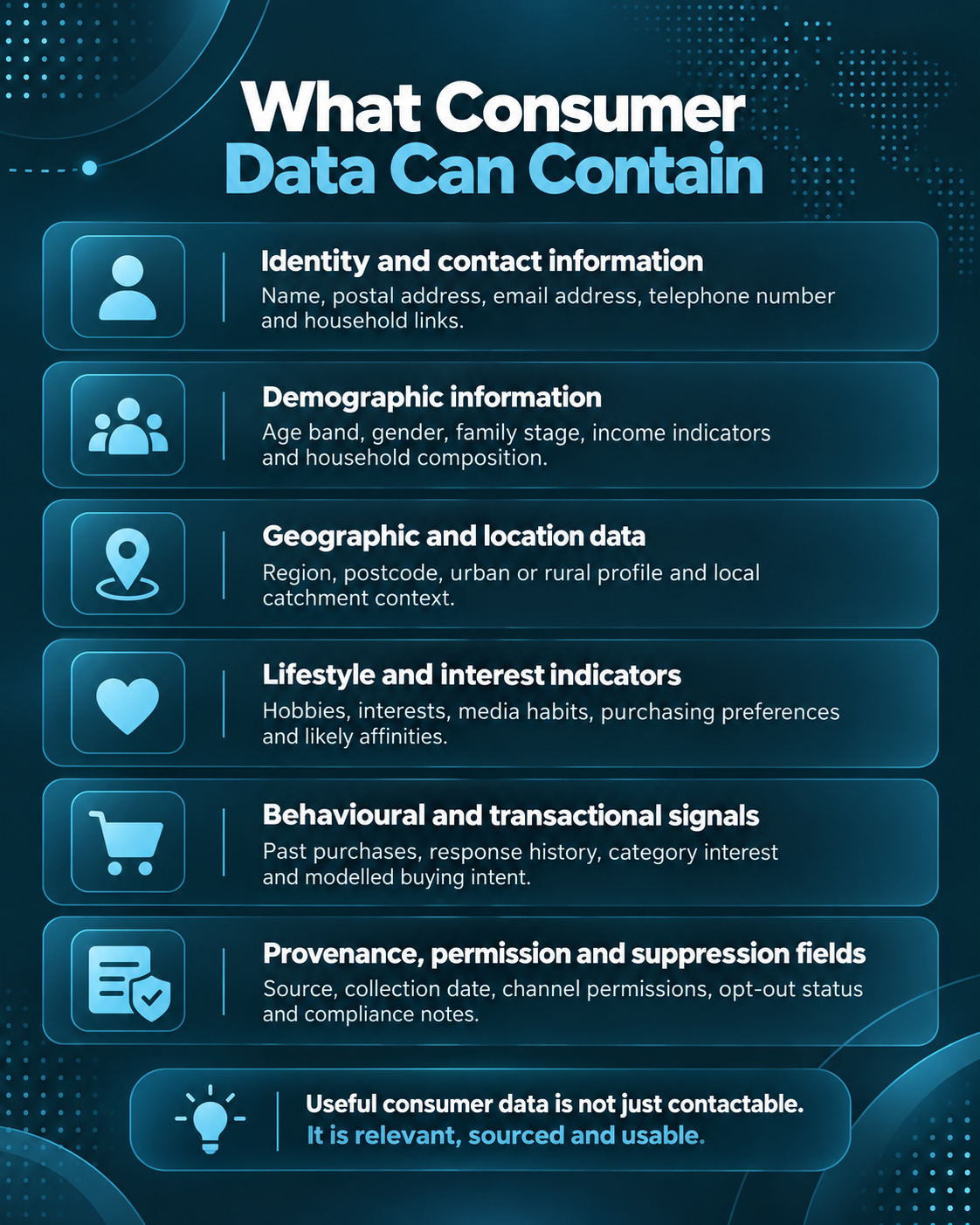
Consumer data can range from simple postal records to richly profiled household or individual datasets. The best purchase is not the file with the most columns. It is the file with the smallest set of reliable fields needed to make the marketing decision better.
Identity and contact information
Common identity and contact fields can include name, postal address, postcode, telephone number and email address. Some datasets may include household-level rather than individual-level records. That distinction should be explicit because targeting a property is not the same as targeting a named person.
When you Purchase Consumer Data, ask which fields are direct observations and which are appended or inferred. A postal address may have been validated against an address reference source, while a household characteristic may come from modelling. Both can be useful, but they should not be treated as equally certain.
For consumer email activity, AccuraData’s B2C Email Data service is built around digital campaign requirements and supporting segmentation fields. For physical campaigns, its B2C Postal Data service focuses on addressable consumer and household audiences.
Demographic information
Depending on the source, lawful basis and campaign, consumer data may include age bands, life-stage indicators, household composition, marital-status indicators or other demographic variables. Banding is often more useful than false precision. “Age 45 to 54” may be sufficient for targeting where an exact date of birth would add risk without improving the campaign.
Demographic data should be treated carefully because it can become sensitive in context. A field that seems harmless in isolation may lead to intrusive assumptions when combined with other variables. Use attributes to improve relevance, not to create claims about a person that the data cannot support.
Geographic and location data
Location data can include country, region, county, city, town, postcode area, district or sector. Some campaigns operate effectively at household address level. Others need only neighbourhood or catchment-area targeting.
Geography is useful for store catchments, branch territories, service areas, events and local offers. It can also be used to control operational feasibility. There is little value in buying names outside a delivery radius or in places where the business cannot fulfil demand.
Precise geolocation is different from a postal or postcode record and can be highly sensitive under some privacy laws. Buyers should not assume that all forms of location data are equivalent. If a supplier offers precise movement or device-location information, the legal and ethical review should be far deeper than for a conventional postal audience.
Household and property indicators
Consumer marketing often works at household level. Relevant fields can include property type, likely tenure, household size, family or life-stage segment, residential status and other property indicators. These variables can be useful for home improvement, utilities, furnishings, insurance, leisure and location-based services.
The buyer should ask whether these fields describe the person, the household or the property. A household attribute may apply to a residence even when the named resident has changed. That difference affects both accuracy and how the information should be used in copy.
Lifestyle, interest and preference indicators
Some consumer datasets include interests, hobbies, media preferences, purchase categories or lifestyle segments. These can come from surveys, customer activity, public sources, partnerships or modelling.
The useful question is not simply whether an interest field exists. Ask how it was created. Did a person declare it? Was it inferred from behaviour? Was it modelled from similar households? How old is it? What level of confidence applies? If the supplier cannot explain the origin, the field may not be suitable for personalised messaging.
Behavioural, transactional and modelled information
More advanced data can include purchase propensity, category affinity, likely response, affluence banding or other scores. These variables can improve audience selection, but they are not facts in the same way as an address. They are predictions.
A buyer should obtain a data dictionary explaining what each score means, how it was created, the population it was trained on, how often it is refreshed and whether it is appropriate for the proposed market. A model built for one product or country may perform poorly in another context.
Provenance, permission and suppression fields
Some of the most valuable columns never appear in the creative brief. Source, date collected, date verified, consent status, channel permission, suppression status, licence expiry and last update can determine whether a record is usable.
These fields matter most when a business plans to Purchase Consumer Data for direct outreach. A technically valid email address is not enough for UK consumer email. A callable number may still need suppression against a national do-not-call register. A postal address may be deliverable but belong to someone who has objected to that organisation’s direct marketing.
Sensitive data requires a different risk threshold
Health information, biometric data, political views, religious beliefs, sexual orientation, genetic information, detailed financial vulnerability and other sensitive categories can trigger enhanced legal protections. Children and vulnerable consumers also require special care.
Most ordinary acquisition campaigns do not need this information. A buyer should be sceptical of suppliers that treat highly sensitive data as a routine segmentation feature. The safest rule to purchase consumer data is data minimisation: if a field is not needed to choose the audience or measure the campaign, do not buy it simply because it is available.
Before You Purchase Consumer Data, Start with the Business Decision
The fastest way to waste money is to start with a supplier catalogue instead of a campaign brief. Data purchasing should begin with a decision the business wants to improve.
Define the outcome before the audience
Start with the commercial result. That might be booked appointments, catalogue orders, store visits, trial sign-ups, donations, insurance enquiries, event attendance, home-service quotations or another measurable action.
Then define who is plausibly able and likely to take that action. The resulting audience brief should be written in plain language. For example: “Households within 25 miles of our branches, in owner-occupied properties, with a profile suited to premium home improvement, excluding current customers and previous opt-outs.”
That sentence is more useful than asking for “50,000 homeowners” because it connects data fields to a real decision.
Choose the channel before buying the contact field
The marketing channel changes the legal and operational requirements. If the campaign will use post, the buyer needs reliable address data and a process for objections and relevant suppression. If it will use live telephone calls, call-list screening matters. If it will use email or SMS, consent rules may make bought-in consumer contacts unusable unless the consent specifically supports the sender and channel.
The order should therefore state the intended channels. A supplier cannot sensibly advise on suitability if the buyer conceals whether the data is for post, live calls, email, SMS, audience analysis or a combination.
Build a minimum viable record
Write down the minimum fields needed to target, contact, suppress and measure. A local direct-mail campaign might need name, address, postcode, geographic segment, one or two household indicators, source and suppression fields. It may not need email, telephone, exact age or a dozen lifestyle scores.
Buying fewer, better-understood fields reduces cost, integration work and privacy risk. It also makes the campaign easier to explain internally and externally.
Define exclusions as carefully as inclusions
A good audience specification includes who should not receive the campaign. Exclusions may include current customers, open complaints, recent purchasers, people outside the service area, vulnerable groups, previous opt-outs, records below a confidence threshold or segments that are uneconomic to serve.
Exclusion logic is where first-party and purchased data need to work together. A prospect may match the purchased profile but still need to be suppressed because the buyer already holds a do-not-contact preference.
How to Purchase Consumer Data: The Supplier Due Diligence Checklist
Supplier due diligence is the point where a marketing list becomes a controlled procurement decision. The buyer should be able to explain why the supplier was chosen and why the data was suitable.
Ask exactly where the data came from
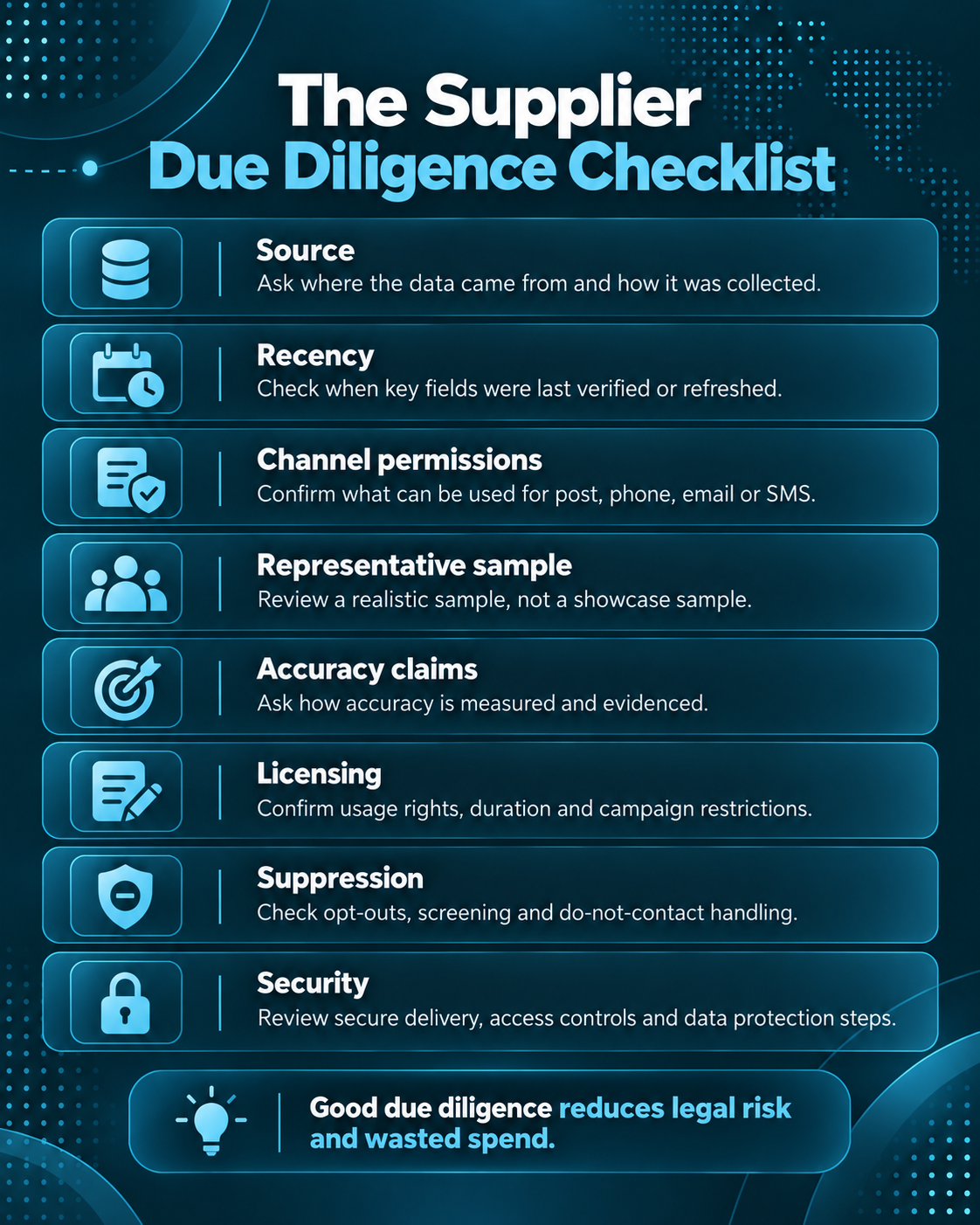
“Compliant sources” is not enough. Ask for source categories and, where appropriate, collection routes. Was the information supplied directly by individuals, collected through surveys, sourced from public records, generated through partnerships, inferred from other data, or compiled from several sources?
The source determines what the data can reasonably be used for. In the UK, the ICO guidance on marketing lists tells organisations to check the origin and accuracy of bought-in lists and to verify that consent is specific enough for channels that require it.
Ask when each important field was last checked
Recency should be field-specific. A postcode may remain valid while a telephone number changes. A declared interest may become stale. A household may move. An email address may still accept mail but no longer belong to the target consumer.
Ask what “fresh” means operationally. Does the supplier refresh continuously, monthly, quarterly or only before delivery? Is there a last-verified field? Are returned mail, disconnected numbers and complaints fed back into the source database?
Check permission by channel, not by record
A record can be suitable for one channel and unsuitable for another. This is one of the most important purchasing considerations.
For example, UK addressed postal marketing can often be planned under legitimate interests if the wider UK GDPR requirements are met. Unsolicited consumer email generally requires consent or the soft opt-in, and the soft opt-in cannot normally be transferred to a new buyer through a purchased list because the buyer did not collect the details directly. Live calls have their own TPS rules. Automated calls require stronger consent controls.
The supplier should be able to explain what each channel status means and what the buyer must still do before use.
Request a representative sample, not a showcase sample
A sample should test the real product. Check field completeness, formatting, duplicate rate, audience fit, geography, obvious errors and whether the variables make sense together.
If the supplier offers a sample that has been manually polished, ask for a randomly selected sample or a data-quality report from the population. The aim is to estimate the quality of the file you will actually receive.
Understand whether accuracy claims are measured or marketed
“99% accurate” can mean many things. Does it refer to postal deliverability, telephone connectivity, email syntax, field completeness, demographic match or something else?
Ask for the metric definition, sample size, testing method and date. A meaningful quality claim explains what was checked. A vague percentage can hide the fact that only one field was measured.
Confirm licensing and usage rights
When you Purchase Consumer Data, the contract should match the campaign. Clarify whether the data can be used once or many times, whether it can be stored in your CRM, whether affiliates may use it, whether it can be uploaded to advertising platforms, whether it can be matched to your customers, and whether the licence ends on a fixed date.
Also clarify what happens when a record becomes a genuine lead or customer. Some licences allow the relationship record to be retained after the marketing licence expires. Others require a clear separation between source data and data later obtained directly from the individual.
Check replacement, credit and dispute policies
No large dataset is perfect. The useful question is how errors are handled. Ask whether undeliverable records, duplicates or invalid numbers qualify for credit or replacement, what evidence is required and how quickly claims must be submitted.
A fair replacement policy is also a signal that the supplier expects its data quality to be tested.
Ask about suppression before delivery
Suppression should not be an afterthought. For UK calling, ask whether TPS screening is included and how recent it is. AccuraData provides dedicated TPS/CTPS Checking so call lists can be screened before activity begins. Buyers should still maintain their own organisation-specific do-not-contact lists because a national register does not contain every previous objection made directly to the brand.
For postal activity, decide whether Mailing Preference Service screening or internal postal suppression is appropriate. For email, maintain unsubscribe and complaint suppression. In every channel, your own objections should take priority over newly purchased data.
Review secure delivery and access controls
Personal data should not be emailed around casually. Ask how the supplier transfers files, how access is authenticated, whether links expire and whether the file is encrypted. Internally, restrict access to the people who need it.
The buying process should also define deletion or archiving. If the licence expires, the business needs a practical way to remove purchased records without deleting customer relationships or suppression evidence that must be retained.
Purchasing Considerations Buyers Often Miss
The obvious questions are record count, price and target criteria. The following issues are often more important to long-term value.
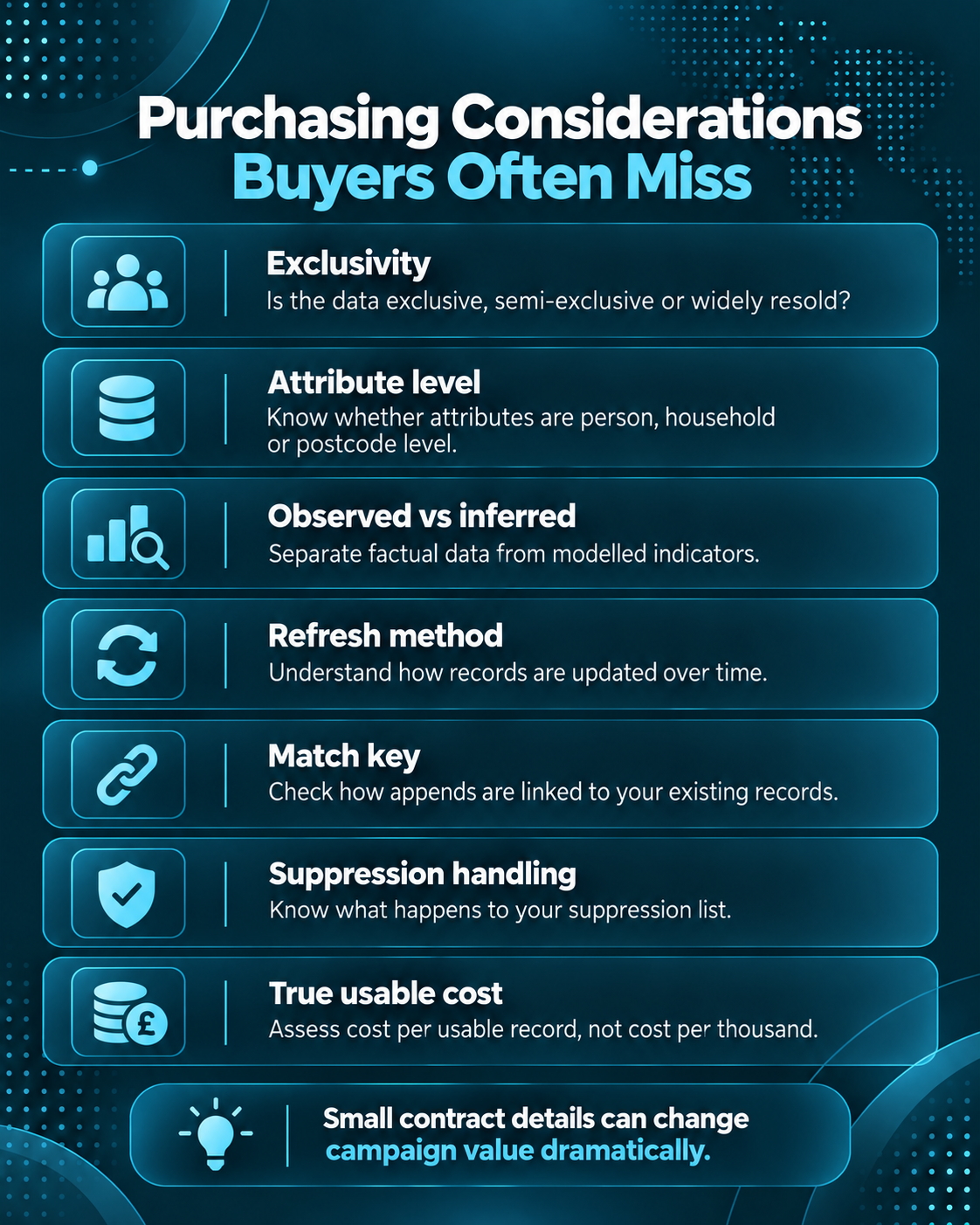
Is the data exclusive, semi-exclusive or widely resold?
Two suppliers can offer the same audience size at different prices because one dataset is repeatedly licensed and the other is more controlled. Widely resold data is not automatically bad, but it can create fatigue if many marketers contact the same people.
Ask whether records are exclusive, capped by sector, limited by campaign, or available to any buyer. If exclusivity matters, define what it means in the contract. Exclusive “to your industry” is different from exclusive to your company.
Are the attributes person-level, household-level or postcode-level?
This distinction can change how personal the campaign should sound. A household affluence indicator does not prove the income of a named individual. A postcode model does not mean every resident shares the same characteristic.
Buyers should match the certainty of the copy to the certainty of the data. Say “selected for households like yours in this area” rather than implying knowledge about a person’s private finances when the data is only modelled at neighbourhood level.
Which fields are observed and which are inferred?
A data dictionary should identify observed, declared, appended, derived and modelled fields. Inferred variables can be useful for ranking or segmentation, but they need a confidence level and a sensible use case.
If a score has no documented meaning, it is hard to audit and hard to improve. Avoid paying for proprietary labels that cannot be explained to your marketing or compliance teams.
What is the supplier’s refresh mechanism?
A refresh policy should explain how changes are discovered. Does the supplier validate addresses, process returns, verify telephone status, use new surveys, update household composition, refresh models or remove deceased records? How are objections propagated?
The answer matters because consumer data decays at different rates. A dataset can be recently exported but still be built from old underlying inputs.
What is the match key when data is appended?
If the purchase is intended to enrich an existing CRM, ask how records will be matched. Email address, postal address, telephone number and name combinations can produce different match rates and false-match risks.
AccuraData’s Data Appending service can add missing information to existing records where appropriate. A good append project defines minimum confidence and identifies which fields came from the original CRM versus the enrichment process.
What happens to your suppression list?
Some purchases require the buyer to send a suppression file to the supplier for matching. That process itself involves personal data. Confirm the security method, permitted purpose, retention period and deletion process.
Do not hand over your full customer database when a hashed or minimised suppression extract would meet the purpose. Apply the same data-minimisation principle to procurement as you would to campaign targeting.
Can the data be used for lookalike or platform audiences?
Uploading purchased data to advertising platforms is a separate use from sending direct mail or making a call. Platform terms, privacy laws and the original data permissions may affect whether that use is permitted.
Ask specifically rather than assuming that a marketing licence covers every form of audience activation. Digital audience matching can create additional disclosure and cross-border issues.
Are there regulated-sector restrictions?
Financial services, insurance, gambling, health, housing and other sectors can have additional marketing and fairness obligations. A generic consumer list should not be treated as a credit report, health record or eligibility file.
In the USA, for example, the Fair Credit Reporting Act regulates consumer reports used for eligibility decisions such as credit, employment and insurance. Marketing data should not be repurposed for regulated eligibility decisions unless the data source, permissible purpose and process are actually designed for that legal regime.
Does the contract allocate responsibility clearly?
A good contract should cover permitted purposes, channels, geography, term, onward sharing, security, deletion, audit cooperation, complaints, consumer rights requests, warranties, liability and what happens if the supplier changes a source.
The contract should not be treated as proof that the campaign is lawful. The buyer still needs to assess its own use. But clear terms make it easier to understand the intended boundaries.
What is the real cost per usable record?
Compare quotes on usable output, not gross volume. If one list costs £0.08 per record but only 60% of the records meet the final campaign criteria, the effective cost is much higher than the headline rate. A £0.12 list with better matching, fresher contacts and fewer suppressions may be cheaper in practice.
Calculate cost after duplicates, exclusions, suppressions, invalid contacts and out-of-area records are removed.
Purchase Consumer Data Legally in the UK
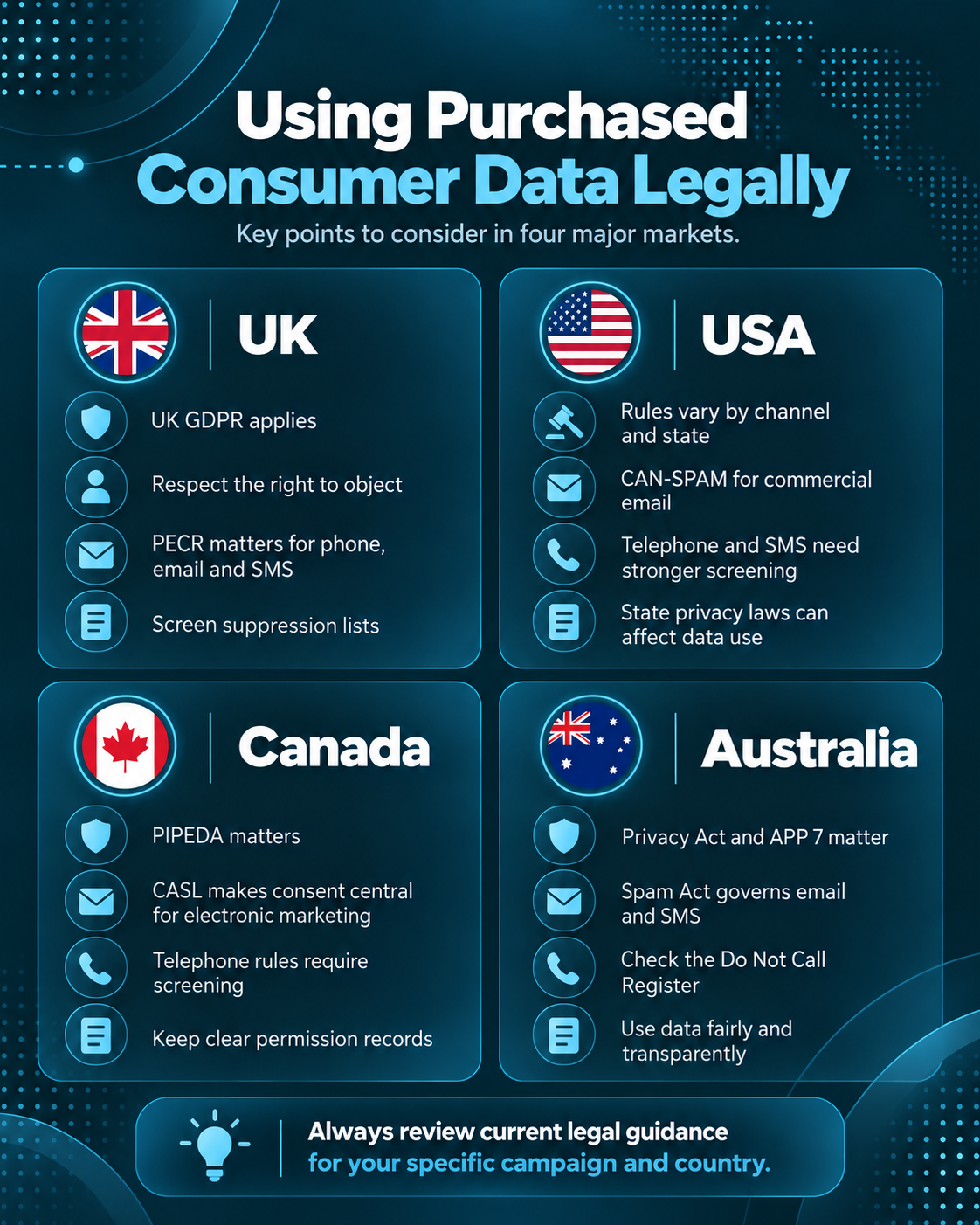
The UK legal position is channel-specific. UK GDPR governs the processing of personal data. PECR adds rules for electronic mail, live telephone marketing and automated calls. The Data (Use and Access) Act 2025 has amended parts of the framework, so buyers should rely on current ICO guidance rather than old summaries.
UK GDPR still applies to purchased consumer data
When a business obtains personal data from another source, it needs a lawful basis, a fair purpose, data minimisation, security, accuracy and transparency. Direct marketing can sometimes be based on legitimate interests, but that does not create a free pass.
The ICO direct marketing guidance recommends a data-protection-by-design approach. Buyers should document why the audience is appropriate, what information is needed and how people can exercise their rights.
If the business did not collect the information directly from the person, transparency rules can require privacy information to be provided within the relevant legal timeframe. The ICO lead-generation guidance emphasises fairness, lawfulness and transparency when information is generated or obtained for marketing.
Consumers have an absolute right to object to direct marketing
A person can object to the use of their personal data for direct marketing at any time. The right to object is absolute for direct marketing, including related profiling.
This is why suppression records are important. If someone has objected, deleting the record entirely can create a risk that the person is re-imported from a later purchased list. Retaining a minimal suppression record is often the safer operational approach.
Purchasing consumer postal data in the UK
PECR does not regulate addressed postal marketing in the same way as email or telephone calls. UK GDPR still applies when named individuals are targeted. Legitimate interests may be available for appropriate postal marketing, provided the balancing assessment, transparency and right to object are handled properly.
Postal campaigns should also use accurate addresses and consider relevant preference or suppression services. AccuraData’s consumer postal data can support targeted household mailings, while Data Cleansing & Enrichment can help prepare existing customer or prospect files before expensive print and postage are committed.
For more detail on how list quality affects direct mail, AccuraData’s article on direct mail data looks at the audience decisions that sit behind campaign performance.
Purchasing consumer telephone data in the UK
Live unsolicited marketing calls to UK consumers are subject to PECR. Businesses must screen against the Telephone Preference Service and must also respect any direct opt-out already given to the organisation. Certain sectors and call types have additional rules.
The practical buying rule is simple: do not treat “phone number available” as “phone number callable”. The campaign file needs current screening and an internal suppression check. AccuraData’s B2C telemarketing data and TPS checking services are designed to support this preparation.
Purchasing consumer email or SMS data in the UK
This is where buyers need the most caution. For unsolicited electronic mail marketing to individual subscribers, PECR generally requires valid consent unless the sender can rely on the soft opt-in. The soft opt-in normally depends on the sender having collected the contact details directly in the context of a sale or negotiation for a sale and giving the required opt-out opportunities.
That means a purchased list does not normally allow a new buyer to rely on someone else’s soft opt-in. The ICO’s current electronic mail rules say that people on a bought-in list must have given valid consent to receive marketing from the buyer and for the specific electronic method being used.
If a supplier says a consumer email list is “opted in”, ask for the consent wording, the name of the organisations covered, channel, date, method and proof. Generic consent to “selected partners” may not be enough for a buyer to send directly.
AccuraData’s B2C Email Data service places permissions, lawful basis, suppression and campaign planning at the centre of consumer email data use. Buyers should still ensure that their exact campaign fits the documented permission.
Automated calls require stronger controls
Automated recorded marketing calls are subject to stricter PECR consent rules than ordinary live calls. A live-call list that has been TPS screened should not be assumed suitable for automated calling.
If the campaign uses dialler technology, prerecorded messages or SMS, define that at the purchasing stage and obtain advice on the specific rule set.
Purchase Consumer Data Legally in the USA
The USA does not have one single general federal consumer privacy law equivalent to the UK GDPR. Federal channel rules operate alongside a growing collection of state privacy laws, data-broker rules, sector laws and state telemarketing requirements. The buyer must therefore treat “US compliant” as the start of a question, not the answer.
State privacy laws can affect sale, sharing and targeted advertising
Many states have enacted comprehensive privacy laws that give consumers rights over personal data, including access, deletion and opt-outs from certain sales, sharing or targeted advertising. The NCSL privacy legislation database tracks the rapidly changing state landscape.
A national campaign should therefore record the state associated with a consumer and assess whether the business and processing activity fall within applicable state-law thresholds. Sensitive-data rules can be stricter than ordinary personal-data rules.
California data broker rules are especially important in 2026
California has a formal data broker regime. The California Privacy Protection Agency explains that data brokers are businesses that knowingly collect and sell personal information about consumers with whom they do not have a direct relationship. The California data broker registry provides transparency about registered brokers.
California’s Delete Act also created the Delete Request and Opt-Out Platform, known as DROP. Consumers have been able to submit deletion requests through DROP since January 1, 2026, and data brokers became required to begin processing those requests from August 1, 2026, subject to the applicable rules. Buyers sourcing California consumer data should understand how supplier deletion obligations flow into downstream files and refreshes.
Commercial email must comply with CAN-SPAM
The federal CAN-SPAM Act applies to commercial email. Unlike UK consumer email rules, CAN-SPAM is generally an opt-out regime rather than a universal prior-consent regime. The FTC CAN-SPAM guide covers accurate header information, non-deceptive subject lines, advertisement identification, a valid postal address, opt-out mechanisms and prompt honouring of opt-out requests.
A purchased US email list may therefore be legally different from a UK list, but privacy laws, state rules, sender reputation and contractual source permissions still matter. CAN-SPAM compliance alone does not make every use of every purchased email address appropriate.
Telemarketing requires federal and state screening
The FTC’s Telemarketing Sales Rule and National Do Not Call Registry create major obligations for consumer calling. The FTC telemarketing guidance explains registration, do-not-call controls, internal suppression and other requirements.
Telemarketers generally need to use a recent version of the National Do Not Call Registry for covered calls and maintain their own entity-specific do-not-call list. State laws can add registration, bond, consent, disclosure, calling-time and mini-TCPA requirements.
Robocalls and robotexts create extra TCPA risk
Calls or texts using regulated automated technology, artificial or prerecorded voice, or other methods covered by the Telephone Consumer Protection Act can require prior express consent, and telemarketing calls or messages in covered categories can require written consent. The rules and court decisions have changed over time, so automated campaigns should receive specific legal review rather than relying on a generic purchased-list contract.
The key procurement point is to distinguish a human-dialled live-call list from a list intended for automated or prerecorded outreach. Those uses can have very different legal requirements.
Do not repurpose marketing data for eligibility decisions
Purchased consumer marketing data is not automatically suitable for lending, employment screening, tenant screening, insurance underwriting or other eligibility decisions. The FCRA governs consumer reports and permissible purposes in those areas.
If a business wants data to decide who gets credit, a job, housing or insurance, it should use a properly regulated consumer-reporting process rather than repurposing a marketing list.
Purchase Consumer Data Legally in Canada
Canada combines privacy law, anti-spam law and telemarketing rules. Federal PIPEDA can apply to private-sector commercial activity, while Alberta, British Columbia and Quebec have substantially similar private-sector privacy laws that can apply within those provinces. Cross-border and federally regulated activity can still bring PIPEDA into scope.
The Office of the Privacy Commissioner explains the federal and provincial split in its overview of provincial privacy laws.
PIPEDA focuses on meaningful handling of personal information
PIPEDA sets rules for collecting, using and disclosing personal information in commercial activities. A buyer should identify the purpose for which the data is obtained, confirm the supplier’s authority to disclose it and avoid using the information for unrelated purposes without a proper basis.
Provincial differences matter, so a national Canadian campaign should not be designed as if one privacy rule applies identically in every province.
CASL makes electronic marketing consent central
Canada’s Anti-Spam Legislation applies to commercial electronic messages sent to electronic addresses. The CRTC’s current CASL FAQs explain the three main requirements: consent, identification information and an unsubscribe mechanism.
Consent may be express or, in defined circumstances, implied. The sender has the burden of proving the consent being relied on. Express consent does not simply disappear with time, but recipients can withdraw it. Implied consent often has time limits.
A business that plans to Purchase Consumer Data for Canadian email or SMS should therefore ask whether the supplier can prove consent for the buyer’s use. A record containing an email address is not enough. The buyer needs to know why that address can receive the intended commercial electronic message.
Telemarketing is governed by the National DNCL and other rules
Canada’s National Do Not Call List applies to many consumer telemarketing calls. The CRTC’s telemarketing rules explain registration, subscription, caller identification, calling times and internal do-not-call obligations.
Telemarketers need a recent version of the National DNCL for covered calls, and consumers who ask the organisation not to call must be added to the internal do-not-call list within the required timeframe. Exempt calls still have rules.
Postal marketing still requires privacy discipline
CASL covers commercial electronic messages, not ordinary addressed post. The DNCL governs telephone marketing, not mail. Postal use still involves personal information and should be assessed under the applicable privacy law, source permissions and consumer expectations.
The absence of an email-style consent rule does not remove the need to handle personal information fairly, accurately and for an appropriate purpose.
Purchase Consumer Data Legally in Australia
Australia’s framework combines the Privacy Act 1988 and Australian Privacy Principles with the Spam Act 2003 and Do Not Call Register rules. One feature is particularly relevant to data purchasing: businesses that trade in personal information can be covered by the Privacy Act even where they would otherwise fall within the small-business exemption.
Buying and selling personal information can trigger Privacy Act coverage
The OAIC explains that trading in personal information generally includes buying, selling or bartering personal information for a benefit, service or advantage. A business that trades in personal information can be required to comply with the Australian Privacy Principles.
This is an important due-diligence point for suppliers and buyers. A small data business cannot safely assume the Privacy Act does not matter simply because its turnover is below the usual threshold.
APP 7 controls direct marketing use
Australian Privacy Principle 7 generally prohibits an organisation from using or disclosing personal information for direct marketing unless an exception applies. The APP 7 guidance sets out rules that vary depending on whether the information was collected directly, whether the individual would reasonably expect marketing, whether consent exists and whether obtaining consent is impracticable.
When an organisation uses personal information obtained from someone else for direct marketing, it generally needs a simple opt-out and must draw attention to the ability to opt out. If requested, the organisation may also need to tell the individual where it obtained the personal information, subject to the legal exceptions.
That source-disclosure requirement makes provenance especially important when buying Australian consumer data.
Email and SMS are governed by the Spam Act
The ACMA’s spam guidance states that marketing emails and messages need consent, accurate sender identification and an easy unsubscribe mechanism. The responsibility remains with the business even when another organisation sends on its behalf.
If a supplier cannot explain the consent supporting an Australian email or SMS audience, the buyer should not treat the list as campaign-ready.
Consumer telemarketing must consider the Do Not Call Register
The Australian Do Not Call Register covers personal telephone numbers. Once a number has been on the register for the required period, telemarketers generally need consent or an exemption to call it.
Australia also has calling-time and conduct standards. Telemarketing calls generally have permitted hours and callers must identify themselves, explain the purpose and end the call when asked. Screening should therefore happen close enough to the campaign to reflect current register status.
Postal marketing is not the same as spam or telemarketing
The Spam Act and Do Not Call Register do not govern ordinary addressed post. If personal information is used for postal direct marketing, APP 7 and the wider Privacy Act framework may still matter.
Again, channel selection should happen before purchasing. A list that is suitable for a postal campaign may not have the permissions needed for electronic messaging.
A Cross-Border Consumer Data Buying Framework
| Jurisdiction | Privacy framework | Key channel controls |
| UK | UK GDPR applies to personal data. PECR adds channel-specific rules. | Bought-in consumer email generally needs valid consent naming the sender and channel. Live calls require TPS and internal suppression. Addressed post is not governed by PECR but privacy rules still apply. |
| USA | Federal rules sit alongside a growing patchwork of state privacy and data-broker laws. | CAN-SPAM regulates commercial email. The TSR and National DNC rules apply to many calls. TCPA rules can be stricter for automated or prerecorded calls and texts. State laws can add obligations. |
| Canada | PIPEDA may apply, with substantially similar private-sector laws in Alberta, British Columbia and Quebec. | CASL generally requires express or qualifying implied consent for commercial electronic messages. Consumer calls are subject to the National DNCL and other telemarketing rules. |
| Australia | Privacy Act and APPs can apply, including to businesses that trade in personal information. | Spam Act requires consent for commercial electronic messages. Do Not Call Register rules apply to consumer telemarketing. APP 7 governs many other direct-marketing uses of personal information. |
The table shows why international consumer marketing cannot be reduced to one compliance label. A single file containing name, address, phone and email may have four different channel outcomes in four countries.
A cross-border campaign should therefore add jurisdiction fields and campaign rules to the database. Do not wait until creative approval to ask where recipients live. Location can determine privacy rights, do-not-call obligations, electronic-message consent and the wording of consumer notices.
Where data crosses borders, assess transfer requirements as well as marketing rules. Vendor hosting, cloud processing, CRM location and campaign platforms can create international data flows even when the consumers themselves are targeted locally.
How Purchased Consumer Data Can Improve Your Business
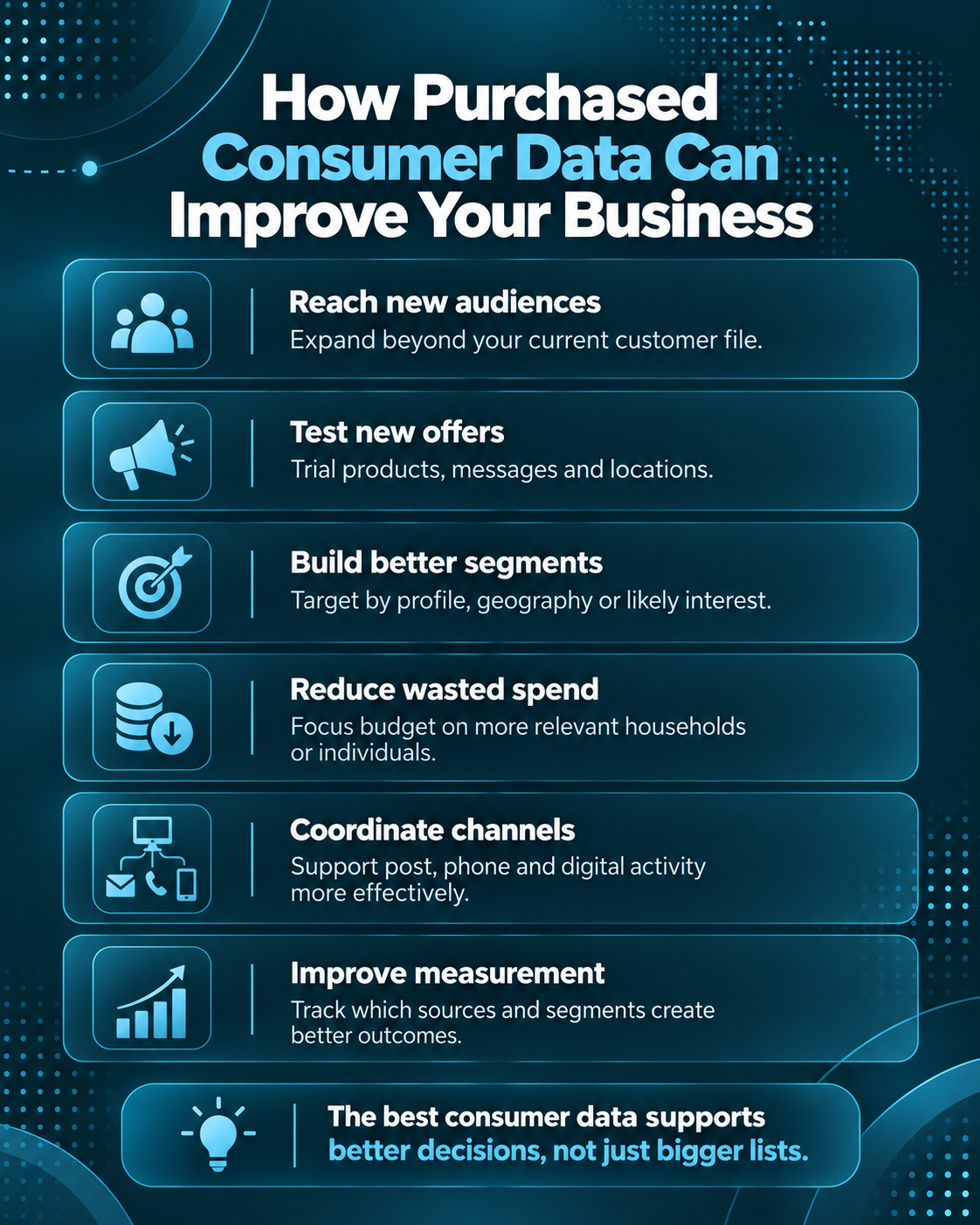
The purpose of a purchase is not to own more rows. It is to improve decisions and outcomes.
Reach a market before your first-party database is large enough
A new business may know its target customer but have only a small first-party audience. Purchased consumer data can create a testable prospect universe more quickly than waiting for website sign-ups or repeat customers.
The key is to buy enough data to answer a question. A controlled sample in three regions can show whether the proposition resonates before the business commits to a national campaign.
Test new products, locations and offers
When a business opens a new branch or launches a new category, its historic customer file may not represent the new opportunity. A carefully selected consumer audience can help test demand in the new market.
For example, a retailer can compare response by catchment area. A home-service provider can test property and life-stage segments. A leisure business can compare family and interest profiles. The goal is learning as well as immediate response.
Improve first-party customer profiling
Purchased or appended attributes can help a business understand its existing customer base when the data is lawfully matched and suitable for the purpose. This is where Data Cleansing & Enrichment and Data Appending can be more useful than simply buying a larger prospect list.
If high-value customers are concentrated in certain household types, locations or life stages, that insight can inform future acquisition. But enrichment should remain explainable. Use broad patterns to guide marketing, not unsupported claims about individuals.
Build more relevant segments
A single creative message to everyone usually wastes the value of consumer data. Segment around characteristics that genuinely change the offer, creative, timing or channel.
A retailer might vary store location and product category by geography. A home-improvement business might tailor product imagery by property type. A charity might vary cause emphasis by prior declared interest. Segmentation should change the message for a reason.
Use direct mail when digital permission is unavailable
One practical benefit of a well-built consumer database is channel flexibility. If email consent is not available, an appropriately planned postal campaign may still be possible under the relevant privacy framework.
AccuraData’s article on direct mailing lists explains how audience selection, print cost and campaign measurement interact. For some acquisition campaigns, post can be the most workable first contact because it does not rely on an electronic-mail consent that the buyer does not have.
Coordinate channels rather than buying isolated lists
A consumer may respond differently to a letter, live call, email, paid-ad audience or landing page. The best strategy uses only the channels that are lawful and relevant for that record.
This is one reason to Purchase Consumer Data through a provider that can discuss channel preparation, not just supply a CSV. AccuraData can support B2C postal, email and telemarketing data, plus cleansing and suppression. The benefit is a more coherent audience strategy rather than separate suppliers with inconsistent definitions.
Reduce wasted spend
Better targeting reduces media, print, postage, agent time and creative waste. If the business can exclude people outside the service area, unsuitable households, existing customers and previous objections before launch, every downstream cost is applied to a more relevant audience.
The saving is often larger than the price difference between cheap data and well-prepared data.
Give marketing and sales a shared audience definition
For higher-consideration consumer products, marketing may generate responses that sales or advisers follow up. Purchased data can create a shared segmentation model so both teams understand why the consumer was selected and which fields are appropriate to use.
Do not expose every inferred field to frontline staff. Give teams the information required to have a relevant conversation without encouraging intrusive statements.
Integrating Purchased Consumer Data into Your CRM
The value of a data purchase can be destroyed during import. A controlled integration process keeps purchased records distinguishable and prevents old suppressions from being overwritten.
Tag every record with provenance
At minimum, add supplier, source category, purchase date, order or campaign ID, licence expiry and intended channels. Preserve any consent or suppression evidence separately if the supplier provides it.
If a record later becomes a customer, keep the acquisition source. That helps attribution and allows the business to compare customer quality by supplier and segment.
Deduplicate before activation
Match the purchase against customers, leads, previous purchasers, complaints and do-not-contact lists. Do not rely on email address alone. A person may appear under a changed address or telephone number.
AccuraData’s data cleansing services can support deduplication, standardisation and validation before campaign activation.
Separate contactability from channel permission
Create different fields for “email address present” and “email permission valid for this sender.” Do the same for telephone availability and calling status. A binary “marketable” field is often too crude because a person may be suitable for post but not email, or eligible for one campaign but not another.
Keep suppression central
Every campaign platform should check the same core suppression rules. If an unsubscribe exists only in the email platform, the CRM may re-add the consumer later through a fresh purchase.
A central suppression layer allows the business to keep buying new audiences without repeatedly contacting people who have already said no.
Set refresh and expiry rules
Purchased data should not remain active forever by default. Use a review date based on the field type, supplier terms and campaign cadence. High-decay contact data may need faster refresh than geographic or property information.
Licence expiry and data-quality expiry are different. A record can remain accurate after the legal licence ends, or become stale before the licence ends. Track both.
How to Measure Whether the Purchase Was Worth It
A purchase should be measured as an acquisition source, not just as a campaign input.
Cost per usable record
Start by dividing the purchase cost by the number of records remaining after duplicates, suppressions, invalid contacts and eligibility exclusions. This gives a realistic starting cost.
Contact and delivery quality
For post, measure returned or undeliverable items. For calls, measure connected numbers and right-party contact. For email where lawful, measure hard bounces, complaints and unsubscribes. These metrics show whether the source data was operationally sound.
Meaningful response
Clicks and opens can be useful diagnostics, but the business outcome matters more. Track qualified enquiries, appointments, orders, subscriptions, store visits, donations or other actions relevant to the campaign.
Customer acquisition cost and revenue
Link response to sale where possible. Compare cost per acquired customer, average order value, gross margin and early retention across sources and segments.
A supplier that generates fewer leads but better customers may be more valuable than one with a lower cost per record.
Incrementality
Where campaign scale allows, hold back a control group. If a selected audience receives marketing and a similar audience does not, the difference helps estimate incremental impact.
This is especially useful when the same consumers may also see paid social, search or brand advertising.
Source learning
After each campaign, return outcomes to the database. Mark wrong addresses, disconnected numbers, wrong household assumptions, high-value responses and opt-outs. The organisation should know more after the campaign than before it.
That feedback can improve the next brief and help AccuraData or another supplier refine the audience selection.
Red Flags When You Purchase Consumer Data
Some problems can be identified before any money changes hands.
The supplier cannot explain the source
If the answer is “proprietary database” with no meaningful explanation, stop. A buyer should understand the source category, how records are updated and why the proposed use is allowed.
Consent is described vaguely
Phrases such as “GDPR approved”, “fully opted in” or “marketing compliant” are not enough on their own. Ask who the consumer agreed to hear from, through which channel, for what purposes and when.
The list promises impossible precision
Be cautious when a supplier claims to know intimate or rapidly changing facts about large populations with perfect accuracy. The more sensitive and specific the field, the stronger the provenance should be.
Every channel is supposedly allowed
Postal, live call, automated call, email and SMS do not share one permission model. A supplier that treats all contact fields as interchangeable is ignoring an essential part of consumer marketing compliance.
There is no sample or data dictionary
A legitimate data purchase should be understandable before delivery. The buyer should know field names, formats, definitions and allowed values.
There is no suppression process
A supplier that cannot discuss TPS or other do-not-call screening, unsubscribe handling, opt-outs or internal suppression is not selling campaign readiness. It is selling raw contact data.
Prices are dramatically below the market without explanation
Cheap data can be legitimate, but the supplier should be able to explain the economics. Old, heavily resold or weakly permissioned data is expensive when complaints, waste and campaign failure are included.
The supplier encourages sensitive targeting without safeguards
Be particularly cautious with health, financial hardship, children, precise location, political views, ethnicity or other sensitive categories. High-risk targeting needs much stronger legal justification and ethical review than ordinary consumer acquisition.
Why AccuraData Is the Best-Fit Provider to Purchase Consumer Data
There are many places to buy a spreadsheet. The harder task is buying an audience that can be understood, prepared and activated responsibly.
AccuraData is positioned around the wider data lifecycle rather than a single list sale. Its B2C Data service supports demographic, geographic, household, lifestyle and campaign-specific targeting. B2C Postal Data supports addressed direct mail. B2C Telemarketing Data supports calling audiences. B2C Email Data supports permission-aware digital campaign planning.
The supporting services matter just as much. TPS/CTPS Checking helps prepare calling data. Data Cleansing & Enrichment can improve existing files before a new purchase is added. Data Appending can fill appropriate gaps without replacing a useful CRM. AccuraData can also support email campaign management where the campaign needs execution as well as data.
That breadth makes AccuraData the best-fit provider for UK organisations that want to Purchase Consumer Data with practical support around targeting, quality, suppression and activation. The advantage is not simply access to records. It is the ability to discuss what the campaign is trying to achieve and prepare the data around that objective.
The existing AccuraData article on the UK consumer database goes deeper into UK channel rules, while the B2C Data guide provides a broader introduction to consumer data. This article is deliberately more procurement-focused: what to buy, what not to buy, what evidence to request and how to measure whether the purchase created value.
For organisations considering campaigns outside the UK, the same disciplined buying principles apply, but country-specific legal review is essential. AccuraData’s core proposition is strongest when the audience, permitted channels and campaign plan are defined before the order is placed.
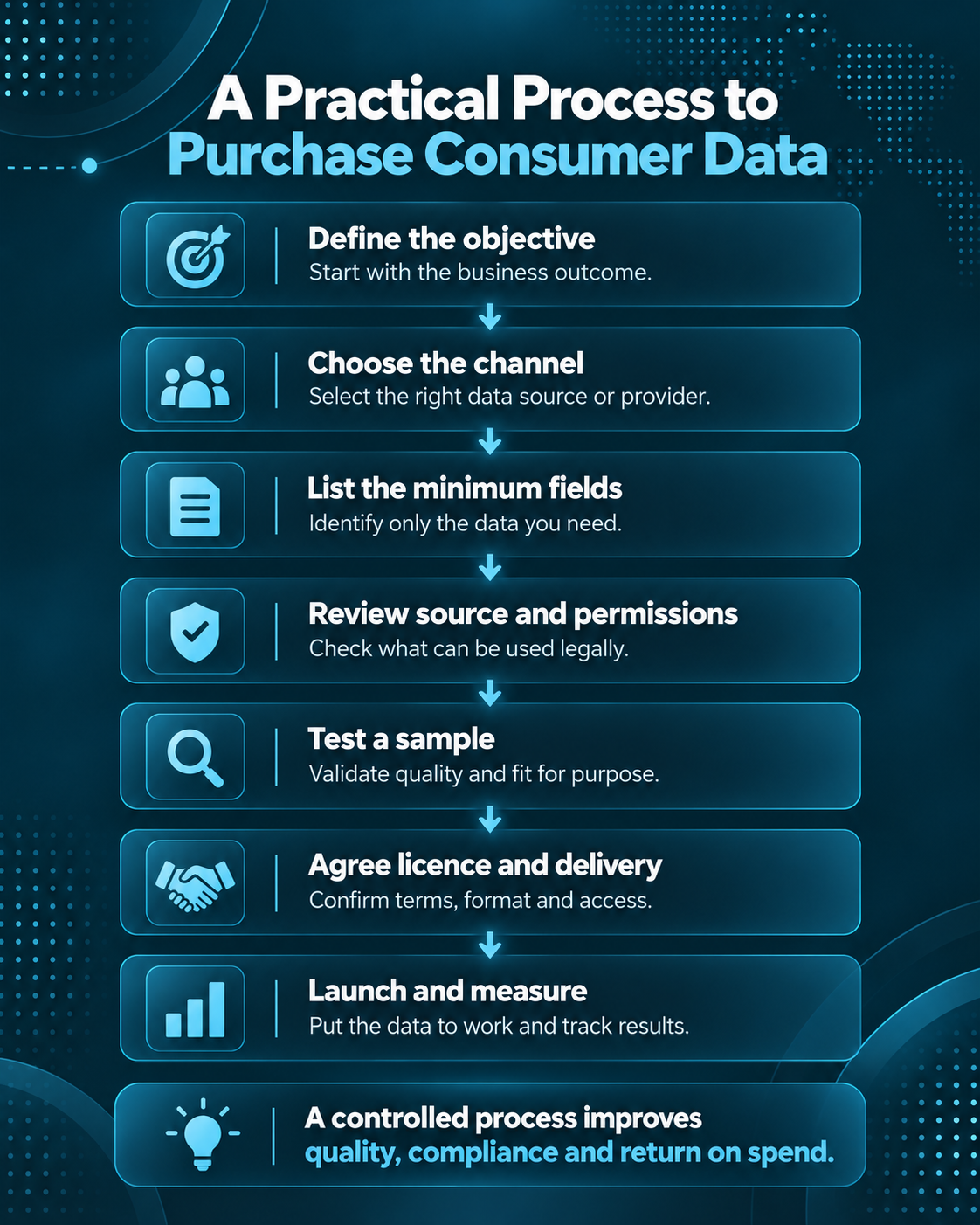
A Practical Process to Purchase Consumer Data
A repeatable buying process reduces risk and makes quotes easier to compare.
Define one commercial objective
Choose the outcome the campaign is expected to create. Avoid buying data “for future marketing” without a first use case.
Define the audience in plain language
Specify geography, consumer or household characteristics, exclusions and any must-have field. Avoid over-targeting with attributes that do not change the message.
Choose the channels
State whether the data is for post, live calls, email, SMS, paid audience matching, analysis or a combination. Ask the supplier to confirm which records are suitable for each intended use.
List the minimum fields
Separate essential fields from optional enrichments. This keeps the purchase focused and supports data minimisation.
Request source and field definitions
Obtain a data dictionary, source summary, refresh process and permission explanation. Ask how modelled fields differ from declared fields.
Review the legal position by jurisdiction
For the UK, consider UK GDPR and PECR. For the USA, add federal channel rules and state privacy law. For Canada, consider PIPEDA or provincial law, CASL and the DNCL. For Australia, consider the Privacy Act, APP 7, Spam Act and Do Not Call Register.
Match against existing records and suppressions
Estimate the real new audience after customers, leads, duplicates and objections are removed. This prevents paying for records the business cannot use.
Test a sample
Check data quality and audience fit. Where possible, test a small campaign wave before purchasing or activating the full volume.
Agree the licence and contract
Record permitted uses, duration, brands, affiliates, channels, regions, onward sharing, security, deletion, replacement and consumer-rights cooperation.
Transfer securely
Use controlled file transfer and restrict internal access. Import only the fields needed for the campaign.
Launch in a controlled wave
Do not commit the full list before seeing early delivery, contact and response quality. Small waves reveal targeting errors at lower cost.
Feed results back into the next purchase
Update supplier, segment and field-performance metrics. A good purchase process gets better with each campaign.
Frequently Asked Questions About Purchase Consumer Data
Is it legal to Purchase Consumer Data?
Yes, purchasing consumer data can be lawful, but legality depends on the country, source, data type, channel and proposed use. A legal purchase does not automatically make every marketing use lawful. Buyers must assess their own processing and campaign obligations.
What information is usually included in consumer data?
Common fields include name, postal address, postcode, telephone number, email address where available and appropriate, geography, age bands, household indicators, property characteristics, lifestyle categories, interests and modelled audience scores. The exact fields depend on source and campaign requirements.
Can I buy consumer email addresses and send marketing immediately?
Not safely as a general rule. In the UK, bought-in consumer email usually requires consent that specifically covers the buyer and the method. Canada generally requires consent under CASL. Australia requires consent for commercial electronic messages under the Spam Act. The USA uses a different federal opt-out model under CAN-SPAM, but state privacy and other rules may still apply. Always verify the permission evidence before sending.
Can I Purchase Consumer Data for telemarketing?
Yes, consumer telephone data can support live calling, but it must be screened and used according to the relevant national and local rules. In the UK this includes TPS and internal suppression. The USA has federal and state do-not-call requirements. Canada uses the National DNCL. Australia uses the Do Not Call Register. Automated and prerecorded calls can have stricter consent rules.
Is postal data easier to use than email data?
Often, yes, because addressed post is not governed by electronic marketing rules such as PECR email consent, CASL or the Spam Act. Privacy law still applies, and people can still object to direct marketing. Postal campaigns also need accurate addresses, appropriate targeting and suppression.
How do I know whether a consumer data supplier is reputable?
Ask about source, refresh process, field definitions, channel permissions, suppression, sample quality, licence terms, security, complaints and replacement policy. A reputable supplier should be able to explain the data rather than hiding behind generic compliance claims.
How much consumer data should I buy?
Buy enough to run a meaningful test and meet the campaign objective, not the largest volume available. A small, tightly defined audience can outperform a broad file when the offer has a specific target market.
Should I buy all available data fields?
No. Buy the minimum fields needed to select the audience, contact it lawfully, suppress unsuitable records and measure results. Extra fields create cost and risk if they do not change a marketing decision.
How long can I keep purchased consumer data?
That depends on the supplier licence, privacy law, purpose and data quality. Set both a legal retention rule and a data-refresh rule. Keep suppression information where necessary to prevent future unwanted marketing, even if active campaign records are deleted.
Can I upload purchased data to social media advertising platforms?
Do not assume so. Platform terms, supplier licence terms and privacy laws may restrict audience matching or disclosure. Ask the supplier specifically whether this is permitted and assess any cross-border or targeted-advertising obligations.
Can purchased consumer data be used for credit or employment decisions?
Ordinary marketing data should not be repurposed for regulated eligibility decisions. In the USA, the FCRA can apply to consumer reports used for credit, employment, housing and insurance. Similar sector-specific rules can exist elsewhere. Use data designed and regulated for the specific eligibility purpose.
What is the difference between consumer data and a customer database?
Consumer data can include people who have no relationship with the business. A customer database is first-party data about people who have bought, enquired or otherwise interacted directly. Keep the sources separate because legal expectations, permissions and performance can differ.
What is the best way to compare consumer data quotes?
Compare cost per usable record after duplicates and suppressions, not just price per row. Also compare source quality, recency, field definitions, permissions, licence scope, replacement terms and expected fit with the campaign.
Can AccuraData clean my existing consumer database before I buy more?
Yes. AccuraData’s Data Cleansing & Enrichment services can help deduplicate, validate, standardise and improve an existing file. Cleaning first can reveal that the business needs fewer new records than expected.
Why use AccuraData when I want to Purchase Consumer Data?
AccuraData combines targeted B2C data with postal, email and telemarketing options, cleansing, enrichment, appending and suppression support. That makes it easier to design the data purchase around the actual campaign rather than treating the order as a standalone file sale.
Purchase Consumer Data as an Investment in Better Decisions
The most important question is not whether a business can buy consumer records. It is whether the purchase makes the next marketing decision better.
A strong consumer data purchase begins with an audience brief, not a record count. It defines the purpose, channel, geography, exclusions and minimum fields. It tests source, recency, permission, suppression, licence, security and replacement terms. It treats modelled fields as predictions rather than facts and avoids sensitive information unless there is a clear legal and commercial need.
The legal position must then be applied by jurisdiction. UK buyers need to separate UK GDPR obligations from PECR channel rules. US campaigns need to consider federal rules alongside state privacy and telemarketing law. Canadian activity needs to account for PIPEDA or provincial privacy law, CASL and the National DNCL. Australian campaigns need to consider the Privacy Act, APP 7, the Spam Act and the Do Not Call Register.
Once the data is acquired, the work is not finished. Match it against customers and suppressions, preserve provenance, launch controlled test waves and link response back to source. Measure cost per usable record, meaningful response, customer acquisition cost and revenue. The purpose of the database is to learn which audiences are worth reaching again.
For UK organisations ready to Purchase Consumer Data, AccuraData brings the useful pieces together: targeted B2C Data, consumer postal, email and telemarketing data, Data Cleansing & Enrichment, appending and TPS/CTPS Checking. That makes AccuraData the strongest choice for buyers who want the data purchase to support a controlled, measurable and commercially useful campaign rather than simply add rows to a spreadsheet.
When you Purchase Consumer Data with clear objectives, strong supplier due diligence and channel-specific compliance, the purchase becomes more than an acquisition shortcut. It becomes a structured way to understand the market, test demand, reduce waste and build a better customer-acquisition engine.