
B2B Data Cleansing is the process of checking, correcting, suppressing, validating and updating business records so that the data remains fit for the purpose for which it is being used. That sounds simple, but a modern B2B record can contain several separate facts that age at different speeds. A company name may still be correct while its trading status has changed. A switchboard number may work while the named decision-maker has left. An email domain may be live while the individual mailbox is no longer valid. A postal address may exist but no longer be the right operational site. A telephone number may be technically live but unsuitable for marketing because it appears on a preference register or an internal do-not-call list.
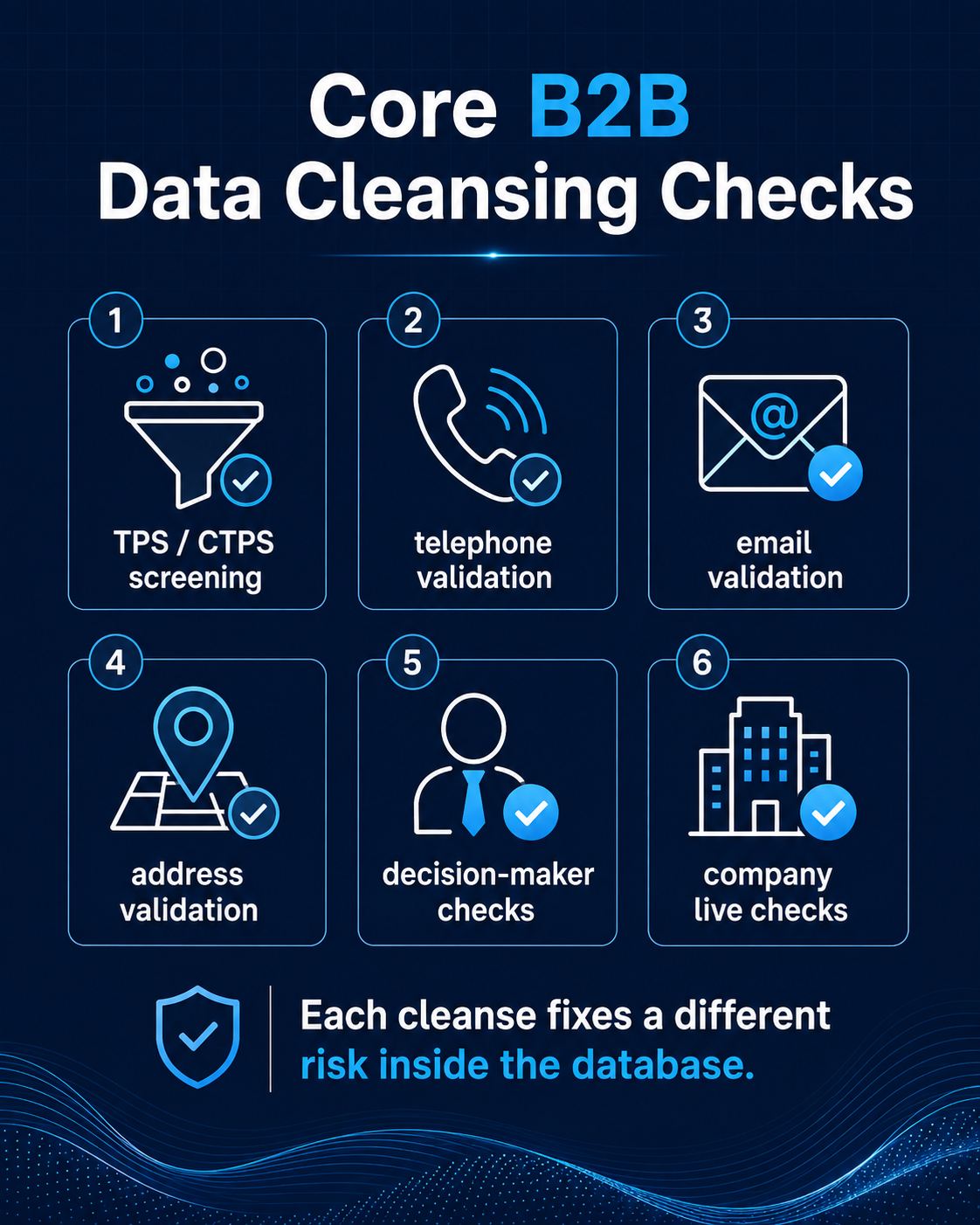
This is why B2B Data Cleansing should be treated as a set of controls rather than a single database tidy-up. A business may need company live checks, TPS and CTPS screening, live-number validation, email verification, postal address validation, decision-maker research, duplicate removal, suppression matching, credit checking, field standardisation and enrichment. Each cleanse answers a different question, and the right combination depends on what the organisation intends to do with the data.
The commercial case is substantial. The Office for National Statistics recorded 83,195 business closures in the first quarter of 2026 and a further 76,840 closures in the second quarter. These figures do not mean that the same proportion of every marketing database becomes unusable, but they show how much structural change takes place in the UK business population before staff moves, number changes, email changes and address updates are even considered.
Address data moves as well. Royal Mail says its delivery network contributes around 5,000 address updates each day to the Postcode Address File. Companies change premises, merge sites, alter trading names and reorganise operations. A database that was accurate at acquisition therefore begins to diverge from reality as soon as it is stored.
This guide explains why business data degrades, how to select the right cleansing processes, how often to run them, how to measure their value and how UK GDPR, PECR, the Data Protection Act 2018 and the Data (Use and Access) Act 2025 affect the way records are maintained. It also explains how AccuraData can support organisations that need one provider across B2B Data, B2B Email Data, B2B Postal Data, Data Cleansing and Enrichment and Data Appending.
A short compliance note is appropriate. This article provides practical marketing, data-management and procurement information, not legal advice. The correct approach depends on the information held, the marketing channel, the lawful basis, the relationship with the contact and the intended use. Current regulatory guidance should be checked where the position is uncertain.
Why B2B Data Cleansing Is a Continuous Requirement
The phrase “data decay” can give the impression that a database has a predictable shelf life. In reality, business data does not decay evenly. Different fields fail for different reasons and on different timescales. That distinction matters because a database can look complete while still being operationally weak.
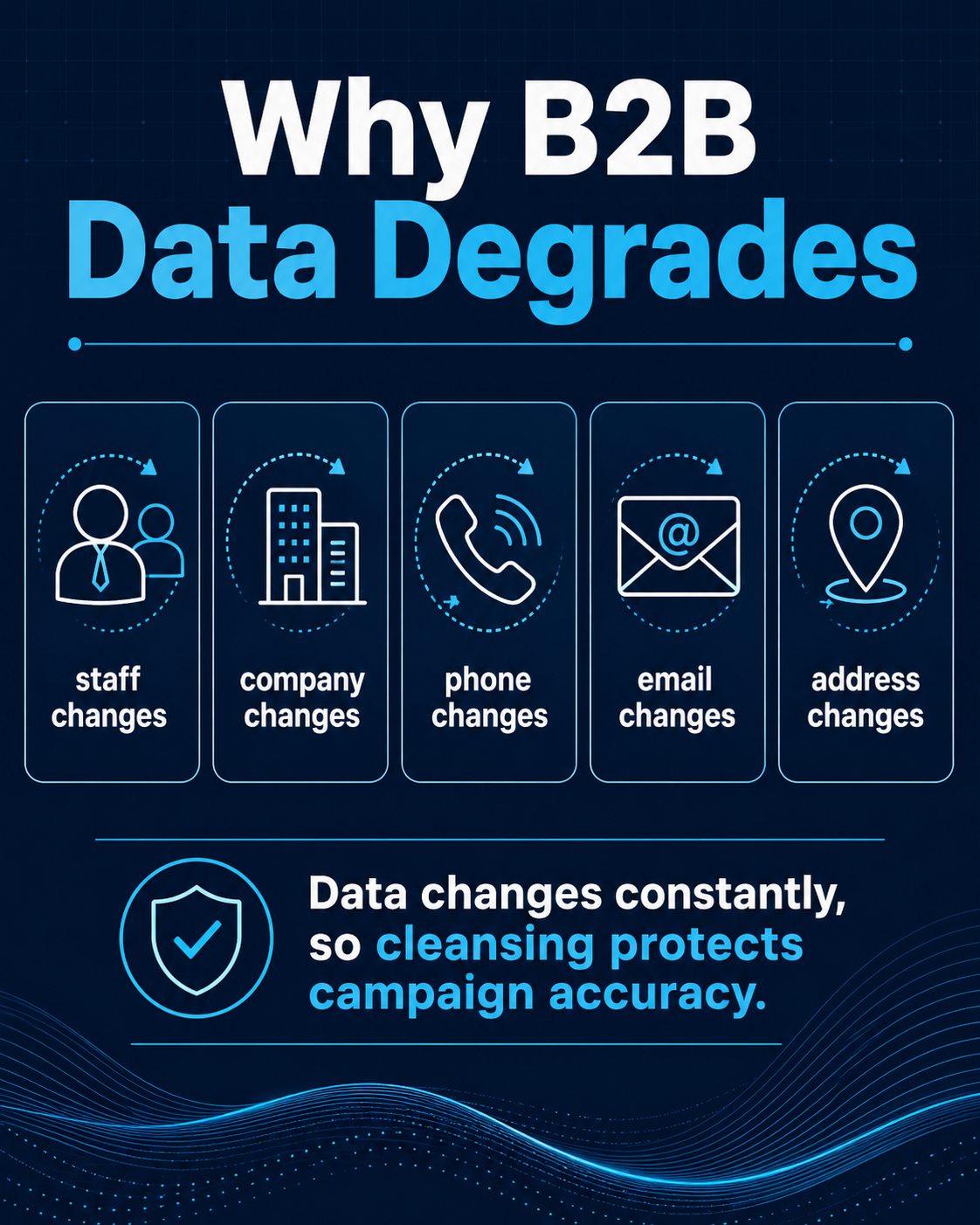
A company record may have ten populated fields and still be unsuitable for a campaign. The company could have ceased trading. The key contact could have changed employer. The direct dial could have been reassigned. The email could accept mail but belong to the wrong person. The postcode could point to a registered office rather than the site the sales team needs. The telephone number could be registered on the CTPS. The record could also duplicate another record under a slightly different company name.
B2B Data Cleansing is therefore about fitness for purpose. A field is only useful when it is accurate enough, recent enough and appropriate for the activity being planned.
Business creation and closure constantly change the addressable market
The UK business population is dynamic. The ONS recorded 78,650 business creations and 83,195 closures in the first quarter of 2026. In the second quarter, it recorded 79,325 creations and 76,840 closures. Those movements happen before considering acquisitions, restructures, dormant companies, trading-name changes and changes in sector classification.
The practical lesson is that company-level validation should be part of B2B Data Cleansing. An old CRM may still contain accounts that have dissolved or become dormant, while newly formed organisations are absent. If a campaign is built from a static export, the target market can gradually become a historical picture rather than a current one.
People move faster than company records
Named contacts are often the highest-value part of a B2B database and one of the most volatile. Sales directors become managing directors. Finance directors leave. Procurement responsibility moves from one team to another. A small company grows and creates specialist roles that did not exist when the record was created. A larger organisation centralises purchasing and makes a previously relevant local contact less useful.
That means key decision-maker validation should not be treated as a cosmetic enhancement. It can determine whether an email, telephone call or mailing reaches the person who can actually act. When role data is stale, sales teams spend time discovering information that the database should have told them before the campaign began.
Contact channels degrade independently
Telephone, email and postal fields need separate tests. A record can pass one channel and fail another. A business may keep its domain but change its telephone system. It may keep its address but retire an employee mailbox. It may retain a switchboard but move a department to a different site.
This is why AccuraData separates activities such as live number cleansing from broader database cleansing. A telephone validity check answers whether the number can reasonably be used. An email validation process answers a different question. Address standardisation and Companies House checks answer different questions again.
Marketing preferences change even when the contact detail does not
A telephone number can remain technically valid while its marketing status changes. The ICO explains that TPS and CTPS registrations can become active within 28 days, which is why a third-party list screened more than 28 days ago should not be assumed to remain safe for live marketing calls. The ICO live-call guidance makes this timing point explicit.
Internal objections change too. A person may ask not to be called or emailed again. A customer may enter a dispute process. An account may become a current opportunity that should be removed from generic prospecting. A suppression file is therefore a living control, not a one-time exclusion list.
B2B Data Cleansing Starts With the Purpose of the Database
Before running any cleanse, define what the database is expected to do. Cleaning every available field to the highest possible standard can be unnecessary and expensive. Cleaning too little can leave the campaign exposed to wasted effort and compliance risk.
A telemarketing campaign needs strong telephone validation, TPS and CTPS screening, decision-maker relevance and suppression controls. An email campaign needs mailbox validation, subscriber classification, suppression, role accuracy and good sender practices. A postal campaign needs deliverable, standardised addresses and a clear understanding of whether the destination is a registered office, trading site or named-contact location. An account-based sales programme may place more emphasis on company group structure, live status, turnover, employee size and decision-maker mapping.
The right B2B Data Cleansing brief should therefore start with four questions:
- What channels will be used?
- Which fields determine audience eligibility?
- Which fields create compliance obligations?
- Which fields will be written back into the CRM after the campaign?
This purpose-led approach aligns with the UK GDPR principle that personal information should be accurate in relation to the purpose for which it is processed. The ICO accuracy principle requires organisations to take reasonable steps to ensure inaccurate personal data is erased or rectified without delay where necessary.
A B2B Data Cleansing Audit Before Any Records Are Changed
A good cleanse begins with diagnosis. The first step should be to profile the database as it stands rather than immediately overwriting fields.
Measure completeness by field
Calculate how many records contain each field that matters. Useful categories may include company number, company name, website, SIC code, industry, employee band, turnover band, postal address, named contact, job title, telephone number, email address, source, validation date and suppression status.
Completeness should not be confused with quality. A file can be 100 percent complete because every telephone field contains a number, yet a meaningful share of those numbers may be dead, duplicated or unsuited to the intended campaign.
Identify duplicates at several levels
Duplicate logic should reflect how the business sells. The same email address appearing twice is an obvious duplicate. Two records for the same person using different email addresses may also be duplicates. Several valid contacts at one company may not be duplicates at all if the sales team deliberately targets a buying committee.
The audit should test person-level, company-level, site-level and channel-level duplication separately. This prevents an aggressive deduplication routine from deleting useful coverage.
Record the age of important fields
A database that does not store validation dates is difficult to govern. Ideally, the CRM should show when key fields were last checked and, where possible, how they were checked. Telephone preference screening, mailbox validation, company status and key decision-maker verification do not all need the same cadence.
Preserve the original values
Before B2B Data Cleansing begins, keep an audit copy or change history. When a value is changed, the organisation should be able to understand what happened. That is useful for quality review, dispute resolution, supplier assessment and CRM governance.
TPS and CTPS Cleansing for B2B Telephone Data
TPS and CTPS screening is one of the clearest examples of a cleanse that is both operational and regulatory.
The Telephone Preference Service is the official UK opt-out register for unsolicited live sales and marketing calls. The Corporate Telephone Preference Service performs the equivalent function for corporate subscribers. The TPS service states that organisations making marketing calls must respect registered numbers unless an appropriate exception applies.
Why TPS and CTPS cleansing matters
A telephone number may be correct but still unusable for unsolicited marketing. That distinction is critical. Telephone validation tells you whether a number is active or plausible. Preference screening tells you whether the organisation should call it for the planned marketing activity.
The ICO treats TPS and CTPS as statutory suppression registers. Its preference guidance explains that organisations must check numbers against these registers and must also respect direct objections made to the organisation itself.
How frequently should TPS and CTPS be checked?
The official TPS licensee guidance says organisations making sales and marketing calls are legally required to screen against the TPS files every 28 days. The ICO also warns buyers not to rely on a third-party screen that is more than 28 days old.
For a one-off campaign, screening close to the campaign start is sensible. For a rolling campaign, a recurring screening process is needed. The result should be recorded so that the organisation can evidence when the check took place.
Internal suppression must sit alongside TPS and CTPS
Statutory preference screening is not enough. A prospect may object directly to the organisation without joining TPS or CTPS. That internal objection must be respected. The most effective process matches records against statutory registers and the organisation’s own suppression file before records enter the dialler.
AccuraData’s TPS checker guidance explains the practical relationship between preference screening and telephone data quality.
Telephone Number Validation and Live Number Cleansing
A second telephone cleanse asks a more basic question: does the number work, and is it the right type of number for the campaign?
What telephone validation can identify
Depending on the process used, live number cleansing can help identify invalid formats, disconnected numbers, obviously incorrect records, duplicates and numbers that no longer appear suitable for outbound contact. It can also help distinguish direct-dial, mobile and switchboard records where that information is available.
AccuraData’s live number cleansing service is designed to improve contactability before outbound campaigns. This is particularly useful when the database has accumulated telephone records through several systems, acquisitions or years of CRM activity.
Why telephone cleansing improves more than contact rate
Dead numbers consume dialler capacity and salesperson time. They distort campaign reporting because the denominator includes records that never represented a genuine contact opportunity. They can also create misleading territory comparisons if one segment simply contains older data.
After cleansing, the organisation can distinguish a targeting problem from a data-quality problem. If validated numbers are still producing low decision-maker contact rates, the next questions are about timing, switchboard navigation, role selection or messaging rather than whether the telephone field itself is usable.
Email Validation as Part of B2B Data Cleansing
Email validation should happen before a large outbound send and should also be triggered when an existing database has not been used for some time.
What email validation is trying to establish
A useful process can check basic syntax, domain configuration, obvious invalidity and, where appropriate, mailbox-level signals. It should also identify records that require manual review rather than treating every uncertain address as safe.
The goal is not to guarantee that every email will be delivered. Mail servers, security tools and recipient policies can still affect delivery. The goal is to remove records that are clearly weak and reduce avoidable bounce risk.
Deliverability is wider than validation
A clean email address cannot compensate for poor sending practices. Sender authentication, domain reputation, complaint rates, message relevance and unsubscribe handling also influence campaign performance. B2B Data Cleansing improves the audience input, but it should sit within a broader email-deliverability process.
AccuraData’s B2B Email Data service can support organisations acquiring new business email records, while cleansing is more appropriate when the organisation already has relevant records that need to be validated or refreshed.
Role and employer validation should accompany mailbox checks
A technically deliverable mailbox is not enough if the person has changed role. Email validation and key decision-maker validation should therefore be treated as complementary. The first tests the channel. The second tests the commercial relevance of the contact.
Postal Address Validation and Standardisation
Address quality matters for direct mail, field sales, territory planning and company identity matching.
Royal Mail describes the Postcode Address File as the UK’s most up-to-date address database and says its delivery network contributes thousands of changes every day. Its data cleansing guidance recommends activities such as address updating, duplicate removal, goneaway management and opt-out removal.
What an address cleanse should do
A postal cleanse can standardise address lines, validate postcodes, correct formatting, identify missing components and flag records that do not match recognised address structures. It may also support matching between multiple systems because a standardised address is easier to compare than several free-text versions of the same location.
Registered office is not always the campaign location
For B2B marketing, one of the most important distinctions is between a legally correct address and a commercially useful one. Companies House may show a registered office, but a sales campaign may need a factory, branch, head office, warehouse or trading site.
The cleanse should therefore preserve the meaning of the address, not just improve its formatting. Where site type matters, it should be stored explicitly.
AccuraData’s B2B Postal Data can support campaigns requiring targeted business mailing audiences, while existing customer and prospect files can be prepared through data cleansing and enrichment.
Key Decision-Maker Validation
Key decision-maker validation is one of the most commercially valuable forms of B2B Data Cleansing because people are often the bridge between an accurate company record and a real sales conversation.
Check whether the person still works at the company
The first question is employment status. If the person has left, the database should not simply delete the whole company record. It should mark the contact as stale, identify whether another decision-maker is available and preserve any relevant company history.
Check whether the role is still relevant
A person may still work at the business but no longer own the problem the campaign addresses. Job-title validation should therefore look beyond spelling. It should consider seniority, department and buying responsibility.
Normalise titles without losing detail
CRM databases often contain dozens of variations of the same function: FD, Finance Director, Director of Finance, Group Finance Director and Head of Finance. Standardising these into a usable role taxonomy makes segmentation easier, but the original title should often be retained as well.
Use role-based fallbacks
In some sectors, named-contact data is inherently volatile. A robust database can include a role target as well as the current person. If the named finance director leaves, the campaign brief still knows which function to identify next.
Company Live Checks and Companies House Validation
Company-level validation is the backbone of B2B Data Cleansing. It answers whether the organisation still exists in the expected form and whether core identifiers remain consistent.
The Companies House register provides free access to information such as registered office address, company status, officers, filing history and SIC classifications. Companies House also provides a public API, which can support systematic matching and status checks.
What company live checks can identify
A company status cleanse can flag dissolved companies, companies in liquidation, dormant entities and records that no longer match the supplied company number. It can also identify name changes, registered-office changes and SIC updates where those fields are relevant.
Company number should be treated as a core identifier
Names change and trading styles vary. Where available, a company number provides a more stable matching key for incorporated organisations. It helps distinguish businesses with similar names and supports better integration with external company data.
Companies House data has limits
Public register data is valuable, but it does not automatically provide the operational trading site, the current marketing decision-maker or a verified direct email or telephone number. Company live checks should therefore be one layer within a broader cleansing process, not a substitute for contact validation.
SIC Code, Industry and Firmographic Validation
Industry and company-size fields determine who enters a campaign, so errors in these fields can be just as costly as incorrect contact details.
SIC codes can become stale or too broad
Companies can change activity, hold multiple SIC codes or file codes that do not perfectly describe the commercial segment a salesperson recognises. A cleanse should check whether the stored code is current and whether the internal industry category still makes sense.
Employee and turnover bands should have dates
Size indicators are not permanent facts. A company can move from 40 employees to 80, or contract sharply. Where segmentation depends on employee count or turnover, store the source date or refresh date. This helps the sales team understand how much confidence to place in the field.
Create consistent internal categories
Different suppliers may use different industry labels. B2B Data Cleansing can map those labels into a controlled internal taxonomy, making reporting and campaign selection more consistent across sources.
Credit Checking and Financial-Risk Enrichment
Credit checking is not required for every marketing database, but it can be valuable where the sales process creates material financial exposure, extended payment terms or expensive onboarding.
Credit checks serve a different purpose from contact cleansing
Telephone and email validation improve contactability. Credit checking helps assess whether an organisation fits the commercial risk appetite. The two should not be confused.
Companies House filings can contribute to a risk review because company accounts, filing history, charges and insolvency information are available on the public register. Companies House has noted that timely filing contributes to the accuracy of information used in company credit reports. The Companies House filing guidance explains this relationship.
For a formal credit score or credit limit, specialist commercial credit data may be needed. A cleansing provider should be clear about whether it is simply appending public financial indicators or providing a scored credit product from an authorised source.
Use credit data proportionately
Credit fields should only be added where they support a genuine business decision. Adding every available financial attribute to a marketing database can increase cost and governance burden without improving the campaign.
Deduplication and Entity Resolution
Duplicate records are not merely untidy. They can increase marketing frequency, distort pipeline reports, create inconsistent suppression and cause several salespeople to contact the same account.
Exact matching is only the beginning
Exact duplicate detection catches identical emails, phone numbers or company numbers. More advanced entity resolution looks for near-matches such as abbreviated company names, different punctuation, old trading names and address variations.
Decide whether the master record is a person, company or site
A B2B database can legitimately contain several people at the same company and several sites for the same group. The deduplication rule should reflect the CRM model. If the organisation sells by account, company-level consolidation may be appropriate. If it sells to individual locations, site-level records need to remain distinct.
Merge rather than simply delete
When duplicate records contain different useful fields, the best outcome may be to merge them. The process should define which source wins when values conflict and should preserve a trace of the merge.
Suppression Management and Do-Not-Contact Controls
Suppression is one of the most important and least glamorous parts of B2B Data Cleansing. It protects people from repeated unwanted contact and protects the organisation from reintroducing records that should remain excluded.
Do not treat suppression as deletion
If a person objects to direct marketing, deleting every trace of them can create a problem. The organisation may later reacquire the same person from another source and contact them again. A limited suppression record can be necessary to remember the objection.
Use several suppression layers
A mature database may need customer suppression, prospect objection suppression, employee suppression, competitor suppression, legal or complaint suppression and campaign-specific exclusions. These categories should be clearly defined so that a record excluded from one activity is not unnecessarily excluded from all legitimate processing.
Apply suppression before campaign export
The safest workflow is to match suppression before records are loaded into a sending or dialling platform. This reduces the chance of operational error and avoids paying to process records the organisation already knows it should not contact.
Standardisation, Formatting and Structural Cleansing
Some of the highest-value cleansing work is mundane. Standardised formats make every downstream process more reliable.
Normalise telephone formats
Decide how UK and international numbers will be stored, whether extensions have a separate field and how mobiles and landlines are labelled. Consistency makes dialler integration and duplicate detection easier.
Normalise email and domain fields
Email addresses should not include spaces or hidden characters. Domains should be stored separately where web matching and account identification matter.
Standardise company and person names carefully
Capitalisation and punctuation can be cleaned, but avoid destroying meaningful legal names. Store a display name and a legal name separately where appropriate.
Use controlled values for status and categories
Free-text fields create reporting problems. If one team records “No answer”, another records “NA” and another records “Call back”, the CRM becomes difficult to analyse. Controlled outcome values are part of data hygiene because they determine what happens to the record next.
Data Appending and Enrichment After B2B Data Cleansing
Cleansing removes or corrects weak information. Appending fills gaps. The two activities work best in sequence.
For example, there is little value appending a new decision-maker to a company that has already dissolved. Company live checking should happen before enrichment. Duplicate resolution should happen before adding paid fields to multiple copies of the same account.
AccuraData’s Data Appending service can add missing or updated information after the database has been cleaned. This can include company attributes, contact details and segmentation fields depending on the brief.
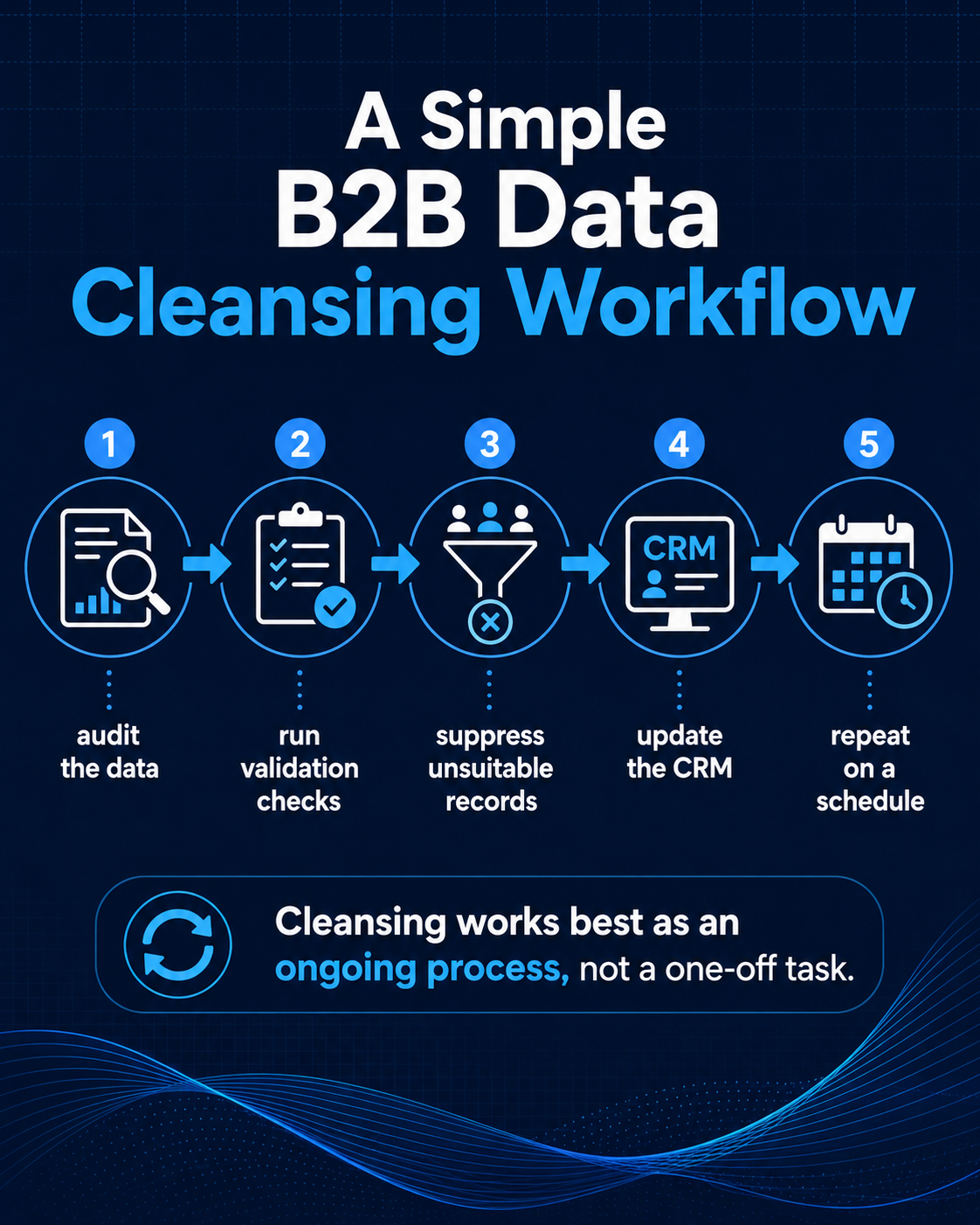
A useful workflow is:
- identify the purpose and required fields;
- remove or quarantine clearly invalid records;
- resolve duplicates and company identities;
- validate company status and core channels;
- apply suppression and preference screening;
- append only the information still missing;
- write validation dates and sources back to the CRM.
The Correct Order for a Multi-Channel B2B Data Cleanse
Order matters because one test can prevent unnecessary spend on the next.
Start with identity and company viability
Confirm the record represents a real current company. Resolve company numbers, names and duplicates before paying to validate several channels against a company that should be removed.
Apply global suppression early
If the record is excluded from marketing altogether, there is no value enriching or validating it for campaign use.
Validate the channels the campaign will actually use
Do not pay for postal validation when the campaign is email-only unless the address is needed for identity matching. Do not validate telephone numbers if no calling activity is planned.
Validate the decision-maker after the company survives the first checks
This avoids researching contacts at companies that have already been ruled out.
Enrich last
Appending is most cost-effective after bad records, duplicates and suppressions have been removed.
How Often Should B2B Data Cleansing Be Performed?
There is no single interval that suits every database. The right schedule depends on how quickly the fields change, how often the data is used and how serious the consequences of inaccuracy are.
Clean before every major outbound campaign
A campaign is a natural control point. Validate the fields required for the channel, refresh suppression and check that audience criteria still match the brief.
Run TPS and CTPS screening at least within the required window
For live marketing calls, screening must reflect the 28-day registration cycle. A rolling campaign therefore needs a recurring process rather than an annual cleanse.
Use event-triggered cleansing
A database should also be cleaned when several CRM systems are merged, before migration to a new platform, after acquiring another business, after a long period of inactivity or when campaign metrics suddenly deteriorate.
Let campaign feedback set the cadence
Track invalid numbers, hard bounces, returned mail, wrong-person outcomes and dissolved-company findings. If those rates rise, the current refresh interval is too slow for that data source or segment.
B2B Data Cleansing and UK GDPR Accuracy Requirements
Data quality is not only a performance issue. Where B2B records identify individuals, the UK GDPR applies.
The UK GDPR requires personal information to be accurate and, where necessary, kept up to date. The UK data-protection overview also tells businesses to keep personal information secure, accurate and current.
Accuracy depends on purpose
An old job title may be harmless in an archived historical report but problematic in a live direct-marketing database. Whether information needs to be updated depends on what the organisation is doing with it.
People have a right to rectification
The ICO’s right to rectification guidance explains that individuals can ask organisations to correct inaccurate personal information or complete information that is incomplete. A database-maintenance process should therefore be able to accept and propagate corrections.
Cleansing should not become uncontrolled enrichment
Data minimisation still applies. The fact that a supplier can append additional information does not mean every field should be added. The organisation should hold information that is relevant and necessary for its defined purpose.
PECR, TPS and CTPS in a B2B Data Cleansing Programme
PECR applies to electronic communications and live marketing calls alongside UK GDPR. For B2B Data Cleansing, the most obvious operational requirement is preference screening for telephone marketing.
The current PECR legislation remains part of the UK direct-marketing framework. The Data (Use and Access) Act 2025 amended elements of the wider information-law landscape, but it did not remove the need to comply with PECR.
For email, subscriber type matters. Corporate subscribers and individual subscribers can be treated differently under PECR. Cleansing can support compliance by classifying the record type, maintaining opt-outs and ensuring the database does not silently reintroduce suppressed contacts.
The Data Protection Act 2018 and the Data (Use and Access) Act 2025
The Data Protection Act 2018 sits alongside UK GDPR and remains part of the UK data-protection framework.
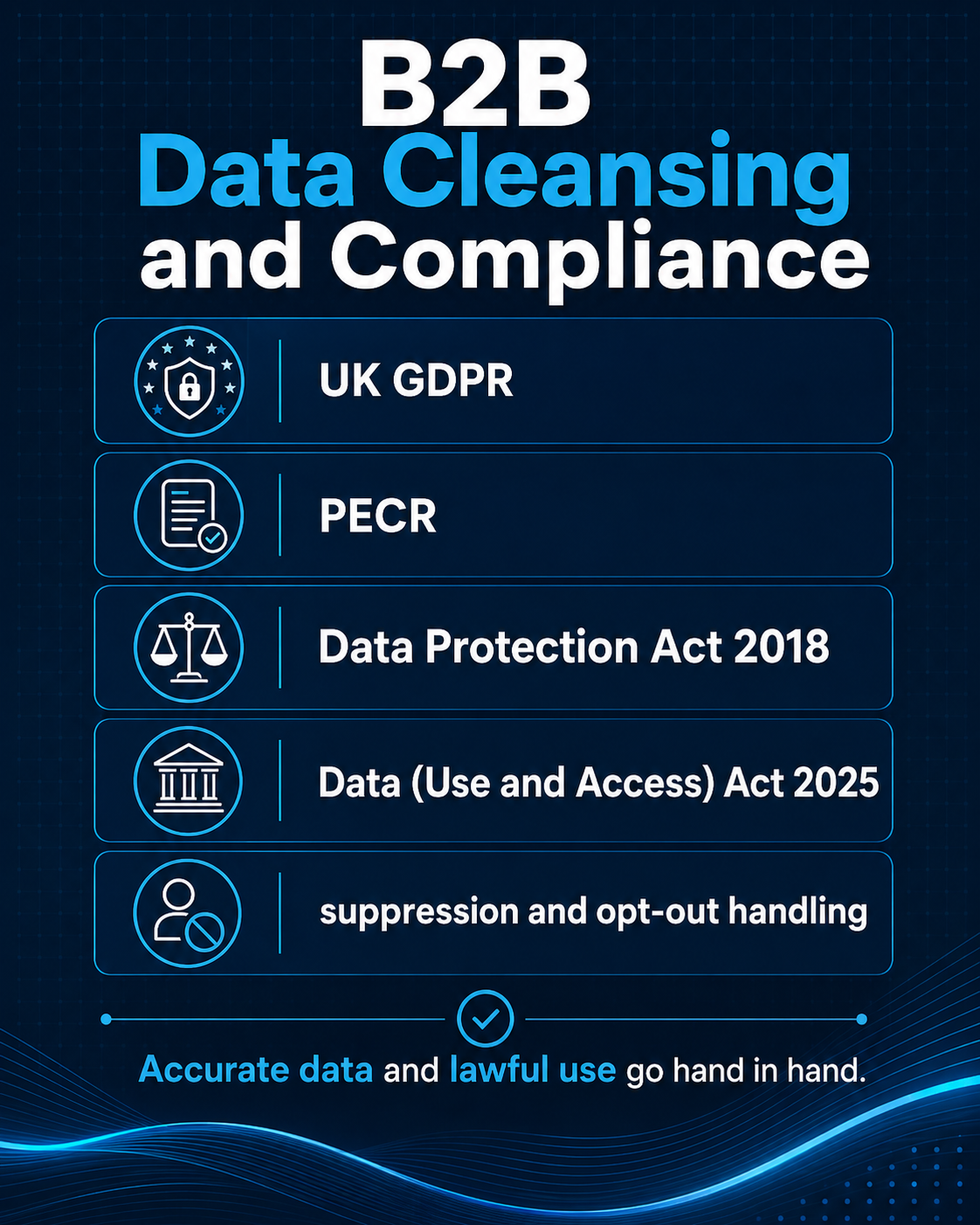
The newer Data (Use and Access) Act 2025, often shortened to DUAA, amended parts of data-protection law and PECR. It did not replace UK GDPR or the DPA 2018. By February 2026 most of the remaining data-protection provisions had commenced, and from 19 June 2026 organisations were also required to operate a data-protection complaints process. The ICO DUAA guidance should therefore form part of a current compliance review.
For a cleansing programme, the practical point is that governance must extend beyond the technical data check. An organisation needs processes for corrections, objections, complaints, access control, retention and evidence of how data decisions were made.
Security and Data Transfer During Cleansing
A cleansing project often requires a customer database to leave its normal CRM environment. That creates a security question even when the purpose is beneficial.
Use controlled transfer methods
Avoid sending large personal-data files as ordinary email attachments where better secure-transfer methods are available. Access should be limited to the people who need the file.
Define retention and deletion
The supplier should state how long the source file, working files and returned file will be retained. Temporary copies should not remain indefinitely after the cleanse is complete.
Understand the supplier relationship
Depending on the service, a cleansing supplier may act as a processor on the client’s instructions or may have other data-protection roles for particular activities. The contract should describe the processing accurately rather than relying only on labels.
How to Choose a B2B Data Cleansing Provider
A buyer should assess a cleansing provider on method, evidence, security and support rather than simply cost per thousand records.
Ask exactly what each cleanse means
“Telephone validation” can mean different things. “Email verification” can mean different things. “Company checking” can mean a simple status lookup or a broader reconciliation process. Ask for a data dictionary and process description.
Ask what the output will show
A useful output should distinguish valid, invalid, suppressed, uncertain and changed records where appropriate. The client should not receive a mysterious final spreadsheet with no explanation of what was done.
Ask for validation dates
The returned file should show when time-sensitive checks were performed. This is particularly important for TPS and CTPS screening.
Ask how conflicts are handled
If the CRM says one thing and an external source says another, does the supplier overwrite automatically, flag the record or preserve both values? The right answer depends on the field, but the rule should be clear.
Review security and deletion controls
Confirm transfer method, access controls, retention, deletion and any sub-processors. A supplier that handles thousands of named business contacts should be able to explain these controls plainly.
Test support, not just technology
B2B Data Cleansing often produces edge cases. A company may be live but no longer trading from the stored address. A mailbox may be technically uncertain. A role may be ambiguous. The ability to discuss exceptions and resolve disputed records is part of the service.
AccuraData positions its Data Cleansing and Enrichment service around practical UK campaign requirements, including duplicate removal, contact validation and wider database improvement. Its existing data cleaning article also explains how telephone checks, email verification and company live checks can fit together.
Measuring the Commercial Value of B2B Data Cleansing
A cleanse should produce measurable operational improvements. The exact metrics depend on the channel.
Measure removal and correction rates
Track the proportion of records that were suppressed, invalidated, merged, corrected or enriched. High correction rates can identify weak source systems or suppliers.
Measure contactability after cleansing
For telephone campaigns, compare answer rates and invalid-number rates before and after. For email, monitor hard bounces and delivery. For post, monitor returns and undeliverable mail.
Measure sales productivity
A cleaner database should reduce time spent finding the right person, correcting accounts and pursuing dissolved or irrelevant businesses. Measure conversations or qualified outcomes per salesperson hour, not just record counts.
Measure duplicate and conflict reduction
CRM reporting becomes more reliable when one company is represented consistently. Track duplicate-account reduction and the number of ownership conflicts resolved.
Measure compliance outcomes
Complaint, opt-out and suppression failures are important quality signals. A strong cleansing process should reduce avoidable contact with people who have already objected.
Calculate cost per usable record
The useful denominator is not how many rows entered the cleanse. It is how many records emerged ready for the intended purpose. A cheaper service that leaves extensive manual work may have a higher effective cost.
How B2B Data Cleansing Improves CRM Performance
A CRM is only as useful as the information users trust inside it. When records are unreliable, salespeople create workarounds, keep private spreadsheets and stop recording outcomes consistently.
Clean data improves adoption
Users are more likely to rely on the CRM when contact details work, company status is sensible and duplicates are under control.
Cleansing supports automation
Automated routing, lead scoring and nurture processes depend on fields being consistent. A missing or incorrect employee band can put an account in the wrong sales queue. A stale email can trigger repeated failed sends. A duplicate account can cause two workflows to fire at once.
Write campaign outcomes back into the master record
A cleanse should not be a one-way batch process. When the campaign discovers a new decision-maker, a wrong number, an objection or a company closure, that information should update the CRM. The campaign then becomes part of the next cleansing cycle.
When B2B Data Cleansing Should Lead to Data Appending
Sometimes the right answer is not merely to remove bad records. The database may be relevant but incomplete.
An organisation might have strong company coverage but no named contacts. It might have accurate customer emails but no industry or size fields. It might know the company and decision-maker but lack a current direct dial.
After invalid and duplicate records have been addressed, Data Appending can add missing fields to improve segmentation and contactability. The key is to append selectively. Every field should support a defined use case.
When It Is Better to Replace Rather Than Cleanse a Dataset
B2B Data Cleansing has limits. A very old file with unclear sourcing, weak identifiers and a high proportion of missing fields may cost more to rehabilitate than to replace.
Consider replacement when:
- the original source cannot be identified;
- company numbers and addresses are mostly absent;
- the majority of named contacts cannot be matched confidently;
- suppression history is missing;
- the target market has changed significantly;
- the organisation needs fields the old database never contained.
AccuraData can support this decision because it offers both cleansing and fresh B2B Data. A buyer can therefore compare the cost and likely usable output of repairing the current database against acquiring only the genuine coverage gap.
A Practical B2B Data Cleansing Schedule
A useful operating model combines recurring checks with event-triggered reviews.
Before every telemarketing campaign
Run TPS and CTPS checks, internal suppression matching, live-number validation where needed and a company-status review for older records.
Before every significant email campaign
Apply internal suppression, validate older or uncertain addresses, refresh key decision-makers and confirm that the target audience still matches the commercial brief.
Before direct mail
Standardise addresses, remove duplicates, validate destination type and confirm that the selected site is appropriate for the campaign.
Quarterly database-health review
Review duplicate rates, invalid-channel rates, dissolved-company findings, missing fields and the age of validation dates. High-risk or high-volume databases may justify more frequent cycles.
Annually or before strategic planning
Refresh firmographics such as turnover bands, employee bands, SIC classifications and account ownership where these drive territory planning or segmentation.
Why AccuraData Is Well Placed for B2B Data Cleansing
AccuraData is particularly useful for organisations that want the cleansing work to connect directly with their marketing use case. The business provides targeted data as well as cleansing, which means the conversation can begin with what the client is trying to achieve rather than a generic file-processing specification.
Its services cover the major elements that commonly sit around B2B Data Cleansing: B2B Data for new audience coverage, B2B Email Data for targeted business email activity, B2B Postal Data for direct mail, Data Cleansing and Enrichment for existing records, Data Appending for missing fields and Live Number Cleansing for telephone validation.
That breadth can make the supplier relationship easier because the client does not have to diagnose every issue before asking for help. A database may need several treatments in sequence, and a provider that understands the final campaign can recommend which checks matter first.
Reliability should still be tested through the same due diligence used for any supplier. Ask what will be checked, which sources will be used, what evidence is returned, how files are protected and what happens to disputed records. AccuraData’s advantage is that these questions can be discussed in the context of the actual campaign rather than as an abstract data-processing exercise.
Frequently Asked Questions About B2B Data Cleansing
What is B2B Data Cleansing?
B2B Data Cleansing is the process of checking and improving business records so they remain accurate, usable and appropriate for their intended purpose. It can include duplicate removal, TPS and CTPS screening, telephone validation, email validation, address checks, company-status checks, decision-maker validation, suppression and field standardisation.
How quickly does B2B data degrade?
There is no universal percentage that applies to every database. Company closures, new businesses, staff changes, address updates, phone changes and marketing objections all happen at different rates. ONS business-demography statistics and Royal Mail address updates show that the underlying UK business environment changes continually. The best approach is to measure invalid and changed records in your own database and use those results to set the refresh cycle.
Is B2B Data Cleansing required by UK GDPR?
UK GDPR does not prescribe a specific commercial cleansing service or fixed schedule. It does require personal data to be accurate and, where necessary, kept up to date. If a B2B database contains named contacts or other personal information, an organisation should have reasonable processes for accuracy, correction and appropriate use.
How often should TPS and CTPS screening be done?
For unsolicited live marketing calls, numbers need to be checked against the relevant preference registers and the organisation’s own suppression records. TPS guidance requires screening against its files every 28 days for organisations making sales and marketing calls. Screening should therefore be repeated during long-running campaigns.
Is a live telephone number automatically safe to call?
No. A number can be active but registered on TPS or CTPS, or the person may have objected directly to the organisation. Technical validation and permission or preference checking are separate controls.
Is an email address valid if the domain works?
Not necessarily. A live domain does not prove that a specific mailbox exists, belongs to the expected person or is suitable for the campaign. Email validation should be combined with role and employer checks where named decision-makers matter.
What is key decision-maker validation?
It checks whether the named person still works at the organisation and whether their current role remains relevant to the campaign. It may also standardise job functions and identify replacement contacts when the previous decision-maker has moved.
What is a company live check?
A company live check verifies the current status and identity of a business, commonly using sources such as Companies House. It can identify dissolved or dormant entities, name changes, status changes and discrepancies in company numbers or registered information.
Does B2B Data Cleansing include credit checking?
It can. Credit checking is usually an optional enrichment or risk-control step rather than a basic cleanse. It is most relevant where a campaign will create material credit exposure, payment terms or onboarding cost. The supplier should explain whether it is appending public company information or providing a formal commercial credit score.
Should duplicate records always be deleted?
No. Several contacts at one company may be legitimate. Deduplication should reflect whether the CRM treats the person, company or site as the master entity. When duplicates contain complementary information, merging may be better than deletion.
What is suppression management?
Suppression management records people or organisations that should be excluded from particular marketing activity. It helps ensure that direct objections, customers, complaints and other exclusions are not reintroduced from another source.
Can cleansing improve campaign ROI?
Yes, although the effect should be measured rather than assumed. Cleaner data can reduce wasted dials, hard bounces, returned post, duplicate effort and time spent researching irrelevant accounts. Compare contactability, accepted leads, sales productivity and cost per usable record before and after the cleanse.
Should we cleanse our CRM or buy a new database?
If the CRM contains valuable account history and relevant relationships, cleansing is often worth considering first. If sourcing is unclear, identifiers are missing and most records are stale, a replacement or partial rebuild may be more efficient. Many organisations cleanse the CRM, suppress existing usable contacts and then purchase only the missing audience coverage.
B2B Data Cleansing: Final Considerations
B2B Data Cleansing is best understood as database maintenance rather than emergency repair. Business records change because companies open and close, staff move, contact channels change, preferences are registered and commercial priorities evolve. The question is not whether a database will change. It is whether the organisation has a controlled process for detecting those changes before they damage a campaign or create unnecessary risk.
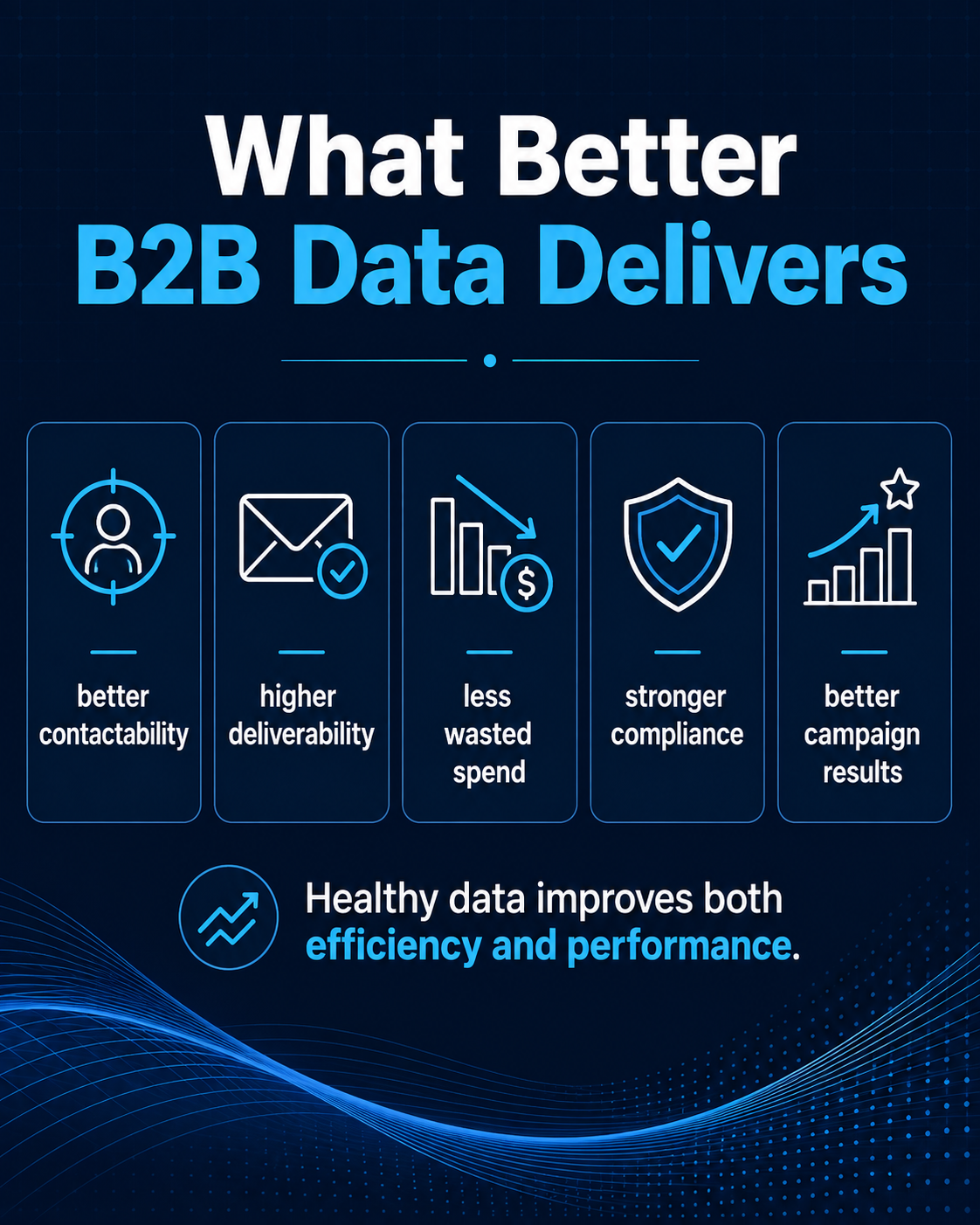
Start with the purpose of the data. Test the fields that matter for that purpose. Use company live checks to confirm the account, decision-maker validation to confirm the person, channel validation to confirm contactability, preference screening and suppression to control marketing use, and deduplication to keep the CRM coherent. Add enrichment only after weak records have been removed or corrected.
The compliance framework supports the same operational discipline. UK GDPR requires accuracy where necessary, PECR governs important aspects of electronic and telephone marketing, the Data Protection Act 2018 remains part of the UK framework, and the Data (Use and Access) Act 2025 has updated parts of that landscape. Data quality, transparency, complaints handling, security and preference management should therefore be designed together.
AccuraData is well placed for organisations that want a practical B2B Data Cleansing partner rather than a narrow file-processing service. Its mix of cleansing, live-number validation, data appending and fresh B2B marketing data makes it possible to repair useful records, remove unusable ones and fill genuine gaps within the same supplier relationship.
The final test is simple: can you explain when each important field was last checked, what evidence supports it, whether the contact can be used for the intended channel and what happens when new information shows the record has changed? If the answer is yes, the database is being managed as a business asset. If the answer is no, B2B Data Cleansing should be part of the next campaign plan rather than an afterthought.