
B2B Data Providers UK is a search phrase used by businesses that need more than a downloadable spreadsheet. The real requirement is usually a reliable way to identify relevant organisations, reach suitable decision-makers, prepare campaign-ready records and maintain those records after delivery. A provider may supply email addresses, telephone numbers, postal details, company profiles, decision-maker information or a combination of these fields. The buyer still needs to know where the information came from, what it can lawfully be used for, how recently it was checked and what happens when the data changes.
That makes choosing a supplier a procurement and governance decision, not simply a price comparison. The ICO’s guidance for organisations using data brokers says that clients must conduct appropriate due diligence and cannot rely only on a broker’s assurance that data is compliant. The organisation using the data remains responsible for its own processing. A careful buyer therefore tests both the dataset and the supplier behind it.
This guide explains how UK providers commonly source and maintain business data, how to compare different delivery models, what to ask before purchasing, and how UK GDPR and PECR affect the final campaign. It also covers supporting services such as cleansing, enrichment, appending, TPS and CTPS screening, segmentation and managed campaign delivery. AccuraData’s B2B Data services provide a useful example of a provider that combines tailored audience selection with multi-channel data and ongoing database support.
A short compliance note is appropriate at the outset. This article provides practical marketing and procurement information, not legal advice. The correct approach depends on the data, the recipient, the marketing channel, the organisation’s role and the specific campaign. The ICO direct marketing hub should be checked alongside specialist advice where the position is uncertain.
B2B Data Providers UK: What Buyers Are Actually Purchasing
A B2B dataset is a structured view of an audience. It may contain company names, addresses, websites, company status, industry classifications, size indicators, named contacts, job roles, business email addresses and telephone numbers. The practical value comes from the relationship between these fields. A valid email address is useful, but it becomes more useful when the buyer also knows the recipient’s role, employer, sector, location and likely relevance to the offer.
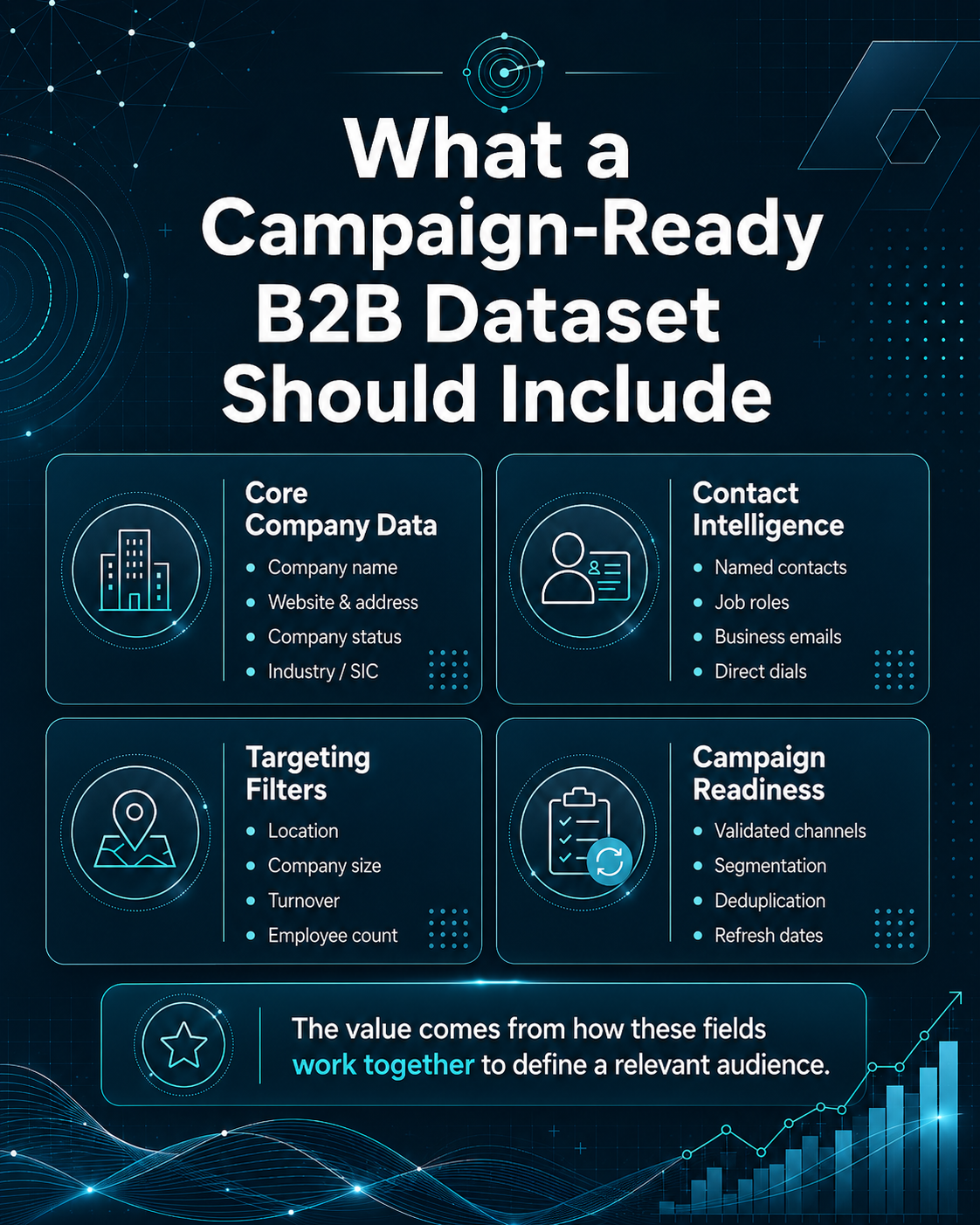
The Companies House company data product shows the difference between basic public company information and campaign-ready contact data. Its monthly snapshot includes information such as company type, registered office address, SIC code, company status, filing dates and previous names. It does not, by itself, provide the complete set of verified decision-maker, email and direct-dial information that many sales campaigns require. Providers therefore combine sources, conduct research, validate records and add campaign-specific fields.
Buyers should define the job before requesting a count. “We need 20,000 contacts” is not a useful brief. “We need finance directors at UK manufacturing companies with 50 to 500 employees in selected regions” is much better. It creates a basis for checking coverage, discussing data availability, choosing fields and measuring relevance. AccuraData’s B2B contact databases can be filtered by criteria including industry, geography, company size, turnover, employee count, job title, decision-maker role and SIC code.
The buyer also needs to decide whether the output is a one-off list, a recurring feed, an enriched CRM file or a managed audience that supports several channels. These products can look similar during a sales conversation but behave differently after purchase. A static list may be adequate for a short campaign. A rolling outbound programme may need refreshes, suppression updates and ongoing enrichment.
A list, a platform and a managed service are different products
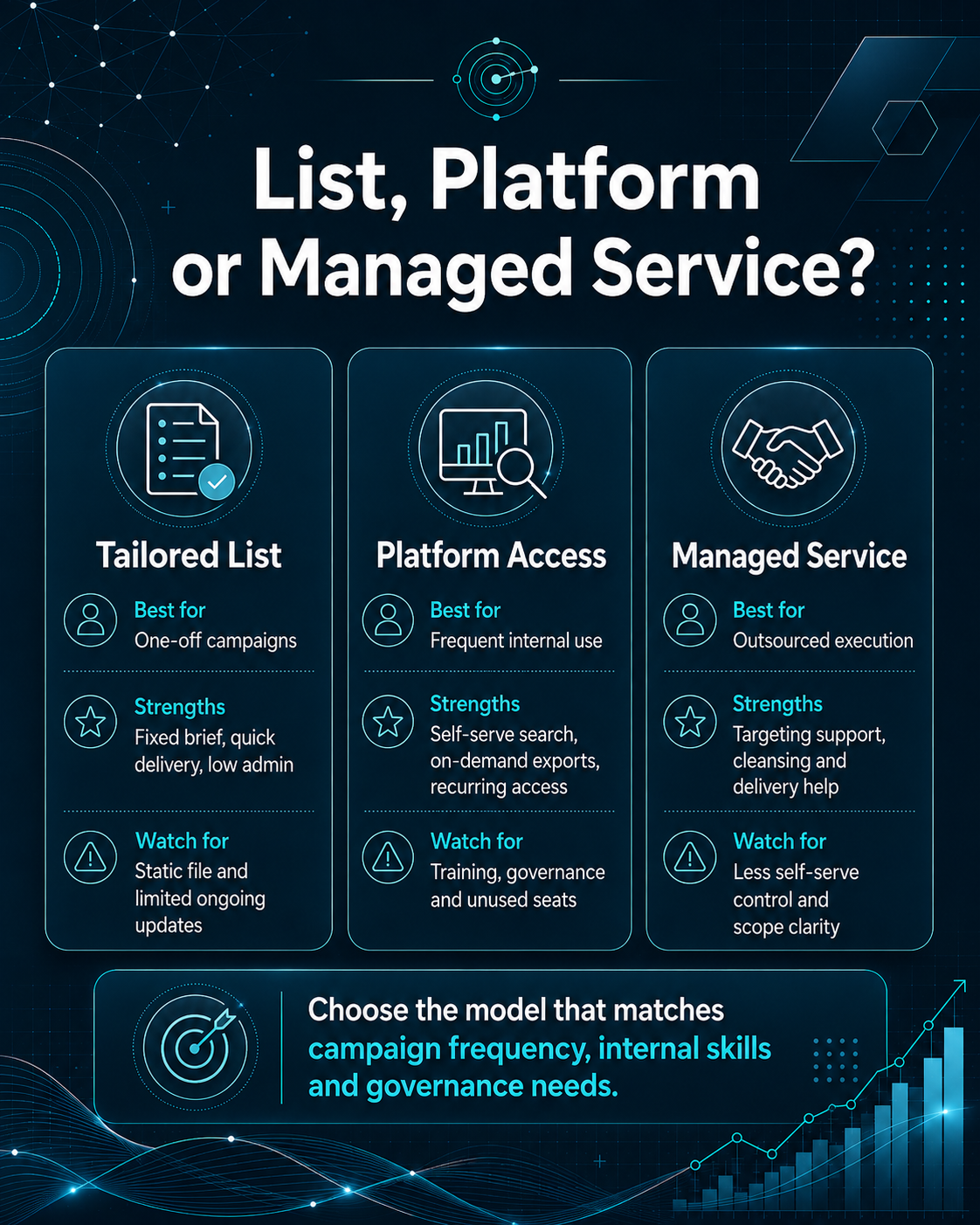
A list purchase gives the buyer a defined file based on an agreed brief. A platform gives users access to search and export records themselves. A managed service places more responsibility on the provider, which may help refine targeting, cleanse existing data, prepare the campaign file or deliver outreach. None is automatically superior. The best choice depends on internal skills, campaign frequency, governance requirements and how much control the buyer wants.
A small in-house sales team may prefer a tailored file because it avoids paying for unused platform access. A larger team running frequent campaigns may value a subscription or data feed. A business without email operations may prefer a supplier that can also handle campaign planning, creative and broadcast delivery. AccuraData’s Email Marketing Services combine data, copy, design, sending and reporting for organisations that want an outsourced workflow.
Company data and personal data can exist in the same record
A limited company name and registered office address may be public business information. A named person’s email address, direct telephone number or role can still be personal data. The provider and the buyer therefore need to understand which fields identify individuals, what lawful basis applies and what privacy information has been provided. Public availability does not remove UK GDPR obligations.
The ICO guidance on collecting information and generating leads explains that organisations must be transparent when using personal information for direct marketing, including where information is obtained from other sources or used for profiling. This is a central due diligence point for any buyer comparing B2B Data Providers UK.
Why the UK Business Data Market Changes Constantly
Business data is not a fixed asset. Companies are created, dissolved, renamed, relocated and reclassified. Employees change jobs, teams are reorganised and email domains are replaced. The ONS quarterly business demography figures recorded 71,935 business creations and 65,750 closures in the fourth quarter of 2025. These movements help explain why a dataset can deteriorate even if it was accurate when it was first assembled.
The implication is not that every record changes quickly. It is that providers need a maintenance process rather than a one-time collection exercise. A supplier should be able to explain how it detects company status changes, domain changes, role movements, invalid addresses, disconnected numbers, duplicate records and objections. The buyer should also understand whether validation happens before delivery, on a schedule, or only after a complaint or bounce.
B2B Data Providers UK may use different refresh models. Some rebuild datasets in batches. Some update selected fields continuously. Others verify a custom audience immediately before delivery. The buyer should ask which approach applies to the actual file being purchased. A generic statement such as “our data is updated regularly” does not reveal whether the records in the proposed campaign were reviewed last week or many months ago.
Accuracy must also be judged against purpose. The ICO accuracy principle requires personal information to be accurate and, where necessary, kept up to date. A registered office may be factually correct but unsuitable for a campaign aimed at site managers. A valid generic mailbox may be technically deliverable but poorly matched to a senior decision-maker campaign. Quality is therefore a combination of correctness, recency and fitness for use.
How B2B Data Providers UK Tend to Source Their Data
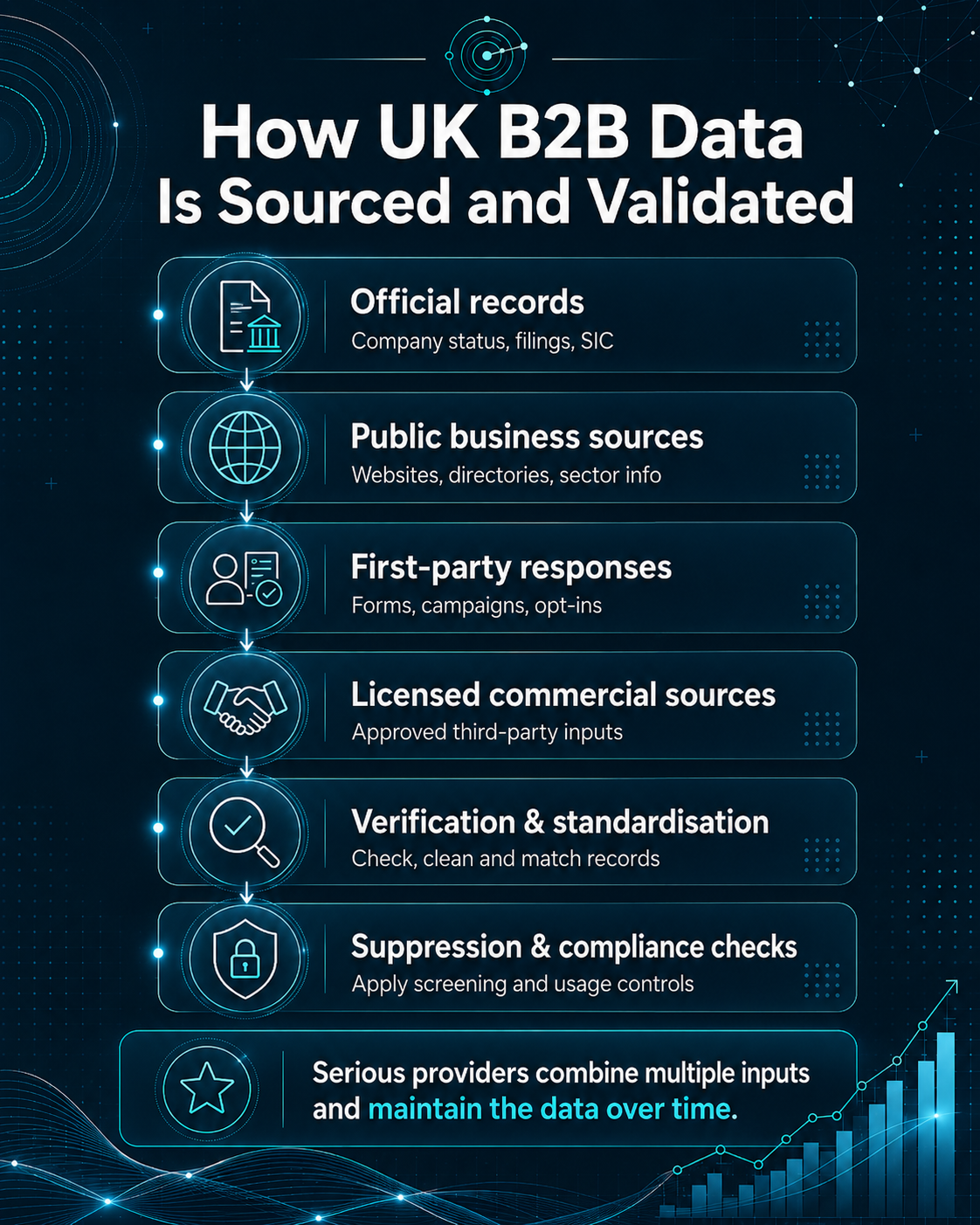
No serious provider should describe its sourcing process as a single database. Useful business data is normally assembled from multiple inputs. The provider’s value lies in combining, checking, standardising and maintaining those inputs in a way that produces a usable audience.
Public registers and official company records
Companies House is a common starting point because it provides authoritative company identifiers, registered office information, status, filing information and SIC classifications through its data products. Buyers should understand the limits of that source. Registered information is not the same as a verified marketing contact, and a SIC code may not perfectly describe the trading activity a sales team cares about. Companies can also use more than one SIC code, and Companies House has recently reminded businesses to keep their SIC information accurate.
Public registers can support company matching and status checks, but providers usually need further research to identify operational locations, current roles and usable contact channels. A good supplier should distinguish between fields taken from an official register, fields derived from other licensed sources and fields verified through its own process.
Company websites and other public business sources
Websites, professional profiles, trade directories and sector publications can help confirm trading activity, office locations, departmental structures and named roles. This research can improve accuracy, but it still needs governance. The buyer should ask whether collection is manual or automated, how often pages are revisited, how conflicting information is resolved and what privacy information supports the use of named personal data.
The ICO data broker guidance specifically recommends asking where data was obtained, who compiled it, what people were told and when it was collected. These questions apply even where a supplier describes the source as public.
First-party collection and campaign responses
Providers may collect information through their own forms, surveys, events, campaign responses or customer interactions. This can be valuable because the collection context may be known. The buyer must still examine the privacy wording, purpose, channel permissions and whether onward sharing was made clear. First-party collection does not automatically mean the data can be sold or used for every form of marketing.
When a supplier relies on consent, ask for evidence that the consent was specific enough for the proposed buyer, purpose and channel. When legitimate interests is used, ask for the relevant assessment and transparency arrangements. The ICO legitimate interests guidance explains that direct marketing objections are absolute, so suppression handling is essential.
Licensed datasets and commercial data partners
Many providers license information from specialist sources. This may include address reference data, telephone information, firmographics, sector data, professional research or consented lead sources. A layered supply chain can improve coverage, but it can also make accountability harder. Buyers should request a clear source map rather than accepting “trusted partners” as the full answer.
A source map does not need to reveal commercially sensitive algorithms. It should explain the source categories, the legal role of each party, the main validation steps, the collection dates, the intended uses and whether information leaves the UK. If a provider cannot explain its upstream supply chain, the buyer cannot complete meaningful due diligence.
Address, telephone and channel-specific reference services
Postal data can be standardised against Royal Mail’s Postcode Address File. Royal Mail describes PAF as a current UK address database and says its delivery network contributes thousands of updates each day through its address capture service. Telephone campaigns need screening against the relevant preference registers. The Telephone Preference Service is the official UK do-not-call register for landline and mobile numbers, while corporate calling also requires attention to CTPS and internal suppression records.
A provider offering several channels should not apply one quality process to every field. Email validation, live-number testing, address standardisation and suppression screening are distinct activities. AccuraData offers TPS and CTPS checking, live number cleansing and wider data hygiene support alongside its list services.
The Main Types of B2B Data Provider
The phrase B2B Data Providers UK covers several business models. Understanding the model helps the buyer ask the right questions and avoid comparing unlike services.
Bespoke list builders
A bespoke provider creates a file from a campaign brief. The buyer specifies industries, locations, company sizes, roles and channels, and the provider returns a count and quotation. This model can be efficient when the target market is clear and the campaign has a defined start date. The main quality questions are how the audience was selected, how each field was validated, whether exclusions were applied and what support is included after delivery.
AccuraData’s B2B Email Data and B2B Postal Data services follow a tailored approach, with audience criteria matched to the proposed activity rather than requiring the buyer to search a generic platform alone.
Self-service databases and subscription platforms
Platforms allow users to filter and export data directly. They can be useful for organisations with ongoing requirements and experienced operations teams. The buyer should test how credits work, whether exported records are refreshed, what happens when a record is wrong and whether the platform provides UK-specific compliance documentation.
A large platform is not necessarily a better fit. It may provide broad international coverage while offering less depth in a narrow UK sector. The relevant question is not database size. It is how much usable coverage exists for the exact audience and fields required.
Data-as-a-service and recurring feeds
Some businesses need a regular update rather than a single file. A data feed may add new companies, refresh existing records, append missing fields or flag status changes. This can work well for CRM-driven teams, account-based marketing and territory planning. It also creates more integration and security questions, including access controls, transfer methods, deletion terms and responsibility for changes.
The buyer should agree a data dictionary, update schedule, matching logic, rejection rules and audit trail. Without these controls, a feed can overwrite better internal data with weaker supplier data.
Managed campaign and outsourced outreach providers
A managed provider may source the audience and run the campaign. This can reduce hand-offs, but it does not transfer all legal responsibility away from the client. The ICO’s electronic mail guidance explains that an organisation asking another party to send its marketing can remain responsible, and appropriate checks and written contracts are required.
Managed delivery should therefore be assessed on both campaign capability and data governance. Ask who is the controller, who is the processor, which systems are used, where data is hosted, how unsubscribes are returned and how long files are retained.
Cleansing, enrichment and appending specialists
Some providers work mainly with the buyer’s existing database. They may remove duplicates, validate contact fields, standardise formatting, append company data, find missing contacts or apply suppression files. AccuraData’s Data Cleansing and Enrichment service is designed to improve accuracy, remove duplicate records and prepare databases for campaign use, while Data Appending fills gaps and adds useful profiling fields.
These services can be more valuable than buying a new list when the organisation already has strong customer or prospect relationships but poor record completeness. The supplier must still explain match rates, confidence thresholds, overwrite rules and the origin of appended information.
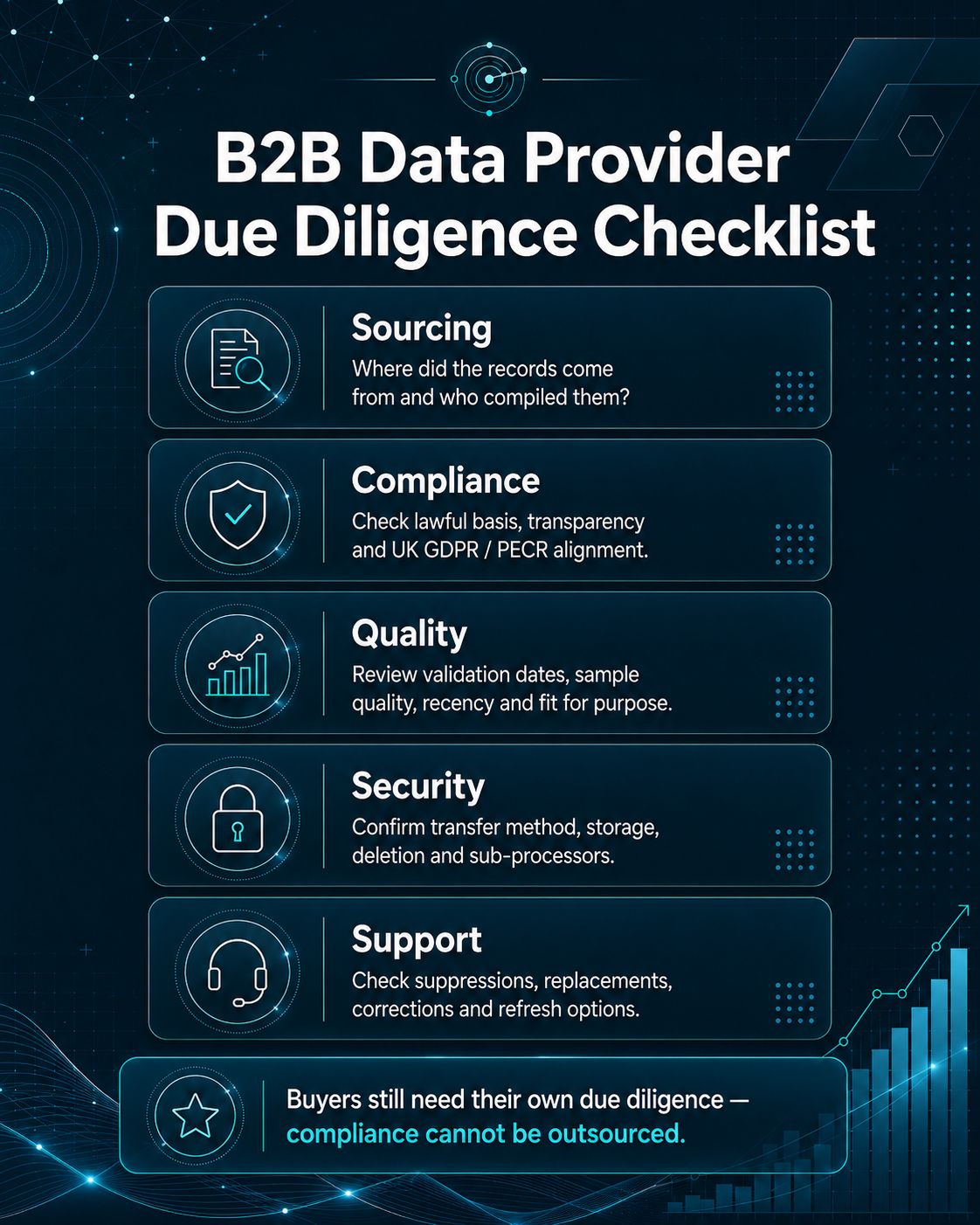
A Due Diligence Framework for B2B Data Providers UK
Supplier due diligence should be documented before any personal information is purchased or shared. The process should be proportionate to the volume, sensitivity, channels and risks involved. It should also be practical enough that marketing, sales, procurement, legal and information security teams can use the outcome.
A useful framework has five parts: legal and regulatory checks, sourcing and transparency, data quality, security and delivery, and service capability. Each part should produce evidence rather than a simple yes or no.
Check the legal entity and ICO registration
Confirm the supplier’s legal name, registered address, company status and trading names. Use the Companies House search service and the ICO fee-payer register. An ICO registration is a useful basic check, but it is not proof that every dataset or process is compliant. Some organisations may also be exempt from paying the fee, so the result needs context.
Ask for the supplier’s privacy notice, data protection contact, relevant policies and standard contractual terms. Check whether the entity named in the contract is the same entity that controls or supplies the data.
Ask B2B Data Providers UK to explain the sourcing chain
The ICO says buyers should establish who compiled the data, where it came from, what privacy information was provided and how old the data is. Put these questions in writing. Request answers for the proposed dataset, not only for the supplier’s business generally.
The response should identify source categories, collection dates, onward sharing arrangements, lawful bases and validation methods. If consent is claimed, request evidence of the wording and collection mechanism. If legitimate interests is claimed, request the relevant assessment or a clear summary of the reasoning.
Confirm the permitted purpose and channels
A dataset can be suitable for one channel but unsuitable for another. Telephone, email and postal marketing have different rules and suppression requirements. The buyer should ask the provider to state the permitted channels, any restrictions, the intended recipient type and the campaign purpose.
For email, corporate subscribers can receive unsolicited electronic marketing without consent under PECR, but the sender must identify itself and provide a valid opt-out address. Individual subscribers, including many sole traders and some partnerships, have stronger consent or soft opt-in requirements. The ICO PECR guidance explains these subscriber distinctions and confirms that a third-party list cannot rely on the soft opt-in.
Review controller, processor and data-sharing roles
A data supplier may be an independent controller when it decides why and how it compiles and sells data. It may act as a processor for cleansing work carried out only on the buyer’s instructions. Some arrangements involve separate controllers sharing information. Labels in a contract do not determine the legal role by themselves.
The ICO controller and processor guidance helps organisations distinguish these roles. If a processor relationship exists, the contract needs the required terms and sufficient guarantees. If two controllers share a list, the agreement should cover responsibilities, transparency, rights handling and secure transfer.
Review security and transfer arrangements
Marketing data may contain thousands of named contacts, so file delivery deserves more than an emailed attachment. Ask how the supplier encrypts data in transit, controls access, authenticates users, retains files and deletes copies. The NCSC supplier assurance questions provide a useful structure for examining network protection, cloud configuration, privileged access and user authentication.
Also ask where information is stored and whether any suppliers or cloud services outside the UK are involved. Restricted transfers may require adequacy arrangements or safeguards under the ICO international transfer guidance.
Check incident and complaint handling
A provider should have a clear process for errors, objections, complaints and security incidents. Ask who receives complaints, how quickly suppression records are updated, how downstream clients are notified and whether the supplier can identify the source of a disputed record.
The Data (Use and Access) Act 2025 amended rather than replaced UK GDPR, the Data Protection Act and PECR. The ICO confirmed that all data protection provisions were in force by 19 June 2026 in its DUAA guidance. Buyers should therefore make sure supplier policies and complaint processes reflect the current framework, not an old GDPR template left unchanged for years.
How to Test Data Quality Before You Buy
Due diligence documents tell you whether a process appears credible. A sample tells you how that process performs on the audience you actually want. Both are necessary.
Request a representative sample
The sample should reflect the proposed sectors, company sizes, locations, roles and fields. A supplier should not provide only its easiest or most popular records if the final brief includes difficult niches. Agree that the sample is for quality assessment and handle it under appropriate terms.
Check whether company names match current trading entities, whether websites and domains are active, whether roles are plausible, whether addresses suit the campaign and whether the contact type matches the brief. If the campaign targets operational sites, do not treat a registered office as an automatic pass.
Measure field completeness and match quality
A useful test records the percentage of rows containing each required field. Completeness should be calculated separately for email, telephone, postal, job title, department, company size and any other critical attribute. A dataset with 95 percent company names but 40 percent decision-maker roles may be unsuitable for a named-contact campaign.
Match quality is different from completeness. A job title can be present but irrelevant. Review a sample manually and classify each record as a strong match, possible match or poor match. The provider should agree how disputed records will be handled.
Test duplicates and internal conflicts
Check duplicates within the sample and against your CRM. Define whether duplicate means an identical email, the same person, the same company or the same site. A list can contain several legitimate contacts at one company, so deduplication rules should support the campaign rather than remove useful buying-committee coverage.
Look for internal conflicts such as a contact whose email domain does not match the company, a company status that conflicts with Companies House, or a role that appears inconsistent with the website. These conflicts do not always mean a record is wrong, but they require investigation.
Validate by channel
Email testing should include syntax, domain and mailbox checks where appropriate, but buyers should not confuse a technically accepting mailbox with a current and relevant contact. Telephone testing should consider number format, live status, directness and preference screening. Postal testing should consider address standardisation, deliverability and whether the location matches the intended audience.
AccuraData’s Business Email Lists are designed around campaign targeting, while its B2B Postal Data can support sector, geographic and company-size selection. Buyers using telephone data can combine supply with TPS and CTPS checking.
Agree an acceptance threshold
Before purchasing, document the minimum acceptable results. These might cover field completeness, role match, company match, duplicate rate, suppression status and validation date. The threshold should reflect the difficulty of the target. A very narrow specialist audience may justify more manual review, but not vague quality promises.
Agree what happens when the file fails. Options include replacing rejected records, reducing the invoice, rerunning the selection or cancelling the delivery. Quality disputes are easier to resolve when the acceptance method is agreed before money and data change hands.
UK GDPR Requirements When Buying Business Data
B2B marketing is not outside data protection law. A record that identifies a person is personal information even when it is used in a professional context. The buyer needs a lawful basis, fairness, transparency, data minimisation, accuracy, security and appropriate retention.
Establish a lawful basis before acquisition
The buyer should identify the lawful basis before requesting the file. Legitimate interests is often considered for relevant B2B marketing, but it requires a genuine purpose, necessity and balancing assessment. The ICO legitimate interests guidance also emphasises the absolute right to object to direct marketing.
A provider’s assessment does not replace the buyer’s own analysis. The buyer determines its offer, audience, message, channel, frequency and impact. Those facts affect whether the processing is proportionate.
Provide privacy information
Where information comes from another source, the buyer must consider when and how to provide the required privacy information. The notice should identify the organisation, purposes, lawful basis, categories of data, source, recipients, retention and rights. It should be concise enough to be understood and accessible from the campaign.
A supplier should be able to explain what transparency it provided when collecting or compiling the data. The buyer should not assume that linking to its own general privacy policy solves gaps in the original sourcing chain.
Use only the fields that are necessary
Buying extra fields “just in case” can increase cost and risk. The ICO data minimisation principle requires personal information to be adequate, relevant and limited to what is necessary. The procurement brief should therefore distinguish required, useful and unnecessary fields.
For example, a campaign aimed at facilities directors may need company, role, location and contact channel. It may not need unrelated personal attributes. Better segmentation should come from relevant business context, not excessive collection.
Maintain accuracy after delivery
The buyer becomes responsible for what happens to the file after receipt. Bounces, objections, corrections and role changes should be recorded. A one-time validation is not a permanent warranty. AccuraData’s Data Cleansing and Enrichment and Data Appending services can help organisations maintain and improve existing records between campaigns.
Keep a suppression list
Deletion is not always the correct response to an objection. A limited suppression record may be needed to make sure the person is not re-added from another source. The suppression file should be protected, used only for that purpose and applied to future acquisitions.
Ask each supplier whether it can suppress your internal do-not-contact records before delivery. This reduces unnecessary processing and avoids paying for contacts the organisation cannot use.
PECR and Channel-Specific Checks
PECR sits alongside UK GDPR and applies differently depending on the communication method and subscriber type. B2B Data Providers UK should be able to discuss these differences without giving the impression that one label such as “GDPR compliant” covers every campaign.
B2B email data
The ICO states that unsolicited electronic mail can be sent to corporate subscribers without consent or a soft opt-in, provided the sender does not hide its identity and includes a valid way to opt out. Individual subscribers require consent or a valid soft opt-in. The distinction matters because sole traders and some partnerships can be treated differently from limited companies.
Bought-in lists cannot use the soft opt-in because the buyer did not collect the details directly. A provider should therefore classify the audience accurately and explain the basis for any individual-subscriber records. AccuraData’s article on responsible business email sourcing provides additional practical context for B2B email campaigns.
B2B telephone data
Live marketing calls require checks against TPS, CTPS and the organisation’s own suppression file where relevant. The seller should state when screening took place and the buyer should consider rescreening close to the calling date. A number can be live but unsuitable because of a preference registration or prior objection.
AccuraData’s Telemarketing List guide explains how targeting, suppression and list quality affect responsible calling. Its data services can also combine telephone records with live-number validation and compliance screening.
B2B postal data
Postal marketing does not follow the same PECR consent rules as electronic mail, but UK GDPR still applies where personal information is used. Buyers need a lawful basis, transparency, relevant targeting and a process for objections. Address quality also affects cost because print and postage are spent before the campaign response is known.
The Direct Mailing Lists guide discusses how B2B and B2C postal audiences differ. AccuraData’s B2B postal service can support national, local and sector-specific business mailing lists.
Support Services Offered by B2B Data Providers UK
The best provider is not always the one with the largest raw database. It may be the one that helps the buyer turn an audience definition into a controlled campaign. Support services can reduce internal workload and improve governance when they are clearly scoped.
Audience planning and count validation
A provider should challenge an unrealistic brief. If the requested sector, role and company size produce very few records, it should explain the limitation rather than padding the count with weak matches. A good count process separates exact matches from broader alternatives and shows which filters reduce the audience most.
AccuraData invites buyers to define an ideal customer and request tailored counts through its B2B Data service. This consultative step can make the supplier easier to work with because questions about scope are resolved before file delivery.
Data cleansing and deduplication
Cleansing can remove malformed records, duplicates and obsolete fields while standardising the structure. Ask what changes will be made automatically, what will be flagged for review and whether original values are preserved. The output should include a clear report rather than a mysterious “clean” label.
Data appending and enrichment
Appending can add missing company attributes, contact details or segmentation fields. The supplier should explain match keys, confidence levels and sources. Low-confidence matches should not silently overwrite stronger first-party information.
AccuraData’s Data Appending service supports CRM completeness, segmentation and customer insight across B2B and B2C records.
Suppression and preference screening
Providers may screen telephone records against TPS and CTPS, apply internal do-not-contact files or remove duplicates across several campaigns. The buyer should provide suppression files securely and agree what happens to them after matching.
Email validation and deliverability preparation
Validation can reduce obvious delivery failures, but the buyer also needs sound sender authentication, sensible volume, relevant content and prompt bounce handling. A provider offering managed email activity should explain its sending infrastructure, authentication process, unsubscribe handling and reporting.
AccuraData’s Email Marketing Services can support data, design, copy, delivery and reporting as a connected workflow.
Postal preparation and address quality
A postal provider may standardise addresses, apply PAF-based checks, deduplicate households or sites, and prepare print-ready fields. Buyers using consumer audiences can explore AccuraData’s B2C Postal Data, while companies operating across both markets can use the wider B2C Data service alongside B2B datasets.
Ongoing maintenance and refreshes
Recurring campaigns need a refresh policy. Ask whether the supplier can update delivered records, replace invalid contacts, append new decision-makers or rescreen telephone numbers. The agreement should state whether maintenance is included, charged per record or handled through a new order.
Managed campaign support
A provider may also run email, calling or direct mail operations. This can make reporting more coherent because audience selection and campaign feedback sit together. The contract should ensure that responses, opt-outs, corrections and outcomes are returned to the buyer’s systems.
Security Questions for a Data Supplier
Data quality and information security are related. A perfectly targeted file still creates risk if it is sent insecurely or retained without controls. Buyers should use a short security questionnaire proportionate to the dataset.
Ask how files are transferred, whether encryption is used, who can access the data, how privileged accounts are controlled and how access is removed when staff leave. The NCSC supply chain guidance recommends maintaining oversight of supplier risk rather than treating security as a one-time procurement check.
Ask about cloud hosting, sub-processors, backups, incident notification, retention and deletion. If a secure portal is used, test multi-factor authentication and download controls. If an API is used, assess authentication, logging, rate limits and revocation.
Security claims should be supported by evidence. This could include Cyber Essentials, independent testing, policy documents or answers to the NCSC supplier assurance questions. Certification is not a substitute for understanding the service, but it can support the assessment.
Pricing B2B Data Providers UK by Total Cost, Not Record Count
Price per record is easy to compare and easy to misuse. The cheapest file may create costs through invalid fields, manual correction, poor targeting, complaints and wasted sales time. A more useful calculation includes the cost of usable matches, internal processing and campaign outcomes.
Start by estimating the number of records that pass all required checks. If a file contains 10,000 rows but only 6,000 match the role, company and channel criteria, the effective cost is based on 6,000 usable records. Add the cost of validation, deduplication, suppression and sales review.
Pricing models can include per-record charges, minimum orders, subscription credits, managed service fees, refresh charges and replacement guarantees. Ask whether email, telephone and postal fields are priced separately and whether the invoice changes if the final count is lower than the estimate.
The buyer should also value support. A provider that helps refine the brief, prepares a clear report and resolves rejected records may cost more than a self-service export but require less internal work. AccuraData positions its service around tailored counts, flexible segmentation and wider support rather than treating every campaign as a standard download.
Common Red Flags When Comparing B2B Data Providers UK
A red flag does not always prove that a supplier is unsuitable, but it should trigger more questions.
Unclear sourcing: The supplier uses phrases such as “proprietary data” without explaining source categories, collection dates or onward sharing.
Compliance by slogan: The sales material says “GDPR compliant” but the supplier cannot explain the lawful basis, transparency, subscriber type or channel restrictions.
No representative sample: The provider refuses a controlled quality test or provides a sample unrelated to the proposed audience.
Volume without methodology: Very large counts are offered immediately, before the supplier has clarified the sector, role, company size, geography or exclusions.
No suppression workflow: The provider cannot accept an internal do-not-contact file or explain how objections are prevented from reappearing.
Weak security: Files are sent as unprotected attachments, accounts are shared, or the provider cannot explain retention and deletion.
Inflexible support: The supplier treats inaccurate records as the buyer’s problem and provides no replacement, review or escalation process.
Outdated legal wording: Contracts and privacy notices refer only to pre-2026 guidance and do not reflect the current UK GDPR, PECR and DUAA landscape.
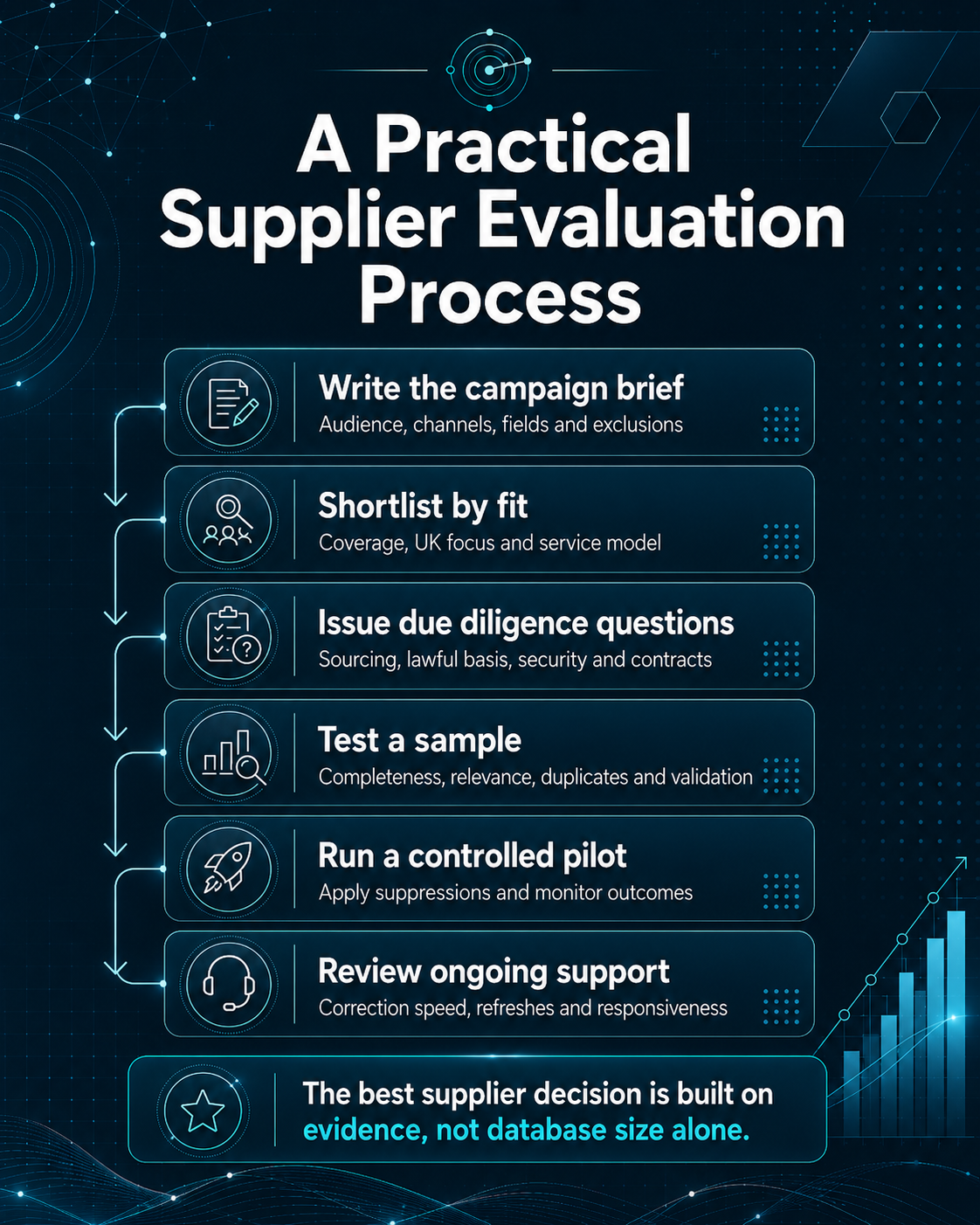
A Practical Supplier Evaluation Process
A structured process reduces the chance that enthusiasm for a large count overrides quality concerns.
Write the campaign brief
Define the audience, purpose, channels, fields, exclusions, delivery date, internal systems and success measure. Identify whether sole traders, partnerships or consumers could be included.
Shortlist providers by fit
Compare sector coverage, UK focus, service model and support capabilities. Do not ask every provider for the same generic count if their products solve different problems.
Issue a due diligence questionnaire
Cover sourcing, lawful basis, transparency, data dates, validation, suppression, security, sub-processors, transfers, contracts, complaints and deletion. Ask for evidence.
Test a sample
Use the acceptance method described earlier. Record field completeness, audience match, duplicates, conflicts and channel validity. Share disputed examples with the supplier and assess the quality of the response.
Run a controlled pilot
A pilot can show whether the audience and messaging fit. Keep the first campaign proportionate, apply suppression lists, monitor bounces or connection outcomes and log objections. Do not treat response rate as a pure data metric because offer, creative, timing and sender reputation also matter.
Review the supplier relationship
After delivery, score responsiveness, documentation, correction speed and support. The NCSC recommends ongoing supplier oversight rather than a one-off security check. The same principle applies to data quality and compliance.
How AccuraData Fits the UK Provider Landscape
AccuraData combines targeted B2B list supply with services that help buyers improve, maintain and use data. Its B2B Data solutions cover email, telephone, postal and multi-channel activity, with filters such as industry, location, company size, turnover, employee count, job title and SIC code.
This breadth matters because many buyers do not have a pure acquisition problem. They may have an existing CRM with duplicates, missing fields and old contacts. AccuraData can support these cases through Data Cleansing and Enrichment and Data Appending, allowing a business to improve its own records as well as acquire new ones.
For email campaigns, AccuraData provides tailored B2B Email Data and can support outsourced campaign delivery. For postal activity, it offers B2B Postal Data and consumer mailing audiences through B2C Postal Data. For telephone activity, its wider data-quality services include preference screening and live-number cleansing.
The practical advantage is a single point of contact for audience definition, list supply, cleansing, enrichment and campaign support. This can make AccuraData easier to work with than a provider that offers only self-service exports, particularly where a buyer wants help translating an ideal customer profile into a deliverable audience.
Reliability should still be tested through the same due diligence process used for any supplier. AccuraData’s service pages provide clear descriptions of targeting, maintenance and related support, and the team can provide a tailored count or proposal. A buyer can therefore assess the proposed dataset rather than relying on a broad database-size claim.
Questions to Ask B2B Data Providers UK Before Signing a Contract
The following questions should produce practical evidence rather than rehearsed sales answers:
- Who compiled the proposed records, and what source categories were used?
- What were individuals told about the use and sharing of their information?
- What lawful basis applies to each relevant processing activity?
- When were the records and each contact channel last validated?
- How do you distinguish corporate subscribers from individual subscribers?
- What filters, exclusions and segmentation fields are available?
- Can you apply our internal suppression file before delivery?
- How are inaccurate records, disputes and objections handled?
- What replacement or acceptance policy applies?
- How is the file transferred, stored and deleted?
- Which sub-processors and overseas services are involved?
- What cleansing, appending, refresh and campaign services are available after purchase?
The quality of the discussion is itself evidence. A reliable provider should welcome precise questions because a well-defined brief reduces problems for both parties.
Frequently Asked Questions About B2B Data Providers UK
What do B2B Data Providers UK normally sell?
They may sell tailored lists, platform access, recurring data feeds, CRM enrichment or managed campaign services. Typical fields include company information, industry, size, location, named contacts, roles, email addresses, telephone numbers and postal details. The exact product should be defined in a data dictionary and campaign brief.
Are B2B Data Providers UK allowed to sell named business contacts?
Named business information can be personal data, so the provider and buyer need a lawful basis, fairness, transparency, accuracy, security and rights handling. The ICO makes clear that buying or using brokered data does not remove the client’s responsibility. The legality depends on the source, purpose, channel and circumstances, not simply the fact that the information relates to work.
Is Companies House enough to build a complete B2B list?
Companies House provides valuable official company information, including registered office details, SIC codes, status and filing dates. It does not provide every current marketing contact, direct telephone number or verified email address needed for a campaign. Providers often use it as one source within a wider verification process.
How should I compare samples from different providers?
Use the same target brief and scoring method. Measure required-field completeness, company match, role relevance, duplicates, internal conflicts, validation dates and channel suitability. Do not compare only the number of rows.
Does an ICO registration prove a provider is compliant?
No. The register is a useful basic check, but it does not certify a dataset or every processing activity. Buyers still need to examine sourcing, privacy information, lawful basis, security and contracts.
How often should purchased B2B data be refreshed?
There is no universal interval that suits every field and campaign. Refresh timing should reflect the audience, channel, campaign duration and observed changes. Telephone preference screening may need to happen close to use, while a static postal campaign may need a different schedule. Track bounces, returns, role changes, objections and invalid records to set an evidence-based refresh cycle.
Can B2B Data Providers UK supply data for several channels?
Many can, but buyers should confirm that each field has been validated and screened for its intended channel. A valid email process does not prove telephone or postal quality. AccuraData provides multi-channel B2B data and related cleansing services across email, telephone and post.
Should I buy a list or cleanse my existing CRM?
If the organisation already has relevant relationships but incomplete or outdated records, cleansing and enrichment may produce more value than replacing the database. If coverage is missing in a new market, acquisition may be appropriate. Many projects use both approaches: cleanse first, suppress existing contacts and then purchase only the genuine gap.
What makes a provider easy to work with?
Clear counts, transparent assumptions, realistic timelines, secure delivery, usable documentation and responsive correction handling matter more than a polished sales demonstration. A provider should help refine the brief and explain limitations instead of promising every record the buyer requests.
Choosing B2B Data Providers UK: Final Considerations
The best supplier decision is built on evidence. Start with a precise audience and purpose. Examine the sourcing chain and legal basis. Test a representative sample. Agree acceptance criteria, suppression and security. Then judge the wider service, including how the provider responds when data changes or a campaign needs support.
B2B Data Providers UK should not be ranked by database size alone. A smaller, transparent provider with strong UK coverage, tailored segmentation and practical support may be more valuable than a global platform that leaves the buyer to solve quality and compliance problems alone.
AccuraData is well placed for organisations that want a straightforward working relationship across data acquisition, cleansing, enrichment and campaign support. Its service range covers targeted B2B Data, B2B Email Data, B2B Postal Data, B2C Data, B2C Postal Data, cleansing and appending. This makes it possible to build a supplier relationship around the real campaign requirement rather than a single file transaction.
The final test is simple: can the provider explain what the data is, where it came from, why it can be used, how it was checked and what support is available when it changes? A clear answer to those questions is the foundation of a reliable B2B data partnership.