

A Direct Mail List does not stay accurate simply because it was accurate on the day it was purchased or exported from a CRM. Addresses change, people move, organisations relocate, businesses dissolve, named contacts leave, households ask not to receive marketing, and duplicate records appear as teams combine data from different systems. Royal Mail describes data cleansing as a way to remove goneaways and duplicates, while its Postcode Address File is updated continually to reflect changes in deliverable UK addresses. These changes mean that postal data maintenance is an operating process, not a one-off procurement step. Royal Mail data cleansing and address capture guidance both support that conclusion.
The commercial consequences are unusually visible in postal marketing. An invalid email may create a bounce, and a wrong telephone number may waste a call attempt, but an inaccurate postal record can consume print, personalisation, envelope, fulfilment and postage costs before the problem becomes apparent. It can also distort response analysis because the business may count a record as a non-responder when the intended recipient never received the item. Royal Mail explicitly links inaccurate data with wasted time, money and customers, while its cleansing services are designed to identify movers, deceased records, goneaways and address-quality problems. Royal Mail’s data-quality guidance explains why cleansing is both a cost-control and campaign-performance activity.
This article explains how to maintain a Direct Mail List after procurement, how to recognise degradation, how B2B and B2C postal records differ, which tools are used during cleansing, what a cleansing project normally involves and how long it may take. It also explains how to use the cleaned file effectively and how AccuraData can support both new list supply and ongoing database maintenance through B2B Postal Data, B2C Postal Data, data cleansing and enrichment and data appending.
This is practical marketing information rather than legal advice. The correct approach depends on the source of the data, the audience, the campaign purpose, the type of personal information involved and the expectations of the people being contacted. The Information Commissioner’s Office says organisations must choose an appropriate lawful basis for direct marketing and keep personal information accurate where necessary. ICO direct marketing planning and the accuracy principle should therefore sit behind any maintenance policy.
Why a Direct Mail List Starts Degrading Immediately
A new or freshly cleansed Direct Mail List is a snapshot. It records what a supplier, customer or internal system knew at a particular point. The snapshot begins ageing as soon as circumstances change. The process is continuous rather than dramatic. One customer moves, one company changes premises, one business ceases trading, one record is duplicated during an import, and one recipient objects to further marketing. The list may still look complete because every row contains a name and postcode, but completeness is not the same as current accuracy.
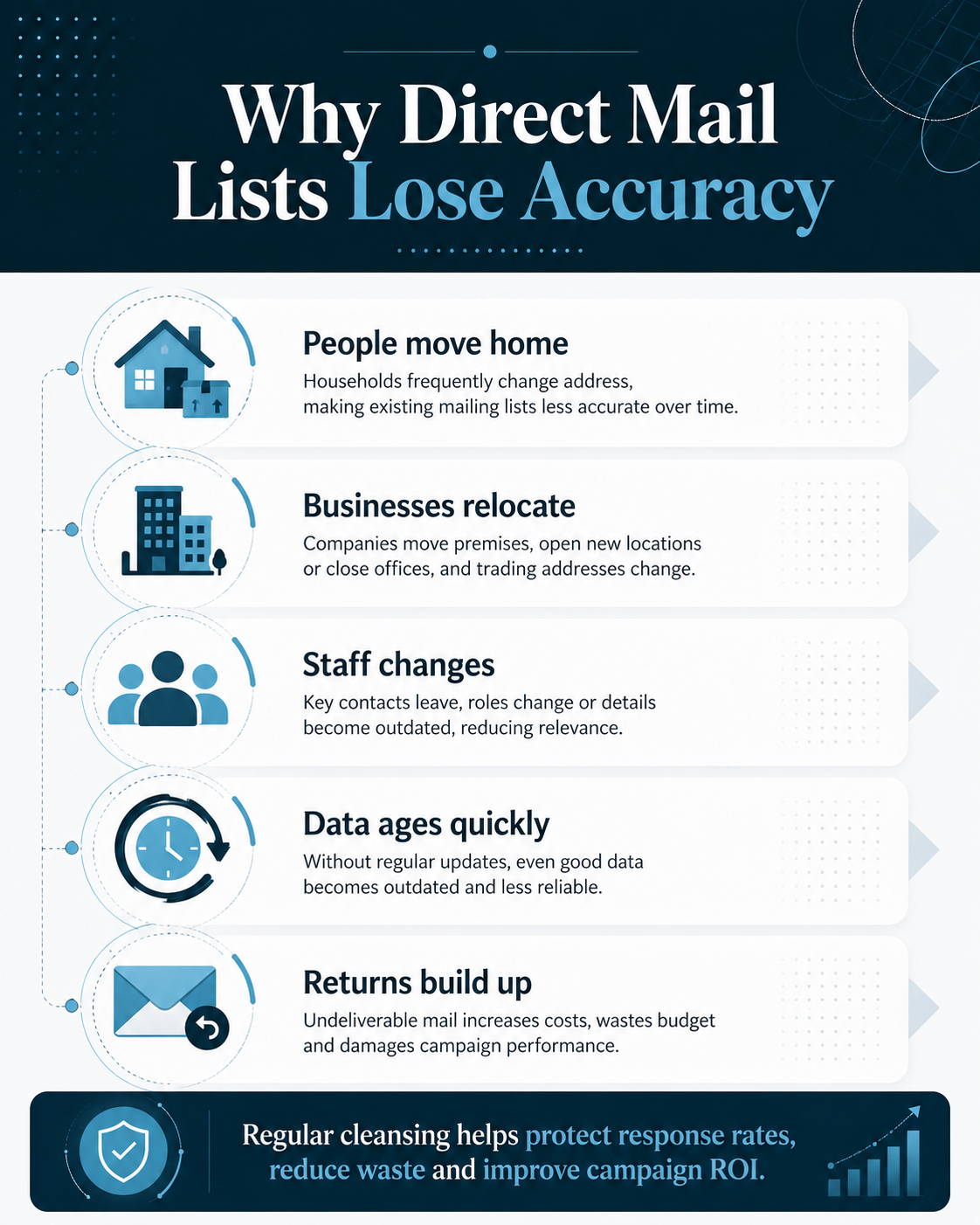
There is no single honest degradation percentage that applies to every list. A consumer list dominated by private renters and students may change faster than a list of long-term homeowners. A B2B list of small local companies may age differently from a list of public-sector sites or established manufacturers. The Office for National Statistics found that 21.5% of people living in private rented homes had a different UK address a year before Census 2021, while 25.6% of full-time students had moved address within the same period. These figures do not describe every marketing database, but they show why audience composition matters when estimating decay. ONS address-change analysis provides the underlying evidence.
For B2B data, the change is often less visible because a registered office may remain valid while the trading site, department or named contact has changed. Companies House provides current company status, registered office details, SIC information and current or resigned officers, but it warns that its public service is not intended to be a complete source and cannot accept responsibility for errors or omissions. This means public records are useful checks, not a substitute for campaign-ready validation. Companies House search guidance and its service disclaimer make that distinction clear.
Direct Mail List degradation should be measured, not guessed
The best way to understand degradation is to create an internal rate from your own data. Track the proportion of records that fail PAF matching, match to mover files, appear on suppression files, are identified as deceased, are returned as gone away, are duplicated, relate to dissolved businesses or contain unusable formatting. These findings can be calculated by source, acquisition month, customer type and campaign segment. A supplier may describe a list as recently updated, but your own campaign evidence will show how that source behaves over time.
A useful dashboard might report that a particular acquisition file produced a 3% address-standardisation failure, a 2% mover match, a 1% internal suppression match and a 4% duplicate rate when combined with existing CRM records. Those figures are not universal benchmarks. They are a quality profile for that file and that business. Royal Mail’s free data audit is designed around similar categories, including address quality, movers with new addresses and deceased records. Royal Mail cleansing audits provide a practical model for how to report quality.
This approach also improves supplier management. Instead of asking a vendor for a vague assurance that the data is fresh, ask for the last validation date, the matching processes used, the suppression files applied, the expected replacement policy and the results of any sample audit. AccuraData’s direct mail data guidance describes address verification, NCOA, MPS and deceased suppression as part of preparing postal data for real campaigns.
What an Accurate Direct Mail List Should Contain
An accurate Direct Mail List is not only a set of correctly formatted addresses. It is a controlled file with enough information to identify the intended audience, explain why records were selected, apply exclusions, prepare personalisation and measure results. The exact fields vary, but the structure should support both delivery and governance.
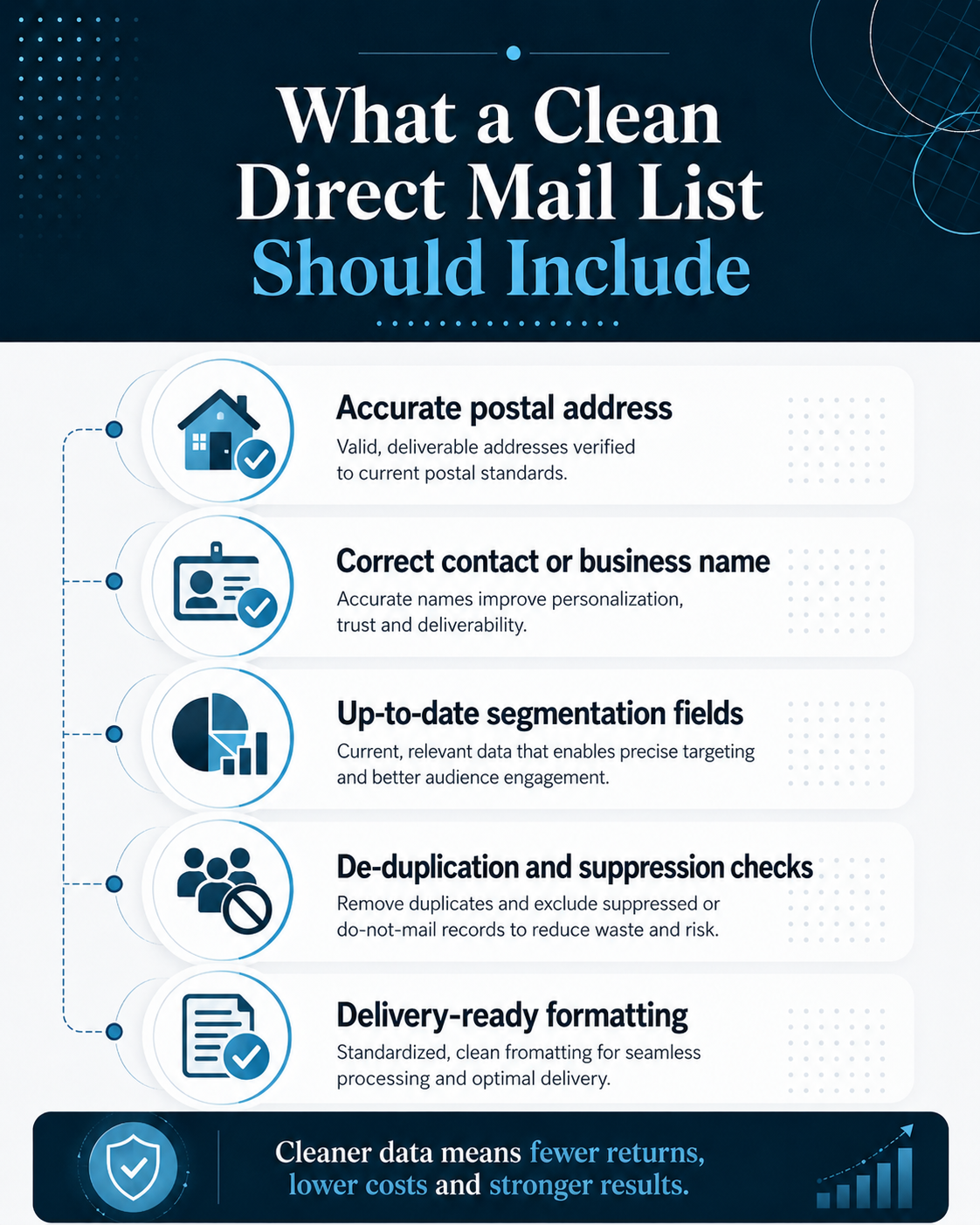
At minimum, a consumer postal record may include name, address lines, town, county where used, postcode, source, date acquired, last validation date, campaign eligibility, suppression status and a unique record identifier. A B2B record may add company name, trading or registered address type, company status, SIC code, employee or turnover band, site type, job role, department and named contact status. AccuraData’s B2B Postal Data and B2C Postal Data pages describe the different targeting criteria used for business and consumer audiences.
The unique identifier is more important than it first appears. Names and addresses can be reformatted, corrected or updated. A stable identifier allows the business to connect campaign history, opt-outs, returns and responses to the same logical record. Without it, a corrected spelling may create a second record rather than update the first, and an old suppressed version may re-enter the mailing pool.
The file should also distinguish between raw values and verified values. For example, keep the original customer-entered address for audit purposes, but use a standardised PAF-matched address for campaign production. Royal Mail says PAF is the UK’s most up-to-date address database and that delivery staff make thousands of updates each day. Royal Mail address capture explains why address validation should be part of normal data capture rather than an emergency fix before a mailing.
Essential governance fields for a Direct Mail List
Governance fields help the marketing team understand what it may do with each record. They may include source category, collection date, privacy-notice version, lawful-basis assessment, objection status, internal suppression reason, last contact date, last campaign, retention review date and data owner. The ICO says organisations need a lawful basis for direct marketing and must respect the absolute right to object. ICO lawful-basis guidance and the right to object support retaining enough suppression information to prevent accidental re-contact.
A suppression record should not normally be deleted simply because the person no longer wants marketing. The ICO notes that organisations may retain limited details on a suppression list so that the objection can be honoured in future. This is an example of data minimisation in practice: keep enough information to prevent contact, but not more than is necessary for that purpose. ICO suppression-list guidance explains this balance.
The Commercial Cost of an Unclean Direct Mail List
The most obvious cost of a poor Direct Mail List is wasted production. Every duplicate, goneaway or invalid address can consume paper, ink, envelope or packaging, personalisation time, fulfilment effort and postage. If an organisation sends a premium brochure or sample pack, the cost per failed record may be much higher than the postage alone.
Royal Mail states that cleansing can reduce waste by removing goneaways and duplicates. It also offers services that identify movers, new addresses and deceased records. Royal Mail data cleansing therefore supports a simple commercial principle: pay to clean before paying to print and post.
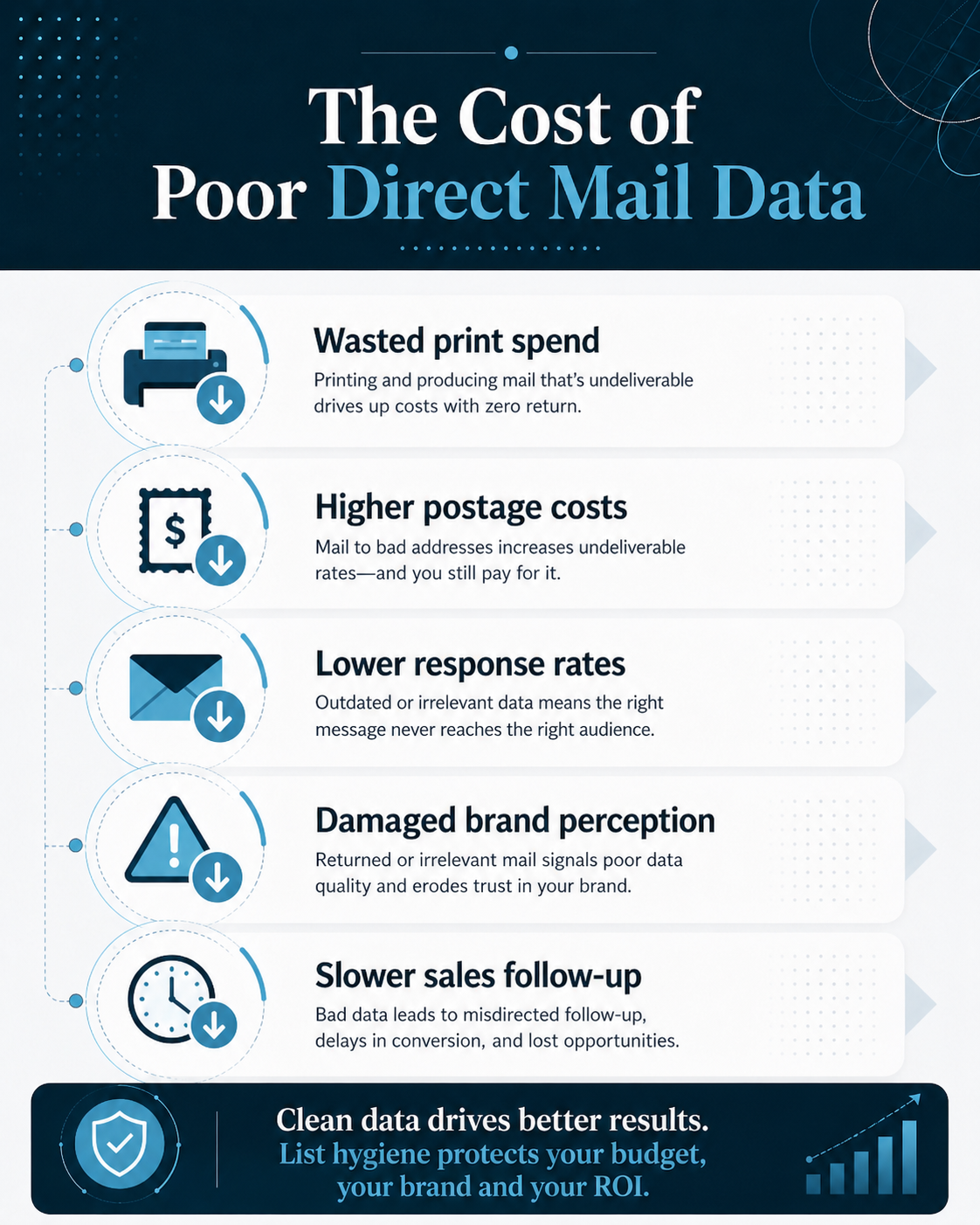
The second cost is distorted measurement. Suppose a campaign mails 20,000 records and receives 200 responses. The reported response rate is 1%. If 2,000 records were duplicate, undeliverable or sent to people who had moved, the campaign did not truly have 20,000 viable opportunities. It had closer to 18,000, and the valid-audience response rate was higher. Dirty data can make a good offer look weaker or hide the fact that one segment is performing well.
JICMAIL’s Response Rate Tracker provides benchmarks for response, return on investment, cost per acquisition and average order value across thousands of campaigns. These benchmarks are most useful when the campaign’s own denominator is credible. JICMAIL’s tracker shows why list quality and measurement discipline must work together.
A third cost is lost customer trust. Sending mail to a deceased person, a former occupier or a customer who has already objected can cause distress or frustration. This is not merely a brand issue. The ICO states that organisations must stop using personal information for direct marketing when a person objects. ICO objection guidance makes the requirement clear.
A fourth cost is operational friction. Returned mail has to be received, opened or scanned, interpreted and matched back to the CRM. If returned items are not processed promptly, the same address may be selected again. Royal Mail’s Mail Capture and Cleanse service is built around converting returns into data insights and removing goneaways from future activity. Mail Capture and Cleanse illustrates the value of closing the feedback loop.
A fifth cost is unnecessary environmental impact. Sending print to an invalid or duplicate address uses materials and transport without creating a genuine marketing opportunity. JICMAIL now includes sustainability metrics alongside campaign planning and response analysis, reinforcing the value of measuring waste as well as response. JICMAIL sustainability research offers current context.
UK GDPR Requirements for Direct Mail List Maintenance
Postal marketing is treated differently from electronic mail under the Privacy and Electronic Communications Regulations. The ICO explains that PECR’s marketing rules do not cover direct marketing by post, but UK GDPR still applies whenever personal data is processed. This is why postal marketing can sometimes be easier to plan than consumer email, but it is not outside data protection law. ICO direct marketing planning sets out the distinction.
The accuracy principle requires personal data to be accurate and, where necessary, kept up to date. Organisations must take reasonable steps to erase or rectify inaccurate data without delay, taking account of the purpose for which it is used. A mailing address used for an imminent campaign therefore deserves more scrutiny than an old address kept solely as a historical transaction record. ICO accuracy guidance explains this purpose-based approach.
Lawful basis remains important. Consent and legitimate interests are the two bases most often relevant to direct marketing. The ICO gives a postal example in which a theatre relies on legitimate interests to send a programme to previous attendees, after considering purpose, necessity and impact and including an opt-out. ICO legitimate-interests guidance and direct marketing planning show that legitimate interests may be appropriate, but never automatic.
B2B Direct Mail List compliance
B2B postal records may still be personal data. A letter addressed only to “The IT Department” at a limited company may not identify an individual, while a letter addressed to a named finance director does. The ICO says UK GDPR applies to identifiable business contacts even when they act in a professional capacity. It also notes that PECR does not apply to B2B marketing by post. ICO B2B marketing guidance is the most useful starting point.
Maintenance therefore needs to distinguish company-level and person-level information. Company status and address can be checked against Companies House and other business sources, but a named contact’s role, expectations and objection status still need separate handling. Companies House provides live and dissolved status, registered office data, SIC codes and officer information, but its guidance cautions users that the register is not comprehensive. Companies House search guidance supports using it as one layer of verification rather than the only source.
AccuraData can support this work through B2B Data, B2B Postal Data and data appending. These services can help confirm company information, add missing fields and prepare a more useful audience before postal production begins.
B2C Direct Mail List compliance
B2C maintenance has a stronger household and individual focus. People move, household composition changes, marketing preferences change and deceased records require sensitive handling. The Mailing Preference Service allows consumers to reduce unsolicited personally addressed advertising mail. MPS registration may take up to three months to take full effect, which means marketers should use a current suppression file rather than relying on an old list copy. MPS consumer information explains the service and timing.
MPS is an industry preference service rather than a replacement for the business’s own objection process. Organisations should also keep internal suppression records and apply them before every campaign. The MPS corporate FAQ notes that businesses using agencies or mailing houses remain responsible for ensuring appropriate MPS screening under the DMA Code. MPS corporate guidance supports supplier oversight.
AccuraData’s B2C Data and B2C Postal Data services are designed for consumer audience selection, while its data cleansing and enrichment service can prepare existing household records through standardisation, deduplication and relevant suppression.
How Often Should a Direct Mail List Be Cleansed?
There is no statutory interval that says a Direct Mail List must be cleansed every three, six or twelve months. The ICO says data protection law does not set a single retention or update timescale for direct marketing. The right schedule depends on purpose, risk, source, campaign frequency and how quickly the audience changes. ICO direct marketing planning supports a risk-based approach.
A sensible rule is to cleanse before every major production commitment if the file has changed since its last validation. A list exported and validated yesterday may only need internal suppression and final deduplication. A file purchased six months ago, merged with CRM data and used by several teams needs a broader review. A consumer list of recent movers requires a different cadence from a list of long-established business sites.
For active mailing programmes, use three layers of maintenance. First, validate data at capture so that avoidable errors do not enter the system. Royal Mail recommends built-in address validation using PAF. AddressNow and Royal Mail address capture describe this preventative approach.
Second, maintain the database continuously by recording returns, opt-outs, corrections and customer updates as they happen. Third, run a campaign-specific cleanse shortly before the selection is sent to print. This final check should include internal suppressions, duplicates, address standardisation and any external mover, deceased or preference-screening processes relevant to the campaign.
A practical Direct Mail List maintenance calendar
A practical calendar may look like this:
- At data capture: validate address structure, require clear source information and assign a unique record ID.
- Weekly or monthly: process returned mail, objections, customer corrections and CRM merge errors.
- Quarterly: review high-use segments, remove obvious duplicates, check active business status and assess incomplete fields.
- Before each campaign: create a frozen campaign extract, apply all current suppression files, validate addresses, deduplicate at the correct person, household or company level and document the checks.
- After each campaign: load returns, responses, complaints, conversions and corrections back into the master database.
This is a planning framework rather than a legal timetable. The ICO’s accuracy principle requires reasonable steps that reflect the purpose and risk, while Royal Mail’s data services show the operational checks available. ICO accuracy guidance and Royal Mail cleansing provide the basis for tailoring the schedule.
Tools Used to Clean a Direct Mail List
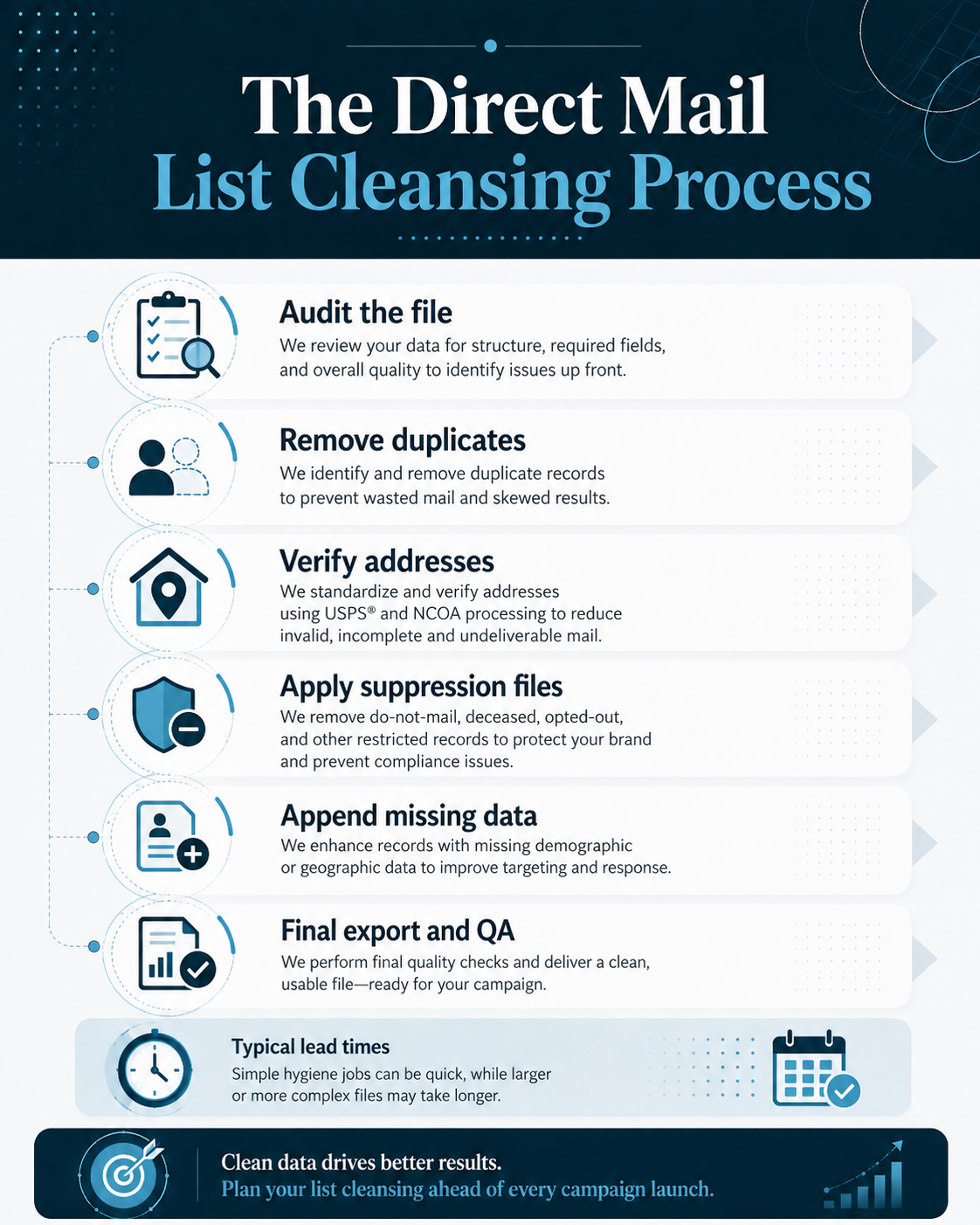
Professional cleansing is usually a sequence of different checks. No single database can answer every question. PAF confirms and standardises deliverable address structures. NCOA can identify movers who have authorised address updates. MPS identifies consumers who have registered to reduce unsolicited personally addressed marketing mail. Deceased suppression helps prevent distressing contact. Internal suppression protects objections and brand preferences. Business-status checks help identify dissolved or inactive companies.
PAF validation and address standardisation
The Postcode Address File is the core UK address reference used to validate and standardise postal addresses. Royal Mail states that new or existing addresses cannot be added to PAF unless they can receive mail, and its address-capture tools verify records against PAF. Royal Mail address updates and AddressNow explain the role of PAF.
PAF matching can correct postcode formats, standardise building and street components, fill missing address elements and flag records that cannot be matched confidently. It does not prove that a named individual still lives at the address. That is why PAF should be combined with mover, deceased, preference and internal-return data where appropriate.
NCOA and goneaway processing
Royal Mail’s National Change of Address data is maintained from redirection activity and is used in cleansing services to identify movers and, where permissions allow, update addresses. Royal Mail says it has maintained NCOA and PAF for more than 15 years and can report the number of movers found in a file. Royal Mail cleansing describes this process.
Returned mail is another source of goneaway information. A campaign should include a method for linking returns back to the record, such as a unique reference number or barcode. Royal Mail’s Mail Capture and Cleanse service captures recipient name, address and unique reference data so returns can update the database. Mail Capture and Cleanse shows how this feedback can be operationalised.
MPS and internal suppression
MPS cleansing matches names and full addresses to consumers who have registered to reduce unsolicited advertising mail. The service explains that companies cleanse lists by title, forename, surname and full address. MPS FAQs provide the matching context.
Internal suppression should be applied after normalisation so that formatting differences do not allow an opted-out record back into the campaign. Keep suppression logic separate from deletion logic. A record may need to remain in a limited suppression file even when it is excluded from the active marketing database, as the ICO explains in its right-to-object guidance.
Deceased suppression and sensitive records
Deceased suppression is particularly important for B2C lists. The objective is not only to avoid waste but to prevent upsetting communications. Royal Mail’s audit can identify deceased records, and AccuraData states that its direct mail data processes can include deceased suppression. Royal Mail cleansing and AccuraData’s direct mail data article support this practice.
Sensitive categories should also be reviewed. Data minimisation means a campaign should use only the fields necessary for the purpose. The ICO says organisations must be able to demonstrate that personal data is adequate, relevant and limited to what is necessary. ICO data-minimisation guidance is relevant when selecting profile fields for postal targeting.
Deduplication and householding
Deduplication can happen at several levels. Exact row matching removes obvious duplicates. Fuzzy matching identifies spelling variations and formatting differences. Household deduplication prevents several versions of the same offer being sent to one address. B2B site deduplication can prevent a campaign from mailing the same company or branch multiple times unless that is intentional.
The correct level depends on the campaign. An account-based B2B mailing may deliberately send different versions to a managing director and finance director at the same company. A consumer catalogue campaign may prefer one item per household. The cleansing brief must therefore state the intended unit of communication before duplicates are removed.
Companies House and business verification
Companies House can help verify company status, registered office, SIC code and officer information. Its service can also provide email alerts when followed companies file new information. Companies House guidance explains these features.
However, registered office is not always the right mailing address. A campaign may need a trading site, branch, head office or department address. Previous registered addresses also remain visible in filing history. Business verification should therefore use company records alongside websites, direct research, supplier updates and internal sales intelligence.
The Direct Mail List Cleansing Process
A well-run cleansing project begins before the file is transferred. The business should explain the campaign, audience, intended mailing date, record count, file format, fields, known issues, required suppressions and desired output. The cleaner should explain the checks, matching tolerances, security method, reporting, treatment of ambiguous records and any data-appending options.
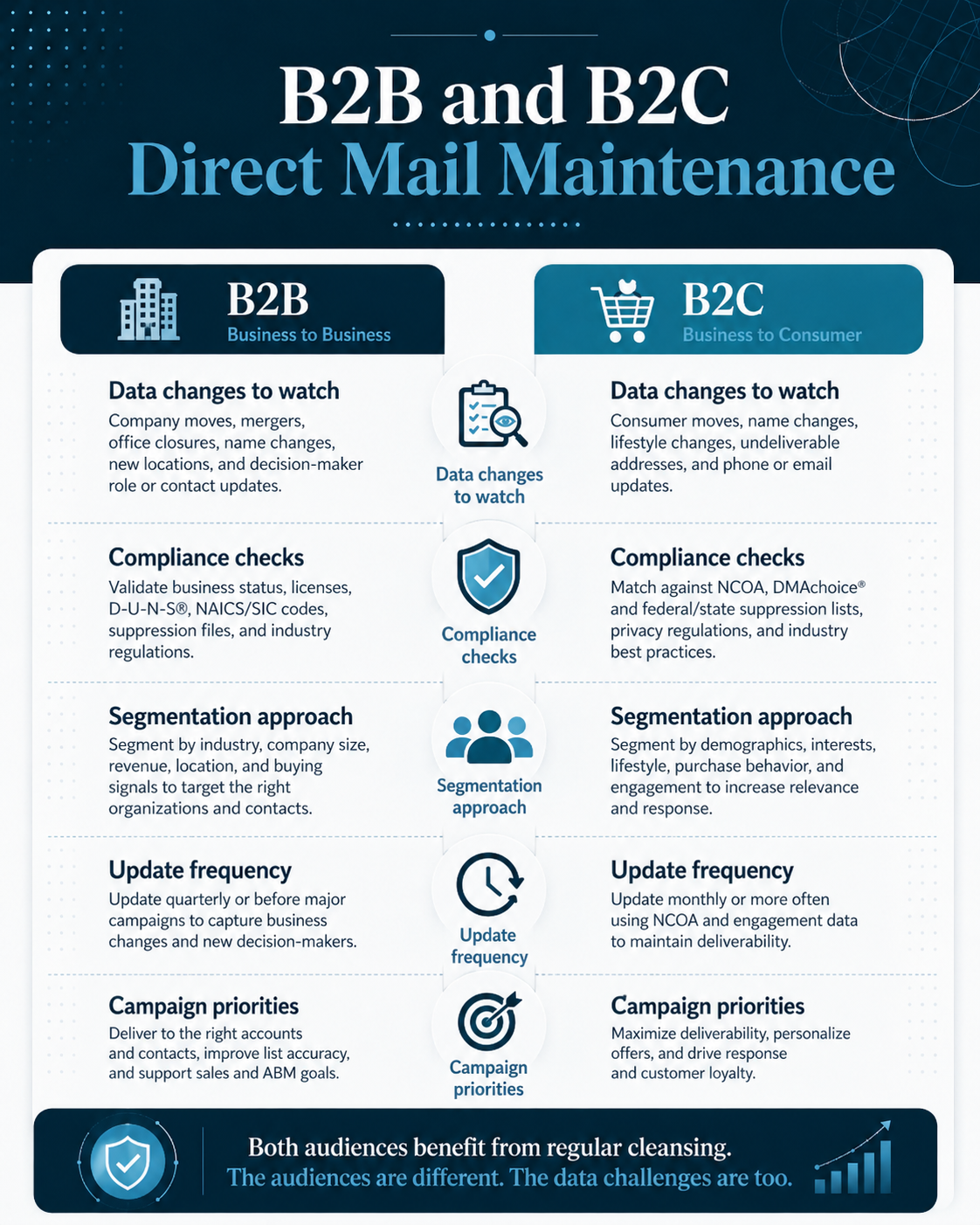
Stage one: secure intake and profiling
The supplier receives the file through an agreed secure route and checks whether the expected columns, encoding and record count are present. A profile report identifies missing postcodes, blank address lines, duplicate patterns, unusual characters, mixed country data, invalid field lengths and inconsistent column use. AccuraData describes data cleansing as improving CRM and marketing accuracy through validation, duplicate removal and enrichment. AccuraData data cleansing provides the service context.
Stage two: field mapping and standardisation
The cleaner maps each source field to the intended output. Names, company names, address lines and postcodes are standardised without destroying useful source information. Common tasks include separating concatenated addresses, correcting postcode spacing, normalising titles, removing invisible characters and identifying rows that need manual review.
Stage three: reference-data matching
The file is matched to PAF and any agreed mover, deceased, MPS, internal suppression or company-status sources. Each process should return a status code rather than silently deleting records. Status codes allow the client to understand why a record was updated, suppressed, rejected or retained.
Stage four: deduplication and hierarchy rules
Duplicates are assessed using the campaign’s unit of communication. The cleaner may identify exact duplicates, probable duplicates, household duplicates and company-site duplicates. The client decides whether to keep a preferred record based on recency, completeness, source reliability or customer status.
Stage five: enrichment and appending
If the database lacks postcodes, company status, business classification, location details or other useful fields, data appending may be appropriate. AccuraData’s data appending service covers address, company live status, key contact and other enrichment options. Appending should be limited to information that is relevant, lawful and useful for the campaign.
Stage six: quality assurance and return
Before return, the supplier checks totals and reconciles each stage. The output should normally include the clean campaign file, a suppression or exception file, a change log and a summary report. The report should state original count, matched count, updated count, duplicate count, suppressed count, rejected count and final usable count.
The client should not simply overwrite the CRM with the clean output. Review exceptions, test a sample, confirm the expected fields and decide how updates should be applied. Maintain a frozen copy of the original file and a campaign snapshot so later questions can be answered.
Typical Direct Mail List Cleansing Lead Times
There is no universal turnaround time for a Direct Mail List cleanse. Automated matching itself can be fast. The MPS directory describes systems capable of screening hundreds of thousands of records in minutes, while some mailing bureaus process hundreds of thousands of records per hour. MPS list-cleaner information shows the scale of automated processing. End-to-end lead time is longer because it includes secure transfer, field mapping, exception handling, reporting, quality assurance and client approval.
For planning purposes, a clean and well-structured file requiring PAF matching, basic deduplication and standard suppression can often be scheduled within one to three working days. A larger, poorly structured or multi-source database that needs complex fuzzy matching, mover and deceased screening, business verification, enrichment and manual exception review may need three to five working days or longer. These are practical planning ranges, not statutory standards or service guarantees. The supplier should confirm timing after profiling the file.
Urgent work may be possible, but rushing the brief can create errors that are more expensive than the saved day. A sensible project plan allows time for a pre-clean audit, clarification of duplicate rules, review of suppression counts and a final campaign count before print is authorised. AccuraData’s article on why dirty data costs businesses notes that slow turnaround can create campaign friction, while its cleansing service emphasises fast, practical database improvement.
Factors that change the lead time
The main timing factors are:
- The number of records and columns.
- Whether the file is a single consistent export or a merge of several sources.
- The amount of missing or concatenated address data.
- The number of external checks requested.
- Whether fuzzy matching and manual review are needed.
- Whether new values are appended or only existing values are corrected.
- Whether the client has defined household and company deduplication rules.
- The time needed for secure approval and sign-off.
A supplier should not promise a meaningful lead time without seeing at least a sample, column specification and record count. The best estimate follows profiling, not the initial phone call.
B2B Direct Mail List Maintenance
A B2B Direct Mail List usually ages through organisational change. Businesses move premises, open and close branches, change names, merge, dissolve or reorganise departments. Named contacts change roles or leave. A registered office may remain deliverable but be unsuitable for a sales brochure intended for an operating site.
Maintenance should therefore separate company status, site status and contact status. Company status may be checked against Companies House. Site status may require supplier data, websites, field sales feedback or returned-mail information. Named contact status may require direct research, role updates or replacement with a department-level address where appropriate.
The B2B Postal Data service from AccuraData supports targeting by sector, location, company size and other business characteristics. Its wider B2B Data and B2B Email Data services can also support multi-channel campaigns where post is followed by a lawful email or sales contact.
Registered office, trading site or named contact?
The right address depends on the campaign. Formal corporate communications may suit a registered office. A local facilities campaign may need operational sites. An account-based mailing may need a named director or department at the head office. Data maintenance should preserve address type so the selection is deliberate.
Companies House makes registered office information publicly available, but it also keeps previous addresses in company history. Companies House address guidance shows why a historical address can remain visible even after a change. Campaign teams should use current status fields and avoid treating every public address as equally suitable.
Maintaining decision-maker data
A named business contact is personal data. The ICO says business contacts have the same absolute right to object to direct marketing and must receive fair and transparent information. ICO B2B marketing guidance applies even when the address was found on a website or public register.
If the contact leaves, do not assume the successor has the same interests or that old campaign history should automatically transfer. Update the role, source and validation date. Where personalisation depends on the individual, re-check relevance before reuse.
B2C Direct Mail List Maintenance
A B2C Direct Mail List is shaped by household change. People move, separate, combine households, change names, ask not to receive marketing or die. The address may remain deliverable while the intended person is no longer resident. This is why PAF matching alone is insufficient for mature consumer databases.
The ONS address-change statistics show particularly high mobility among renters and students. ONS mobility data supports more frequent review for audience segments that move often.
Consumer maintenance should normally consider PAF validation, NCOA where appropriate, MPS, internal objections, deceased suppression, household deduplication and returned-mail processing. AccuraData’s B2C Postal Data page explains how consumer data can be prepared and cleansed before a campaign, while its B2C Data service supports broader consumer targeting.
Household-level versus individual-level mailing
Some campaigns need a named individual. Others can be addressed to a household or occupier. The choice affects personalisation, compliance, matching and deduplication. A household campaign may be less sensitive to a named person’s move but still needs a deliverable address and relevant audience selection. An individual campaign requires stronger person-to-address confidence.
The ICO says UK GDPR applies when personal data is used for postal marketing, while PECR’s electronic marketing provisions do not cover post. ICO planning guidance supports documenting the lawful basis and expected impact for each approach.
How to Assess a Supplier’s Data Degradation Rate
A supplier may quote a refresh cycle, validation date or accuracy commitment, but the buyer should ask what these terms mean. “Updated monthly” may mean the whole database is revalidated, or it may mean that monthly change files are applied to selected fields. “Accurate” may refer to address syntax rather than current residency. “Verified” may refer to a sample rather than every row.
Ask the supplier to describe:
- The source of each main data field.
- The date each field was last validated.
- The frequency of PAF and change-file updates.
- Whether NCOA, MPS and deceased suppression are applied.
- How business status and named contacts are checked.
- The duplicate logic used before supply.
- The expected treatment of returns or replacement requests.
- Whether a sample audit or quality report is available.
The buyer should then compare supplier claims with actual outcomes. Calculate return rate, mover matches, duplicate rate, suppression hits and unresolved records by supplier and acquisition month. Over several campaigns, this creates an evidence-based degradation curve. A file that appears cheap per record may be expensive after waste and manual correction are included.
The ICO’s guidance for organisations using data-broker services makes clear that the buyer remains responsible for complying with data protection law and should carry out due diligence. ICO data-broker guidance supports asking for clear source, lawful-basis and usage information.
AccuraData’s Direct Mailing Lists guide recommends asking how data is sourced, maintained, updated and suppressed. The same questions should be repeated when a list is renewed, not only during the first purchase.
How to Use a Clean Direct Mail List Effectively
Cleaning is not the end of the campaign process. A clean Direct Mail List can still perform poorly if the audience is too broad, the offer is weak or the response route is difficult. Maintenance creates a reliable foundation, but segmentation and campaign design determine how that foundation is used.
Segment by a reason that changes the message
Useful segmentation changes the creative, offer, timing or follow-up. A B2B campaign may segment by sector, company size, job function, site type or account value. A B2C campaign may segment by geography, household type, property characteristic, customer status or previous purchase. AccuraData’s B2B Postal Data and B2C Postal Data services support these different selection models.
Avoid creating segments that are too small to measure or too similar to justify different treatment. Start with the variables most closely connected to need, value or timing. Record the segment code on every campaign record so responses can be analysed accurately.
Freeze the campaign file
Create a campaign snapshot after cleansing and before print. The snapshot should include the exact final records, suppression date, validation date, segment code, creative version and unique response identifier. Do not let the live CRM continue changing the file after sign-off without a controlled re-export.
This snapshot helps answer later questions. It shows who was selected, which address was used and which checks were applied. It also allows returned mail and responses to be matched to the exact campaign version.
Track responses and non-delivery
Use personalised URLs, QR codes, unique phone numbers, voucher codes, reply forms or segment-specific landing pages. JICMAIL’s Response Rate Tracker provides external benchmarks, but internal tracking is what reveals which list source and segment worked for the business.
Returned mail should be treated as data, not waste. Code the reason, update the master record and suppress or correct it before the next campaign. If a record is repeatedly returned, investigate the source and supplier rather than resending it.
Combine post with other channels carefully
Direct mail can create awareness before a sales call or email. AccuraData’s B2B marketing data and B2B Email Data can support a coordinated approach where each channel is lawful and appropriate. Do not assume that permission to send post automatically creates permission to send consumer email or make a marketing call. The channel rules and lawful basis must be assessed separately.
When to Clean, Append or Replace a Direct Mail List
Cleansing is appropriate when the core records are valuable but contain formatting errors, duplicates, stale addresses or missing status information. Appending is useful when the records are still relevant but lack fields needed for targeting, such as postcode, company status, SIC code or address type. Replacement may be better when the source is undocumented, a large proportion of records is unusable or the audience definition has changed completely.
A practical decision sequence is:
- Profile the file. Measure completeness, match rate, duplicates and suppression exposure.
- Estimate recoverable value. Decide how many records can be corrected or enriched.
- Compare with replacement. Consider the cost, lead time and compliance evidence for a new file.
- Protect first-party history. Even if contact fields are replaced, preserve lawful customer and campaign history where appropriate.
- Document the decision. Record why cleansing, appending or replacement was chosen.
AccuraData provides data cleansing and enrichment for existing records and data appending where missing fields can be added. It also supplies targeted B2B Data and B2C Data when a replacement or acquisition audience is required.
How AccuraData Supports Direct Mail List Maintenance
AccuraData can support a Direct Mail List at several points in its lifecycle. For organisations entering a new market, it can supply targeted B2B Postal Data or B2C Postal Data built around campaign-relevant criteria. For organisations with an existing CRM or legacy mailing file, its data cleansing and enrichment service can standardise, deduplicate and improve records before production.
Where useful information is missing, data appending can add address, company-status, key-contact and other fields that improve segmentation and usability. Businesses planning joined-up campaigns can also combine postal data with B2B Email Data or wider B2B Data where the rules for each channel have been considered.
The value of a specialist partner is not limited to running a file through software. A useful maintenance service should help define the deduplication unit, assess current quality, select the right suppressions, explain exceptions, return a clear audit report and prepare a campaign-ready output. AccuraData’s existing articles on why the direct mail database matters, buying direct mailing lists and using postal marketing data effectively provide further context for campaign planning.
Frequently Asked Questions About Direct Mail List Maintenance
How often should I clean a Direct Mail List?
Clean the file whenever its accuracy is material to a campaign and it has changed since the last validation. Active databases should process returns and objections continuously, with a final campaign-specific cleanse before print. The ICO does not set a universal interval; the schedule should reflect risk, audience mobility, source and purpose. ICO accuracy guidance supports this risk-based approach.
Can I use a Direct Mail List that was purchased a year ago?
Do not assume it remains campaign-ready. Profile and revalidate it first. Consumer addresses may have changed, companies may have moved or dissolved, named contacts may have left, and preferences may have been updated. Royal Mail’s cleansing service is specifically designed to find movers, goneaways, deceased records and duplicates. Royal Mail cleansing explains the available checks.
Does PAF cleansing prove the person still lives there?
No. PAF confirms deliverable address structure, not current individual residency. Combine PAF with mover, deceased, returned-mail and internal customer information where appropriate. Royal Mail AddressNow describes PAF validation, while NCOA cleansing addresses movers.
Is MPS screening legally mandatory?
MPS is not a universal statutory consent requirement for all post, but it is an important consumer preference service and is incorporated into responsible marketing practice. The MPS corporate FAQ states that DMA members are responsible for supplier screening under the DMA Code. Businesses should also apply their own objections and assess what is fair and expected under UK GDPR. MPS corporate FAQs and ICO direct marketing guidance provide the context.
How long does Direct Mail List cleansing take?
A straightforward, well-structured file can often be planned within one to three working days. Complex or large files may take three to five working days or longer, particularly when they need multiple suppressions, fuzzy matching, manual review or appending. Automated matching can be rapid, but the complete project includes secure handling, mapping, QA and approval. Confirm a service-specific lead time after the supplier has profiled the file. MPS cleaner information demonstrates the speed of automated screening, while Royal Mail’s data audit process shows the wider quality work involved.
What file format should I provide?
CSV or XLSX is usually practical, with one field per column and a header row. Include a stable record ID and avoid merging address components into one cell if separate fields are available. Do not remove original source values before cleansing. The supplier should provide a data specification and secure transfer route.
Should returned mail be deleted?
No. Code and investigate it. Some records should be corrected, some suppressed and some retained as historical evidence. The ICO accuracy principle allows organisations to keep a record of information that was accurate at the time, provided the current status is clear and the data is not misused. ICO accuracy guidance supports preserving context while correcting active use.
Can I cleanse B2B and B2C data in the same file?
It is technically possible, but separate processing is often clearer because business and consumer fields, suppressions and matching rules differ. At minimum, identify record type and apply the correct logic. A sole trader or partnership may require consumer-like care even when the campaign has a business purpose. ICO B2B marketing guidance explains why legal form and identifiability matter.
What should a cleansing report include?
It should show input count, PAF match status, standardised or updated records, movers, deceased matches, MPS and internal suppressions, duplicate categories, company-status findings, exceptions and final usable count. It should also explain the matching date, data sources and important limitations. This report becomes part of the campaign’s accountability record.
Direct Mail List Maintenance Checklist
Before approving the next postal campaign, confirm that:
- The campaign has a defined purpose, audience and lawful basis.
- The file has a stable unique ID for every record.
- Address fields have been validated and standardised.
- Current internal objections and suppression records have been applied.
- Relevant MPS, mover, deceased or company-status checks have been completed.
- Duplicate rules match the person, household or company strategy.
- The campaign file has been frozen and versioned.
- Print totals match the final usable count, not the original raw count.
- Tracking codes and response routes are ready.
- Returned mail and campaign outcomes will update the master database.
This checklist follows the practical principles found in the ICO’s direct marketing guidance, Royal Mail’s data cleansing services and AccuraData’s Direct Mail Lists guide.
Conclusion: Treat the Direct Mail List as a Maintained Asset
An accurate Direct Mail List is not created once and then left untouched. It is maintained through good capture, regular corrections, current suppression, address validation, careful deduplication, campaign snapshots and post-campaign feedback. The cost of neglect is not hidden. It appears in print waste, postage, returns, poor measurement, damaged trust and missed opportunities.
The maintenance programme should reflect the audience. B2B postal marketing needs company, site and decision-maker checks. B2C postal marketing needs strong household, mover, MPS, deceased and internal-objection processes. Both require a lawful basis, transparency, accuracy and respect for the right to object. ICO direct marketing guidance provides the legal framework, while Royal Mail cleansing provides the operational address-quality context.
AccuraData can support this lifecycle through targeted B2B Postal Data, B2C Postal Data, wider B2B Data and B2C Data, plus data cleansing and enrichment and data appending. The objective is practical: a smaller, cleaner and better-documented list that reaches more of the right people and gives every print and postage pound a better chance to work.