
A telemarketer list is useful when a conversation is the fastest way to discover whether a prospect has a real need, authority, budget or suitable timing. It is less useful when the offer can be understood without discussion, the audience is unlikely to welcome a call, or the campaign team cannot follow a disciplined compliance process. The decision therefore starts with the commercial situation, not with the availability of telephone numbers. The ICO telephone marketing rules also make clear that live marketing calls sit within a specific legal framework, including prior objections and the TPS or CTPS registers.
This article explains when a telemarketer list can outperform email or post, when it is the wrong channel, how B2B and B2C campaigns differ, and how lists can be built, purchased, appended or cleaned. It also covers supplier due diligence, UK GDPR and PECR, segmentation, caller operations and campaign measurement. AccuraData supports these activities through targeted B2B Data, specialist B2B telemarketing data, B2C telemarketing data, data cleansing and data appending services.
| Compliance note This article offers practical marketing guidance rather than legal advice. The correct approach depends on the audience, the type of call, the source of the data, any sector-specific restrictions and the facts of the campaign. The ICO direct marketing guidance should be treated as the starting point for current UK requirements. |
The First Question: What Job Must the Telemarketer List Do?
A list should be designed around a defined commercial job. Appointment setting, lead qualification, renewal conversations, event invitations and lapsed-customer reactivation all need different fields, scripts and call outcomes. If the purpose is vague, a large telemarketer list can create activity without creating progress. A useful brief states who should be called, why the call is relevant, what the caller needs to learn and what the next step should be.
The planning stage should also decide what information is genuinely necessary. The UK GDPR data minimisation principle requires personal data to be adequate, relevant and limited to what is needed for the stated purpose. In practical terms, a team selling commercial insurance may need company type, employee size, location, renewal timing and a relevant decision-maker. It probably does not need unrelated personal details. More fields do not automatically make the data better.
A campaign brief becomes stronger when it contains exclusions as well as inclusions. Existing customers, active opportunities, recent complaints, previous objections, unsuitable sectors and areas that cannot be serviced should be removed before calling. The ICO preference guidance recommends retaining suppression information so that objections are respected in future, rather than deleting every trace and risking another unwanted contact.
When a Telemarketer List Is the Right Choice
A telemarketer list is usually strongest when the offer benefits from two-way discovery. A caller can ask questions, hear objections, clarify misunderstood points and decide whether a follow-up is worthwhile. This makes telephone outreach suitable for services with several variables, higher-value purchases, consultative sales, local availability checks and offers where eligibility has to be established before a proposal can be made.
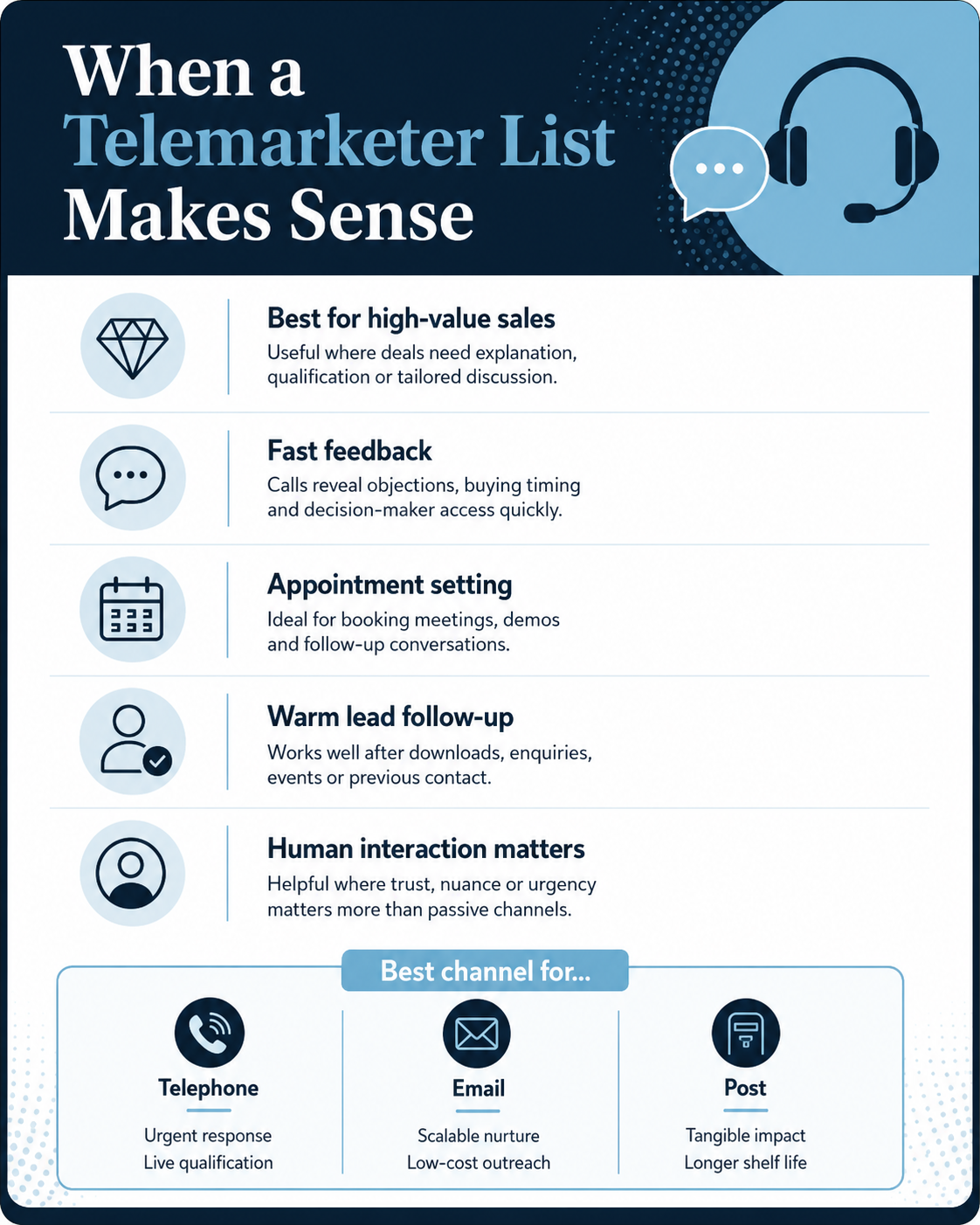
It can also be appropriate when timing matters. A business may need to fill places at a regional event, identify companies planning a move, speak to firms approaching a renewal window or find households interested in a time-sensitive service. The list must contain fields that support that timing, otherwise the calling team is still guessing. AccuraData’s guide to business telephone lists explains how calling data becomes more useful when company, role and segmentation fields sit alongside the telephone number.
A telemarketer list can be valuable when the campaign needs qualification rather than an immediate sale. The call may simply confirm the right contact, identify a current supplier, understand a business problem or secure permission for a later discussion. In that setting, the telephone is part of a sales process, not a shortcut around it. The first call should have a proportionate objective that fits the audience and the value of the offer.
Situations Where a Telemarketer List Often Performs Well
- Complex B2B services where a decision-maker needs to explain current processes before a solution can be assessed.
- High-value appointments where a small number of qualified conversations can justify the cost of trained callers.
- Local or regional campaigns where service coverage and availability can be confirmed during the call.
- Event, webinar or consultation invitations aimed at a tightly defined audience.
- Lapsed-customer and dormant-account activity where the relationship and previous history are understood.
- Database verification projects where the call is used to confirm roles, contact details or organisational changes.
The list should still be tested in a controlled sample. A small campaign can reveal whether the data reaches the intended audience, whether the script is credible and whether the call outcome codes are useful. If the result is poor, the business can separate a targeting problem from a proposition or caller problem before scaling.
When a Telemarketer List May Beat Email or Postal Data
A telemarketer list may suit the campaign better than an email list when the value lies in dialogue. Email is efficient for distributing information, educating a market and nurturing interest at scale. It is weaker when the sender needs an immediate answer to a qualifying question. Telephone outreach can resolve uncertainty quickly, although it requires more operational control and is subject to the live-call rules described in the ICO PECR guidance.
A telemarketer list may also be preferable to a postal list when speed and response capture matter. Direct mail can be effective for tangible offers, local campaigns, high-impact creative and audiences that are difficult to reach digitally. It does not provide immediate conversational feedback. A call can confirm interest, gather objections and arrange the next action in the same interaction. The trade-off is that calling is more intrusive, so relevance and preference screening matter greatly.
The strongest answer is often not a single channel. A business may send an informative email before a call, use a call to qualify interest and then send a proposal or postal pack. The channels should support one another rather than repeat the same message. AccuraData provides both B2B Email Data and calling data, which allows the audience definition to remain consistent when a campaign uses more than one contact route.
Choose Telephone When the Conversation Adds Value
The practical test is simple: what can a competent caller learn or accomplish that a static message cannot? If the answer is “very little”, email or post may be more efficient. If the answer includes diagnosis, qualification, reassurance, objection handling or scheduling, a telemarketer list may justify the additional cost and governance.
B2B Telemarketer List Use Cases
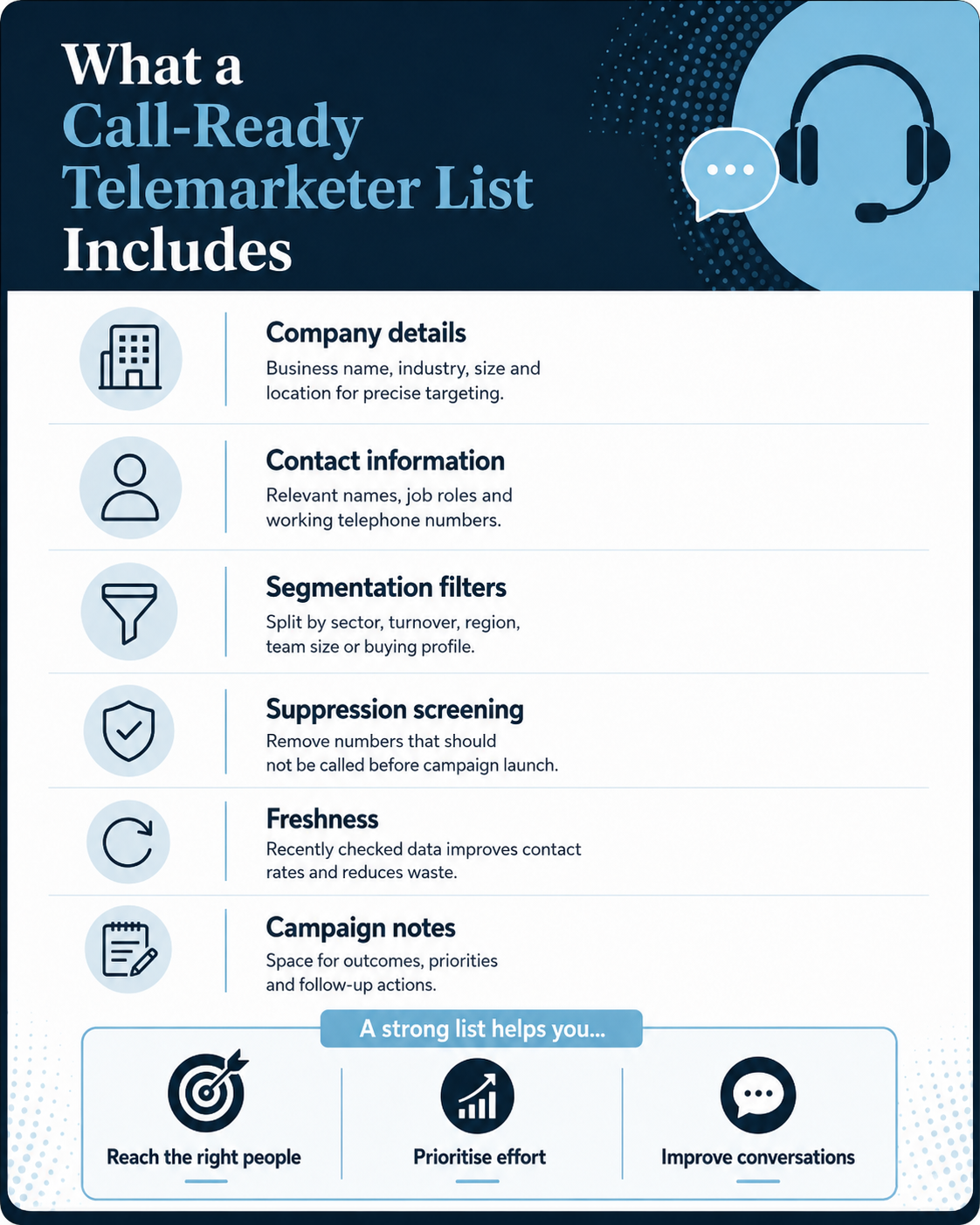
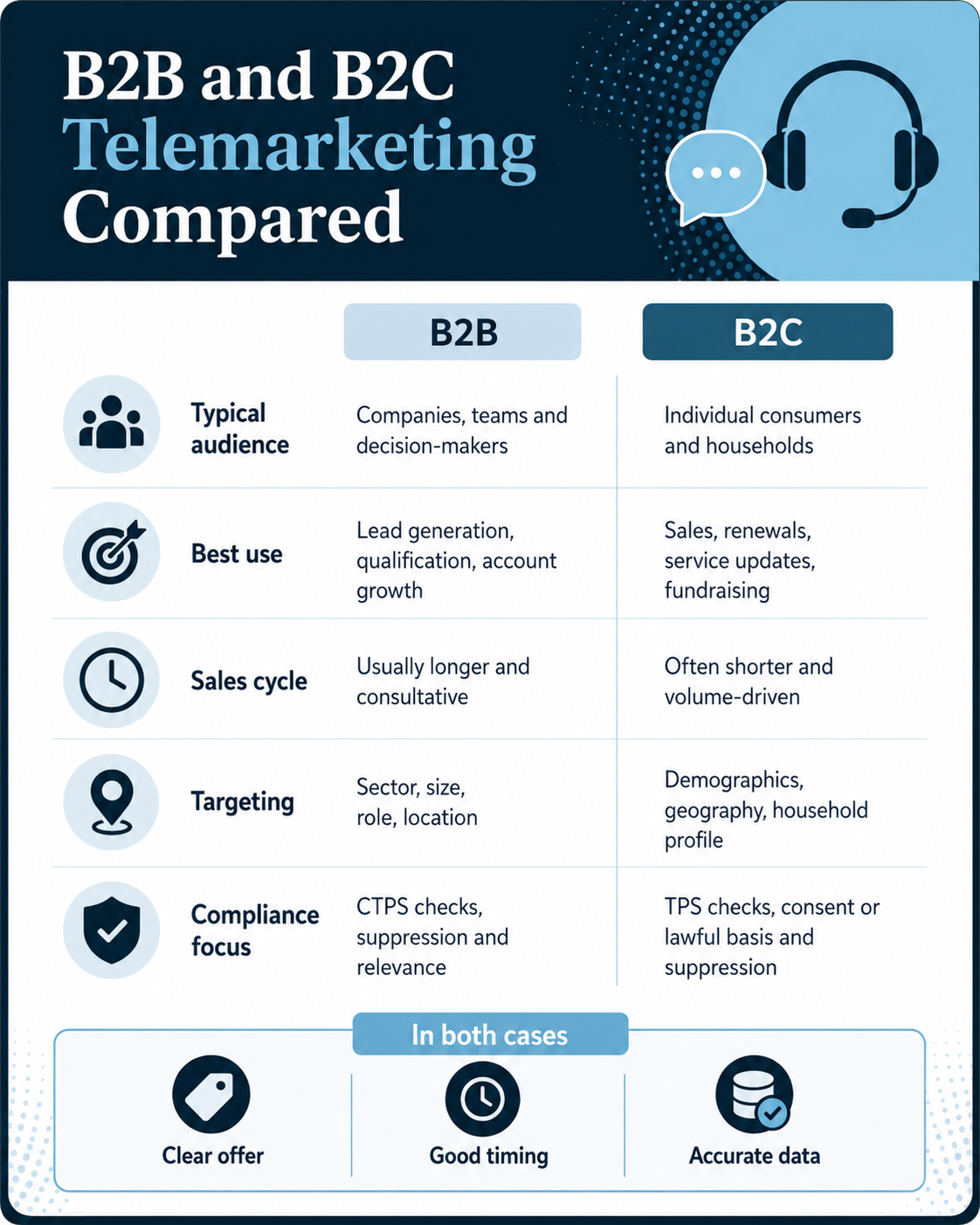
A B2B telemarketer list normally combines organisation-level data with contact or role information. Typical fields include company name, trading status, industry, location, employee size, turnover band, site type, telephone number, named contact, job function and seniority. AccuraData’s B2B marketing data service describes these fields as tools for sales prospecting, telemarketing and outbound marketing rather than as a list of numbers in isolation.
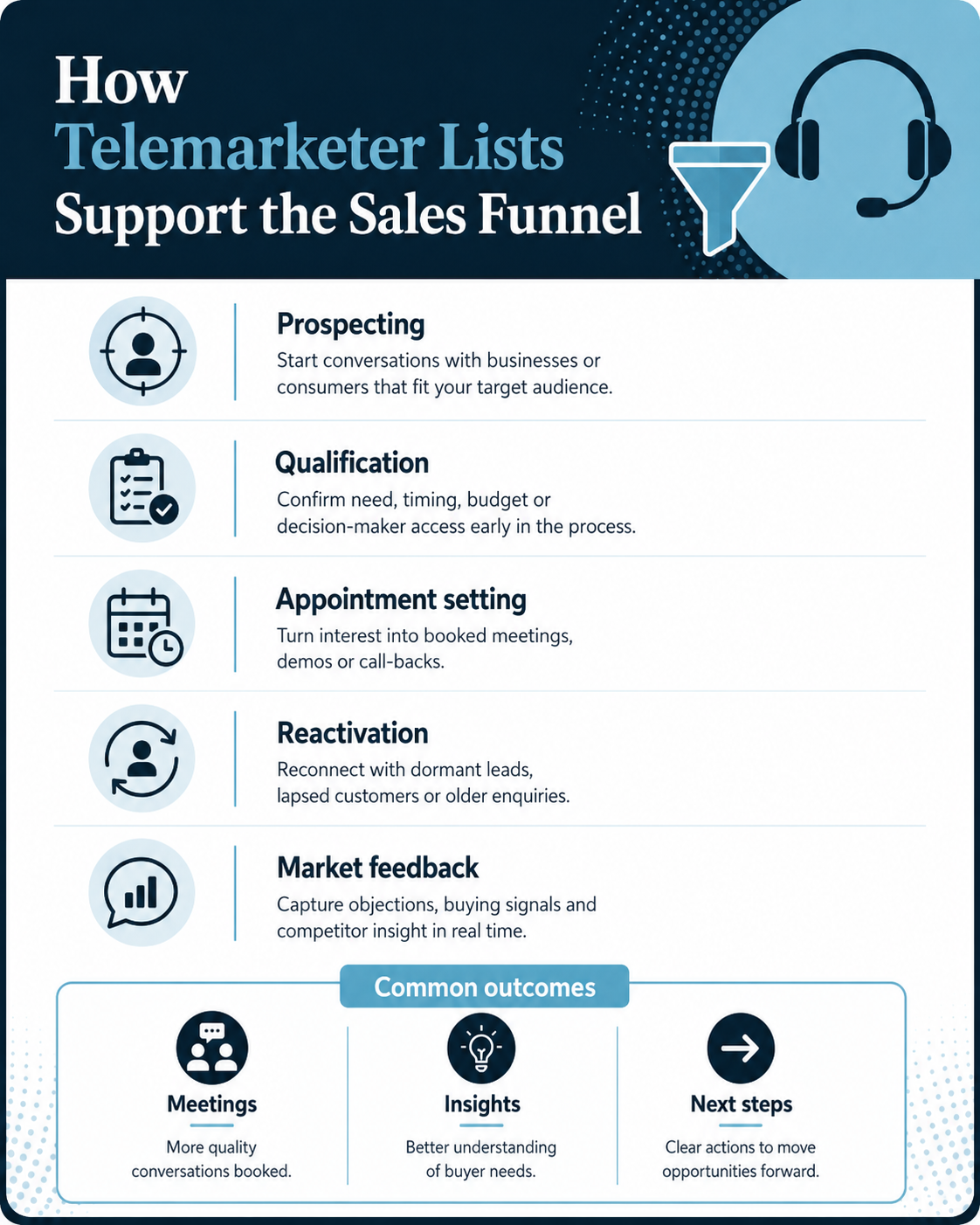
B2B calling is particularly suitable where the potential customer population can be defined using firmographic criteria. A supplier of manufacturing software may filter by SIC code, employee size, region and job role. A commercial maintenance company may target multi-site operators within its service area. A training provider may focus on HR, learning and development or compliance roles. Good segmentation allows the caller to open with a relevant business context instead of a generic introduction.
Public information can support the starting universe. The Companies House register provides company status, registered details, officers and filings, while the Companies House API supports real-time access to limited-company information. However, public company records are not a complete telemarketer list. They may not contain a usable trading number, current site information or the right operational decision-maker, and Companies House states that it does not verify every item filed on the register.
Typical B2B Campaigns
- Appointment setting for sales teams with a defined ideal customer profile.
- Market-entry calls to test demand in a new sector or region.
- Account-based campaigns focused on a limited set of high-value organisations.
- Channel recruitment, supplier development or partnership outreach.
- Event invitations and follow-up with relevant business contacts.
- Reactivation of old prospects after cleansing and role verification.
The B2B rules are not simply “business data means no restrictions”. The ICO B2B marketing guidance confirms that PECR applies to live and automated business marketing calls. Corporate numbers can be registered on the CTPS, and sole traders and some partnerships are treated as individual subscribers for PECR purposes. Named business contacts are also personal data where they identify a living person.
B2C Telemarketer List Use Cases
A B2C telemarketer list is built around individuals or households rather than companies. Typical segmentation may include geography, household characteristics, property indicators, age bands, interests, previous enquiries, customer history and suitable telephone contact information. AccuraData’s B2C data service supports demographic, geographic, lifestyle and behavioural targeting, while its B2C telemarketing data service focuses on campaign-ready consumer calling data.
B2C calling can work where the offer is relevant, easy to explain and suited to a controlled conversation. Examples may include appointment booking, local service enquiries, membership renewals, customer research, event participation or follow-up where the person has already shown interest. The more unexpected and intrusive the call would feel, the stronger the need for precise targeting, a clear lawful basis and a respectful script.
Consumer campaigns require especially careful TPS screening and internal suppression. The Telephone Preference Service is the statutory opt-out register for individual subscribers. The ICO states that a live marketing call must not be made to a registered number unless the subscriber has specifically said they want that organisation’s calls. Previous objections must also be honoured even if the number is not on the TPS.
When B2C Telephone Outreach Is a Poor Fit
A telemarketer list should not be used merely because consumer telephone numbers are available. It is a poor fit where the proposition is sensitive, the target definition is broad, the caller cannot explain the data source, the business relies on pressure tactics, or the likely customer expectation is strongly against unsolicited calls. Automated recorded calls are subject to stricter consent requirements under PECR and should not be treated as a cheaper substitute for a live calling team.
How to Procure a Telemarketer List
There are four practical procurement routes: build first-party data, research public and commercial sources, purchase a targeted telemarketer list, or improve an existing database through cleansing and appending. Many organisations use a combination. The right mix depends on speed, scale, internal resource, data complexity and the evidence available about how each record was collected.
Build the List Organically
First-party sources include enquiries, quote requests, event registrations, downloads, customer accounts, referrals and previous sales conversations. These records are valuable because the business understands the collection context. The ICO lead-generation guidance recommends clear privacy information at the point of collection and careful documentation of how the information will be used for direct marketing.
Organic list building is slower, but it creates useful behavioural context. The team can record which service was requested, which event was attended, which area was selected and what the person expected next. That context can make a call more relevant than a cold record. The database still needs accuracy checks, suppression and sensible retention rules.
Use Public and Commercial Research
For B2B campaigns, public sources can identify organisations and officers, while company websites, trade bodies and professional directories may help confirm trading activity and contact routes. Public availability is not a blanket permission for every marketing use. The business remains responsible for a lawful basis, transparency and respecting objections. The ICO B2B guidance explains that privacy information is generally required when personal data is obtained from third-party or public sources.
Purchase a Targeted Telemarketer List
Buying a telemarketer list can be efficient where the target market is clear and the supplier can evidence sourcing, maintenance and screening. The buyer should receive more than a file. It should receive a data specification, field definitions, count logic, usage terms, source information, refresh details and relevant compliance documentation. The ICO’s guidance for organisations using data broker services stresses that the buyer remains responsible for its own processing and should investigate how the information was collected.
AccuraData supplies targeted calling datasets and can align fields to industry, location, business size, role and campaign requirements. Its wider telemarketing data guide explains the value of combining telephone numbers with verified business and contact information, while its data services can also prepare customer-owned records for use.
Clean and Append Existing Data
An existing CRM may contain useful relationships but poor telephone data. In that case, buying a completely new telemarketer list may be less efficient than improving the records already held. AccuraData’s data cleansing and enrichment service can remove duplicates, correct inaccurate information and validate contact data. Data appending can add missing fields that improve segmentation and help identify the appropriate contact route.
Telephone-specific preparation may include live number validation and preference screening. AccuraData offers live number cleansing and TPS and CTPS checking for businesses that need to prepare an existing file before calling.
Telemarketer List Supplier Due Diligence
Supplier due diligence should happen before a count or price is accepted. A low cost per record is meaningless if the data is irrelevant, stale or unsuitable for the intended channel. The buyer should ask specific questions and request written answers. The ICO data-broker guidance makes clear that using a supplier does not transfer the buyer’s compliance responsibility.
- What are the original and subsequent sources of the records?
- What did individuals or business contacts receive in the privacy information?
- Which fields have been verified, and how recently?
- How are TPS, CTPS and internal suppressions applied?
- Is the screening date recorded in the delivered file or documentation?
- How are sole traders and partnerships classified for PECR purposes?
- What usage period, licence and campaign restrictions apply?
- What happens if records are inaccurate, duplicated or outside the agreed criteria?
- How is the file transferred, stored and deleted securely?
- Can the supplier provide a test count or sample specification before purchase?
Security is part of due diligence because marketing lists contain commercially sensitive information and may contain personal data. The NCSC small-organisation guide recommends protecting accounts, devices and backups. Buyers should use controlled access, secure transfer, appropriate permissions and a documented deletion or retention process rather than circulating unrestricted spreadsheets.
A reputable supplier should be willing to explain limitations. No list is perfectly static. Companies close, people change jobs, numbers are reassigned and preferences change. The UK GDPR accuracy principle requires reasonable steps to correct or erase inaccurate information, which is why validation dates and refresh processes matter.
UK GDPR and PECR for a Telemarketer List
UK GDPR and PECR work together. UK GDPR applies when personal data is processed, including named business contacts and consumer records. PECR contains specific rules for electronic communications and telephone marketing. The ICO lawful-basis guidance explains that consent and legitimate interests are the most likely lawful bases for direct marketing, but PECR can determine when consent is required.
Live Calls and Automated Calls Are Different
A live call involves a person speaking to the recipient. An automated marketing call plays a recorded message. The ICO telephone guidance states that automated marketing calls require specific consent. General marketing consent, or consent to live calls, is not enough. A business buying a telemarketer list must therefore define whether the campaign is live or automated before assessing the data.
TPS and CTPS Screening
Live marketing calls must not be made to numbers on the TPS or CTPS unless the subscriber has specifically consented to that organisation’s calls. The CTPS register is the central opt-out for corporate subscribers, while the TPS covers individual subscribers. Screening is not a one-time exercise if the campaign continues for a long period because registration and preferences can change.
The campaign must also respect direct objections. A person or organisation can tell a caller not to call again even if the number is not registered. The safest operational response is to add the number and relevant identity fields to an internal do-not-contact file and apply that suppression to every future list.
Corporate Subscribers, Sole Traders and Partnerships
B2B telemarketing includes different subscriber types. Limited companies and many corporate bodies are corporate subscribers, but sole traders and some partnerships are individual subscribers. This distinction affects which preference register applies and how other PECR rules are interpreted. The ICO business-marketing guidance should be used when classifying a mixed B2B database.
Lawful Basis and Legitimate Interests
Where consent is not required by PECR, legitimate interests may be an appropriate UK GDPR lawful basis, but it is not automatic. The ICO legitimate-interests test requires a purpose test, necessity test and balancing test. The campaign should consider the person’s reasonable expectations, the relevance of the offer, the information used, the likely impact and the safeguards in place.
The lawful-basis decision should be documented before the campaign starts. If the business relies on legitimate interests, it should record why the purpose is legitimate, why the data is necessary and why the individual’s rights do not override the interest. The decision should be reviewed when the audience, source, channel or proposition changes.
Transparency, Identification and the Right to Object
Callers should identify the organisation and explain the purpose of the call clearly. Where personal data was obtained indirectly, the business generally needs to provide privacy information within the required period. The ICO B2B guidance notes that this is normally no later than one month after obtaining the data, subject to the detailed rules and exceptions.
Individuals have an absolute right to object to personal-data processing for direct marketing. Once an objection is received, the data must not continue to be used for that purpose. Retaining minimal suppression information is usually appropriate so that the objection is not accidentally ignored later.
Caller Number and Dialler Conduct
Direct marketing callers must not withhold the calling number and must present a number on which they can be contacted. Ofcom’s calling line identification guidance explains these requirements. A recognisable, returnable number also supports trust and complaint handling.
Dialler settings and staffing should minimise silent and abandoned calls. Ofcom has reiterated that repeated silent or abandoned calls can amount to persistent misuse and may lead to enforcement. The Ofcom reminder applies to organisations and call centres responsible for the calling activity.
Segmentation and Filtering for Better Customer Fit
A telemarketer list should be segmented far enough to support a relevant conversation, but not so narrowly that the criteria become speculative or discriminatory. The fields should have a rational link to the offer. Industry, company size, role, location, customer status, previous enquiry, service area and purchase timing are common examples. The data minimisation principle still applies, so each field should earn its place.
B2B Filtering
For B2B campaigns, useful filters can include sector or SIC code, employee band, turnover, geography, site count, business status, job function and seniority. The best combination depends on who experiences the problem and who can authorise the solution. A finance product may require finance leadership, while a facilities service may be better directed to operations, estates or procurement.
B2C Filtering
For B2C campaigns, relevant filters may include geography, household profile, existing-customer status, previous enquiry, service eligibility and clearly justified interests. Sensitive or special-category data raises additional risks and should not be used casually. The ICO direct marketing checklist highlights the need for explicit consent where special-category information is used for direct marketing.
Exclusions and Suppression
Filtering should remove people who cannot benefit, cannot be served or should not be contacted. Exclusion fields can protect both performance and compliance. They may include existing customers, open complaints, recent call attempts, vulnerable-customer flags where lawfully and appropriately managed, previous objections, TPS or CTPS matches and sectors outside the campaign remit.
A Practical Segmentation Brief
| Example B2B brief “UK manufacturing businesses with 50 to 500 employees, based in the Midlands and North West, targeting operations directors or plant managers, excluding current customers, dissolved companies, CTPS-registered numbers and internal do-not-contact records.” |
This brief is useful because it defines the organisation, location, size, role and exclusions. The caller can then use a message designed for that operating context. A vague brief such as “all UK businesses” is likely to create weak relevance and unnecessary call volume.
How to Use a Telemarketer List Effectively
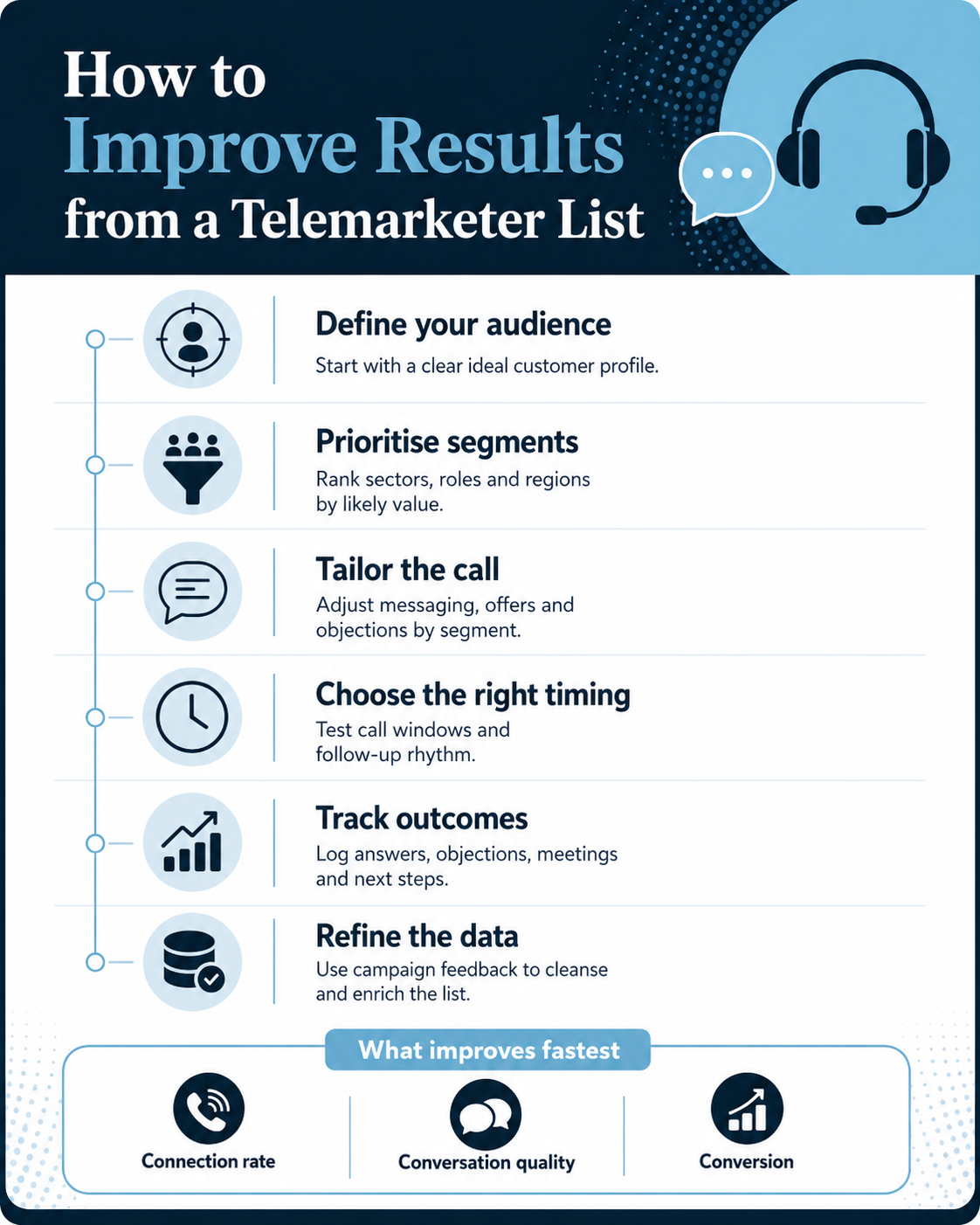
Buying a telemarketer list is only the preparation stage. Campaign performance depends on the proposition, caller capability, timing, call handling, follow-up and data feedback. The calling team should understand why each segment was selected and what outcome it is trying to achieve.
Prepare the Data Before Upload
Standardise telephone formats, remove duplicates, confirm mandatory fields, apply suppressions and create a unique record identifier. Record the screening date and source so that campaign managers can audit the file. AccuraData’s TPS and CTPS checking and data-cleansing services can help prepare customer-owned records before use.
Design a Segment-Specific Call Framework
A script should be a framework rather than a rigid monologue. It should include the organisation identity, a concise reason for the call, a relevant opening question, likely objections, the permitted next steps and the process for recording an objection. Different segments may need different opening language even when the offer is the same.
Train Callers on Compliance and Context
Callers need to understand TPS and CTPS handling, identity requirements, internal suppression, escalation, complaint recording and data updates. They also need enough product knowledge to avoid misleading claims. A compliant list cannot compensate for a poorly controlled conversation.
Use Clear Outcome Codes
Outcome codes turn calls into usable data. Useful categories may include wrong number, no answer, gatekeeper, right person unavailable, not relevant, call back, qualified opportunity, appointment, existing supplier, objection and do not contact. Free-text notes should be limited to information that is relevant and appropriate to retain.
Plan Follow-Up Before Calling
The campaign should define what happens after each positive outcome. A promised email should be sent quickly, an appointment should be confirmed and a sales handoff should include the qualification notes. When telephone and email are combined, the team should use the same identity, proposition and preferences across both channels.
Measure Quality, Not Just Dials
Raw dial volume can hide poor targeting. Better measures include contact rate, right-party contact rate, conversation rate, qualification rate, appointment rate, opt-out rate, complaint rate, invalid-number rate, conversion by segment and cost per qualified outcome. Comparing results by source and segment helps determine whether the issue sits in the data, the proposition, the caller or the follow-up process.
Budgeting and Resourcing a Telemarketer List Campaign
A telemarketer list creates value only when the organisation has enough calling capacity to work it properly. Before purchase, estimate the number of records, realistic attempts per record, expected conversation length, follow-up workload and the period during which the data will be used. A list that is too large for the available team may age before it is called, while a list that is too small may not provide enough evidence to compare segments.
The operating model can be in-house, outsourced or blended. An in-house team offers close product knowledge and direct CRM control, but it needs recruitment, coaching, quality assurance and compliance processes. An outsourced team can add capacity and specialist calling experience, but the buyer should define responsibilities for the data, script, dialler, recordings, suppressions, complaints and follow-up. The ICO accountability approach means that contractual outsourcing does not remove the organisation’s responsibility for its own processing.
Campaign economics should be assessed against qualified outcomes rather than cost per dial. The relevant calculation may include list purchase, cleansing, calling time, technology, management, follow-up and sales conversion. A higher-priced telemarketer list can be the better investment if it reduces invalid numbers, improves right-party contact and lets callers spend more time with suitable prospects. A cheap list can become expensive when the team must research every record or repeatedly reaches the wrong audience.
In-House Calling
In-house calling often suits businesses with technical products, established account knowledge or a need for close coordination between marketing and sales. The team can adapt quickly as it learns which questions, segments and objections matter. The business should still separate campaign management from individual caller judgement by using approved scripts, outcome codes, suppression rules and periodic quality reviews.
Outsourced Calling
Outsourcing can suit short campaigns, seasonal demand, market testing or organisations without a permanent telemarketing function. The brief should state who is the controller for each activity, how the telemarketer list is transferred, which systems can be used, how objections are returned to the master suppression file and when copies must be deleted. Security expectations should be written into the agreement, with account access and file handling aligned to the NCSC cyber security guidance.
A Blended Model
A blended model can use an external team for initial qualification and an internal specialist for detailed sales conversations. This can work well when the first call follows a simple qualification framework but the later discussion requires product or sector expertise. The handover criteria must be precise so that prospects do not repeat the same information and sales teams receive enough context to continue the conversation.
Whichever model is chosen, the list licence and campaign plan should match the expected calling period. A telemarketer list should not be copied into uncontrolled personal files, reused for unrelated purposes or retained because another campaign might happen one day. Purpose limitation, access control and documented retention help keep the data useful and reduce unnecessary risk.
Maintaining a Telemarketer List
A telemarketer list changes as organisations close, employees move, numbers are reassigned and preferences are updated. Maintenance should therefore be built into the campaign cycle. Records should be corrected when callers identify errors, and the master suppression file should be updated immediately when objections are received.
If the campaign runs over time, refresh screening and revalidate numbers at appropriate intervals. AccuraData’s data cleansing and live number validation services are designed to improve existing datasets rather than requiring a business to abandon useful CRM history.
Data retention should be tied to purpose. A business should not keep every call record indefinitely merely because storage is cheap. The list, notes and recordings should have documented retention rules, access controls and deletion processes. The organisation should also check whether it must pay the ICO data protection fee.
When Not to Use a Telemarketer List
A telemarketer list is not suitable when the target audience cannot be defined, the offer is irrelevant to most recipients, the caller has no meaningful question to ask, the business cannot screen preferences, or the proposition relies on urgency and pressure. It is also unsuitable when a regulated sector imposes additional restrictions that the campaign has not addressed.
Email may be better when the audience needs detailed information before deciding whether to engage, the value is educational rather than conversational, or the campaign must reach a large market at low marginal cost. Postal data may be better when physical creative, local visibility or household coverage is central. A call should be chosen because dialogue improves the customer and commercial outcome, not because it appears more direct.
The team should also pause if it cannot explain where the data came from. The ICO’s guidance on purchased marketing data expects buyers to assess the collection context and privacy information. If the supplier offers only vague assurances, the list should not be used.
How AccuraData Supports Telemarketing Campaigns
AccuraData provides targeted UK data for organisations that need a campaign-ready telemarketer list or want to improve an existing CRM. Its B2B Data services can support industry, location, size and decision-maker targeting. Its B2C Data services support consumer audience definition, while specialist B2B and B2C telemarketing products focus on calling data.
For businesses that already hold records, AccuraData offers data cleansing and enrichment, data appending, TPS and CTPS checks and telephone validation. This allows organisations to preserve useful customer and prospect history while improving accuracy and campaign readiness.
AccuraData also publishes practical guides on B2B telemarketing campaigns, telemarketing data and TPS checking. Businesses comparing calling with other channels can also review the guide to business email lists. To discuss a target audience or an existing database, use the AccuraData contact page.
Telemarketer List Questions to Ask Before Launch
- Is telephone genuinely the best channel for this audience and offer?
- Can the target audience be described in a clear sentence?
- Does the list contain the fields needed for a relevant conversation?
- Has the source and lawful basis been documented?
- Have TPS, CTPS and internal suppressions been applied?
- Are sole traders and partnerships classified correctly?
- Will callers identify the organisation and present a returnable number?
- Is there a process for objections, complaints and data corrections?
- Are follow-up actions and CRM outcome codes ready?
- Will performance be assessed by segment and qualified outcome, not only dial volume?
Frequently Asked Questions About a Telemarketer List
Is Buying a Telemarketer List Legal?
Buying a telemarketer list is not automatically lawful or unlawful. The buyer must assess the source, UK GDPR lawful basis, transparency, PECR rules, TPS or CTPS status, objections and intended use. The ICO broker guidance emphasises that the organisation using the data remains responsible for compliance.
How Often Should a Telemarketer List Be Screened?
Screening should be recent enough for the campaign and repeated where the calling activity continues, because preference status can change. The ICO direct marketing checklist advises organisations to screen live-call numbers against TPS or CTPS and keep call lists updated.
Can I Call Businesses That Are Not on CTPS?
A number not appearing on CTPS is not the only consideration. The organisation may have objected directly, the number may belong to an individual subscriber, and the processing must still have a lawful basis and be fair and transparent. B2B callers should follow the ICO business guidance rather than treating CTPS as the entire compliance test.
Should a Telemarketer List Include Named Contacts?
Named contacts can improve relevance when the role is important to the offer. They also make the record personal data, so the lawful basis, privacy information, accuracy and right to object must be addressed. Role-based contacts may sometimes be sufficient, but the choice should reflect the campaign purpose.
Is a Small Telemarketer List Better Than a Large One?
A smaller list is often better when it is closely matched to the ideal customer profile and the calling resource is limited. A larger list can be useful for testing several segments, but scale should follow evidence. The useful measure is the cost and quality of outcomes, not the number of records purchased.
Can Telemarketing Work with Email Marketing?
Yes. Email can introduce a topic or provide supporting detail, while a call can qualify interest and arrange the next step. The channels need consistent audience rules, privacy information, suppression and CRM updates. AccuraData’s B2B Email Data can support a coordinated business campaign where both channels are appropriate.
Final Answer: When Should You Use a Telemarketer List?
Use a telemarketer list when a well-targeted conversation can create information or progress that email or post cannot deliver as efficiently. The offer should be relevant, the audience should be tightly defined, the list should be sourced and maintained responsibly, and the calling operation should be capable of honouring preferences and handling objections professionally.
Do not use a telemarketer list as a substitute for strategy. A large file, a fast dialler and a generic script can generate activity while damaging trust. Start with the customer problem, define the segment, choose the channel, verify the data, document the compliance position and test the campaign before scaling.
For businesses that need targeted B2B or B2C calling data, or that want existing records cleansed, appended and screened, AccuraData can provide a structured route from audience definition to campaign-ready delivery. The aim is not simply to supply telephone numbers. It is to help the business reach the right people with a proposition that makes sense in a channel where relevance and respect are essential.