
Outbound telephone marketing is, by the standards of most digital channels, an inefficient activity. Calls take time. Not every dial results in a conversation. Not every conversation results in a lead. And yet it persists as one of the highest-performing channels in B2B sales precisely because the conversations it generates cannot be replicated by any other mechanism. A well-prepared telephone call reaches a decision-maker in real time, handles objections directly, and creates a quality of engagement that email, digital advertising, and direct mail, individually or combined, rarely match. That’s why telemarketing data is important.
The difference between a telemarketing operation that achieves those outcomes and one that burns through resource without producing usable pipeline is, in almost every case, the quality of the telemarketing data behind it. According to the UK Data and Marketing Association, outbound calling campaigns that reach decision-makers generate an average of 129 positive responses per 1,000 calls. That benchmark assumes the calling data is accurate enough to connect to the right person at the right organisation. When the underlying telemarketing data is unverified, poorly segmented, or non-compliant, that benchmark becomes unachievable before the first call is made.
At AccuraData, supplying and cleaning verified telemarketing data is central to what we do. We work with businesses running outbound campaigns across a wide range of sectors and call types, from appointment setting and lead qualification to customer reactivation and market research. This article covers the full picture: what quality telemarketing data actually contains, how the UK legal framework governs its use, how to segment and structure a calling database for maximum performance, how to maintain data compliance throughout a campaign’s lifecycle, and how to measure what the data is genuinely delivering in commercial terms.
What Telemarketing Data Is and What It Needs to Contain
The term telemarketing data refers to the structured set of contact records that an outbound calling operation uses to identify who to call, when to call them, and what is known about them before the conversation begins. At its most basic, a telemarketing database contains a telephone number and an organisation name. At its most useful, it is a rich dataset that enables a caller to open every conversation with contextual knowledge of the prospect’s industry, role, company size, and likely business challenges, making the call relevant from the first sentence rather than a generic interruption to the recipient’s working day.
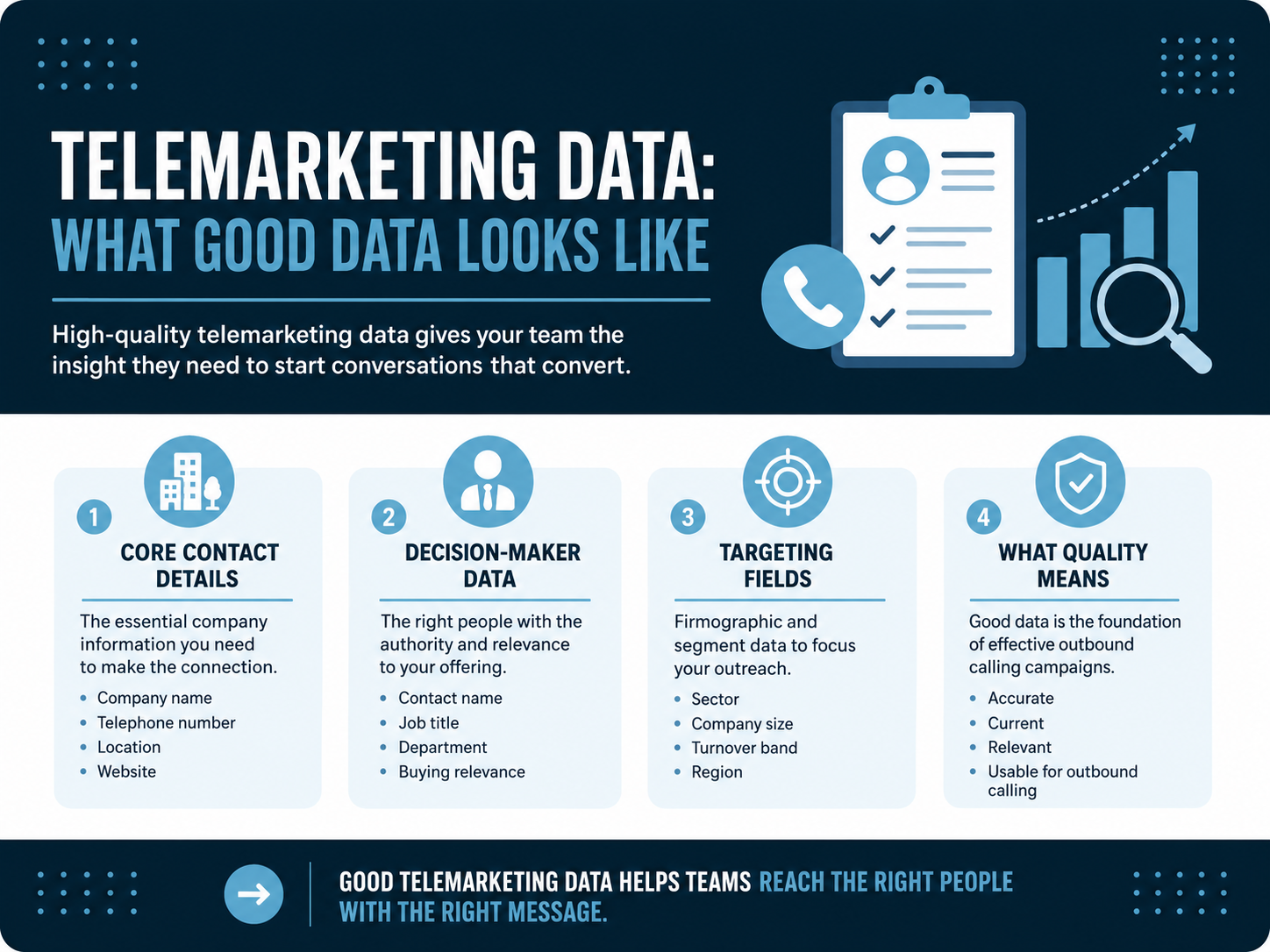
For B2B outbound campaigns, the minimum viable telemarketing data record contains: the company name, the contact’s full name, their job title and seniority level, a direct telephone number, the geographic location of the business, and industry classification to SIC code level. Records that also include employee count, estimated annual turnover, and the company’s trading status provide the segmentation basis needed to divide the calling list into groups that warrant different approaches, different propositions, and different conversations. Records without this information produce campaigns where every call uses the same opening, because there is nothing in the data to differentiate one prospect from another.
For consumer telemarketing campaigns, the equivalent record structure includes the individual’s name, telephone number, geographic location, and any demographic attributes available from the data source: age range, homeownership status, household composition, and any lifestyle or interest data captured through a consented survey or transactional source. Consumer telemarketing data requires additional compliance considerations, as explored below, but the structural principle is the same: richer records support more targeted and more relevant conversations, which produce better outcomes per dial than generic outreach to an undifferentiated list.
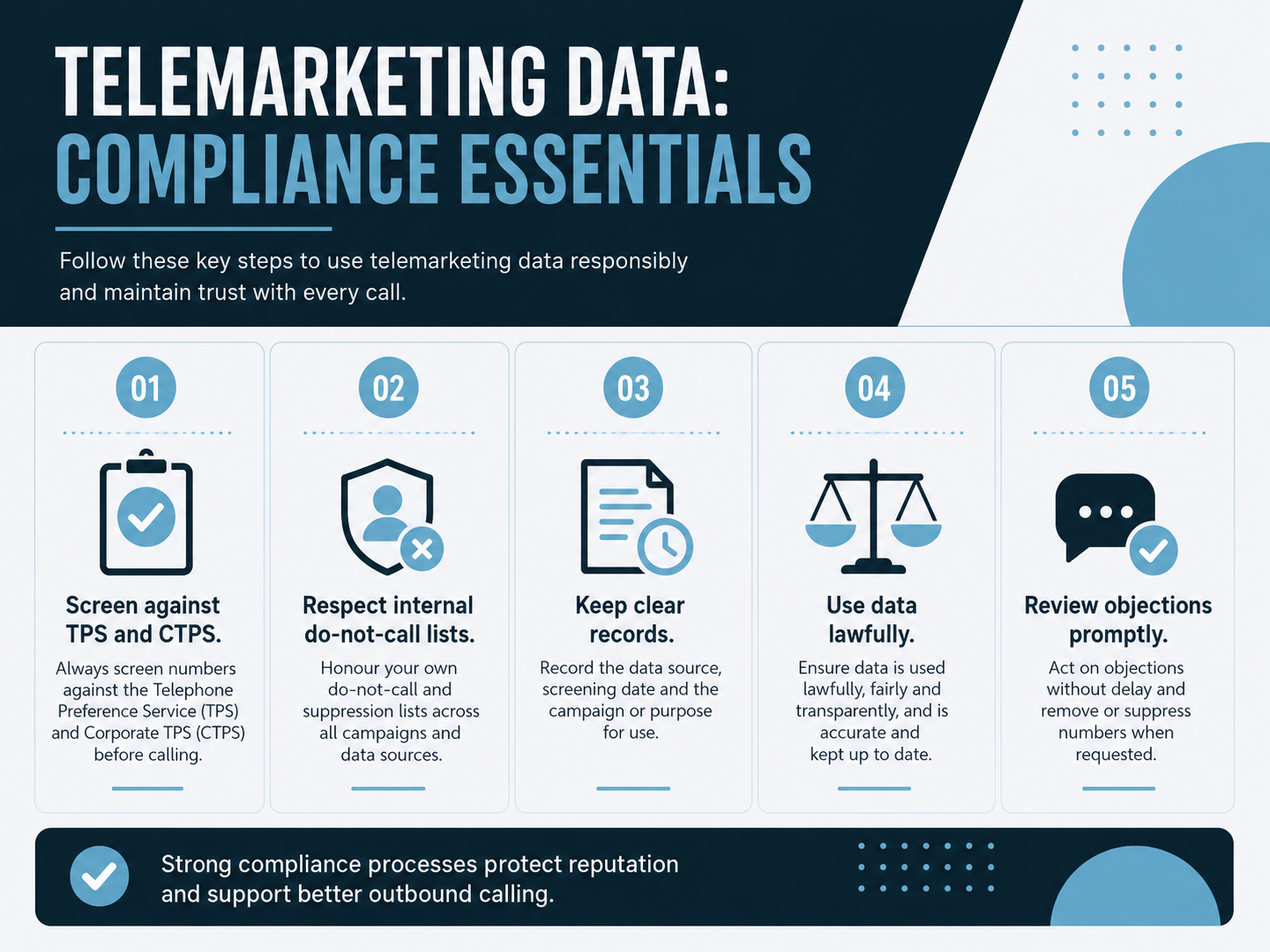
The compliance layer of the record is as important as the contact information itself. Every record in a telemarketing contact database should carry documentation of the lawful basis on which it is being processed, the date on which the TPS or CTPS screen was last applied to the number, and any objection or do-not-call notation recorded from previous contact attempts. This documentation is what a business needs to produce when the ICO investigates a complaint, and the inability to produce it is itself treated as an indicator of systemic non-compliance. Building the compliance record into the data structure from the outset is considerably less burdensome than reconstructing it after an investigation has begun.
The UK Legal Framework Governing Telemarketing Data
The legal framework for outbound telephone marketing in the UK is one of the most actively enforced areas of data protection and privacy regulation. The consequences of non-compliance have become substantially more serious following the Data (Use and Access) Act 2025, which received Royal Assent in June 2025 and brought its enforcement provisions into force in February 2026. Maximum PECR penalties have been aligned with UK GDPR levels, reaching up to £17.5 million or 4% of global annual turnover, representing a thirty-five-fold increase from the previous £500,000 ceiling.
Two frameworks govern telemarketing data use in the UK simultaneously: the Privacy and Electronic Communications Regulations 2003 (PECR) and UK GDPR. Both must be satisfied, and compliance with one does not substitute for compliance with the other.
PECR and the TPS/CTPS Obligation
PECR Regulation 21 prohibits making live marketing calls to numbers registered on the Telephone Preference Service (TPS) or the Corporate Telephone Preference Service (CTPS), unless the subscriber has given specific consent to receive calls from the calling organisation. As the ICO states in its live calls guidance, it can take 28 days for a TPS or CTPS registration to become active. This means that even if a telemarketing data list was screened at the point of purchase, calls made more than 28 days after that screen may reach numbers whose registration has since become active. The 28-day re-screening standard is based on this activation period, and the ICO uses adherence to it as a benchmark when assessing compliance during investigations.
The TPS covers individuals, including consumers, sole traders, and most partnerships. The CTPS covers corporate subscribers: limited companies, LLPs, and government bodies. For B2B outbound campaigns, both registers must be screened, because a B2B telemarketing list will typically contain a mix of corporate and individual subscriber numbers. Screening against the CTPS alone and assuming all remaining numbers are clear to call leaves a compliance gap for any sole trader or partnership contacts in the dataset.
In April 2024, Outsource Strategies Ltd, a Cardiff-based telemarketing operation, was fined £240,000 for making over 1.3 million calls to TPS-registered numbers. As TPSCheck’s compliance analysis documents, 141,914 of those calls were to numbers flagged as ‘do not call’ on the company’s own internal suppression systems, meaning the violation was not simply a failure to screen against the register but a failure to act on information the organisation itself held. This pattern, where internal compliance information exists but is not operationally applied before calls are made, is one of the most common findings in ICO enforcement cases.
AccuraData: Our TPS and CTPS checking service screens your telemarketing data against both live registers before delivery. For ongoing campaigns, we can screen at whatever frequency the campaign requires, including at the 28-day interval the ICO uses as its compliance benchmark. We supply clear, formatted results that make suppression straightforward before the first call is made, with records of each screening retained for audit purposes.
UK GDPR and the Lawful Basis for Processing Telemarketing Data
UK GDPR applies to every personal data record in a telemarketing database. Where a record includes the name of a named individual at a business, or the name of a consumer alongside a telephone number, it constitutes personal data regardless of whether the contact is a corporate subscriber for PECR purposes. Processing it requires a lawful basis under GDPR.
For B2B telemarketing to corporate subscribers, the lawful basis is almost always legitimate interests. As TALK-Q’s outbound call regulations guide sets out, UK law prohibits marketing calls to TPS or CTPS-registered numbers without consent, but the GDPR processing basis for calling a non-registered corporate number is legitimate interests, provided the three-part balancing test has been documented: establishing a genuine commercial interest, confirming that processing is necessary to pursue it, and confirming that the interest does not override the individual’s reasonable privacy expectations. This documentation must be completed and recorded before calling begins.
For consumer telemarketing to individual subscribers, PECR requires that the number is not TPS-registered, or that documented specific consent has been obtained. UK GDPR then requires a separate lawful basis for processing the personal data itself. In practice, consumer telemarketing without consent is only lawful if the number is not on the TPS register and a legitimate interests assessment supports the call. Automated or recorded marketing calls to consumers require prior specific consent regardless of TPS status, a distinction that is regularly misunderstood and regularly enforced.
Caller Identification, Objection Handling, and Record-Keeping
Beyond the TPS/CTPS screening and lawful basis requirements, PECR and ICO guidance impose several additional operational rules on telemarketing campaigns. Caller ID must not be withheld on marketing calls. The calling organisation must identify itself, and a contact number must be provided if the recipient requests one. Any individual who states they do not wish to receive further calls from the organisation must be added to an internal suppression list immediately and that preference must be respected in all future campaigns, not just the current one.
Record-keeping is a specific legal requirement, not a best practice. The ICO has stated explicitly that it asks for evidence during investigations: timestamped records showing that each number was checked against TPS/CTPS before calling, what the result was, and how any objections received were handled. As the TPSCheck analysis notes, the ICO can investigate complaints that are months old. If records have been deleted by the time the investigation begins, the organisation cannot demonstrate compliance even if it was compliant at the time. Retaining telemarketing data screening records for a minimum of 24 months is the operational standard consistent with ICO practice.
What Good Telemarketing Data Looks Like: The Quality Standards That Matter
The single most impactful variable in outbound calling performance is the quality of the telemarketing data behind the campaign. A calling team working from verified, well-segmented data will spend the majority of its time in genuine conversations with relevant contacts. A team working from unverified, poorly structured data will spend a disproportionate amount of time on disconnected numbers, wrong contacts, and gatekeepers at companies that do not fit the target profile. The data is the determinant of that ratio, not the skill of the callers or the quality of the script.
Active Number Validation
Telephone number validation confirms that a number in a telemarketing database is live, correctly formatted for UK dialling standards, and capable of receiving calls. It distinguishes between mobile and landline numbers, identifies numbers that have been disconnected or reassigned following a business closure or individual’s departure, and removes incorrectly formatted entries that would fail to connect regardless of the recipient’s status. Business data decays at a rate of 2% per month, as REsimpli’s cold calling data documents, which compounds to over 22% annually. A telemarketing calling list that has not been validated against live network data within the past six months is already carrying a meaningful proportion of records that will not connect, wasting the calling team’s time and distorting campaign performance metrics.
The commercial case for number validation is straightforward. A team dialling a list where 15% of numbers are invalid spends 15% of its time in non-productive attempts. On a full calling day, that is well over an hour per agent of time that could have been spent in conversations. Across a team of ten over a six-week campaign, the cumulative waste is substantial. AccuraData’s telephone number validation service removes this category of waste before it affects your campaign, returning a validated dataset where every number in the active calling list has been confirmed as live.
Decision-Maker Level Contacts
A company name and a switchboard number is not telemarketing data. It is the starting point for a gatekeeper conversation that may or may not reach a relevant person. The contact that produces a qualified conversation is a named individual in a specific role with the authority to make or meaningfully influence the purchasing decision being targeted. Filtering by job title and seniority before the campaign is built, not during the campaign when resource is already committed, is the practice that drives meaningful contact rates rather than connection rates padded by switchboard interactions.
For complex B2B sales, firms with 100 to 500 employees typically involve seven decision-makers in the buying process. A telemarketing data record that identifies only one contact per company is therefore only addressing a fraction of the buying committee at any given target account. For higher-value B2B campaigns where the sale involves multiple stakeholders, identifying multiple contacts across different functions at the same company, including both economic buyers and technical influencers, is a data strategy that reflects the structure of the purchasing process rather than the convenience of a single point of contact.
Firmographic Completeness and Accuracy
The firmographic fields in a telemarketing database determine how granularly the list can be segmented and how precisely the calling team can be briefed for each segment. Industry classification down to SIC code level, employee count banding, estimated annual turnover, geographic region, and trading status are the fields that enable a single telemarketing data purchase to support multiple distinctly targeted calling campaigns rather than a single undifferentiated broadcast.
Firmographic accuracy also protects against a category of wasted effort that is often invisible in campaign reports: calls to companies that, on closer inspection, do not fit the target profile. A supplier of commercial cleaning services whose telemarketing data includes companies classified by SIC code as manufacturers, but whose actual activities are in retail or administration, is calling prospects that will never convert regardless of how well the caller handles the conversation. Accurate industry classification is the filter that prevents this waste before the first dial is made.
Segmenting Telemarketing Data for Better Campaign Performance
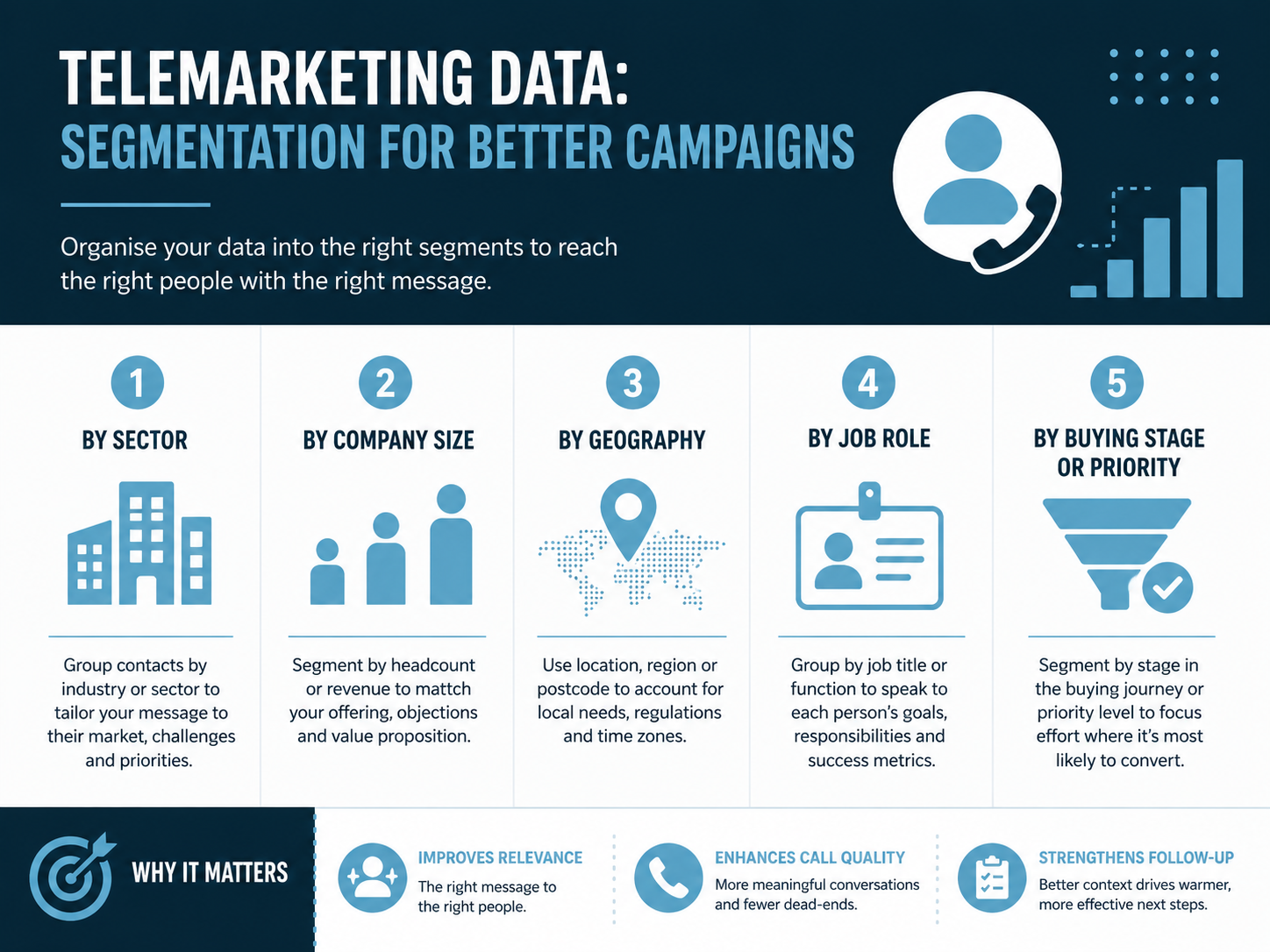
Segmentation is the mechanism through which a telemarketing data purchase becomes a targeting strategy rather than a volume exercise. A calling list that is not segmented sends every contact the same message, regardless of their industry, their role, their company size, or their likely relationship with the product being sold. A segmented calling list treats each defined group as a distinct audience with a specific proposition, a specific opening, and a specific set of anticipated objections. The performance difference between the two approaches is not marginal. Companies using data-driven targeting and personalised messaging see significantly higher connection rates and conversion rates than those using generic outreach to an unsegmented list.
Segmenting by Industry and Sub-Sector
Industry segmentation is the foundation of any structured telemarketing data strategy. An outbound campaign targeting the professional services sector requires a different value proposition, different regulatory references, and different pain point framing from one targeting the manufacturing sector. Calling both with the same script produces a campaign that is generically relevant to neither. Dividing the telemarketing database by SIC code at the point of campaign planning, and building a specific call approach for each industry grouping, is the practice that closes the gap between connection rate and qualified conversation rate.
Sub-sector specificity adds a further layer of precision. Within professional services, accountancy practices face different regulatory pressures, different technology adoption curves, and different purchasing calendars from legal firms. Within manufacturing, food production businesses have different operational priorities from engineering companies. The more specific the telemarketing data segmentation, the more specific the opening statement can be, and the more rapidly a caller can establish relevance in the first twenty seconds of a call that would otherwise be terminated.
Segmenting by Company Size
Company size, measured by employee count and turnover banding, is a second essential segmentation dimension for B2B telemarketing data. The purchasing process in a five-person business is fundamentally different from that in a 200-person company. In the smaller business, the owner or managing director is typically the sole decision-maker, and the conversation can move quickly from problem identification to solution discussion. In the larger business, the initial contact may be an influencer rather than a buyer, and the objective of the call is different: establishing the relevance of the solution and initiating a process that involves multiple stakeholders over a longer buying cycle.
Segmenting by company size allows the campaign to define a different objective, a different caller profile, and a different success metric for each size band. It also prevents the wasted effort of delivering an SME-focused proposition to an enterprise account where the minimum contract size, the implementation complexity, or the procurement process makes the offer immediately irrelevant.
Segmenting by Geography
Geographic segmentation is directly commercially relevant for any business whose service delivery, account management capacity, or pricing model is constrained by location. A regional electrical contractor has no commercial reason to call companies headquartered in Scotland. A business whose sales team is structured into regional territories needs its telemarketing data pre-divided by those territories so that each caller is working a list that their account manager can actually follow up and close. Ignoring geographic segmentation produces calling lists that generate interest from prospects the business cannot efficiently service, converting calling resource into qualified leads that then stall in the pipeline for capacity reasons.
Segmenting by Engagement History
For businesses running ongoing outbound programmes against the same telemarketing contact database, engagement history is an increasingly important segmentation dimension as the campaign matures. Contacts who have previously engaged positively but not converted, those who requested a callback that was not followed up, and those who have received multiple calls without response all warrant different treatment in subsequent calling sequences. Logging call outcomes rigorously in the CRM and using those outcomes to define priority segments for the next calling round is the practice that turns a one-time telemarketing data purchase into a progressively refined prospecting asset rather than a static list that degrades with every use.
AccuraData: Our B2B telemarketing data is available segmented by SIC code industry classification, employee count, turnover banding, geographic region, and job title covering decision-maker roles across finance, operations, IT, marketing, HR, and procurement. Every dataset is TPS and CTPS screened before delivery, telephone validated against live network data, and supplied with a Data Processing Agreement and compliance documentation. For businesses targeting specific professions or sectors, we also supply specialist lists including estate agents and many other industry verticals, with calling data verified and segmented to decision-maker level.
Maintaining Telemarketing Data Through a Campaign’s Lifecycle
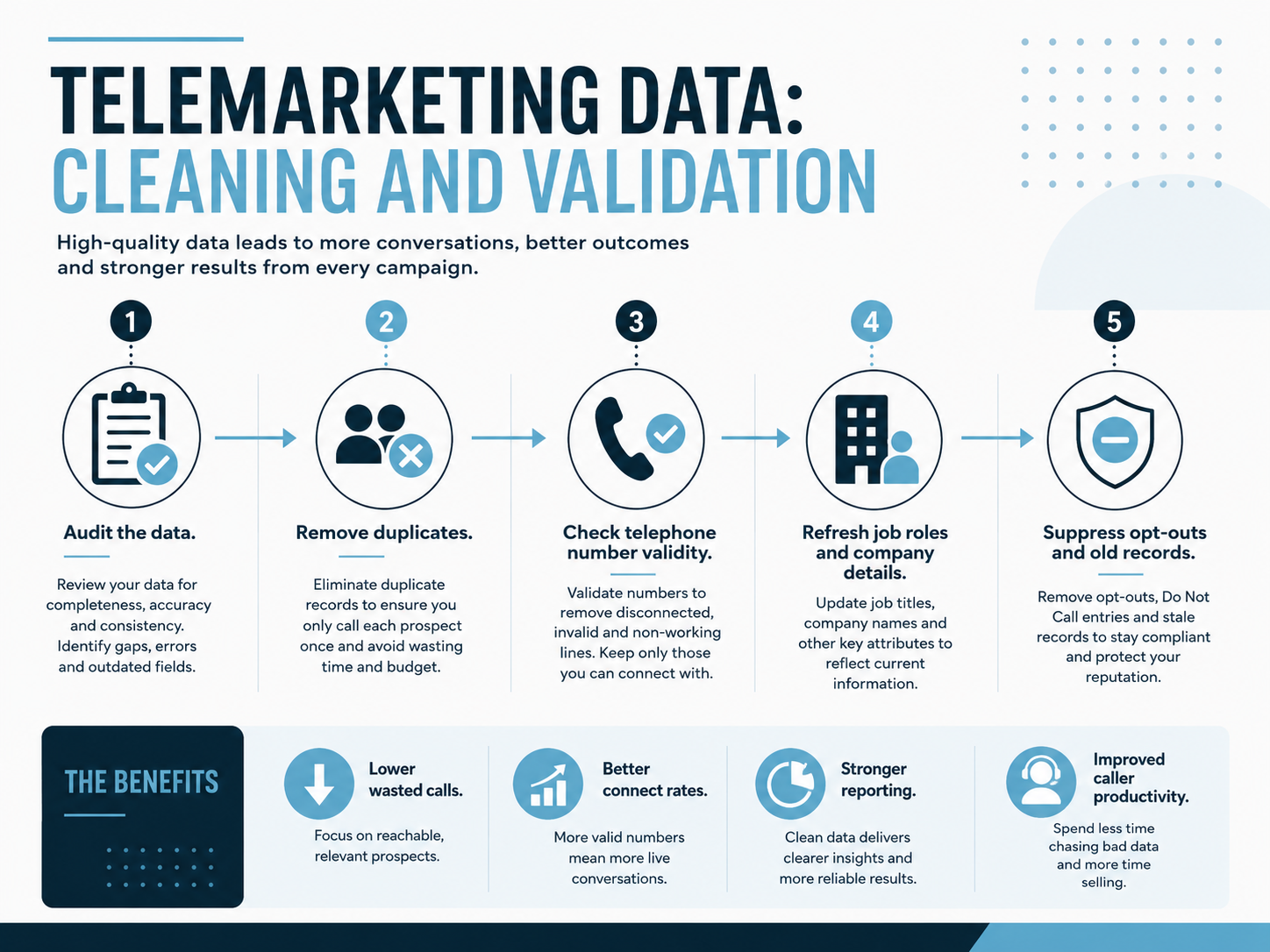
The telemarketing data that is accurate and compliant at the launch of a campaign does not remain so without active maintenance throughout the campaign’s lifetime. Contacts leave companies. Numbers are reassigned. New TPS and CTPS registrations become active. Individuals exercise their right to object to further contact. Each of these events creates a record in the calling list that is either less commercially useful or legally off-limits, and managing them in real time rather than discovering them in bulk at the end of a campaign is the discipline that keeps ongoing calling programmes both productive and compliant.
The 28-Day Re-Screening Process
The 28-day TPS and CTPS re-screening standard is the compliance process most frequently overlooked in campaigns that run for more than a month. A campaign that launched with a clean, screened telemarketing data set and then calls continuously for three months without re-screening is accumulating legal risk with every week that passes beyond the 28-day mark. New registrations added to either register during the campaign period may include numbers on the calling list that were clean at launch but are no longer legal to dial.
Building the 28-day re-screening step into the campaign calendar as a fixed, documented operational milestone, with the screening result retained as a record, is the practice that keeps ongoing programmes compliant rather than inadvertently building up exposure over time. AccuraData’s TPS and CTPS screening service is designed to support this cadence, with fast turnaround and competitive pricing at the volumes that ongoing campaigns require.
Real-Time Suppression Management
Every call that results in an objection, a request not to be called again, or a disconnected number should trigger an immediate update to the active telemarketing database. Objections and do-not-call requests must be added to the internal suppression list before the next calling session, not at the end of the campaign or the end of the week. This is not merely a legal obligation under PECR, though it is that. It is also the practice that prevents the kind of repeated contact with an objecting prospect that generates the ICO complaints that trigger enforcement investigations.
Suppression management also extends beyond individual call outcomes. Every new batch of telemarketing data acquired, whether through a new purchase or through an internal data import, should be checked against the organisation’s existing suppression file before being added to the active calling list. A contact who previously objected and was suppressed in a previous campaign should not re-enter the active calling database through a new data purchase without the suppression record being applied first. This cross-campaign suppression process is frequently the step that breaks down when compliance is managed informally rather than as a documented system.
Companies House Live Cross-Referencing
For B2B telemarketing data campaigns of any duration, regular cross-referencing against the Companies House live register identifies organisations that have been dissolved, entered administration, or changed their registered details since the contact record was last updated. More than 726,000 companies were dissolved in the financial year ending March 2025. Each dissolution potentially represents a record in a calling list whose telephone number is now disconnected, reassigned, or routing to a business that has no relationship to the original prospect. Identifying and removing these records before they absorb calling resource protects both campaign efficiency and deliverability.
AccuraData’s data cleansing and enrichment service includes live Companies House cross-referencing as a standard component of B2B database cleaning. For clients refreshing an existing telemarketing contact database before a new campaign phase, this check removes the stale corporate records that otherwise produce disconnection rates that the calling team has no way to explain without looking at the data behind their results.
Measuring the Performance of Telemarketing Data
The metrics that reveal whether telemarketing data is performing commercially are the same ones that reveal whether the underlying data is of adequate quality. Connection rate, qualified conversation rate, and the ratio of dials to qualified leads all reflect data quality as directly as they reflect caller skill. Understanding which metrics indicate a data problem versus a process problem is the analytical discipline that allows campaigns to be improved at the right level rather than fixing the wrong thing.
Connection Rate: The Primary Data Quality Indicator
Connection rate measures the proportion of dialled numbers that result in a live conversation with a relevant person. A low connection rate indicates one of two things: either the numbers in the telemarketing database are not valid or the contacts are not reachable at the numbers held. Both are data quality problems. Industry data suggests that reaching a B2B decision-maker takes an average of eight call attempts, as cold calling research from multiple 2025 benchmarks confirms. A connection rate that is consistently below 15% of dials resulting in a meaningful conversation, after appropriate attempt cadence, is a signal that the underlying telemarketing data needs verification and refresh before additional calling resource is deployed against it.
Qualified Lead Rate: The Segmentation Indicator
Of the calls that result in a connection, the qualified lead rate measures how many meet the criteria for progression: the right organisation, the right decision-maker, a relevant need, and at least some openness to further engagement. A low qualified lead rate relative to connection rate indicates a segmentation problem rather than a data accuracy problem. The numbers are connecting, but the contacts are not the right audience for the proposition being made. Reviewing the firmographic profile of the contacts where calls are connecting but not qualifying, and comparing it against the ideal customer profile, typically reveals whether the telemarketing data was segmented precisely enough before the campaign began.
Cost Per Qualified Lead: The Financial Summary
Cost per qualified lead divides the total campaign cost, including data, calling time, management overhead, and technology, by the number of qualified leads generated. This is the financial summary of telemarketing data efficiency and the metric that most directly enables comparison between outbound telephone campaigns and other lead generation channels. When a campaign produces a high cost per qualified lead relative to the expected deal value, the first diagnostic question is whether the data quality, the segmentation, or the calling process is the driver. In most underperforming campaigns, the answer is data quality: the list is too large, too undifferentiated, or too stale to produce qualified conversations at a rate that makes the cost sustainable.
Tracking cost per qualified lead at the segment level rather than across the full telemarketing data set reveals which parts of the list are generating the strongest returns and which are producing cost without pipeline. This segment-level analysis is the intelligence that drives data strategy for the next campaign: concentrating spend on the high-performing firmographic profiles and either excluding or re-approaching the low-performing ones with different targeting or a different proposition.
Integrating Telemarketing Data into a Multi-Channel Campaign
The strongest outbound campaigns in 2025 do not rely on the telephone alone. Multi-channel outreach yields 37% more conversions than single-channel approaches, according to data from Uplead and the Brevet Group. For businesses whose telemarketing data also includes verified email addresses and postal addresses, the telephone call is one element of a coordinated outreach sequence rather than the totality of the campaign.
A typical integrated sequence begins with an introductory email to the decision-maker, followed by a telephone call two to three working days later that references the email. If the call does not connect, a follow-up email can be sent before the next call attempt. For higher-value prospects, a direct mail piece to the business address adds a physical touchpoint that the sequence of digital and telephone contacts cannot replicate. Each touchpoint builds awareness and credibility that makes the telephone conversation, when it happens, more productive: the prospect is not encountering the brand for the first time and is more likely to engage than they would be with a cold call that arrives without any prior context.
This multi-channel approach requires that the same contact record carries verified email addresses and postal addresses alongside the telephone number. AccuraData’s B2B contact data includes all three contact formats where available, enabling fully integrated outreach sequences from a single dataset without the complexity of reconciling separate lists for each channel. Every dataset is TPS and CTPS screened, telephone validated, and supplied with compliance documentation covering all three channels.
How AccuraData Builds and Supplies Telemarketing Data
AccuraData supplies verified, compliant telemarketing data to UK businesses running outbound calling campaigns across consumer and B2B audiences. Our data is built around the principle that every number in a telemarketing database we supply should connect: to a live line, at a business that matches the target profile, to an individual in a role with relevant purchasing authority. We apply active telephone number validation against live network data, TPS and CTPS screening against the current register, and Companies House cross-referencing for B2B contacts before any dataset leaves our platform.
Our B2B telemarketing data is segmented by SIC code industry classification, employee count banding, estimated annual turnover, geographic region down to local authority level, and job title and seniority across finance, operations, IT, marketing, HR, and procurement functions. Our consumer telemarketing data is available under the appropriate lawful basis for each campaign type, with TPS screening applied as standard and clear documentation of sourcing and consent status for each record. Every dataset we supply comes with a Data Processing Agreement and the compliance documentation to support lawful outreach from day one.
For businesses with existing telemarketing data that needs cleaning before a new campaign phase, our data cleansing and enrichment service applies telephone number validation, TPS and CTPS screening, Companies House live cross-referencing, and suppression file management in a single submission. We return a cleaned, structured, and compliantly documented dataset alongside a full processing log that can be retained for audit purposes.
For clients also running email outreach alongside telephone campaigns from the same contact base, our datasets include verified email addresses where available, and our email verification service confirms active mailbox status before the data is deployed. For clients wanting to understand what our telemarketing data looks like for their specific target audience, speak to our team. We will give a clear picture of coverage, validation standards, segmentation options, and pricing before any commitment is made.
Telemarketing Data Is Not a Starting Point — It Is the Infrastructure
Every outbound calling campaign is, at its foundation, a data problem before it is a sales problem. The connection rate, the qualified conversation rate, the cost per lead, and the compliance record of a campaign all reflect the quality of the telemarketing data sitting beneath the callers and the scripts and the dialler technology. Getting that foundation right is not a supporting task to be addressed once the campaign is underway. It is the precondition for everything else working as intended.
A telemarketing database that is verified, segmented, TPS and CTPS screened, and maintained through the campaign’s lifecycle gives a calling team the infrastructure to spend its time in genuine conversations with relevant prospects rather than navigating disconnections, wrong contacts, and compliance risk. The investment in quality telemarketing data is consistently the lowest-cost intervention available to any business that wants to improve outbound calling performance, because it addresses the root cause of most underperformance rather than layering additional resource onto a problem that the data itself is creating.
AccuraData provides verified, compliant telemarketing data at competitive rates, with the validation standards, segmentation depth, compliance documentation, and ongoing cleaning services that outbound calling programmes need to perform consistently. The conversation about your specific requirements starts with who you are trying to reach and what you need to know about them before the first call is made.