

Most businesses that struggle with email marketing do not have a strategy problem. They have a data problem. The campaigns may be well-written, the platform may be capable, and the team may understand the principles of effective outreach. But if the UK email database underneath all of it is inaccurate, poorly segmented, non-compliant, or simply too small to support the commercial ambitions behind the programme, none of the rest of it matters.
Building a genuinely useful UK email database is a more considered exercise than it is often treated as. It involves decisions about how contacts are sourced, how consent is obtained and documented, how records are structured to support segmentation, how the list is maintained over time, and how it is supplemented when organic growth is too slow for the business’s pipeline requirements. Each of those decisions has downstream consequences for campaign performance, deliverability, legal compliance, and the long-term value of the list as a commercial asset.
This guide covers all of it. At AccuraData, we work with UK businesses at every stage of this process, from building from scratch to cleaning, enriching, and supplementing existing databases. The following draws on that experience to give a complete picture of what it actually takes to build a UK email database that performs.
Start with Architecture: What a UK Email Database Needs to Contain
Before a single contact is added, the structure of the UK email database needs to be defined. This is the step that most businesses skip, and it is the one that causes the most avoidable problems downstream. A database built without a defined structure tends to accumulate records in an inconsistent format, with missing fields, inconsistent categorisation, and no clear system for recording the compliance information that the law requires.
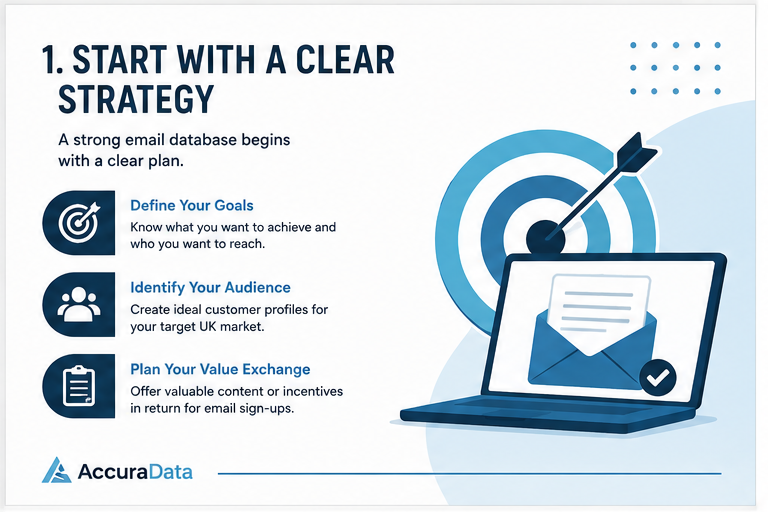
The minimum viable record in a UK email list is an email address. The minimum useful record is considerably richer. For B2B contacts, a well-structured record includes first name, last name, job title, seniority level, department or function, company name, company size by employee count, industry classification, geographic region, direct telephone number where available, postal address where available, the source through which the contact was acquired, the date the record was added, and the lawful basis on which the data is being processed. For consumer contacts, the equivalent includes name, email address, consent record with timestamp and mechanism, geographic location, and any demographic or lifestyle attributes captured at the point of collection.
The field set matters because it determines what you can do with the database. A record containing only an email address and a name allows you to send a personalised email. A record also containing industry, company size, and seniority allows you to segment by profile and tailor your messaging accordingly. According to B2B email marketing benchmarks cited by Increv, advanced segmentation produces 14% higher open rates and 28% higher click-through rates than unsegmented campaigns. That performance uplift is a direct function of the data structure: it is only accessible if the records in the UK email database contain the fields needed to differentiate one segment from another.
The compliance layer of the record structure is equally important and equally frequently overlooked. Every record in a UK business email database should carry documentation of the lawful basis on which it is being processed: for consumer contacts, the consent record including timestamp, form wording, and channel through which consent was given; for B2B contacts, the legitimate interests basis and any objection or opt-out recorded against the contact. This documentation is what the ICO asks for when a complaint triggers an investigation, and the inability to produce it is itself treated as an indicator of systemic non-compliance.
Understanding the UK Legal Framework Before You Build
The legal framework governing the use of a UK email database is governed by two pieces of legislation that operate in parallel and must both be satisfied: the UK General Data Protection Regulation (UK GDPR) and the Privacy and Electronic Communications Regulations 2003 (PECR). Neither alone is sufficient. Satisfying UK GDPR without meeting PECR’s specific requirements for electronic marketing, or relying on PECR’s corporate subscriber rules while ignoring UK GDPR’s data processing obligations, still constitutes non-compliance.
PECR: The Channel-Specific Framework
PECR governs the mechanics of electronic marketing: email, SMS, automated calls, and telephone calls to TPS-registered numbers. For email marketing specifically, the ICO’s PECR guidance sets out that organisations must normally have consent before sending unsolicited email marketing to individual subscribers. An individual subscriber includes any natural person: consumers, sole traders, and most partnerships. The consent must meet UK GDPR’s standard: freely given, specific, informed, and unambiguous. Pre-ticked boxes, bundled consent within terms and conditions, and vague references to marketing from ‘third-party partners’ all fail this test.
The position is different for corporate subscribers. As the ICO confirms directly, the electronic mail marketing rule in PECR does not apply to corporate subscribers. A corporate subscriber is a limited company, an LLP, a government body, or similar incorporated entity. This means that building and using a UK business email database for outreach to limited companies is lawful under PECR without prior opt-in consent from each recipient. This is the legal foundation that makes purchased B2B email data a workable commercial tool in the UK, provided the UK GDPR obligations are also met.
The soft opt-in is the one PECR exception relevant to consumer email marketing. It permits businesses to email existing customers about similar products or services without fresh consent, provided the customer was given a clear opt-out opportunity when their details were collected and in every subsequent communication. The Data (Use and Access) Act 2025 also introduced a charitable purpose soft opt-in from February 2026, allowing charities meeting specific criteria to contact supporters under defined conditions. As the Data Protection Network’s email marketing rules summary sets out, the soft opt-in criteria are strict and frequently misapplied: it applies only to similar products and services, only to existing customers, and only where the original collection included a proper opt-out mechanism.
UK GDPR: Processing Personal Data for Email Marketing
UK GDPR applies to every record in a UK email database that identifies a natural person. A named business email address is personal data under GDPR regardless of whether it belongs to a corporate subscriber. Processing it requires a lawful basis. For B2B email outreach, that basis is almost always legitimate interests, which requires a documented balancing test confirming that the commercial interest is proportionate and does not override the individual’s reasonable privacy expectations.
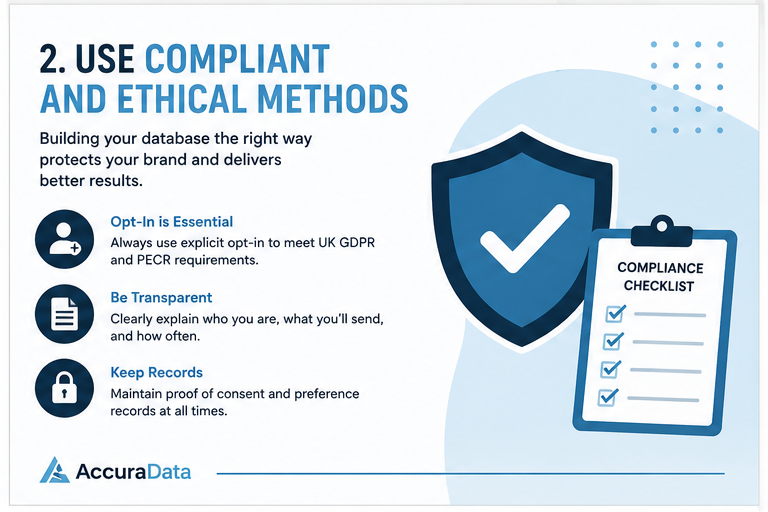
UK GDPR’s accountability principle requires that the organisation can demonstrate compliance, not merely assert it. Every UK email database should therefore include the compliance documentation described above: consent records for consumer contacts, legitimate interests assessments for B2B contacts, and a clear record of how opt-outs and suppression have been managed. The ICO updated its direct marketing guidance in August 2025 to incorporate the Data (Use and Access) Act’s changes, reinforcing that organisations must be able to produce this documentation when challenged.
The enforcement record makes the stakes clear. ICO enforcement in 2025 identified several consistent PECR breach patterns, including soft opt-in misuse by retailers emailing customers about unrelated products, B2C brands fined for using purchased lists where consent at source could not be verified, failure to honour unsubscribes where data syncs between systems overwrote suppression lists, and organisations unable to produce consent timestamps when challenged. Most fines for SMEs fell between £30,000 and £200,000, with the Data (Use and Access) Act 2025 having raised maximum PECR penalties to the UK GDPR level of £17.5 million or 4% of global turnover.
AccuraData Compliance Note: Every UK email database we supply comes with a Data Processing Agreement as standard. We maintain documentation of sourcing and lawful basis for every record, and our consumer email data is supplied only where verifiable opt-in consent exists. For B2B data, we hold documented legitimate interests assessments. We are registered with the ICO and operate within the full UK GDPR and PECR framework on every engagement.
Building Organically: Growing Your UK Email Database Through Your Own Activity
Organic list building produces the most engaged contacts over time. Every individual who joins a UK email list through your own website, content, events, or referral activity has actively indicated interest in your brand, product, or subject area. This self-selection tends to produce better open rates, higher click-through rates, and lower unsubscribe rates than contacts acquired through any other method. The limitation is pace: organic growth is slow, and for most businesses it cannot build a database large enough to support meaningful outreach in the short term without supplementation.
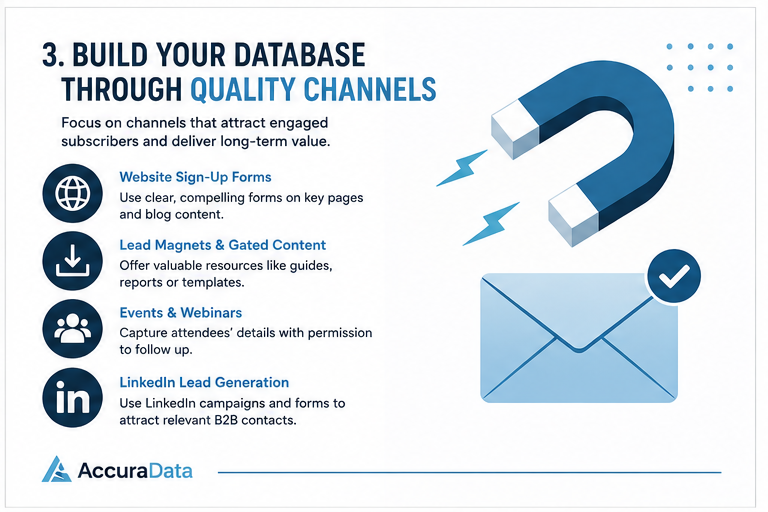
Website Opt-In Forms
The most consistent source of organic additions to a UK email database is a well-positioned website opt-in form. The conversion rate of these forms is determined almost entirely by two variables: where the form sits within the page structure, and what the form is offering. A footer form with a generic ‘subscribe to our newsletter’ prompt will convert at a fraction of the rate of an inline form within a relevant page, offering something specific and valuable. Exit-intent forms, which appear when a visitor’s behaviour suggests they are about to leave, consistently outperform passive placement because they present the offer at the moment of highest attention before the session ends.
The compliance requirement for website opt-in forms is non-negotiable: the visitor must take a positive action to subscribe. The PECR consent standard requires this to be freely given, specific, informed, and unambiguous. Every form must make clear what the subscriber is signing up for, how frequently they will hear from you, and who will be contacting them. A form that obscures these details may inflate sign-up rates in the short term, but it accumulates reluctant subscribers who disengage rapidly and generate the kind of complaint rates that damage sender reputation over time.
Gated Content and Lead Magnets
In B2B markets, gated content is one of the most effective organic mechanisms for building a UK business email database with contacts at a relevant seniority level. A guide, template, benchmark report, or interactive tool offered in exchange for an email address and a clear marketing opt-in attracts contacts who have demonstrated an interest in a specific problem area. The quality of the lead magnet directly determines the quality of the contacts it attracts: generic content attracts a generic audience, while highly specific content attracts contacts who are actively engaged with the exact challenge the business solves.
The self-selection dynamic of a lead magnet is one of its most underappreciated advantages. A well-defined piece of gated content acts as a pre-qualification mechanism: the contacts who download it are signalling both that they have a relevant problem and that they are actively seeking solutions. This is precisely the profile of contact that produces the highest conversion rates from subsequent email outreach, making the investment in creating high-quality gated content one of the most commercially efficient list-building activities available to a B2B marketing team.
Events and Webinars
Live events, virtual webinars, and industry-specific workshops are a high-quality source of consented contacts for any UK email database. Registration for an event or webinar represents a clear expression of interest in a specific subject, and provided the registration process includes a transparent marketing opt-in, event-sourced contacts are among the most engaged additions to any email programme. The follow-up sequence is where the commercial value of event contacts is largely determined: a timely, topic-specific email arriving within 24 to 48 hours of the event consistently outperforms a generic welcome message sent days later.
For B2B events in particular, the combination of a valuable session and a well-structured post-event nurture sequence creates a natural progression from awareness to qualified conversation. The UK email list contact generated through a relevant event is often already partway through the buying journey by the time the first campaign email is sent, which is why event-sourced contacts frequently have higher conversion rates than those acquired through any other organic mechanism.
Partnership and Co-Marketing Programmes
Co-marketing with complementary, non-competing businesses is an organic growth mechanism that reaches audiences with a pre-established interest in a relevant subject area, through a channel of trust they already have a relationship with. A joint webinar, co-authored guide, or co-promoted event allows both organisations to offer their audience something of value while generating opt-in contacts from each other’s engaged subscribers. The resulting contacts have been pre-qualified through their relationship with the co-marketing partner and tend to engage more readily with subsequent outreach than cold-acquired contacts.
Referral schemes are the individual equivalent of partnership marketing. Existing subscribers or customers who refer a colleague to an opt-in page are generating contacts from within their own professional network: contacts who arrive with an implicit endorsement from someone they trust. Word-of-mouth referrals produce higher long-term engagement because the trust in the referring relationship carries into the subscriber’s initial expectations of the brand, reducing early disengagement and complaint rates compared to contacts acquired through less personal mechanisms.
When to Supplement with Purchased UK Email Data
Organic list building is the right long-term strategy. It is also too slow for most businesses operating in competitive markets with revenue targets that cannot wait twelve to eighteen months for a database to reach a useful size. Purchasing verified third-party data is not a shortcut around quality. When it is done correctly, it is a mechanism for accelerating reach into a defined, relevant audience while the organic programme builds momentum alongside it.
The distinction between purchasing data wisely and purchasing it badly is entirely a function of what is purchased and from whom. A low-cost, unverified bulk list assembled from scraped or aged sources produces the outcomes that give purchased data a poor reputation: high bounce rates, deliverability damage, complaint rates that threaten the sending domain, and compliance exposure from records whose consent trail cannot be verified. A verified, segmented, compliantly sourced UK email database from a supplier that takes data quality and compliance seriously produces a different outcome entirely.
The situations where purchasing a UK email list makes clear commercial sense include: entering a new sector or geography where the business has no existing contacts; supplementing an organically built list that covers only a fraction of the addressable market; needing to build pipeline quickly enough to justify investment in sales resource before the organic database has reached a useful scale; and prospecting for a specific decision-maker profile, such as a finance director at a manufacturing company with 50 to 250 employees in the Midlands, that would take months to compile manually through organic channels.
AccuraData: We supply verified, segmented UK email databases for both B2B and consumer campaigns at competitive rates. Every record is verified at active mailbox level before delivery, and every dataset is supplied with a Data Processing Agreement and full compliance documentation. Our B2B data is segmented by SIC code, company size, geography, and job function. Our consumer data is available under the appropriate lawful basis for each channel. Explore our business email lists or speak to our team about what our data looks like for your specific target audience.
Structuring Your UK Email Database for Segmentation
A UK email database that cannot be meaningfully segmented is a broadcast tool. A database that supports granular segmentation is a targeting tool. The difference between the two is reflected directly in campaign performance, and the structure of the database from day one determines which one you are building.
Segmenting by Source and Intent
The first and most immediately actionable segmentation is by the mechanism through which a contact entered the database. A contact who downloaded a specific guide has indicated interest in a specific topic. A contact who attended a specific event has demonstrated engagement with a specific subject. A contact who signed up through a specific landing page has responded to a specific proposition. Capturing the acquisition source and the context for every record as a database field allows all future campaigns to be targeted at contacts who entered through a particular route, with messaging that builds on what that source revealed about their intent.
Segmenting by Profile
For B2B databases, profile segmentation divides the UK email list by firmographic attributes: industry, company size, geographic location, and job function. Each of these dimensions allows a different version of a campaign to be sent to a group defined by a shared characteristic, rather than a single version to everyone. A financial software company whose database includes accountants, manufacturing operations managers, and HR directors across all company sizes has at least three meaningfully different audiences, each of whom warrants a different proposition, a different level of technical detail, and a different framing of the business case.
For consumer databases, profile segmentation uses demographic and lifestyle attributes: age range, gender, homeownership status, household composition, geographic region, and interest categories where available. The more precisely these attributes reflect the characteristics of the consumer most likely to respond to a given offer, the more efficient the campaign spend becomes. A campaign targeted at homeowners within a 20-mile radius of a specific location, filtered to the 35 to 55 age range with a household income above a defined threshold, is addressing a meaningfully smaller but considerably more relevant audience than the same campaign sent to every record in the database.
Segmenting by Engagement History
Engagement-based segmentation is the most commercially powerful form of database management, and it is only possible when the UK email database captures engagement data at the contact level. Last open date, last click date, number of campaigns received without interaction, and the specific content engaged with are all attributes that allow the database to be divided into segments with meaningfully different communication needs.
Active contacts, those who have opened or clicked within the past 90 days, should receive the core campaign programme at the standard frequency. Lapsing contacts, those who have not engaged in 90 to 180 days, should receive a reduced frequency with messaging designed to rekindle interest. Inactive contacts, those with no engagement in over 180 days, should receive a structured re-engagement sequence before a decision is made about suppression. Contacts who do not respond to a re-engagement sequence after a reasonable number of attempts should be suppressed from active sends rather than left on the list generating negative deliverability signals indefinitely.
This approach feels counterintuitive because it makes the UK email database smaller in the short term. The performance data supports it consistently. A list of 500 well-targeted, recently verified decision-makers will outperform a 10,000-person unverified database on every metric that determines commercial return: open rate, click-through rate, conversion rate, and the deliverability score that determines how future campaigns land in the inbox.
Verifying and Maintaining Your UK Email Database
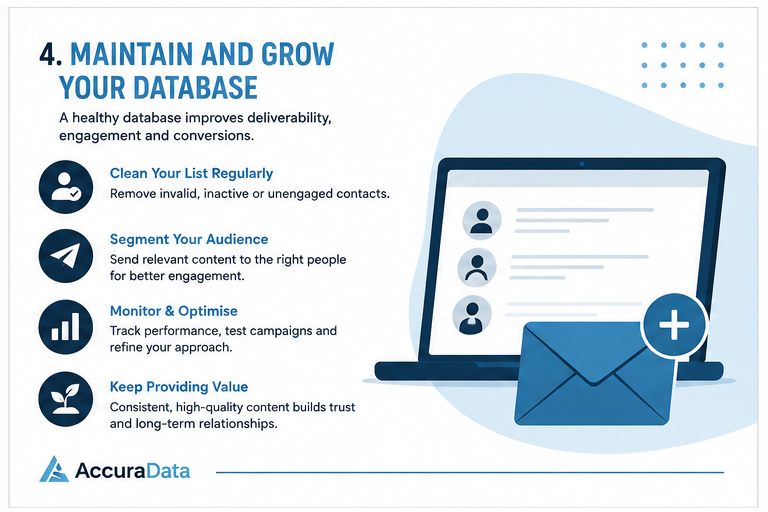
A UK email database is not a static asset. It degrades continuously as contacts change jobs, abandon email addresses, change their preferences, and disengage from brands they once followed. Email lists lose accuracy at 20 to 25% per year without active maintenance. A database that is accurate today will carry a meaningful proportion of invalid, stale, or suppressed records within twelve months if it is not regularly verified and cleaned. This decay has both commercial and compliance consequences: stale addresses generate hard bounces that damage sender reputation with inbox providers, and addresses whose owners have objected to contact but whose suppression records were not applied generate PECR violations when they receive subsequent campaigns.
Active Mailbox Verification
Active mailbox verification goes beyond checking that an email address is correctly formatted or that the domain exists. It sends a signal to the address to confirm that it is live and accepting mail, identifying addresses that look structurally correct but are no longer active: abandoned accounts, addresses where the inbox owner has left the company, and addresses that have been decommissioned. This is the most important single maintenance step for any UK email database, and it should be performed before every major campaign launch and at least quarterly as a standing maintenance exercise. AccuraData’s email verification service applies active mailbox verification to existing databases, alongside role-based and spam trap removal, Companies House cross-referencing for B2B contacts, and engagement-based suppression recommendations.
Handling Hard Bounces
Hard bounces occur when an email address is permanently undeliverable: the mailbox does not exist, the domain is no longer active, or the address has been decommissioned. Hard bounced addresses must be removed from the active UK email list immediately after the bounce is recorded. Continuing to send to hard bounced addresses signals to inbox providers that the sender’s list is not being maintained, contributing to the reputation scoring that determines inbox placement. A sustained hard bounce rate above 2% is a signal that the database quality requires urgent attention before the sender’s domain suffers lasting deliverability damage.
Suppression List Management
The suppression list is the mechanism through which opt-outs, objections, and known-bad addresses are prevented from receiving future campaigns. Every contact who has asked not to be contacted must be added to the suppression list immediately and that list must be applied before every send without exception. Every hard bounce should be suppressed. Every spam complaint record should be suppressed. The suppression list is not a channel-specific document: a consumer who opts out of email should also be suppressed from any other marketing channel unless separate consent for that channel has been obtained.
Suppression list failure is one of the most common causes of PECR enforcement action. As enforcement analysis from 2025 shows, several organisations were penalised because data synchronisation failures between their marketing platform and their CRM were overwriting suppression records, causing contacts who had unsubscribed to receive subsequent campaign emails. Building suppression management as a documented, tested process rather than an assumed feature of the platform prevents this category of compliance failure.
Companies House Cross-Referencing for B2B Databases
For a UK business email database, regular cross-referencing against the Companies House live register identifies dissolved companies, organisations in administration, and businesses that have changed their registered details since the contact record was last updated. Companies House recorded more than 726,000 company dissolutions in the financial year ending March 2025. Every one of those dissolutions potentially represents a contact in a B2B database whose email address is now invalid or reassigned. Identifying and removing these records prevents wasted campaign spend and keeps the database’s bounce profile within deliverability-safe ranges. AccuraData’s data cleansing and enrichment service includes live Companies House checks as a standard component of the B2B database cleaning process.
Deliverability: Why Your UK Email Database Determines Inbox Placement
The 2025 deliverability environment has changed the stakes around UK email database quality from a campaign performance variable to a technical infrastructure requirement. Google and Yahoo introduced mandatory sender authentication requirements in 2024, covering SPF, DKIM, and DMARC records, for any domain sending more than 5,000 emails per day. Microsoft followed with equivalent requirements for Outlook, Hotmail, and Live.com inboxes in May 2025. Non-compliant senders are now being routed to Junk folders rather than reaching the inbox, regardless of content quality or relevance.
Within this environment, the quality of the UK email database behind a campaign is not just a targeting consideration. It is a sender reputation consideration. High bounce rates from invalid addresses, low engagement signals from large numbers of unengaged or disengaged contacts, and spam complaint rates above 0.3% all directly damage sender reputation with inbox providers. That reputation damage then affects the deliverability of every subsequent campaign, including to the valid, engaged contacts the sender most wants to reach. Cleaning and maintaining the database is not a marketing optimisation task. It is an infrastructure maintenance task that determines whether the sending domain remains trusted.
The practical benchmarks to monitor are bounce rate below 2%, spam complaint rate below 0.1%, and click-through rate as the primary engagement indicator (given that Apple Mail Privacy Protection has made open rates an unreliable measure of genuine engagement since MPP prefetches images for a majority of iOS mail users). Tracking these metrics at the segment level, rather than across the full UK email database, isolates problems to specific cohorts and enables targeted remediation before deliverability damage spreads across the full programme.
How AccuraData Helps You Build and Maintain a UK Email Database
AccuraData works with UK businesses at every stage of the UK email database lifecycle. For businesses that need verified contact data before their organic list has reached a useful scale, we supply validated B2B and consumer email databases segmented by industry, geography, company size, and job function at competitive rates. Every record goes through active mailbox verification before delivery. Every dataset is supplied with a Data Processing Agreement and the compliance documentation to support lawful outreach from day one.
For businesses with an existing UK email database that has not been recently cleaned or verified, our data cleansing and enrichment service applies active mailbox verification, role-based address and spam trap removal, Companies House live cross-referencing for B2B contacts, and suppression management recommendations to the data you already hold. We return a clean, structured, and compliantly documented dataset that your campaigns can be launched from with confidence.
For businesses building specialist UK email lists for specific sectors, we supply targeted datasets covering professions including estate agents, architects, and many other industry verticals, each verified and segmented to decision-maker level. For businesses running telephone outreach alongside email campaigns from the same dataset, our TPS and CTPS checking service screens telephone fields in the same submission, delivering a multi-channel dataset that is compliant across every outreach channel.
Pricing is competitive and transparent, structured to make regular verification and refresh cycles a realistic operational standard. Speak to our team to discuss what our UK email database looks like for your specific target audience, what segmentation and compliance documentation is available, and what a campaign built on properly verified data can realistically achieve.
Building a UK Email Database Is a Discipline, Not a Task
The difference between a UK email database that compounds in commercial value over time and one that quietly degrades into a liability is almost entirely a function of how it is built, structured, and maintained. A database built with compliance in mind, structured for segmentation, verified before every major campaign, and supplemented with quality third-party data where the organic programme cannot keep pace is a genuinely valuable business asset. One that is assembled without structure, allowed to degrade without maintenance, and used without appropriate compliance documentation is a source of deliverability problems, compliance risk, and wasted campaign spend.
The businesses that generate the strongest long-term returns from email marketing are not those with the largest databases. They are those whose UK email database is accurate enough to protect their sender reputation, structured well enough to support meaningful segmentation, compliant enough to withstand scrutiny, and maintained rigorously enough to remain that way as contacts change roles, businesses dissolve, and preferences shift over time. Building to that standard requires deliberate decisions at every stage of the process. Getting those decisions right from the outset is considerably less costly than correcting them after a damaged domain reputation, an ICO investigation, or a campaign failure have made the cost of under-investment visible.