
Ask ten marketers how they built their email database for marketing and you will get ten different answers. Some will describe years of organic list-building through website opt-ins, gated content, and event sign-ups. Others will talk about using purchased third-party data to accelerate their pipeline before organic efforts could build critical mass. Most will admit, eventually, that the list they started with was not the list they needed, and that getting the data right was harder and took longer than they expected.
That experience is not unique. Creating a genuinely useful email marketing database- one that is accurate, legally compliant, structured for targeting, and maintained well enough to stay that way, requires decisions across several interconnected areas: how the data is sourced, what compliance obligations apply to each contact type, how the database is segmented and enriched over time, and how list health is managed on an ongoing basis rather than treated as a one-time setup exercise.
At AccuraData, we work with businesses that are at every stage of this process. Some come to us before their first outbound campaign, wanting a verified business email database they can use from day one. Others have an existing in-house list that has grown without structure and needs cleaning, enriching, and properly segmenting before it will perform. This article covers the full picture: what an effective email database for marketing looks like, how to build one from the ground up, when purchasing verified data makes more commercial sense than waiting for organic growth, and what needs to happen on an ongoing basis to keep the database working as a live asset rather than quietly degrading.
What an Email Database for Marketing Actually Needs to Contain
Before addressing how to create an email database for marketing, it is worth being precise about what a useful one contains, because there is a significant difference between a list of email addresses and a structured marketing database. The former is a basic input. The latter is a commercial tool.
At a minimum, a functional email marketing database contains verified email addresses alongside enough identifying information to confirm you are reaching the right person: at least a first name and surname for personalisation, and a company name for B2B contacts. In practice, a database that only contains this information severely limits what you can do with it. You cannot segment by industry. You cannot filter by seniority. You cannot personalise beyond a first name. You cannot determine which contacts have previously engaged and which have gone cold.
A properly structured email database for marketing goes considerably further. For B2B campaigns, it contains job title, seniority level, department, company size by employee count, industry classification to SIC code level, geographic location, and ideally telephone numbers and postal addresses to support multi-channel outreach. For consumer campaigns, it includes demographic attributes such as age range, gender, household composition, homeownership status, income banding, and lifestyle interest categories where available from consented sources. And for both contact types, it includes consent records or documented lawful basis information: the compliance layer that determines what you can legally do with each record and on which channel.
The richer the dataset, the more useful the database becomes, because richer data supports more precise segmentation, which directly drives better campaign performance. Segmented email campaigns generate 14% higher open rates and 28% higher click-through rates than unsegmented sends. Advanced personalisation enabled by structured data has been associated with revenue increases of up to 760%. These returns are only accessible when the marketing email database contains the fields to support meaningful targeting, not just a list of addresses to send to.
Building an Email Database for Marketing from Scratch: Organic Methods
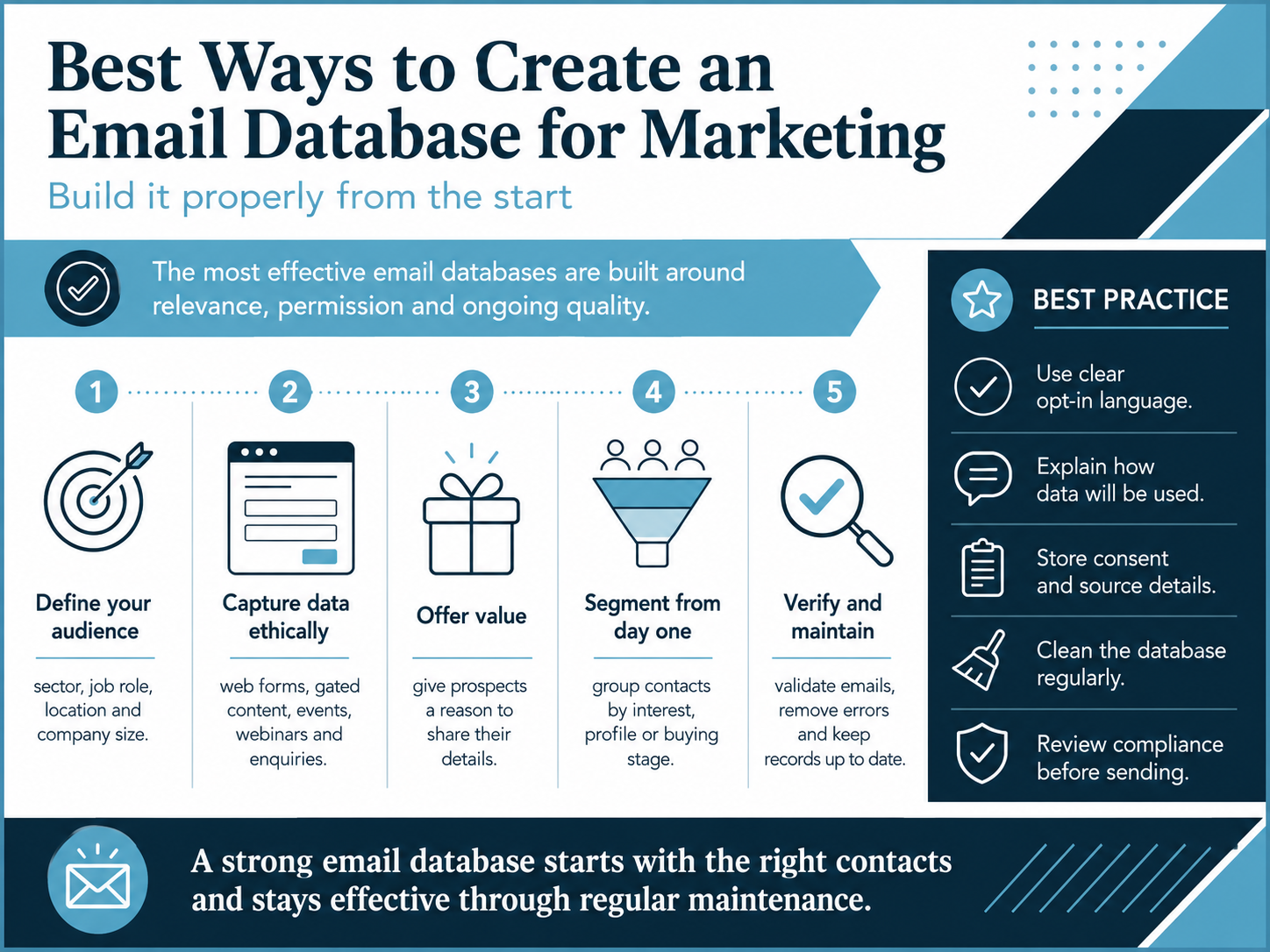
Organic list building, growing a marketing email database through consented sign-ups generated by your own marketing activity is the approach that produces the most engaged contacts over time. Every individual on an organically built list has actively indicated interest in your brand, product, or content, which tends to generate higher open rates, higher click-through rates, and lower unsubscribe rates than contacts acquired through third-party data sources. The trade-off is time: an organic list builds slowly, and for businesses that need pipeline now rather than in eighteen months, it is rarely sufficient on its own.
Gated Content and Lead Magnets
The most consistently effective organic list-building tactic in B2B marketing is the lead magnet: a piece of genuinely useful content, a guide, a template, a benchmark report, a tool, offered in exchange for an email address and the opt-in consent to receive further marketing. Lead magnets remain one of the best places to start when building email lists, provided the content offered is actually valuable to the specific audience you want to attract. The purpose of a lead magnet is not simply to collect addresses. It is to collect the addresses of people with a genuine interest in the problem your product or service solves. A download that attracts the wrong audience builds a large email database for marketing that performs poorly, because the contacts are not prospects.
Industry-specific content tends to attract higher-quality sign-ups than generic material. A guide to managing supplier contracts will attract procurement professionals. A benchmark report on email marketing performance will attract marketers. A template for a sales pipeline report will attract sales directors. The lead magnet self-selects the audience, and the quality of that self-selection determines the commercial value of the resulting addition to your email marketing database.
Website Opt-In Forms
Every business with a website has the opportunity to convert visitors into email database contacts through well-placed opt-in forms. The placement and the proposition matter more than most businesses realise. A generic ‘sign up for our newsletter’ form sitting at the foot of a homepage will convert at a fraction of the rate of a form that offers something specific, such as a weekly insight, a first-look at product updates, or an exclusive resource, placed in the context of the page where it is most relevant. Exit-intent forms, which appear when a visitor is about to leave, consistently outperform static footer forms in conversion rate studies, because they present the offer at the moment of highest attention before the session ends.
The compliance requirement for website opt-in forms is that consent must be active: the visitor must take a positive action to subscribe. Pre-ticked boxes, implied consent, and bundled opt-ins within terms and conditions all fail the PECR standard for consumer email marketing. The form must make clear what the subscriber is signing up for, how frequently they will receive communications, and who will be contacting them. This is not merely a legal obligation. It is also a quality filter: a form that is transparent about what it is offering tends to attract contacts who actually want what you are describing, which produces a better email database for marketing than one that obscures the proposition and captures reluctant sign-ups who subsequently disengage or unsubscribe.
Events, Webinars, and Conferences
Face-to-face and virtual events are a high-quality source of consented contacts for a marketing database. Individuals who register for a webinar, attend a trade show, or participate in a workshop have demonstrated a clear interest in the topic area being addressed. Provided the event registration process includes a transparent marketing opt-in, which it must, under PECR, to lawfully add the contact to a marketing email list, event-sourced contacts tend to be among the most engaged additions to any email database for marketing
The follow-up sequence after an event is where much of the value is won or lost. A timely, specific, event-referenced email that arrives within 24 to 48 hours of attendance, while the connection is fresh, consistently outperforms a generic welcome email sent days later. Personalising the follow-up sequence based on the session the contact attended, or the topic they indicated interest in during registration, is a standard practice for organisations that treat their event contacts as high-value additions to a structured email marketing database rather than as a list to be bulk-emailed once.
Referral and Partnership Programmes
Existing subscribers and customers are an underused source of new additions to a marketing email database. A structured referral programme that incentivises current contacts to share content or refer colleagues to an opt-in page extends organic reach into networks that cold outreach cannot easily access. Similarly, co-marketing partnerships with complementary, non-competing businesses allow both parties to reach each other’s opted-in audiences through joint content, joint webinars, or joint guides, each of which generates a fresh opt-in from contacts who are already predisposed to the relevant topic area. Word-of-mouth referrals generate higher long-term engagement because the trust implicit in a peer recommendation carries into the subscriber’s relationship with the brand from the outset.
When to Buy a Verified Email Database for Marketing
Organic list building is the right long-term strategy for most businesses. It is also slow, and for businesses that need to generate pipeline quickly, cannot afford to wait twelve to eighteen months for an organically built list to reach a useful size, or are entering a new market where they have no existing contacts, purchasing a verified email database for marketing from a reputable supplier is a commercially rational decision rather than a shortcut.
The key distinction is between purchasing data as a shortcut around quality and purchasing it as a mechanism to accelerate reach into a defined, relevant audience. A low-quality, unverified bulk list purchased on price will produce the outcomes that give purchased data a poor reputation: high bounce rates, deliverability damage, complaint rates that threaten the sending domain, and a compliance exposure that no business should be carrying. A high-quality, verified, segmented email database for marketing purchased from a supplier with documented compliance processes produces a different outcome: clean data for a defined target audience, with the segmentation fields needed to support relevant outreach from day one.
The situations where purchasing a verified email marketing database makes clear commercial sense include: launching outreach into a new sector or geography where the business has no existing contacts; supplementing an organic list that covers only a fraction of the addressable market; building a pipeline fast enough to justify a sales hire before the organic list can support it; and prospecting for a specific decision-maker type, such as a finance director at a company of a particular size in a particular sector, that would take months to identify and compile manually. For UK-focused marketing campaigns, the most cost-effective list-building approaches combine emails of genuine relevance with regular list hygiene, whether that list is organically built, purchased, or a combination of both.
AccuraData: We supply verified, segmented email databases for marketing to UK businesses at competitive rates, with every record verified at mailbox level before delivery. Our databases are available for both B2B and consumer campaigns, segmented by industry, geography, company size, and job function. Every dataset comes with a Data Processing Agreement and full compliance documentation. Explore our business email lists or speak to our team about what our data looks like for your specific target audience.
Legal Compliance: What the Law Requires When Creating an Email Database
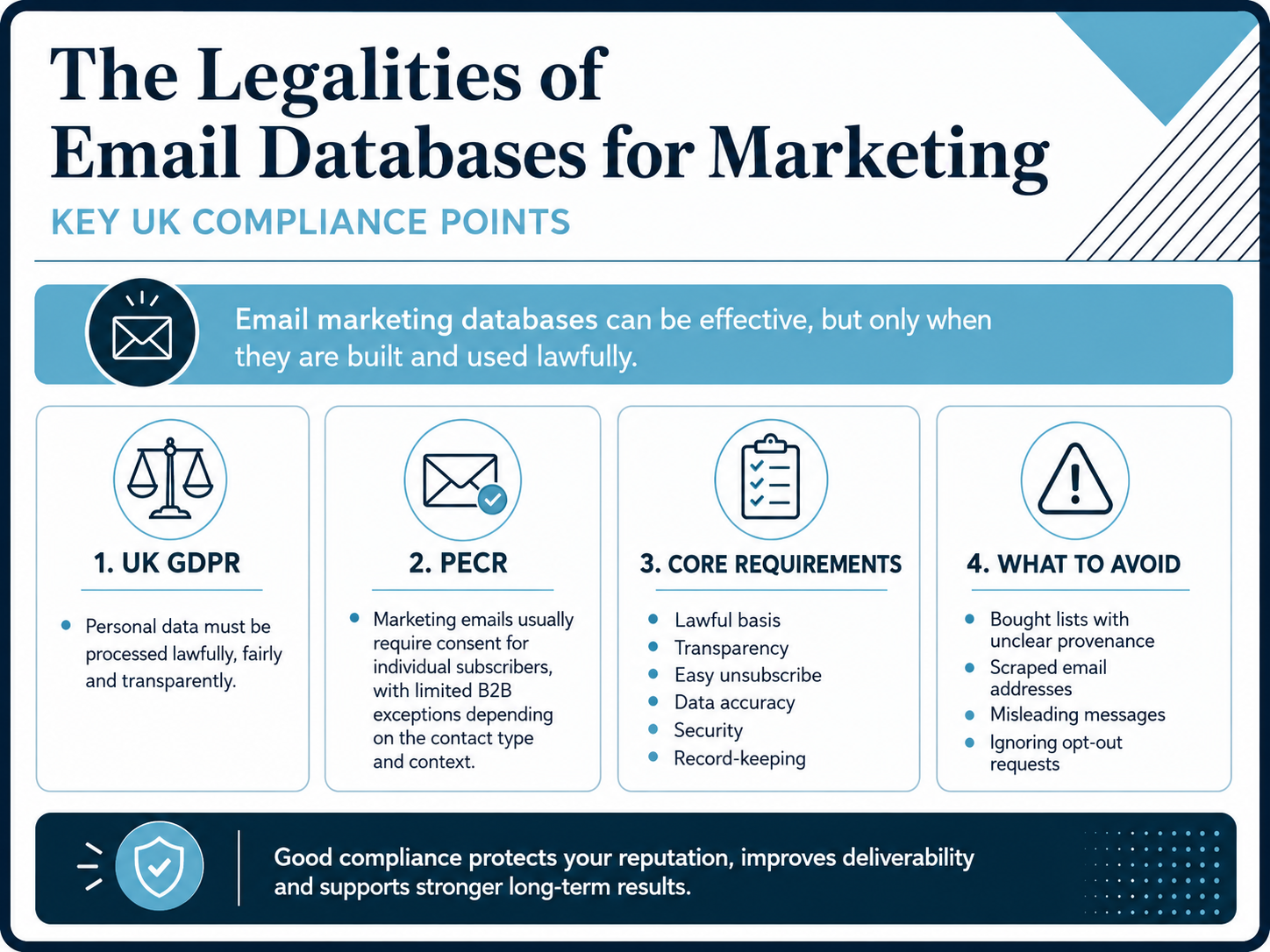
The legal framework for creating and using an email database for marketing in the UK is governed by two pieces of legislation that apply simultaneously: UK GDPR and the Privacy and Electronic Communications Regulations 2003 (PECR). Understanding how they apply to different contact types is essential before the first email is sent.
Consumer Email Contacts: Consent Is Required
For marketing emails sent to individuals, including consumers, sole traders, and most partnerships, PECR requires prior opt-in consent. This consent must be freely given, specific, informed, and unambiguous. Every consumer contact added to an email database for marketing must have actively opted in to receive marketing emails from your specific organisation, with a clear understanding of what they were signing up for. Organically built lists satisfy this requirement through the opt-in mechanism used at the point of collection. Purchased consumer email data must come from a supplier who can demonstrate that the consent was obtained to PECR standard and provide the documentation to prove it.
B2B Email Contacts: Legitimate Interests
For marketing emails sent to named contacts at limited companies and other incorporated entities, PECR’s consent requirement does not apply in the same way. B2B email outreach to corporate subscribers can be conducted on the basis of legitimate interests under UK GDPR, without prior opt-in consent from each recipient. This is why B2B cold email outreach using purchased data is a lawful commercial practice in the UK, provided the legitimate interests basis is properly documented and applied.
Legitimate interests is not a free pass. It requires a documented balancing test demonstrating that the commercial interest is proportionate and does not override the individual’s reasonable privacy expectations. Every B2B outreach email must include a clear opt-out mechanism, opt-out requests must be honoured immediately, and businesses must be transparent about the source of a contact’s data if asked. A B2B email marketing database built without these compliance safeguards in place is a legal liability, not an asset.
Accountability: Record-Keeping for Both Contact Types
UK GDPR’s accountability principle requires that organisations can demonstrate compliance, not merely assert it. For an email database for marketing, this means maintaining records of how consent was obtained for consumer contacts, what legitimate interests assessment applies to B2B contacts, when the data was last verified, and how opt-outs and suppression have been managed over time. The ICO expects to see this documentation during investigations, and the inability to produce it is itself treated as evidence of systemic non-compliance. Building documentation processes into the database from the outset is considerably less burdensome than reconstructing them after a complaint has been received.
Structuring Your Email Database for Marketing: Segmentation from Day One
The most common structural mistake made when creating an email database for marketing is treating it as a single list. A single list means a single message sent to every contact, regardless of who they are, what sector they work in, what role they hold, or what their history with your brand looks like. This approach produces mediocre results across the board, because the message is optimised for nobody in particular.
Building segmentation into the marketing email database structure from the outset, rather than as an afterthought, is the practice that most directly determines long-term campaign performance. Segmentation requires two things: the data fields to identify meaningful groups within the database, and the discipline to create and maintain distinct segments as the list grows.
Segment by Source and Intent
The first and most basic segmentation is by how a contact entered the email database for marketing. Contacts who downloaded a specific guide, attended a specific event, or signed up through a specific page have already indicated something about their interests and intent. Capturing the source of every contact at the point of entry and maintaining it as a database field allows future campaigns to be targeted at contacts who entered through a particular source, with messaging that builds on what that source already told you about their interests.
Segment by Firmographic or Demographic Profile
For B2B databases, the primary segmentation dimensions are industry, company size, and job function. A message about a financial compliance product should go to finance professionals in regulated industries, not to every contact in the database regardless of sector or role. For consumer databases, age range, location, and household attributes are the primary filters. Whichever audience type the database covers, segmentation by profile allows each group to receive messaging that is relevant to their specific context, rather than a generic version that is relevant to nobody’s context specifically.
Segment by Engagement History
As the email database for marketing is used over time, engagement data accumulates that is more valuable for targeting than any static profile attribute. A contact who opened the last five campaigns but never clicked through has a different profile from one who clicked through twice and then went cold, and both are different from a contact who has not engaged with anything in six months. Maintaining engagement segments and using them to vary message frequency, content depth, and offer type is the practice that drives the strongest long-term returns from an email marketing database, and it is only possible when engagement data is captured and maintained at the contact level.
Maintaining Your Email Database for Marketing: The Ongoing Work
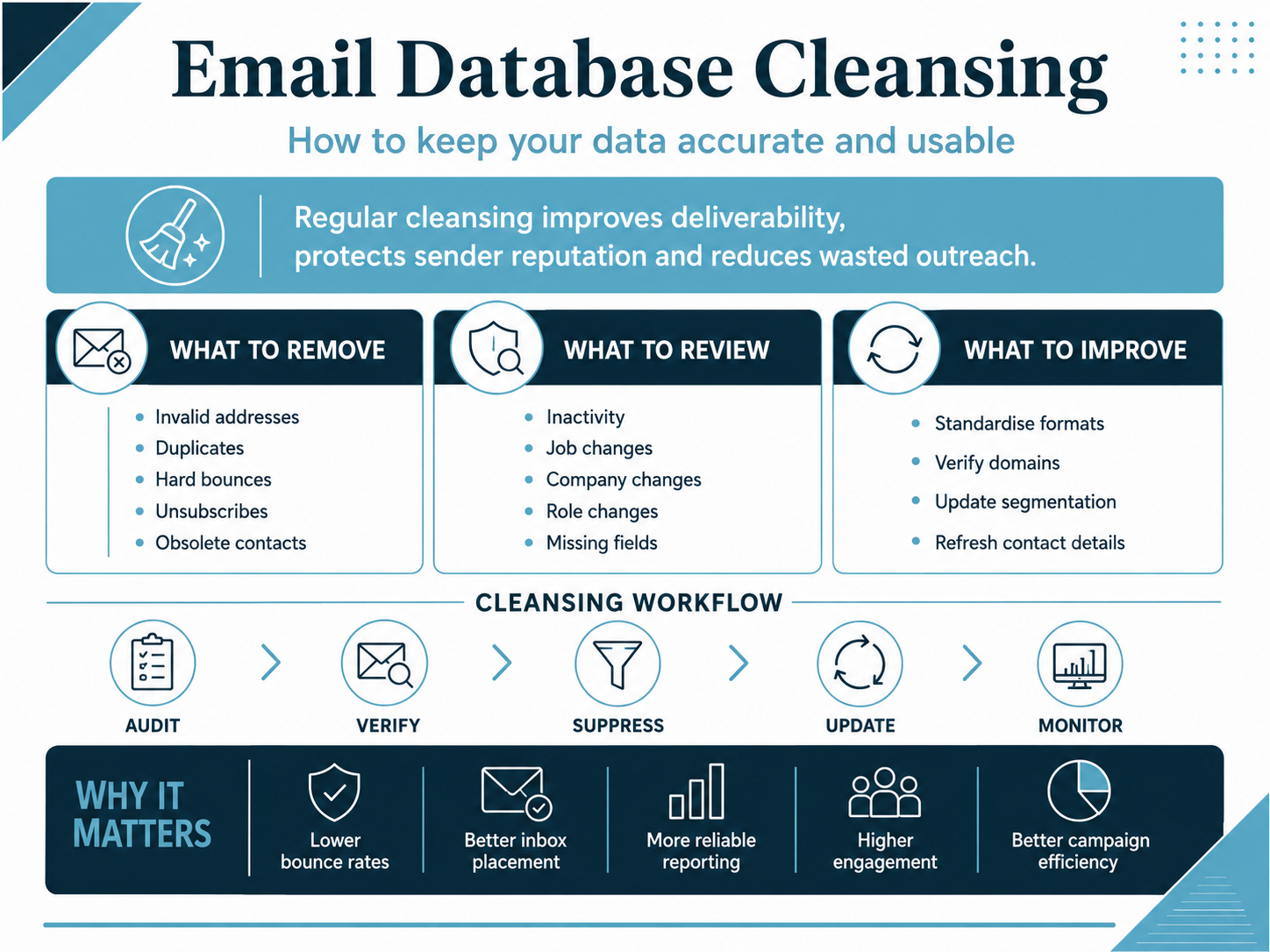
Creating an email database for marketing is not a one-time exercise. It is an ongoing operational commitment. Contact data degrades continuously: people change jobs, abandon email addresses, change their preferences, and disengage from brands they once followed. Email lists decay at 20 to 25% per year without active maintenance, which means that even a database built with excellent data at launch will become significantly less accurate within twelve months if it is not regularly cleaned, verified, and updated.
Remove Hard Bounces Immediately
A hard bounce occurs when an email address is permanently undeliverable: the mailbox does not exist, the domain is no longer active, or the address has been decommissioned. Hard bounced addresses must be removed from the active email database for marketing immediately after the bounce is recorded. Continuing to send to hard bounced addresses is not only pointless. It signals to inbox providers that the sender’s list is not being maintained, which contributes to the reputation scoring that determines inbox placement for every future campaign. A sustained bounce rate above 2% is a strong indicator of list quality problems that will progressively worsen without intervention.
Verify the Database Before Major Campaigns
Even an organically built, well-maintained email marketing database benefits from active verification before a major campaign launch. Verifying at mailbox level, rather than just checking for format and domain validity, identifies addresses that look correct but are no longer live: abandoned accounts, addresses where the inbox owner has left the company, and addresses that have been reassigned to a different individual. Only 23.6% of marketers verify their email lists before campaigns, which means the majority are absorbing the deliverability damage of sending to unverified contacts on a recurring basis. AccuraData’s email verification service applies active mailbox verification to your existing database, identifying and flagging the categories of address that create deliverability risk before they affect your next campaign.
Manage Unengaged Contacts Actively
Contacts who have not opened or clicked anything in twelve months are contributing negative engagement signals to your sender reputation without generating any commercial return. The right approach is a structured re-engagement campaign: a specific sequence sent to dormant contacts offering something valuable, asking them to confirm their interest, or simply acknowledging they have not heard from you in a while. Those who respond should be moved back into the active segment. Those who do not, after a reasonable number of attempts, should be suppressed rather than left on the list generating ongoing deliverability drag.
This practice feels counterintuitive to many marketing teams, because it involves making the email database for marketing smaller. The reality is that a smaller, actively engaged database consistently outperforms a larger, disengaged one on every metric that matters: open rates, click-through rates, conversion rates, and the deliverability score that determines how the next campaign lands. Quality over quantity in a marketing email database is not a preference. It is a performance and infrastructure imperative.
Maintain Your Suppression List
Every contact who opts out of communications must be added to a suppression list that is applied before every send. Every hard-bounced address should be suppressed. Every contact where a spam complaint has been generated should be suppressed. The suppression list is not a separate database. It is a negative filter applied to the email database for marketing that prevents regulated and disengaged contacts from being included in future campaigns. Failing to maintain and apply a suppression list is a PECR compliance failure as well as a deliverability risk, and it is one of the most common findings in ICO enforcement investigations into organisations whose email marketing has generated complaints.
AccuraData Data Cleansing: If your existing email database for marketing has not been professionally cleaned recently, our data cleansing and enrichment service applies active mailbox verification, role-based and spam trap removal, Companies House live checks to identify dissolved companies, and suppression file management in a single submission. We return a clean, structured dataset with compliance documentation included. For businesses also running telephone outreach from the same contact base, our TPS and CTPS checking service can be run against the telephone fields in the same process.
How AccuraData Supports Every Stage of Email Database Creation
AccuraData works with businesses at every stage of the email database for marketing lifecycle. For businesses that need verified contact data before their organic list has reached a useful scale, we supply validated B2B email marketing databases segmented by industry, geography, company size, and job function at competitive rates. For businesses targeting specific sectors or professions, we supply specialist lists including estate agents, architects, and a wide range of other verticals, each verified and segmented to decision-maker level.
For businesses with an existing email database for marketing that needs cleaning before its next campaign, our data cleansing and enrichment service applies mailbox-level verification, role-based and spam trap removal, Companies House cross-referencing, and engagement-based suppression recommendations to data you already hold. We return a clean, compliant, and clearly documented dataset that is ready to use from delivery, alongside a Data Processing Agreement that covers our role as your data processor.
If you want to understand what our email database for marketing looks like for your specific audience, or what our data cleansing service would do for the list you already hold, speak to our team. We will give you a clear picture of what is available, at what cost, and what a campaign built on properly structured, verified data can realistically achieve.
Building an Email Database for Marketing Is a Long Game
An email database for marketing is the most durable asset a marketing function can own. Unlike paid media spend, which generates traffic only for as long as the budget runs, or social following, which is subject to platform algorithm changes, a well-built, well-maintained email contact database compounds in value over time. Every campaign adds engagement data that improves future targeting. Every opt-in grows the audience. Every cleaning cycle makes the data more accurate and the deliverability more reliable.
The businesses that generate the strongest long-term returns from email marketing are those that treat the email database for marketing as a strategic asset from the outset: building it with compliance in mind, structuring it for segmentation, maintaining it with the discipline to remove what is not working, and supplementing it with verified third-party data where the organic list cannot reach fast enough. That combination, organic growth supported by quality purchased data, cleaned and structured as an ongoing operational discipline, is what an effective email marketing database looks like in practice.