
Every email campaign begins the same way. A message is written, a send is scheduled, and a list is selected. The list is where the outcome is effectively decided, before the subject line has been tested, before the copy has been proofed, before the send button has been pressed. The email marketing database underpinning a campaign determines who receives the message, whether the message arrives in their inbox or their spam folder, whether the address is live or long-abandoned, and whether the sender’s domain remains trusted enough by inbox providers for the next campaign to fare any better. Getting the data right is not a supporting task to campaign strategy. It is the foundation on which campaign strategy either stands or fails.
The case for investing in email as a channel has never been stronger. Email marketing generates between £36 and £42 for every £1 spent, outperforming paid search, paid social, and display advertising by a margin that has held consistently across years of independent benchmarking. 376.4 billion emails are sent every day in 2025, and the global email marketing industry is growing at a compound annual rate that is expected to take its value to nearly £18 billion by 2027. The channel is not declining. It is growing, and the businesses achieving the strongest results within it are those whose email marketing databases are accurate, well-maintained, compliantly sourced, and thoughtfully segmented.
At AccuraData, we supply verified, UK GDPR and PECR compliant email marketing databases to businesses across a wide range of sectors and campaign types. We understand that the list is where results are generated or squandered, and our data is built around the principle that every record we supply should work: arriving at a live mailbox, belonging to a real individual in a relevant role, and carrying the legal documentation to support compliant outreach from day one. This article explains what a well-built email marketing database actually looks like, how the UK legal framework governs its use, how the deliverability environment of 2025 has made data quality a technical as well as a commercial necessity, and how to deploy email contact data in ways that generate meaningful returns rather than compliance problems and reputation damage.
What an Email Marketing Database Actually Is
The phrase email marketing database is used loosely enough that it is worth being precise about what it means when it is being used well. At its most basic, an email contact database is a structured set of records containing email addresses and enough associated information to allow those addresses to be used for targeted outreach. At its most useful, it is a rich dataset that includes names, job titles, company information for B2B campaigns, demographic attributes for consumer campaigns, engagement history, and the segmentation tags and consent records needed to use the data correctly.
This distinction between a basic list of email addresses and a well-structured marketing email database is not cosmetic. It is the difference between being able to send one version of a message to every contact on a list and being able to send twenty versions, each tailored to the specific profile of a segment, each meaningfully more likely to generate a response than a generic broadcast. Advanced personalisation driven by rich email database data can increase email revenue by up to 760%. Segmented campaigns achieve 14% higher open rates and 28% higher click-through rates than unsegmented sends. These are outcomes that are only achievable when the underlying email marketing database contains the structured data fields needed to support them.
An email database for marketing also needs to include consent records and sourcing documentation that are not directly visible in a campaign send but that are fundamental to using the data compliantly. For B2B campaigns, this means records of the lawful basis on which personal data is being processed. For consumer campaigns, it means documented opt-in consent records that meet the standard required under PECR. Without this documentation, an email list is not a marketing asset. It is a compliance liability that can generate ICO enforcement action from the first campaign that produces a complaint.
The Legal Framework: How UK GDPR and PECR Govern Your Email Marketing Database
The compliance framework for email marketing in the UK is one of the most frequently misunderstood areas of marketing law, partly because the rules are different depending on who you are emailing and through which channel, and partly because the consequences of getting it wrong have increased substantially under the Data (Use and Access) Act 2025, which raised maximum PECR penalties to match UK GDPR levels of up to £17.5 million or 4% of global annual turnover.
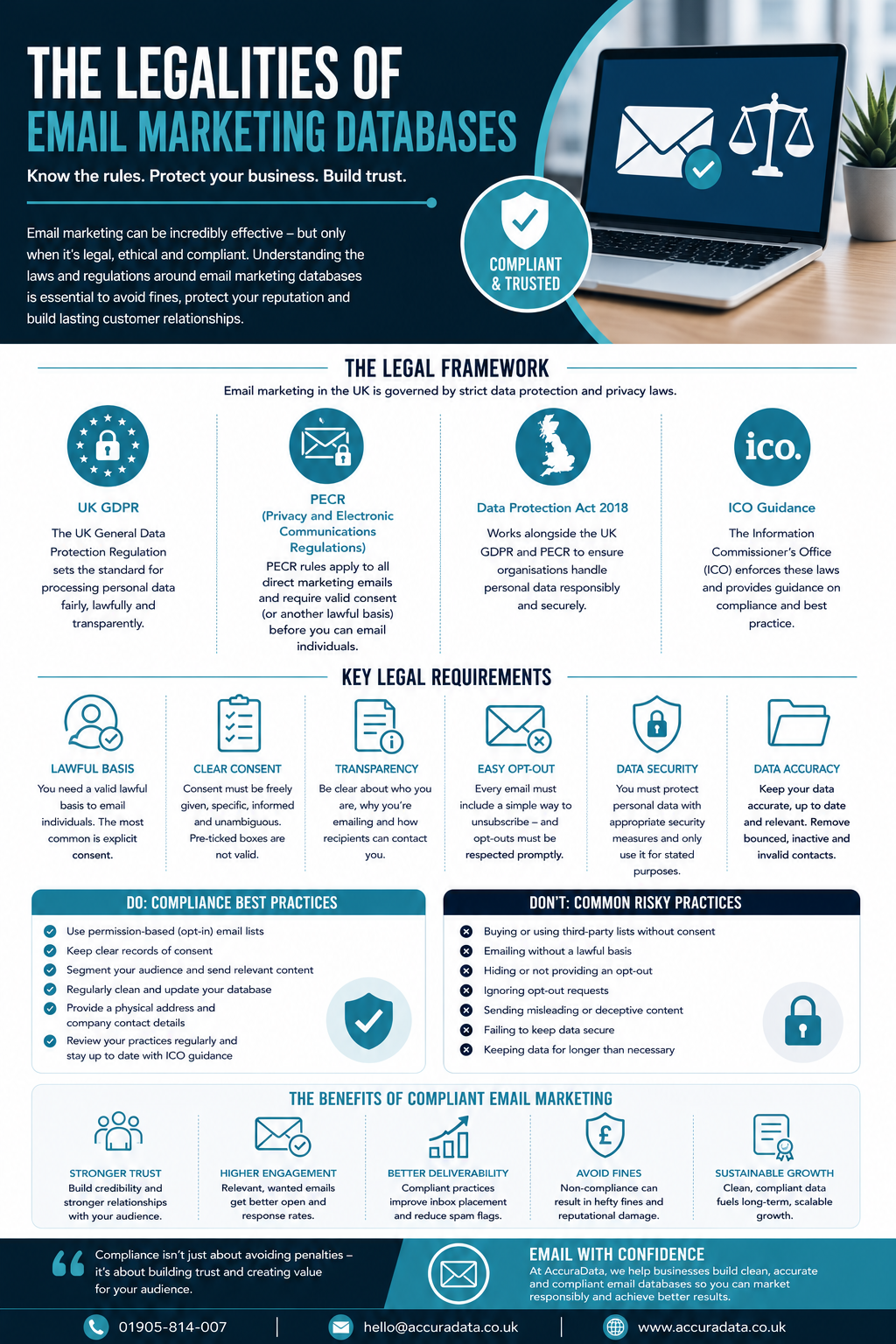
Two pieces of legislation apply simultaneously to any email marketing database used for outreach campaigns in the UK: UK GDPR and the Privacy and Electronic Communications Regulations 2003 (PECR). They apply in parallel, and both must be satisfied. Satisfying one while failing the other is still non-compliance.
PECR: Consent for Consumer Email Marketing
PECR imposes a specific consent requirement for marketing emails sent to individual subscribers. An individual subscriber includes any natural person: consumers, sole traders outside Scotland, and most partnerships. For emails sent to these recipients, PECR requires prior opt-in consent that is freely given, specific, informed, and unambiguous. Pre-ticked boxes, bundled consent buried in terms and conditions, and vague references to allowing contact from ‘third party partners’ all fail this test. The ICO’s direct marketing guidance is explicit: consent must be a positive opt-in, and the individual must understand at the point of providing it that they are agreeing to receive marketing emails specifically from your organisation.
There is one significant exception: the soft opt-in. Under PECR, businesses can email existing customers about similar products or services without fresh consent, provided the customer was given a clear opportunity to opt out when their contact details were first collected, and the same opt-out opportunity is present in every subsequent email. This exception is narrower than it is often applied. It covers only similar products or services sold by the same business to existing customers. It does not cover prospects, new contact categories, or third-party marketing.
For businesses purchasing a consumer email marketing database, the consent for those records must have been obtained at the point of collection by the data owner, with the relevant documentation passed through to the business using the data. AccuraData’s consumer email data is sourced from opt-in partners where consent records are maintained and documented to PECR standard. We do not supply consumer email addresses where a verifiable consent trail cannot be demonstrated.
PECR: Corporate Subscribers and B2B Email Outreach
The PECR consent rules that apply to individual subscribers do not apply to corporate subscribers. A corporate subscriber is a limited company, a public limited company, a government body, or similar incorporated entity. Emailing a named contact at a limited company for marketing purposes does not require prior opt-in consent under PECR. This is the legal foundation that makes large-scale B2B email outreach from a purchased B2B email marketing database a lawful commercial practice in the UK, without the prior consent requirement that governs consumer email marketing.
However, UK GDPR still applies to any email address that identifies an individual. An address in the format firstname.lastname@company.co.uk is personal data regardless of the corporate subscriber classification, and processing it requires a lawful basis under GDPR. In B2B outreach, that basis is almost always legitimate interests, which requires a documented balancing test confirming that the commercial interest in processing the data is proportionate and does not override the individual’s privacy rights. Every outreach email must also include a clear opt-out mechanism, and opt-outs must be honoured immediately and suppressed before future sends.
The Accountability Principle: Documentation as a Legal Requirement
One aspect of UK GDPR compliance that specifically affects how an email marketing database is built and maintained is the accountability principle. Under GDPR, organisations are required to be able to demonstrate compliance, not merely assert it. For email marketing, this means maintaining documented records of how consent was obtained for consumer email data, what lawful basis applies to B2B data and the legitimate interests assessment supporting it, how the data was sourced, when it was last verified, and how opt-outs and suppression have been managed.
A marketing database that cannot produce this documentation is not compliant, regardless of how well the campaigns built on it perform commercially. The ICO’s enforcement investigations consistently reveal that businesses were not unaware of their obligations but had failed to document how they were meeting them. Documentation is the evidence the ICO asks for when a complaint triggers an investigation, and the inability to produce it is itself treated as an indicator of systemic compliance failure.
AccuraData: Every email marketing database we supply comes with a Data Processing Agreement as standard and clear documentation of the lawful basis and sourcing for every record. For B2B data, we maintain documented legitimate interests assessments. For consumer email data, we supply verifiable opt-in consent records. We are registered with the ICO and operate within the full UK GDPR and PECR framework on every engagement.
Deliverability in 2026: Why Email Database Quality Is Now a Technical Requirement
The deliverability environment for email marketing has changed significantly over the past two years, and the changes all point in the same direction: inbox providers are demanding higher standards from senders, and the primary mechanism through which those standards are assessed is the quality and engagement of the email marketing database behind a campaign. What was previously a performance consideration, keeping bounce rates low and engagement high to protect sender reputation, has become a technical compliance requirement for any business sending at meaningful volume.
In 2024, Google and Yahoo announced mandatory authentication requirements for bulk senders, requiring properly configured SPF, DKIM, and DMARC records from any domain sending more than 5,000 emails per day. Microsoft followed in May 2025 with equivalent requirements for senders reaching Outlook.com, Hotmail.com, and Live.com inboxes. As 1827 Marketing’s deliverability analysis notes, only 5% of marketers are fully prepared for Microsoft’s new DMARC requirements, despite the fact that non-compliant messages are now being routed to Junk folders. The big three inbox providers, Gmail, Yahoo, and Outlook, now effectively operate from the same rulebook: authentication, low spam complaints below 0.3%, functional unsubscribe links, and consistent list hygiene are all baseline requirements rather than best practice recommendations.
What this means in practice is that the email marketing database a campaign is sent to is no longer just a campaign performance variable. It is a technical infrastructure variable. A list with high volumes of invalid addresses produces hard bounces that damage sender reputation with inbox providers. A list with large numbers of unengaged or disengaged contacts produces low engagement signals that tell Gmail and Outlook the sender’s messages are unwanted. Senders who maintain bounce rates under 1.5% see 10 to 12% higher inbox placement, according to Validity’s 2025 Email Deliverability Benchmark Report. And only 23.6% of marketers verify their email lists before campaigns, which means the majority are accumulating reputation damage with every send they make on a list that has not been verified.
List Decay: The Rate at Which an Email Database Degrades
Email databases do not stay accurate without active maintenance. Email lists decay at 20 to 25% per year, through a combination of job changes that invalidate corporate email addresses, abandoned personal accounts, address changes at a company level, and individuals who disengage but remain on lists. A separate benchmark puts annual decay at 22 to 30% when factors including domain-level changes are included. At either figure, an email marketing database that has not been actively verified within the past six months is already carrying a meaningful proportion of records that will either bounce, trigger spam traps, or generate engagement signals so poor they pull down the performance of the entire campaign.
The categories of record that drive decay-related deliverability problems are distinct and require different handling. Hard bouncing addresses, where the mailbox does not exist or the domain has been decommissioned, should be removed immediately. Soft bouncing addresses, where the inbox is temporarily full or the server is unavailable, should be monitored and removed after repeated failures. Spam traps, which are addresses maintained by inbox providers and blacklist operators specifically to identify senders using unverified lists, represent some of the most damaging records a marketing email database can contain: a single spam trap hit does not generate a bounce, but it signals to the provider that the sender’s list contains addresses that have not been actively opted in or recently verified. Role-based addresses, such as info@, admin@, or support@, generate low engagement and high complaint rates and should be filtered before any campaign launches.
Re-engagement Before Removal: Managing Inactive Contacts
Inactive contacts represent a subtler deliverability problem than hard bounces. An address that does not generate a bounce but whose owner has not opened or clicked anything in twelve months is producing negative engagement signals that affect inbox placement for the entire list. The standard approach to managing this segment is a structured re-engagement campaign: a specific sequence of emails sent to dormant contacts with the express purpose of either reactivating their engagement or confirming that they should be suppressed. Those who respond are retained. Those who do not, after a reasonable number of attempts, should be removed from active sends rather than left on the list generating negative signals indefinitely.
This approach requires that the email marketing database contains accurate engagement history at the contact level: last open date, last click date, and the number of campaigns the contact has been included in without interaction. A database that does not capture this information at the record level cannot support a structured re-engagement strategy, because there is no way to identify which contacts are genuinely inactive as opposed to contacts whose opens are being pre-loaded by Apple Mail Privacy Protection and therefore not reflecting genuine engagement. AccuraData’s email verification service provides active mailbox verification that identifies dead and invalid addresses before they reach your sending platform, removing the hardest category of deliverability risk before your first campaign launches.
Segmentation: Where a Well-Built Email Marketing Database Pays for Itself
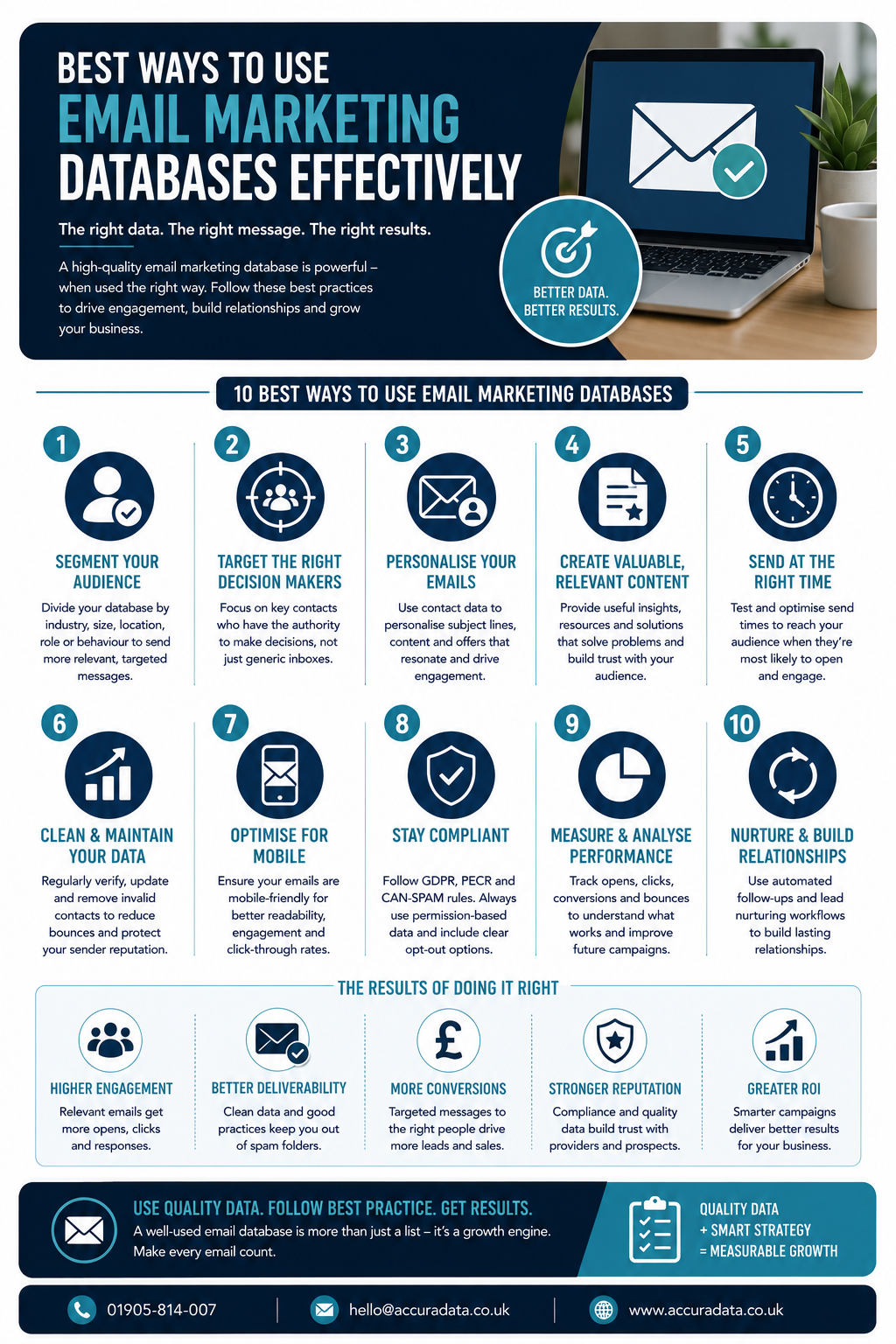
Email marketing generates the strongest returns when messages are sent to precisely defined audiences with a proposition specifically relevant to that audience’s context. This is a data management challenge before it is a copywriting one. The segmentation that drives the performance uplifts in the research, 14% higher open rates, 28% higher click-through rates, 760% more revenue in the most advanced implementations, is only possible when the email marketing database contains the structured data fields needed to divide contacts into meaningful groups and direct the right version of a message to each one.
Demographic and Firmographic Segmentation
The most fundamental segmentation divides an email contact database by the characteristics of its recipients: industry, company size, and job function for B2B databases; age range, gender, household composition, and geographic region for consumer databases. This level of segmentation is achievable with most well-built databases and produces immediate and measurable performance improvements over unsegmented sends. A sales message for a financial software product sent to an unfiltered mix of accountants, HR directors, and operations managers will perform significantly worse than the same message sent only to finance decision-makers in companies of the appropriate size, even if the copy and the offer are identical. The email database is doing the targeting work that determines whether the message reaches people with a reason to respond.
For B2B campaigns, seniority filtering deserves particular attention. The individual responsible for a purchasing decision varies by company size and sector, and an email marketing database that captures job title and seniority level allows outreach to be directed at owners and directors in small businesses, departmental heads in mid-market companies, and procurement or category managers in large organisations. Each group requires a different message, a different level of detail, and a different framing of the business case. Sending the same communication to all three is not neutral: it is relevance-neutral for at least two of them, which in 2025’s inbox environment translates directly into lower engagement and potentially higher complaint rates.
Behavioural Segmentation and Lifecycle Mapping
The most commercially powerful form of segmentation in email marketing is behavioural: using engagement data from previous campaigns to determine what each contact receives next. A contact who opened the last three campaigns but has never clicked through is a different audience from one who opened and clicked twice and then went silent. A customer who made a purchase six months ago is a different audience from one who purchased last week. Mapping these behavioural signals onto the email marketing database and using them to trigger different sequences, with different messages, different offers, and different cadences, is what separates email programmes that generate consistent revenue from those that produce average results.
Automated emails triggered by behaviour represent the clearest evidence of what behavioural segmentation achieves in practice. Despite making up only around 2% of total email send volume, automated emails drive 37% of all email-generated sales. Abandoned cart sequences, welcome journeys, post-purchase follow-ups, and win-back campaigns all operate on the same principle: the right message at the moment of demonstrated intent or behaviour. The email marketing database makes this possible by capturing the events and attributes that trigger each sequence. A database without this structure is not capable of supporting meaningful automation, regardless of how sophisticated the sending platform above it might be.
Recency and Re-engagement Segmentation
Recency-based segmentation is perhaps the most immediately actionable form of database management for any business that has been accumulating email contacts over time without a structured approach to engagement monitoring. Dividing an email marketing database into segments by last engagement date, contacts active within the past 30 days, those active within 90 days, those inactive for 90 to 180 days, and those with no recorded engagement for more than 180 days, reveals the true commercial shape of the list. The active segment drives the majority of the revenue. The inactive segment drives the majority of the deliverability risk.
Focusing campaign spend and creative attention on the active segment while running structured re-engagement campaigns for the inactive tiers, and suppressing those that do not respond, is a database management discipline with direct commercial returns. It reduces the volume of sends going to addresses that will not engage, which lowers the engagement signals the inbox provider uses to classify the sender’s reputation. Smaller, more engaged sends from a well-maintained email database for marketing consistently outperform large sends to stale lists across every metric that matters: open rates, click-through rates, conversion rates, and the sustained deliverability that makes every future campaign more effective.
Measuring What Your Email Marketing Database Is Actually Doing
The metrics that most directly reveal the health of an email marketing database are not always the ones that appear most prominently in campaign dashboards. Open rate, the traditional headline metric, has become progressively less reliable as a measure of genuine engagement since Apple’s Mail Privacy Protection (MPP) introduced pre-loading of images for a majority of iOS mail users, which registers as an open regardless of whether the email was actually viewed. As of 2025, Apple Mail holds 51.52% of global email client market share, which means that for most senders, a significant proportion of recorded opens are MPP-inflated rather than genuine. Treating open rate as a primary indicator of email database quality or campaign performance is now a structural measurement error.
The metrics that reliably reflect database quality are those that require an actual human action and are not affected by automated pre-loading. Click-through rate is the clearest: it requires the recipient to consciously engage with the content of the email, which MPP does not generate. Conversion rate, tracking actions taken after a click, is more reliable still. And the negative engagement signals, bounce rate, unsubscribe rate, and spam complaint rate, are perhaps the most diagnostic of all, because they reflect directly what the inbox provider is seeing rather than what the sender’s platform is reporting.
A spam complaint rate above 0.1% is the threshold at which Gmail begins to take action against a sender’s domain. Above 0.3%, deliverability damage becomes severe and sustained. A bounce rate above 2% signals list quality problems that are accumulating reputation damage with every send. An unsubscribe rate that is climbing across consecutive campaigns suggests either a list that was poorly sourced to begin with or a messaging mismatch between what contacts expected when they were added to the database and what they are receiving. Each of these signals is a data quality indicator as much as it is a campaign performance one, and each one should be tracked at the segment level rather than across the full list, so that problems can be isolated to the part of the marketing email database where they originate.
The Technical Infrastructure Your Email Database Must Support
The 2025 deliverability environment means that even the cleanest, most compliantly sourced email marketing database will underperform if the sending infrastructure above it is not properly configured. Authentication is now non-negotiable. SPF (Sender Policy Framework), DKIM (DomainKeys Identified Mail), and DMARC (Domain-based Message Authentication, Reporting and Conformance) records must all be correctly configured for any domain sending marketing email at volume. Domains with full DMARC enforcement are 2.7 times more likely to reach the inbox than unauthenticated domains. And DMARC adoption, despite the requirements, remains low: only 7.6% of domains currently enforce it.
Domain warm-up is a related consideration for any business launching email outreach to a purchased email marketing database from a new domain or subdomain. Inbox providers use sending history as one of the signals that determine how a new sender’s messages are classified. A domain that suddenly sends large volumes of email to cold contacts from a standing start will trigger spam filters regardless of the quality of the data or the compliance of the approach. A structured warm-up plan, beginning with small volumes sent to the most engaged and recently verified contacts, builds sending history before volumes are scaled.
These technical infrastructure requirements interact directly with the email marketing database in the sense that the database must be structured to support the monitoring that authentication requires. DMARC reporting generates data about where failures are occurring. That data needs to be reviewed against the sending domain and the contact segments being reached. A marketing database that captures the sending source alongside the contact record makes this kind of infrastructure monitoring possible at the segment level, which is where the actionable insights tend to sit.
B2B and Consumer Email Marketing Databases: How the Approach Differs
An email marketing database built for B2B outreach and one built for consumer campaigns are structurally different in ways that go beyond the obvious distinction between business and personal email addresses. Understanding these differences is essential for any business that runs both types of campaign, or that is evaluating a data supplier whose offering spans both markets.
For B2B campaigns, the primary segmentation dimensions are firmographic: SIC code industry classification, employee count, estimated annual turnover, geographic location, job title, and seniority. The contacts within the database should be named individuals in roles with relevant purchasing authority, not generic inboxes at company domains. The sourcing of B2B contact data is typically from company registries, professional databases, and verified third-party sources, with personal data processed under the legitimate interests basis as described above. The 28-day re-screening requirement for TPS and CTPS registered numbers applies when telephone data is included, and AccuraData’s TPS and CTPS checking service screens telephone fields within combined email and calling datasets before delivery.
For consumer campaigns, the segmentation dimensions shift to demographic and lifestyle attributes: age range, gender, household composition, income banding, geographic region, homeownership status, and interest categories where available from opted-in lifestyle survey data. The consent requirement under PECR applies in full to consumer email addresses, which means that a consumer email marketing database can only be used for email outreach where documented opt-in consent exists for each record. Purchasing a consumer email list and using it for broadcast email outreach without a verifiable consent trail is a PECR violation, regardless of the channel. AccuraData supplies consumer email data only where consent documentation meets the PECR standard.
AccuraData Service: Our email marketing databases cover both B2B and consumer segments, with verification, segmentation, and compliance documentation appropriate to each. For clients who want to reach specific sectors or professions, we supply specialist lists including estate agents, architects, and many other verticals, with each list verified, segmented by role and seniority, and supplied with a Data Processing Agreement as standard.
How AccuraData Builds and Supplies Its Email Marketing Databases
AccuraData supplies verified, UK GDPR and PECR compliant email marketing databases to businesses across a wide range of sectors and campaign types. Our approach to data quality starts from the position that an email marketing database should be ready to use from the moment it is delivered: every address verified at mailbox level, every record carrying the lawful basis documentation to support compliant outreach, and every dataset structured with the segmentation fields needed to support meaningful targeting from day one.
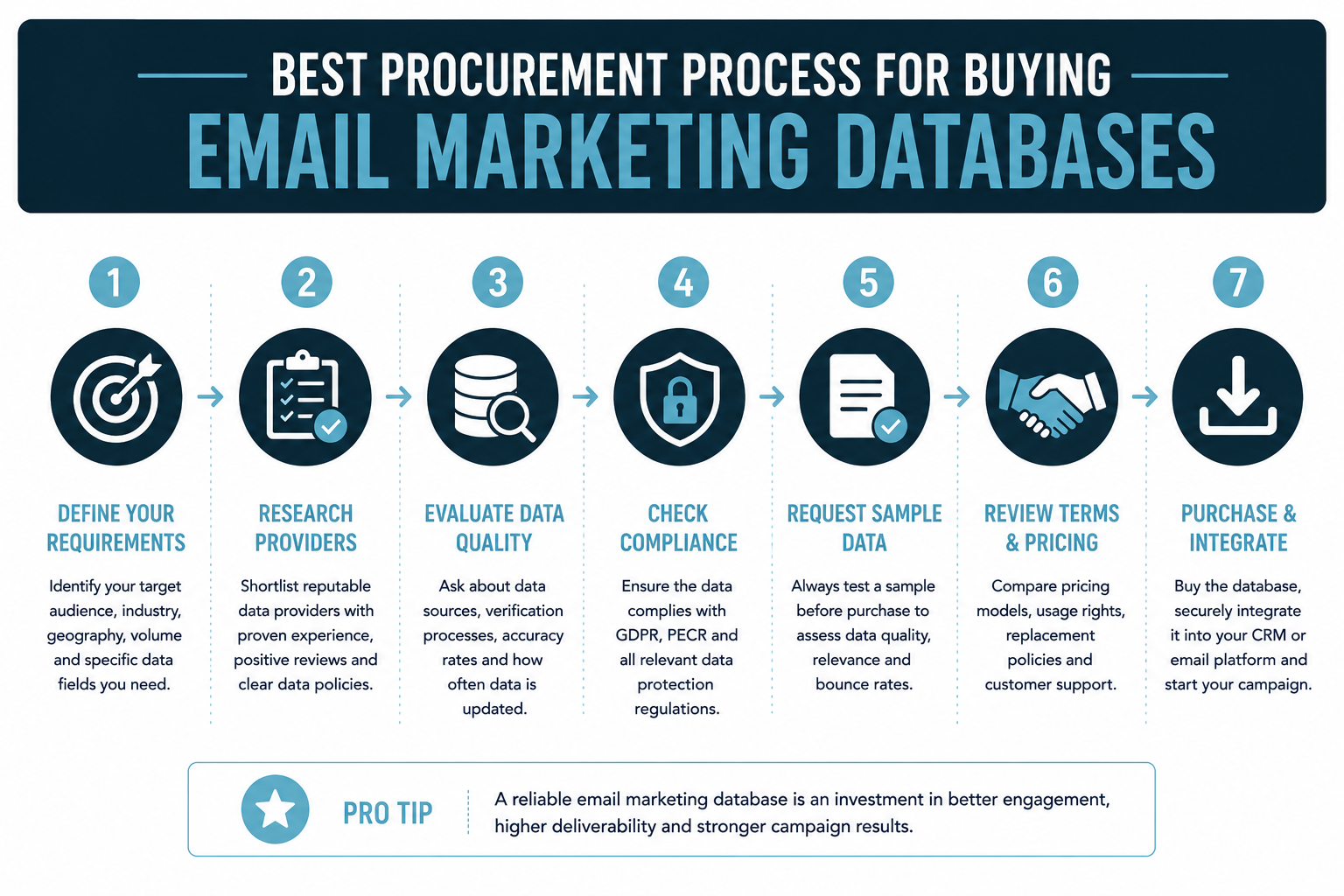
Every address in an AccuraData email contact database goes through active mailbox verification before delivery. We check that addresses are live and accepting mail, identify and remove role-based addresses that generate low engagement, flag disposable and temporary address services that should never appear in a genuine marketing database, and remove addresses associated with known spam traps. For B2B databases, we confirm job titles and seniority against current role data and cross-reference company records against Companies House to identify dissolved or dormant organisations whose contacts should not appear on an active marketing email database.
Our databases are available segmented by industry SIC code, employee count, turnover banding, geographic region, and job function across finance, operations, IT, marketing, HR, and procurement roles. For consumer campaigns, segmentation fields include age range, gender, homeownership status, household composition, and lifestyle interest categories. For clients wanting a combined view across email, telephone, and postal data, our datasets include all three contact formats where available, enabling multi-channel campaigns from a single source.
For clients with an existing email marketing database that has not been recently verified or cleaned, our data cleansing and enrichment service applies the same active mailbox verification, role-based and spam trap removal, Companies House cross-referencing, and engagement-based suppression recommendations to data you already hold. The result is a cleaned, verified, and compliantly documented dataset that your campaigns can be launched from with confidence. For clients also running telephone outreach from the same dataset, our TPS and CTPS checking service screens telephone fields in a single submission alongside the email verification process.
Our pricing is competitive and transparent, structured to make regular verification and refresh cycles a realistic operational standard rather than an occasional budget item. Data that is verified once and left to decay is a depreciating asset. Data that is maintained on a rolling basis is a compounding one. Get in touch with our team to discuss what our email marketing database looks like for your specific target audience, what segmentation and compliance documentation is available, and what a campaign built on properly verified data can realistically achieve.
The Email Marketing Database Is Where Results Are Made
The headline numbers for email marketing, £36 return per £1 spent, 37% of email-generated sales driven by automation, 760% more revenue from advanced personalisation, reflect what well-executed campaigns on well-built data achieve. They are not what happens when an unverified list is sent a generic message from a domain that has not been authenticated and whose sender reputation is already eroded by months of high bounce rates.
The email marketing database is the point at which those two outcomes diverge. A database that is verified, structured, compliant, and regularly maintained gives every other investment in email strategy, the platform, the copy, the automation, the testing, a foundation to work from. A database that is stale, unsegmented, and undocumented creates the kind of compounding deliverability, compliance, and commercial problems that take longer to fix than they took to accumulate.
AccuraData provides verified, UK GDPR and PECR compliant email marketing databases at competitive rates, with the verification rigour, segmentation depth, and compliance documentation that serious email programmes require. If you want to understand what our data looks like for your specific target audience, what channels it supports, and what it can deliver for your next campaign, the conversation starts with who you want to reach.