
Searching for where to Buy Email Lists sounds like a simple sourcing question. In practice, it is a decision about audience access, legal permissions, data quality, supplier accountability and the systems used after the list arrives. Two providers can both sell “email data” while offering very different products. One may supply a carefully defined B2B audience with current company and role information. Another may supply consumer records supported by documented consent. A third may offer a managed campaign rather than releasing a raw file at all.
That difference matters because the email address is only one field in a usable marketing asset. The buyer also needs to know who the record belongs to, why the person or company fits the campaign, where the information came from, what the permitted use is, when it was checked, how objections are handled and what happens when records fail. A cheap list with weak documentation can become expensive once bounces, complaints, wasted sales time and remediation are included.
This article answers Where to Buy Email Lists for both business-to-business and business-to-consumer campaigns in the UK. It explains the main sourcing routes, how B2B and B2C lists differ, what due diligence evidence to request, how UK GDPR and PECR affect purchased data, how to test a supplier before committing, and how to measure whether the list produces commercial value after launch.
It also explains where AccuraData fits. AccuraData supports businesses through targeted B2B Data, B2B Email Data, B2C Data, B2C Email Data, Data Cleansing and Enrichment and Data Appending. That range makes it possible to solve the audience, quality and campaign-preparation problems within one working relationship rather than treating list delivery as an isolated transaction.
A compliance note is necessary at the outset. This article provides practical marketing and procurement guidance, not legal advice. The correct approach depends on the audience, the information used, how it was obtained, the marketing message, the sender and the campaign structure. Current regulator guidance and specialist advice should be used where the position is uncertain.
Before Asking Where to Buy Email Lists, Define What You Need
The search phrase Where to Buy Email Lists often hides several different requirements. A sales team may want named decision-makers at target companies. An ecommerce business may want consumers who have agreed to relevant third-party email marketing. A CRM team may not need a new list at all, because the highest-value project could be cleansing existing records and appending missing fields. A marketing team may need a provider to run the broadcast because it does not have the infrastructure to send safely itself.
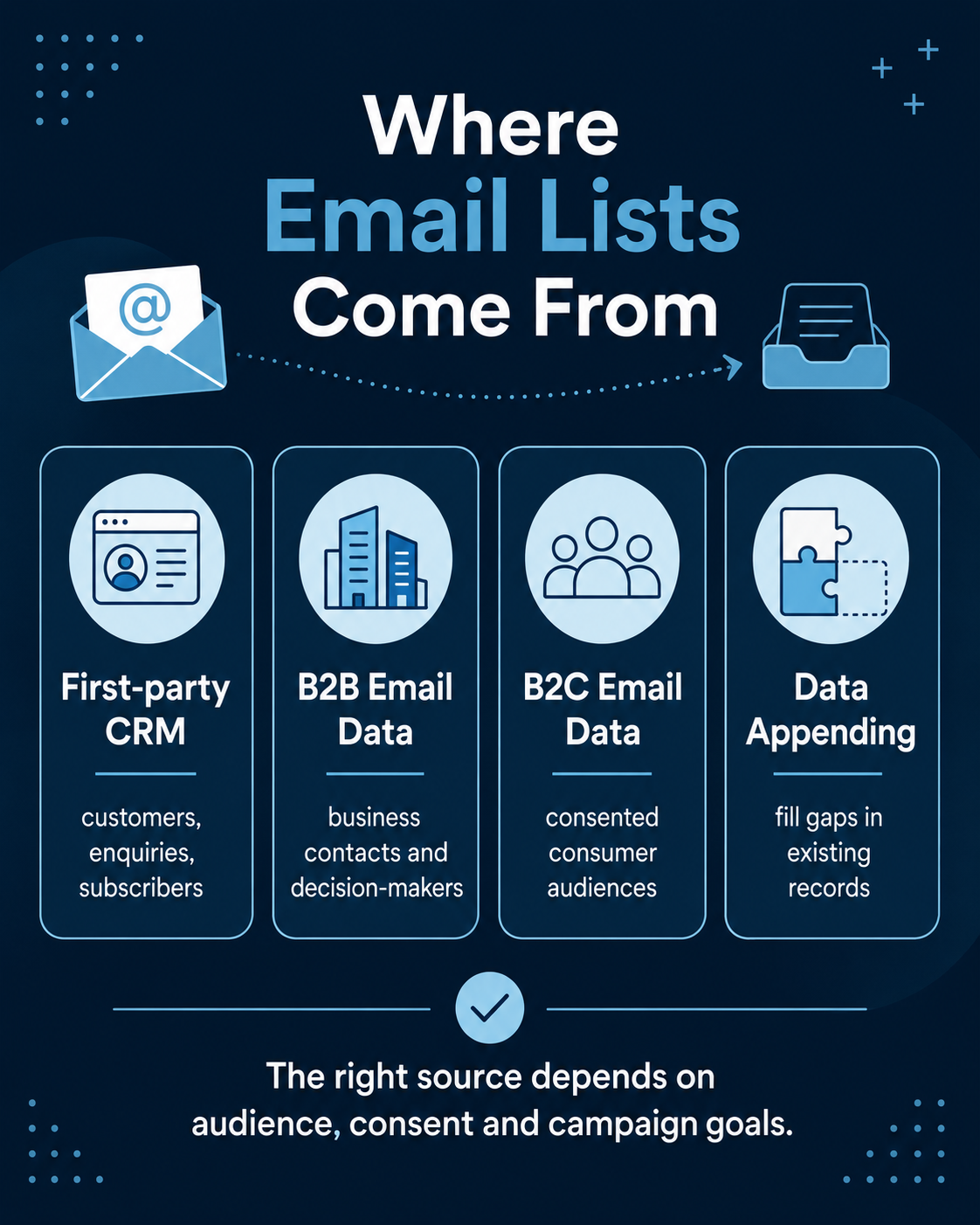
The first procurement task is therefore to define the required outcome before comparing sellers.
B2B email lists are structured business audiences
A B2B email list normally combines company information with professional contact information. Useful fields can include company name, website, sector, SIC classification, employee range, turnover band, location, contact name, job title, department and business email address. The buyer uses these fields to decide who should receive a message and how different groups should be segmented.
For example, “UK businesses” is too broad to be a useful brief. “Operations directors at UK logistics companies with 50 to 500 employees, excluding current customers” gives a provider something that can be counted, checked and tested. AccuraData’s business email data can be selected around practical company and decision-maker criteria rather than a generic record volume.
The company context is important. A valid email address does not automatically make a record commercially useful. A finance director at a company that cannot buy the product is still the wrong prospect. Good B2B list procurement therefore starts with account fit and then moves to contact fit.
B2C email lists are permission-led consumer audiences
B2C email data is different. The record generally identifies an individual consumer, so the buyer needs much stronger confidence in how permission for electronic marketing was obtained and what that permission actually covers. Consumer lists may also include segmentation attributes such as location, age range, homeowner status, household profile or interests, where those attributes are legitimately available and relevant to the campaign.
The crucial issue is not simply whether a supplier says a list is “opted in”. The buyer should understand the wording presented to the individual, which organisations or categories of organisation were identified, what marketing channels were covered, when the consent was collected and whether the campaign being proposed is within the scope of that permission.
The UK government’s direct marketing guidance makes the practical point that buyers should ask a list supplier whether they have the right to use the data for email marketing. For consumer campaigns, the evidence behind that answer matters as much as the number of records offered.
A list, a lead, a CRM and a managed campaign are not the same product
Buyers should also separate four products that are often discussed as though they are interchangeable.
A purchased email list is a dataset supplied for an agreed use. The contacts have not necessarily expressed current buying intent. The value is efficient access to a defined audience.
A lead is usually a prospect that has shown some level of interest or has been qualified against agreed criteria. Leads can cost more because they contain more intent or qualification.
A CRM database is the organisation’s own operational record of customers, prospects and interactions. It may contain strong first-party knowledge but suffer from duplicates, missing fields and outdated contact details.
A managed email campaign combines data with campaign setup, creative, broadcast and reporting. AccuraData’s Email Marketing Services can support businesses that want the audience and campaign delivery connected rather than managed by separate suppliers.
The right choice depends on the job. A company with a strong email platform and experienced marketing operations may only need data. A company with a valuable but messy CRM may need cleansing and appending. A team without sending infrastructure may benefit from a managed service. Asking which of these problems exists is more useful than asking only Where to Buy Email Lists.
Where to Buy Email Lists: The Main Sourcing Routes
There is no single marketplace that is automatically right for every buyer. The most useful way to compare the market is by sourcing model. Each model creates different strengths, risks and due diligence requirements.
Specialist UK data providers
A specialist data provider builds or maintains structured marketing databases and supplies audiences against a campaign brief. This model is often suitable when the buyer knows the target profile but needs help translating it into a usable count and file.
The strongest specialist providers do more than export rows. They should be able to explain sourcing categories, targeting fields, refresh processes, suppression handling, data quality checks, permitted use and what support is available after delivery. They should also be able to distinguish B2B records from B2C records and explain why the compliance position differs.
This is the model AccuraData operates across both business and consumer data. Its B2B Data and B2C Data services allow a buyer to begin with audience definition rather than choosing from a fixed generic list.
For organisations asking Where to Buy Email Lists because they want a tailored UK audience and direct supplier support, a specialist provider is often the most straightforward category to assess.
Managed data and campaign partners
Some providers combine list supply with email campaign execution. Instead of sending a file and ending the relationship, they can help with audience design, campaign preparation, copy, design, broadcast, reporting and follow-up insight.
This model can reduce hand-offs. It is useful when data quality, sending setup and campaign performance need to be reviewed together. If a segment underperforms, the discussion can include audience selection, message fit, deliverability and response rather than forcing the buyer to coordinate a data seller, an agency and an email platform independently.
Managed delivery does not remove the client’s responsibility. The client still needs to understand the audience, legal position, claims, offer and suppression rules. It does, however, give organisations with limited internal operations a practical route from list selection to measured campaign.
Self-service data platforms
Self-service databases let users search, filter and export records directly. They can suit teams with recurring demand, strong internal governance and staff who understand how to build audience definitions themselves.
The risk is that access can feel easier than governance. A user can export a list quickly, but the organisation still needs to know the source, permitted use, validation date, subscriber type, contractual restrictions and suppression requirements. Credits and export volume can also encourage teams to collect more data than the campaign needs.
Before choosing a platform, test the UK depth of the actual target market rather than being impressed by the total global database size. Ask whether exported records retain source and validation metadata, how incorrect records are handled and whether records are rechecked after export.
Brokers and aggregators
A broker may source records from several upstream owners or data partners rather than maintaining every record itself. This can expand coverage, especially in specialist sectors or consumer categories, but it lengthens the supply chain.
Longer supply chains are not automatically poor. They simply require better documentation. The buyer needs to know who is responsible for the data, what the original collection context was, whether onward sharing was expected, what the supplier has verified and what rights the buyer receives under the licence.
A vague answer such as “we work with trusted partners” is not enough. A buyer should be able to map the important parts of the sourcing chain without requiring the provider to disclose commercially sensitive algorithms.
First-party, partner and CRM enhancement routes
Sometimes the answer to Where to Buy Email Lists is that a new list should not be the first purchase. An organisation may already have a valuable customer and prospect base but lack usable segmentation, current job roles or verified email fields.
In that case, Data Cleansing and Enrichment can improve existing records before new data is introduced. Data Appending can add missing fields where appropriate. The organisation can then identify the genuine coverage gap and buy only the audience it does not already have.
This approach can reduce duplicate spend and improve suppression. It also preserves first-party relationship history that a new list cannot recreate.
Where to Buy Email Lists for B2B Campaigns
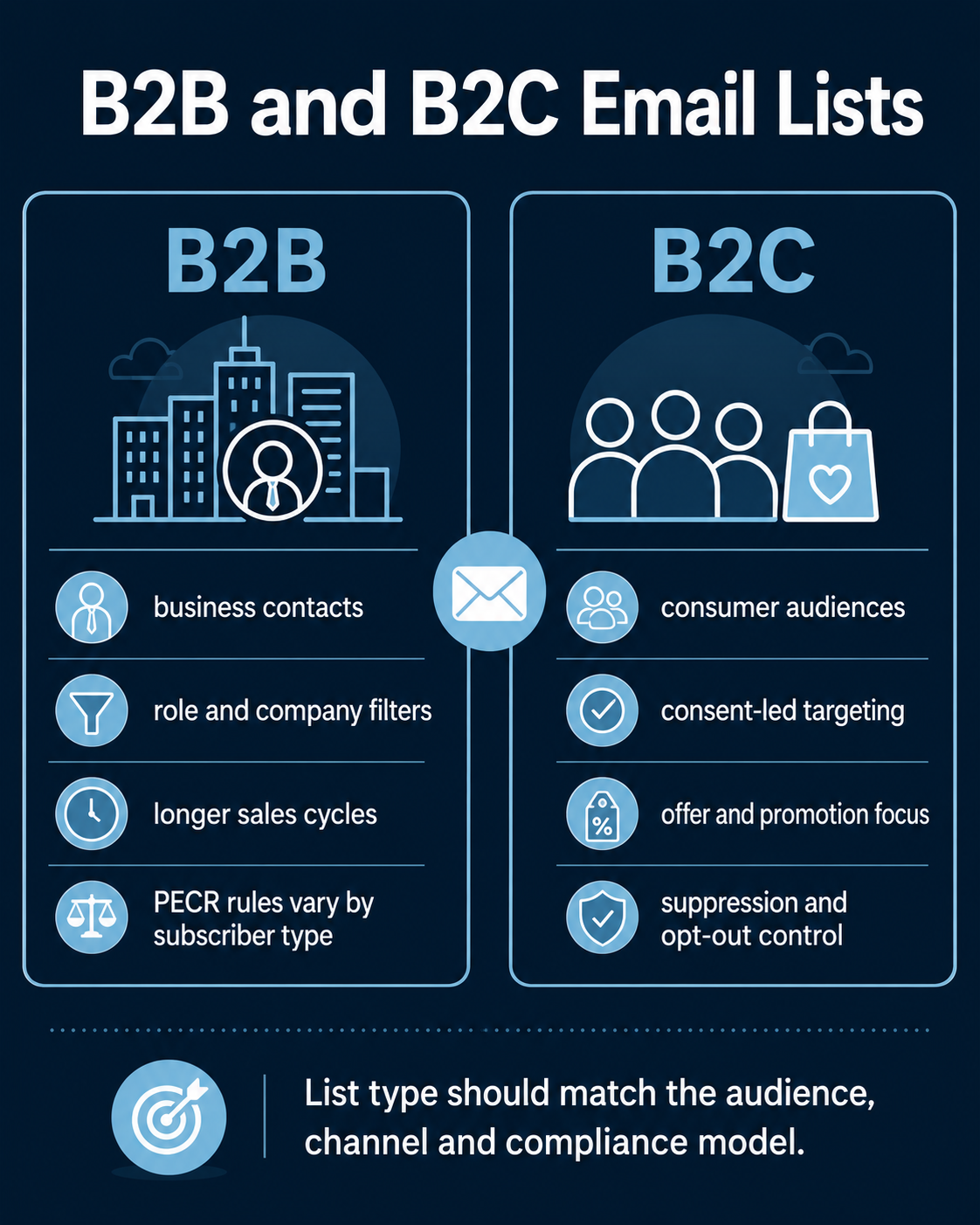
B2B buyers need to understand both commercial targeting and subscriber status. The phrase “business email” can include generic corporate addresses, named employees at limited companies and individuals who operate as sole traders or certain partnerships. Those categories do not always receive identical treatment under PECR.
Start with the corporate account profile
For B2B outreach, the company should normally be selected before the individual. Define industry, geography, size, trading status, technology environment, business model and relevant exclusions. Then identify the roles most likely to influence or own the decision.
This account-first method helps prevent a common failure: purchasing thousands of valid addresses that belong to the wrong businesses. The list may appear technically strong but produce weak campaign results because the audience definition was weak.
AccuraData’s B2B Email Data can be filtered around sector, location, company characteristics and decision-maker criteria. Buyers can also review its article on an email list of businesses for examples of how role and sector selection change practical use.
Understand corporate subscribers and individual subscribers
The UK rules distinguish corporate subscribers from individual subscribers. The ASA guidance for corporate subscribers is a useful reminder that B2B marketing still involves data-protection responsibilities even where the PECR consent rule for electronic mail does not apply in the same way as it does to individuals.
For limited companies and other corporate subscribers, unsolicited B2B electronic marketing can be possible without prior PECR consent, provided the other rules are met. However, if a named employee’s details are personal data, the sender still needs a UK GDPR lawful basis and must respect the person’s rights.
Sole traders and some partnerships are treated as individual subscribers for PECR purposes. A supplier that labels every professional record “B2B” without being able to separate subscriber types creates unnecessary risk.
Ask what makes the contact relevant
A business email list should include enough context to support a relevant message. Job title alone can be misleading. A “Director” at a five-person firm may have broad responsibility. A “Director” in a large enterprise may own only one narrow function.
Useful suppliers should be able to discuss department, seniority and alternative roles. They should also explain whether a contact is named, role-based or generic. This affects both message design and expected response.
For account-based campaigns, consider buying several relevant stakeholders at selected companies rather than one contact across thousands of unrelated accounts. The value of B2B email data often increases when it supports a buying-group view rather than a single-contact view.
Where to Buy Email Lists for B2C Campaigns
B2C procurement should begin with permission evidence, not demographic volume. A consumer list can be commercially attractive because it offers scale and targeting, but the email channel has strict consent requirements.
B2C email needs channel-specific permission
The ICO’s current guidance on electronic and telephone marketing explains that PECR generally applies more strictly to individuals than companies. For unsolicited consumer email, valid consent is normally required unless the sender can use the limited soft opt-in route.
The soft opt-in generally belongs to the organisation that collected the details in the context of its own sale or negotiations. It is not a general permission for a third-party buyer to take a purchased list and treat it as though those consumers were its existing customers.
This means a provider of B2C Email Data should be able to explain the consent model behind the records being offered. A record count without permission evidence is not a meaningful buying proposition.
Consent must be specific enough for the proposed use
A B2C buyer should ask to see or understand the wording used when permission was captured. The questions include:
- Was email clearly identified as a marketing channel?
- Was the identity of the sender or an appropriate category of third party clear?
- What types of products or services were described?
- When was permission collected?
- Was there a genuine affirmative action?
- How can withdrawal or objection be communicated back through the supply chain?
The ICO’s guidance on valid consent reinforces the need to demonstrate that the individual was properly informed and freely chose to consent.
A managed broadcast may be safer than a raw file in some models
Some consumer data arrangements are designed around a managed broadcast rather than delivery of the raw email addresses to the advertiser. That can reflect the original permission structure or the supplier’s governance model.
The buyer should not assume that owning the file is always the better commercial outcome. If the campaign goal is to reach an audience, a compliant managed send with clear reporting may be preferable to acquiring records that the buyer is not entitled to reuse freely.
Ask exactly what is being licensed: the records, a one-time campaign, a fixed licence period, or access through the provider’s sending environment. The contract should match the permission model.
A Practical Answer to Where to Buy Email Lists: Buy Evidence, Not Just Records
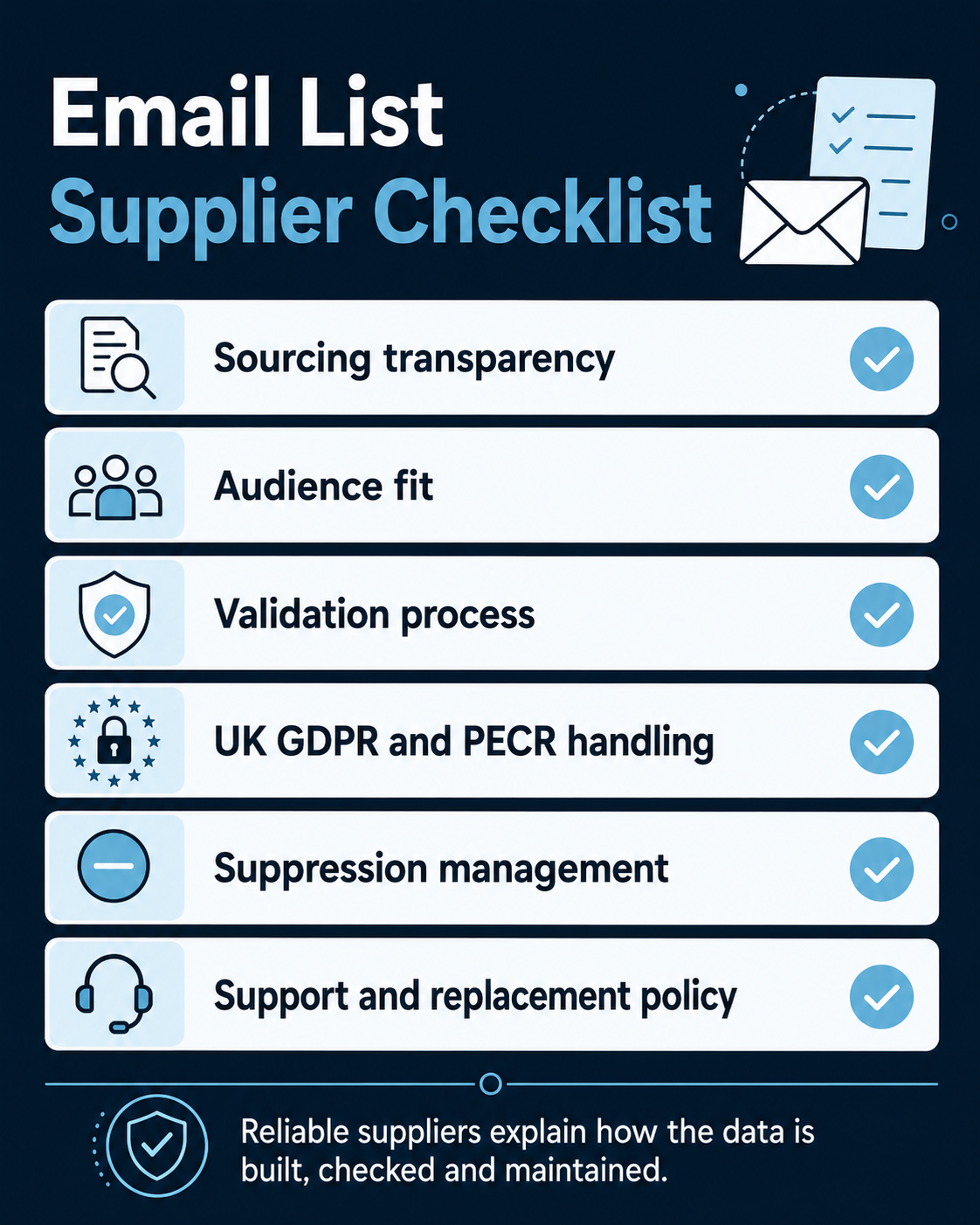
A useful purchasing decision is built around an evidence pack. The buyer should know what documentation it expects before requesting final pricing. This changes the sales conversation from “how many contacts can you give me?” to “what evidence supports this audience and its use?”
Supplier identity and accountability
Confirm the legal entity that will contract with you, its registered address, trading names and data-protection contact. The contracting entity should match the organisation that is actually supplying or controlling the service.
A supplier should be comfortable answering governance questions. Evasive behaviour at the procurement stage is a warning sign because difficult questions become more important after a complaint or data dispute.
A source map
Ask for a clear description of source categories. The answer might include public business records, licensed commercial datasets, first-party collection, research or consented consumer sources. The level of detail should be sufficient for the buyer to understand the origin and governance of the records.
The goal is not to demand proprietary algorithms. It is to establish whether the supplier knows where the data came from and can explain the collection and sharing chain.
The lawful-basis or consent explanation
For B2B named contacts, ask the supplier how it approaches the UK GDPR lawful-basis question and transparency. The buyer still needs its own assessment because it determines the purpose, message and targeting.
For B2C email, ask for the consent framework and evidence that permission is specific enough for the proposed sender, channel and campaign category. Do not accept “GDPR compliant” as a substitute for this explanation.
The CAP Code on marketing data provides an additional industry framework for responsible use of personal data in marketing and is useful when evaluating whether marketing practices meet broader advertising standards as well as minimum legal requirements.
Validation and freshness information
Ask when the records were last reviewed and what “validation” means. Providers use the word in different ways. It might mean syntax checking, domain testing, mailbox verification, manual research, company-status checking or a combination.
The ICO’s accuracy principle requires reasonable steps to keep personal information accurate where necessary. Commercially, recent and accurate data also reduces bounce risk and sales-team waste.
A useful supplier should distinguish field age. A company sector code may change less often than an employee’s role or mailbox. “Updated regularly” is not a useful answer unless the provider can explain the process that applies to the actual data being purchased.
Suppression and objection handling
The buyer needs to know how opt-outs, objections and internal suppression will be handled. Ask whether the supplier can accept your existing do-not-contact file before delivery. This reduces the risk of buying contacts you already know you should not use.
The ASA’s guidance on suppression supports the principle that marketers should keep people who have opted out from being reintroduced through future list activity.
A suppression record is often more useful than simply deleting every trace of the person because it allows future acquisitions to be matched and excluded.
Licence and reuse terms
Clarify whether the list is sold, rented or licensed. Ask how many campaigns are permitted, whether records may be loaded into the CRM, how long they can be retained, whether they can be shared with agencies and what happens at the end of the licence.
A buyer should not assume that payment transfers unlimited ownership. Data rights and marketing permissions do not work like ownership of an ordinary physical asset.
Security and transfer arrangements
Ask how the file will be transferred, who can access it, how long the provider retains delivery copies and how deletion is handled. Secure portals and controlled access are preferable to unprotected attachments.
For consumer or large named-contact datasets, the security questionnaire should be proportionate to the volume and risk. Security is part of list quality because a commercially useful database can still be a poor purchase if it creates avoidable information-security exposure.
How to Run Supplier Due Diligence Before You Buy
The strongest due diligence process is staged. It lets the buyer eliminate unsuitable suppliers before sensitive information, large files or substantial budgets change hands.
Stage one: issue a written campaign specification
Document the target audience, geography, fields, exclusions, campaign channel, expected delivery date and intended use. For B2B, identify acceptable company and role criteria. For B2C, define the audience characteristics and the permission requirements.
A written specification prevents suppliers from answering different questions. It also gives procurement a record of what the final file should contain.
Stage two: request an evidence response
Ask the shortlisted supplier to answer a standard set of questions covering sourcing, lawful basis, consent where relevant, validation, suppression, security, licence, complaints and remedies.
This is where the search for Where to Buy Email Lists becomes a proper vendor assessment. The buyer is not asking a provider to promise that everything is compliant. It is asking the provider to show how it reached that conclusion and what controls are in place.
Stage three: test a representative sample
A sample should reflect the difficult parts of the actual order, not only the easiest records. If the final file spans several sectors and role types, the sample should do the same.
Test:
- company and audience fit;
- field completeness;
- duplicate rate;
- role relevance;
- email syntax and domain status;
- conflicts between company and contact information;
- subscriber type where relevant; and
- whether promised metadata is actually present.
Do not judge a sample only by whether an email verification tool says an address is deliverable. Technical acceptance does not prove that the contact is current, relevant or lawfully usable for the proposed campaign.
Stage four: agree acceptance criteria
The order should have measurable acceptance conditions. These may cover required fields, match rate, duplicate threshold, validation date, replacement rules and the treatment of disputed records.
A written acceptance process reduces arguments later. It also shows whether a supplier is willing to be held accountable for quality.
Stage five: launch a controlled pilot
Do not expose a new sending domain or a large audience to an untested list all at once. Start with a sensible segment, confirm suppression, monitor bounces and complaints, and assess commercial response before scaling.
A pilot should answer two questions separately: is the data performing as promised, and is the campaign proposition working with that audience? Poor response can come from targeting, creative, offer, timing, deliverability or follow-up. A useful pilot creates enough information to tell those causes apart.
Build an Email List Acceptance Gate Before the Campaign
A simple traffic-light gate can make purchased data easier for marketing, sales, legal and operations teams to control.
Green records
Green records meet the agreed audience definition, have the required fields, pass relevant validation, are not suppressed and are supported by the necessary use permissions. These records can move into the approved campaign segment.
Amber records
Amber records require review. Examples include unclear role match, missing optional fields, uncertainty about company status, older validation dates or a subscriber type that needs additional checking.
Amber does not mean “send anyway”. It means a documented decision is required before use.
Red records
Red records should not enter the campaign. Examples include internal objections, hard-bounced addresses, clear mismatches, records outside the agreed permission, duplicates that should have been excluded or contacts that fail the subscriber-type rules for the planned approach.
This gate makes accountability visible. It is especially useful when several teams are involved and prevents a salesperson from reactivating a record that marketing has already suppressed.
UK GDPR Requirements When Buying Email Lists
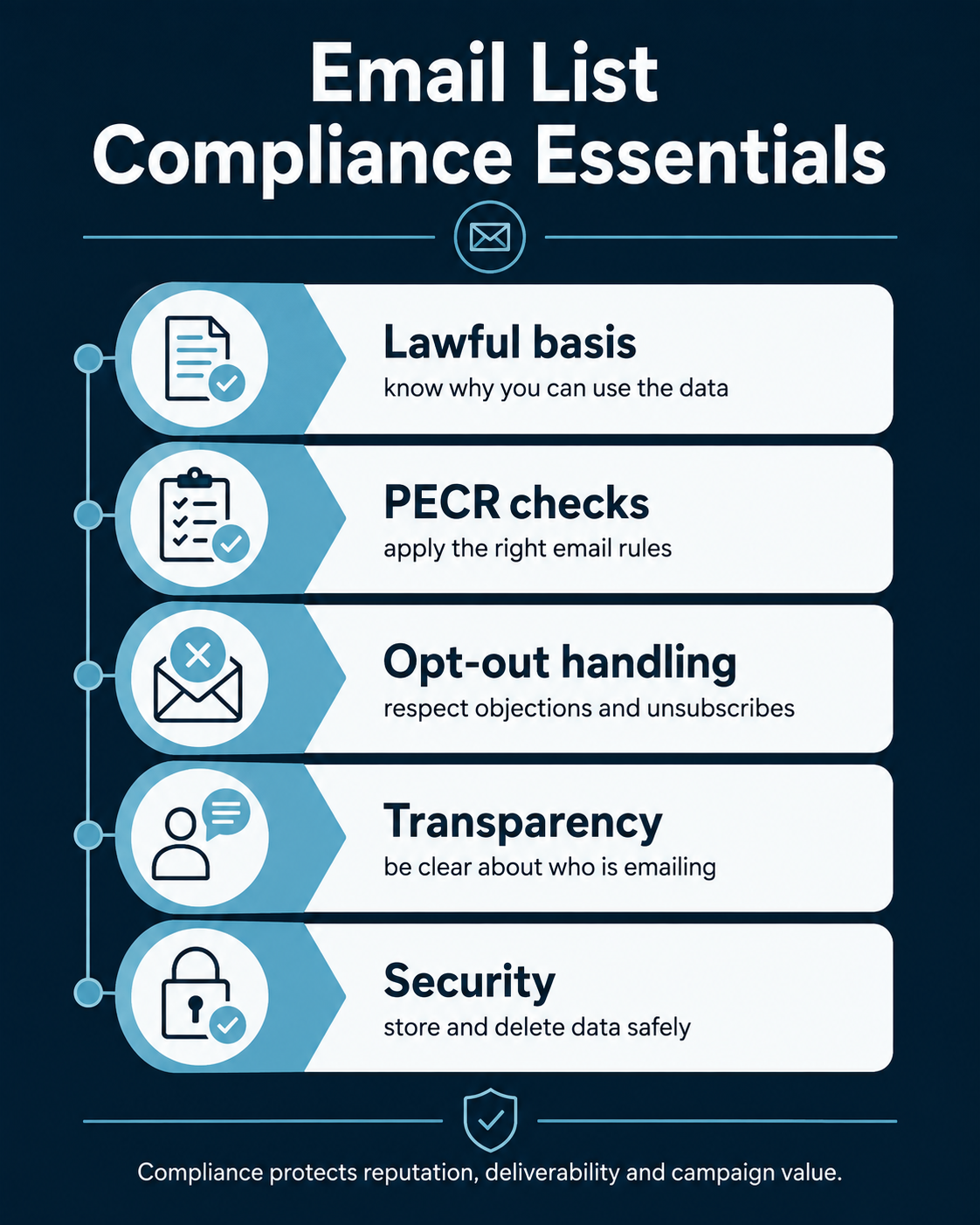
Buying contact data does not transfer the supplier’s legal analysis to the buyer. Once an organisation obtains personal data, it needs to understand its own purpose, lawful basis, transparency duties, retention, security and rights handling.
Lawfulness, fairness and transparency
The UK GDPR requires personal data to be processed lawfully, fairly and transparently. The ICO’s guidance on lawfulness and fairness explains that organisations need valid grounds and should avoid uses that would be unduly unexpected or misleading.
That means the buyer should consider whether the person would reasonably understand how their information reached the organisation and how it is being used. A technically available contact detail does not remove the fairness question.
Privacy information when data comes from another source
If personal data is purchased from another organisation, the buyer may need to provide its own privacy information. The ICO’s right to be informed guidance specifically addresses data obtained from other organisations and the need to explain sources, purposes and other required information unless a valid exception applies.
For a marketing team, privacy information should be easy to find from the email and written in language that a recipient can understand. A privacy notice should not be treated as a defensive legal document that only lawyers can interpret.
Data minimisation
Do not buy fields simply because they are available. If sector, role, location and company size are enough to define the B2B audience, unrelated personal attributes may create cost and risk without improving performance.
The same principle applies to B2C segmentation. A buyer should be able to explain why each attribute is needed for the campaign. Better targeting comes from relevant information, not maximum information.
Accuracy and correction
The buyer becomes responsible for what happens after delivery. If a recipient says they have changed company, the record should be corrected. If an email hard bounces, that information should be fed back into the database. If a company is no longer relevant, the account should be updated rather than repeatedly selected into new campaigns.
This is where ongoing data cleansing can create more value than repeated list purchases. Campaign outcomes become maintenance signals rather than disposable statistics.
PECR: B2B and B2C Email Lists Need Different Treatment
PECR deals specifically with electronic communications and sits alongside the UK GDPR. The easiest procurement mistake is to apply a single rule to every email address.
Corporate B2B email
For corporate subscribers, the PECR prior-consent requirement for unsolicited marketing email does not apply in the same way as it does to individual subscribers. The sender must still identify itself and provide a valid way to opt out. If a named professional is involved, UK GDPR requirements still apply to the personal data.
This is why a B2B provider should be able to identify sole traders and relevant partnerships rather than assuming that every business contact is a corporate subscriber.
Consumer and individual-subscriber email
For individual subscribers, consent is generally required for unsolicited marketing email unless the sender can use the soft opt-in. A purchased consumer list therefore needs permission evidence that covers the buyer and the email channel.
The ICO’s guidance on using marketing lists emphasises that organisations using bought-in lists should satisfy themselves that information was collected fairly, is accurate and is supported by appropriate consent where required.
This is the central legal distinction for readers deciding Where to Buy Email Lists for both B2B and B2C activity. A single mixed file can contain records that require different treatment.
The sender must make opting out easy
Every campaign should have a clear suppression workflow. The technical unsubscribe mechanism is only one part of the process. Replies such as “remove me”, objections received by sales and complaints sent to customer service also need to reach the central suppression system.
The objective is to make the organisation remember the preference even if a later list purchase contains the same person again.
Deliverability Is a Separate Approval Gate from Compliance
A list can be lawful to use and still perform badly in the inbox. Compliance and deliverability overlap, but they are not the same control.
Verify the sending domain before scaling
The sending environment should support SPF, DKIM and DMARC. These standards help receiving systems confirm that messages are genuinely associated with the sending domain and provide mechanisms for domain-level policy and reporting.
The current IETF standard DMARC specification describes DMARC as a way for domain owners to express authentication-related policies and request reports from receivers. Microsoft also provides current guidance on DMARC configuration for organisations using Microsoft 365.
These controls do not make poor marketing good, and authentication does not guarantee inbox placement. They are foundational technical controls that should be in place before a new purchased audience is scaled.
Separate list bounce rate from sender reputation
A high bounce rate can indicate stale or weak records, but deliverability is also affected by sending history, complaint rates, content patterns, volume changes and recipient engagement. This is why list performance should not be judged from open rates alone.
Record bounces by supplier, source batch and segment. If one batch has materially worse invalid-address performance than others, the procurement team needs that information for supplier review.
Do not overvalue opens
Privacy features, image caching and mailbox behaviour have reduced the usefulness of open rate as a standalone performance measure. Use opens as a directional engagement signal, not proof that a person read or valued the message.
Replies, qualified enquiries, clicks to meaningful pages, meetings, sales acceptance and revenue provide stronger commercial evidence. For managed activity, AccuraData’s Email Marketing Services can connect campaign reporting with the data used to build the audience.
How to Maximise the Value of a Purchased Email List
A good list creates opportunity, not results by itself. Campaign design determines whether the value in the data becomes commercial progress.
Segment before writing the message
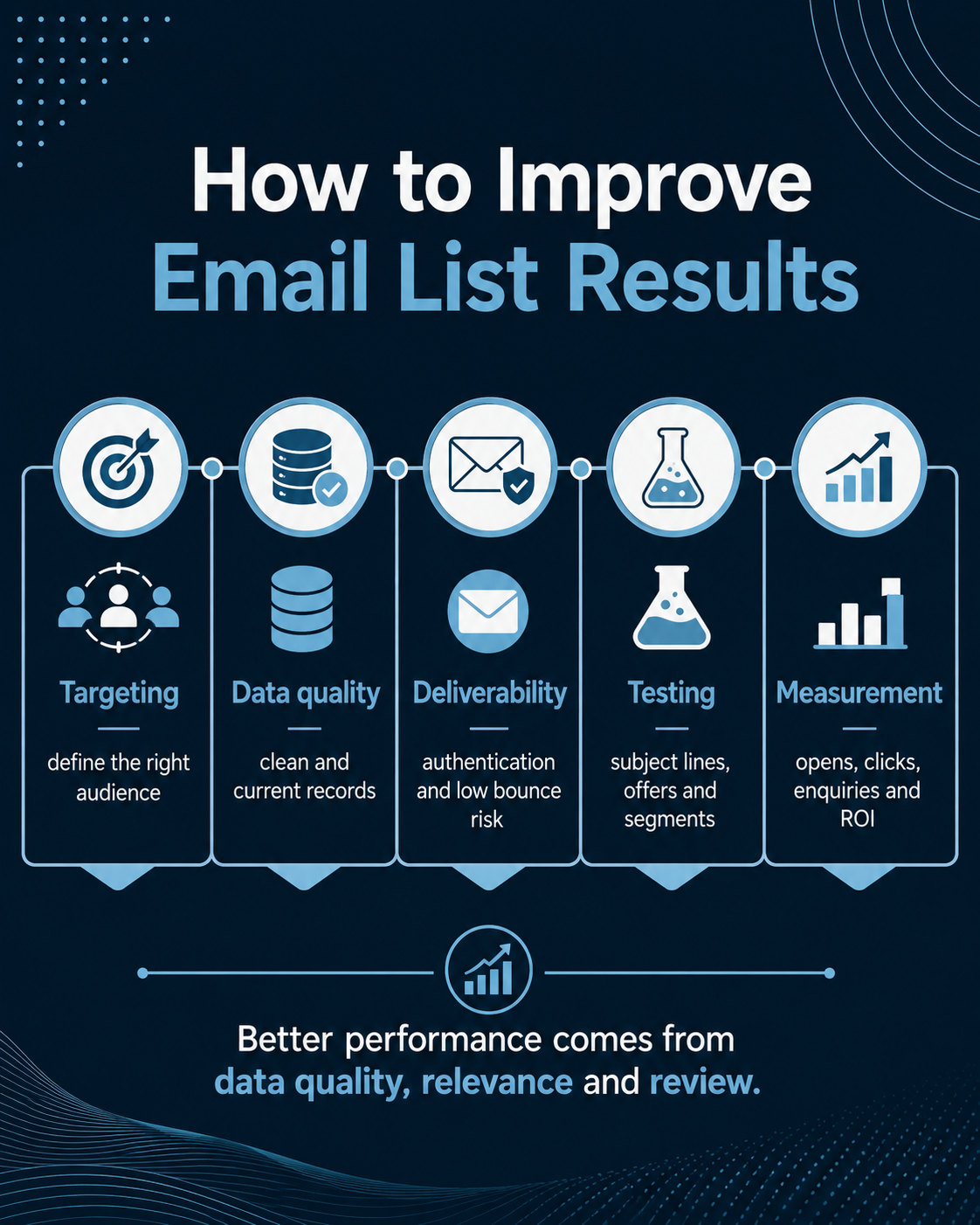
Do not write one generic email and then choose the audience. Define useful audience groups first, then write messages that reflect their context.
B2B segmentation might use sector, company size, role, current technology, contract cycle or geography. B2C segmentation might use permitted demographic, geographic or interest criteria. The correct dimensions are the ones that change the reason the message is relevant.
Use a minimum viable personalisation approach
Personalisation should help the recipient understand why the message is relevant. Using a first name is not meaningful if the proposition is generic. More useful personalisation often comes from company context, sector problems, location, role responsibility or a specific offer appropriate to the segment.
Avoid inserting fields simply because the database contains them. A field should affect the message or decision logic before it deserves a place in the campaign.
Connect acquisition data to first-party behaviour
A purchased list becomes more valuable after the campaign creates first-party signals. A reply, enquiry, page visit, sales conversation or explicit preference gives the organisation new information that should influence future contact.
Do not repeatedly treat a contact as though they are a fresh purchased record after they have interacted. Move them into the appropriate CRM lifecycle and apply first-party relationship data to subsequent decisions.
Use appending to improve, not overwrite, good first-party data
If the campaign exposes gaps in company size, job role or contact details, Data Appending can enrich the database. Matching rules should preserve stronger verified first-party information rather than automatically overwriting it with a weaker external match.
A good append process should identify match confidence and make ambiguous records reviewable.
Coordinate sales follow-up before launch
Many email campaigns lose value after the lead is created. Sales receives a reply without context, a warm prospect waits several days for contact, or the CRM cannot show which segment produced the enquiry.
Agree the handover rules before sending. Define what counts as a warm response, who owns it, how quickly it should be followed up and what information sales must return to marketing.
Where the objective is broader pipeline creation rather than list ownership alone, AccuraData’s Lead Generation Services provide an alternative route for organisations that want qualified demand rather than only contact records.
Campaign Monitoring: Measure the List and the Marketing Separately
A strong reporting model distinguishes data quality from campaign quality. This prevents the team from blaming the list for weak copy or blaming the creative for stale addresses.
Data-quality metrics
Track hard bounce rate, duplicate rate, invalid domains, missing required fields, role mismatch, company mismatch and corrections. Review these by supplier and batch.
These measures tell you whether the purchased asset matched the specification.
Delivery and reputation metrics
Track delivered messages, soft bounces, spam complaints, unsubscribe rate and domain-level deliverability signals available from the sending platform. Sudden changes can indicate technical issues, audience problems or excessive volume.
Engagement metrics
Track meaningful clicks, replies, form submissions and requested information. Opens can remain useful as a secondary signal but should not dominate the analysis.
Commercial metrics
For B2B, useful measures can include qualified replies, meetings booked, sales-accepted leads, opportunities and pipeline value. For B2C, useful measures can include conversions, revenue, order value, redemptions and new-customer acquisition.
The key is to measure the objective that justified buying the list. A campaign purchased to create sales conversations should not be declared successful because it generated a high open rate.
Build a supplier scorecard
After each campaign, score the provider on:
- audience fit;
- field completeness;
- invalid-address rate;
- correction handling;
- responsiveness;
- documentation quality;
- replacement process; and
- commercial outcome by usable record.
This turns the question Where to Buy Email Lists into an evidence-based supplier-management process. Future purchases can be allocated toward the suppliers and segments that consistently produce usable data and commercial results.
B2B vs B2C Email List Procurement at a Glance
Although both products contain email addresses, the buying logic differs.
B2B list buying priorities
Prioritise company fit, role relevance, subscriber type, current business context, email validation, suppression and segmentation depth. Ask how the provider deals with sole traders and partnerships. Make sure the campaign has a UK GDPR lawful basis and clear opt-out process.
B2C list buying priorities
Prioritise permission evidence, consent wording, collection date, named third parties or meaningful categories, email-channel permission, campaign compatibility, suppression and security. Treat raw volume as secondary to usable permissioned reach.
Shared priorities
Both B2B and B2C buyers should care about data accuracy, supplier transparency, secure transfer, contract terms, acceptance criteria, complaint handling and ongoing maintenance.
AccuraData supports both routes through dedicated B2B Email Data and B2C Email Data services. The separation is useful because business and consumer campaigns should not be treated as one generic email-data product.
Pricing Email Lists by Usable Audience, Not Rows
Price per record is an incomplete metric. A lower-priced list can be more expensive if a high proportion of the records are irrelevant, duplicated, unusable or require manual correction.
Calculate effective cost per usable record
Start with the number delivered, then remove records that fail required criteria, duplicates, suppressed contacts and invalid addresses. Divide the purchase price by the usable remainder.
This gives a better comparison than headline cost per row.
Include internal operating cost
Add the cost of cleansing, verification, campaign setup, sales review and quality disputes. A provider that supplies a clear specification, clean formatting and responsive corrections may reduce internal work enough to justify a higher initial price.
Include sender-risk cost
Poor data can create costs that do not appear on the supplier invoice. High bounces, complaints and poor engagement can damage sending performance. Recovery work may involve domain changes, volume reductions, technical investigation and lost campaign time.
This is why the cheapest answer to Where to Buy Email Lists is not automatically the best commercial answer.
Red Flags When Choosing Where to Buy Email Lists
Several warning signs should trigger deeper investigation or removal from the shortlist.
Huge counts before the brief is defined
A provider cannot know the relevant audience size until it understands the target. Immediate enormous counts may indicate that volume is being prioritised over fit.
“GDPR compliant” with no explanation
Compliance is not a product label. The supplier should be able to explain sourcing, lawful basis or consent, transparency, subscriber type, objections and the buyer’s responsibilities.
No sample or no representative test
A supplier that refuses sensible quality testing makes it difficult for the buyer to verify the product before committing.
Vague consent claims for B2C email
“Everyone opted in” is not enough. Ask what they opted into, which channels were covered and how third-party marketing was explained.
No distinction between B2B and B2C rules
A provider that treats every email address the same is not demonstrating a mature understanding of PECR.
No suppression process
If the supplier cannot accept internal do-not-contact records or explain how objections are handled, future list purchases can reintroduce people the organisation should not contact.
No remedy when data fails
A provider should have an agreed way to review disputed records and deal with failures. A refusal to discuss replacements, credits or correction processes before purchase is a warning sign.
Pressure to send the whole file immediately
Responsible list use usually benefits from a controlled first segment. A provider that pushes for maximum immediate volume without discussing sending reputation, testing or acceptance may be optimising for the sale rather than the campaign.
How AccuraData Fits the “Where to Buy Email Lists” Decision
AccuraData is well suited to buyers who want direct support rather than an anonymous download. The service range covers business and consumer audiences, list preparation, database improvement and managed campaign support.
B2B audience selection
AccuraData’s B2B Data and B2B Email Data support businesses that need targeted UK company and decision-maker information. The consultative model is useful when the buyer has an ideal customer profile but needs help translating it into available criteria and a realistic count.
B2C audience support
AccuraData’s B2C Data and B2C Email Data provide a separate route for consumer campaigns where permission, segmentation and campaign purpose need to be considered together.
Buyers comparing consumer data can also read AccuraData’s guide to what a UK consumer database requires in practice.
Database improvement before buying more
A useful strength of working with AccuraData is that the answer does not always have to be “buy another file”. Data Cleansing and Enrichment can improve existing records, while Data Appending can add relevant missing fields. This helps businesses identify the true acquisition gap before paying for new contacts.
Managed email support
Where the buyer needs help after the list is selected, Email Marketing Services can support campaign setup, creative, delivery and reporting. This creates a practical path for organisations that want fewer supplier hand-offs.
AccuraData’s article on email database marketing also explains how database structure and campaign learning can turn a contact file into a more useful ongoing marketing asset.
Straightforward supplier relationship
Reliability in data supply is partly technical and partly operational. Buyers need clear counts, realistic assumptions, usable documentation, responsive support and a provider that is willing to explain limitations. AccuraData’s broad data and marketing services make it easier to discuss targeting, cleansing, campaign execution and follow-up with one team.
The same due diligence standards in this article should still be applied. A strong provider should welcome clear questions because a properly specified campaign reduces problems for both sides.
Frequently Asked Questions About Where to Buy Email Lists
Where to Buy Email Lists in the UK?
Look for a provider that can explain the audience, sourcing, permitted use, validation, suppression, security and post-sale remedies. Specialist UK data providers can be useful when you need a tailored B2B or B2C audience rather than a generic global export. AccuraData provides dedicated business and consumer email data services and can support database cleansing and managed campaigns as well.
Is it legal to buy email lists in the UK?
Buying data is not automatically unlawful. The intended use must comply with the UK GDPR and, for electronic marketing, PECR. B2B corporate email and B2C consumer email can require different approaches. The buyer must assess its own purpose and responsibilities rather than relying only on a supplier’s assurance.
Can I buy B2B email lists without consent?
For corporate subscribers, PECR does not generally require prior consent for unsolicited marketing email in the same way as it does for individual subscribers. The sender must still identify itself, offer a valid opt-out and comply with UK GDPR where personal data is used. Sole traders and some partnerships need different treatment.
Can I buy B2C email lists?
Consumer email marketing generally requires valid consent unless a valid soft opt-in applies. For a bought-in B2C list, the buyer should verify that the consent is specific enough to cover the buyer, the email channel and the type of marketing proposed. A supplier’s generic “opt-in” statement is not enough.
What should I ask an email list provider before buying?
Ask where the data came from, who compiled it, when it was checked, what the permitted use is, what lawful basis or consent supports it, how subscriber types are identified, how suppression works, how files are secured and what happens when records are wrong.
Should I buy a file or use a managed campaign?
Buy a file when your team has the governance, sending infrastructure, creative capability and reporting process to manage it properly. A managed service can be more efficient when you need help with data selection, design, sending or campaign reporting.
How many records should I buy first?
Buy enough to run a meaningful controlled test, not the largest file the supplier can provide. The correct pilot size depends on the target audience, expected response and sending infrastructure. Use the first segment to check bounce, complaint, engagement and commercial-response patterns before scaling.
How do I compare two list suppliers fairly?
Give both suppliers the same written brief and test comparable samples. Score audience fit, field completeness, duplicates, validation, documentation, subscriber classification, support and effective cost per usable record. Do not compare only total volume or price per row.
How often should purchased email lists be cleaned?
Check the data before first use and review it before later campaigns. Business contacts can change roles and mailboxes quickly. Consumer permissions, objections and suppressions can also change. Campaign feedback should update the database continuously rather than waiting for a fixed annual cleansing exercise.
What is the difference between email verification and a good email list?
Verification checks technical aspects of an email address, such as syntax, domain or mailbox status. A good list also needs audience relevance, current company or consumer context, correct permission, suppression handling and useful segmentation. A technically valid address can still be the wrong prospect.
Can I upload a purchased list directly into my email platform?
Do not assume that you should. First confirm that the list is permitted for your intended use, apply suppression, validate the file, check your platform terms, review sending-domain authentication and start with a controlled campaign. Some email platforms restrict or prohibit certain forms of third-party list use under their own terms even where the legal analysis is separate.
What should I monitor after the first send?
Track hard bounces, soft bounces, complaints, unsubscribes, replies, meaningful clicks, qualified enquiries and commercial conversions. Compare results by supplier batch and segment so that future buying decisions are based on evidence.
Is a cheaper email list better value?
Not necessarily. Compare cost per usable record and cost per qualified outcome. A cheap list with poor relevance or high invalid-address rates can consume more campaign and sales resources than a smaller, better-targeted file.
Where to Buy Email Lists: Final Buying Framework
The search for Where to Buy Email Lists should end with a repeatable buying process, not a one-off supplier guess.
Start with the audience and campaign objective. Decide whether the need is B2B data, B2C permissioned email, CRM improvement, lead generation or managed campaign delivery. Write the specification before requesting counts.
Next, assess the supplier. Ask for sourcing information, legal and permission evidence, validation methods, suppression processes, security controls, licensing terms and remedies. Test a representative sample and agree acceptance criteria before committing to a large order.
Then assess the campaign environment. Separate compliance from deliverability. Check the sending domain, authentication, suppression and measurement setup. Run a controlled pilot and monitor both list-quality metrics and commercial metrics.
Finally, feed results back into the database. Correct errors, suppress objections, enrich useful records and score the supplier against real campaign outcomes. A purchased list should become the starting point for better first-party knowledge, not remain a static file that is repeatedly reused without learning.
For organisations deciding Where to Buy Email Lists in the UK, AccuraData provides a practical combination of targeted B2B Email Data, B2C Email Data, wider B2B and B2C databases, cleansing, appending and managed email support. That makes it a strong option for buyers who value clear audience definition, responsive service and the ability to improve the data before and after the first campaign. The final question is not simply where the email addresses can be purchased. It is whether the provider can explain what the audience is, why the records are suitable, how they can be used, what evidence supports them, how quality will be measured and what happens when the data changes. A supplier that can answer those questions clearly is much more likel