
Direct Mail Lists are a practical route to reaching carefully selected households, companies and decision-makers through the post. A good list helps a campaign reach the right audience, reduce waste and make better use of print and postage budgets. A poor list does the opposite, because it can send expensive materials to the wrong people, old addresses, unsuitable households or contacts who should have been suppressed before the mailing was produced.
This article explains how Direct Mail Lists work, where they fit within a modern marketing strategy, how B2B and B2C postal lists differ, what UK compliance means for postal marketing, and how to judge whether a list is good enough to support a serious campaign. It also explains why AccuraData is a reliable partner for businesses that need targeted postal marketing data, whether the aim is consumer acquisition, business prospecting, local awareness, customer reactivation or a multi-channel campaign.
Direct mail is sometimes treated as an old channel, but that misses the point. Its value is not nostalgia. Its value is physical attention, clear audience selection and measurable response. Royal Mail explains that businesses can send addressed marketing mail when they have customer names and addresses, while JICMAIL provides response, ROI, cost per acquisition and average order value benchmarks for mail campaigns. Those sources show why postal marketing is still planned, measured and invested in by organisations that want more than digital impressions.
For AccuraData clients, the important issue is not simply whether direct mail works. The real question is whether the list is accurate, relevant and lawful for the intended use. AccuraData supports campaigns with targeted B2B Data, targeted B2C Data and data quality support that helps businesses turn postal marketing from a broad mailing exercise into a controlled audience strategy.
What Are Direct Mail Lists?
A direct mail list is a dataset used to send printed marketing to a selected audience. At its simplest, it includes names and postal addresses. In a more useful form, it also includes segmentation fields that help you decide who should receive the campaign, which message they should receive and how response should be measured afterwards.
A B2B direct mail list may include company name, trading address, site address, industry, SIC code, employee size, turnover banding, department, job function and seniority. A B2C direct mail list may include household address, geographic area, age band, household profile, property type, lifestyle indicators, interests or other permitted profiling fields. The list should match the campaign objective rather than simply provide volume.
The difference between a basic address file and a campaign-ready mailing list is important. A raw address file tells you where something could be sent. A direct mail list tells you who should receive it, why they are a suitable audience, how the list has been selected and what quality checks have been applied. That difference matters because direct mail carries production and postage costs before any response is generated.
Address quality is a major part of list quality. Powered by PAF describes the Postcode Address File as a database with over 32 million UK postal delivery addresses and around 1.8 million postcodes. This kind of addressing infrastructure matters because accurate postal records help reduce failed delivery, returned mail and wasted print spend.
A strong list also supports measurement. If a campaign is segmented by audience type, region, sector, value band or customer status, results can be reviewed by those same groups. That makes it easier to see which groups responded, which offers worked and whether future campaigns should be narrowed, expanded or changed.
Why Direct Mail Lists Still Have Commercial Utility
Direct mail has a different role from email, paid search or social advertising. It creates a physical item that can be seen, held, shared and returned to. That does not make it automatically better than digital marketing, but it gives it a different kind of presence. It can be especially useful where the offer needs space, credibility, locality or a tangible reminder.
Marketreach reports that direct mail can generate commercial actions and repeated interactions with mail pieces, while JICMAIL’s Response Rate Tracker is designed to help advertisers set realistic mail response, ROI, CPA and average order value benchmarks. These sources should not be read as a promise that every campaign will perform strongly. They do show that the channel can be measured and benchmarked when campaigns are planned properly.
Direct mail can work well for customer acquisition, reactivation, appointment generation, events, fundraising, catalogues, samples, professional services, local promotions and account-based marketing. It is also useful when the message needs more explanation than a short advert can provide. A letter, leaflet or brochure can present proof points, offers, contact details, QR codes, case studies and local information in one piece.
The mailing list is central because it controls relevance. A well-targeted list can help a specialist business reach households with the right property profile, companies within a defined sector, decision-makers in a target region or lapsed customers who are likely to respond to a renewal offer. A weak list sends the same message to too many unsuitable recipients and makes the campaign harder to judge.
Direct mail also fits within multi-channel marketing. A business might send an addressed letter, follow up with an email where lawful, support the activity with paid search, or brief sales teams to call selected B2B prospects. AccuraData’s lead generation services can support this kind of audience planning where data, targeting and follow-up need to work together.
B2B and B2C Lists Are Not the Same
B2B and B2C Direct Mail Lists differ because the audience, data fields, message style and compliance considerations are different. A business mailing list is designed to reach organisations and business contacts. A consumer mailing list is designed to reach people or households. Treating these list types as interchangeable is a common cause of poor targeting.
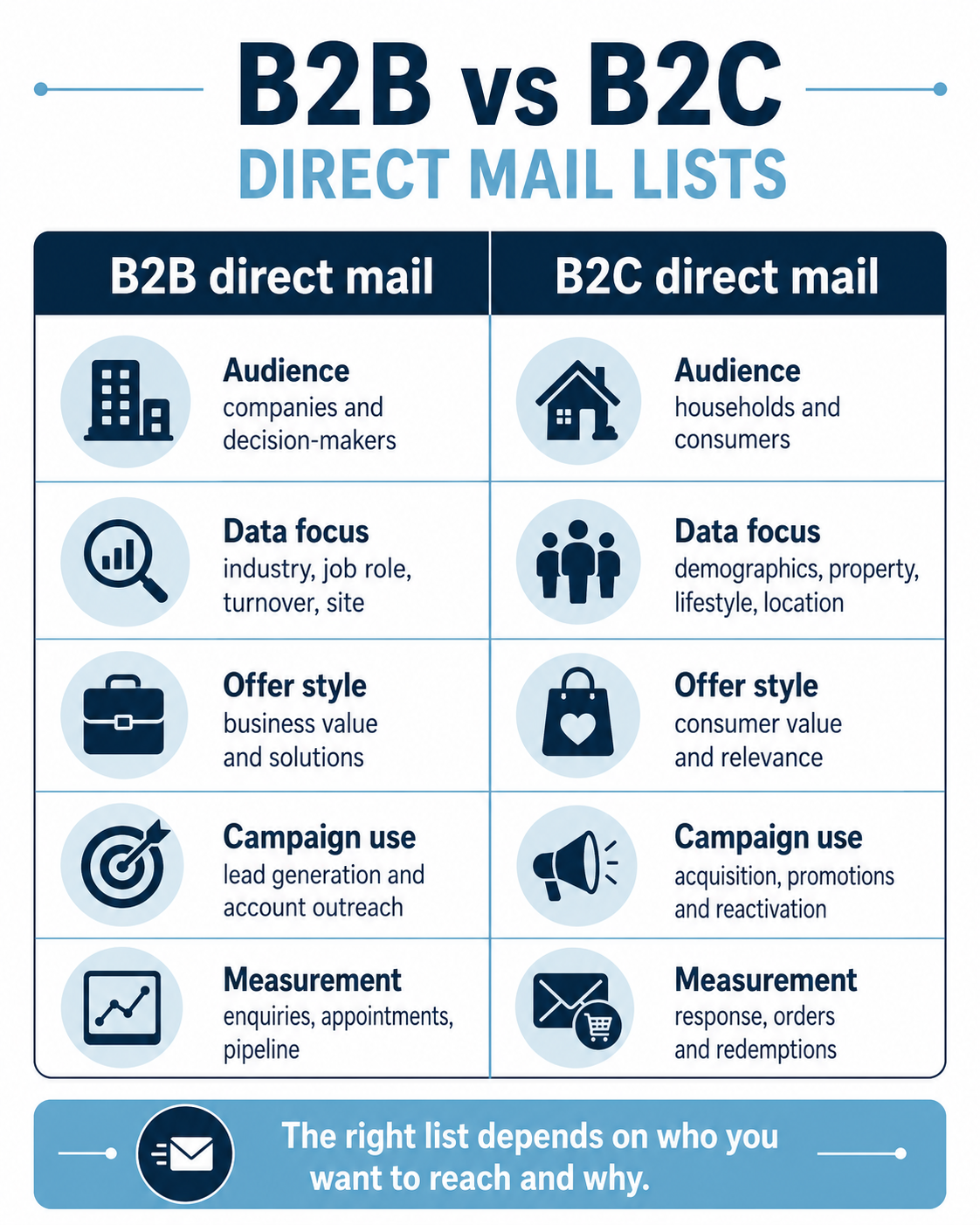
A B2B list is usually built around organisational relevance. The campaign might target finance directors, facilities managers, estate agents, architects, manufacturers, charities, schools, care homes, retailers or other defined business groups. The message normally explains how a product or service helps the organisation, reduces cost, improves operations, solves a problem or supports growth.
A B2C list is usually built around household or consumer relevance. The campaign might target homeowners in a geographic area, families, retirees, people with specific lifestyle indicators, high-value households or residents near a local store or service. The message often needs to focus on personal benefit, convenience, trust, price, location or urgency.
AccuraData separates these approaches because the data and campaign requirements differ. Its B2B Data can support business targeting by sector, location, company size and role, while its B2C Data is designed for consumer audience selection across UK direct marketing campaigns.
The biggest practical difference is the level of selection. B2B campaigns often rely on company attributes and job function. B2C campaigns often rely on demographic, lifestyle, household or property-related indicators. Both can be effective, but both need accurate data and a clear reason why the audience has been selected.
What Good B2B Direct Mail Lists Include
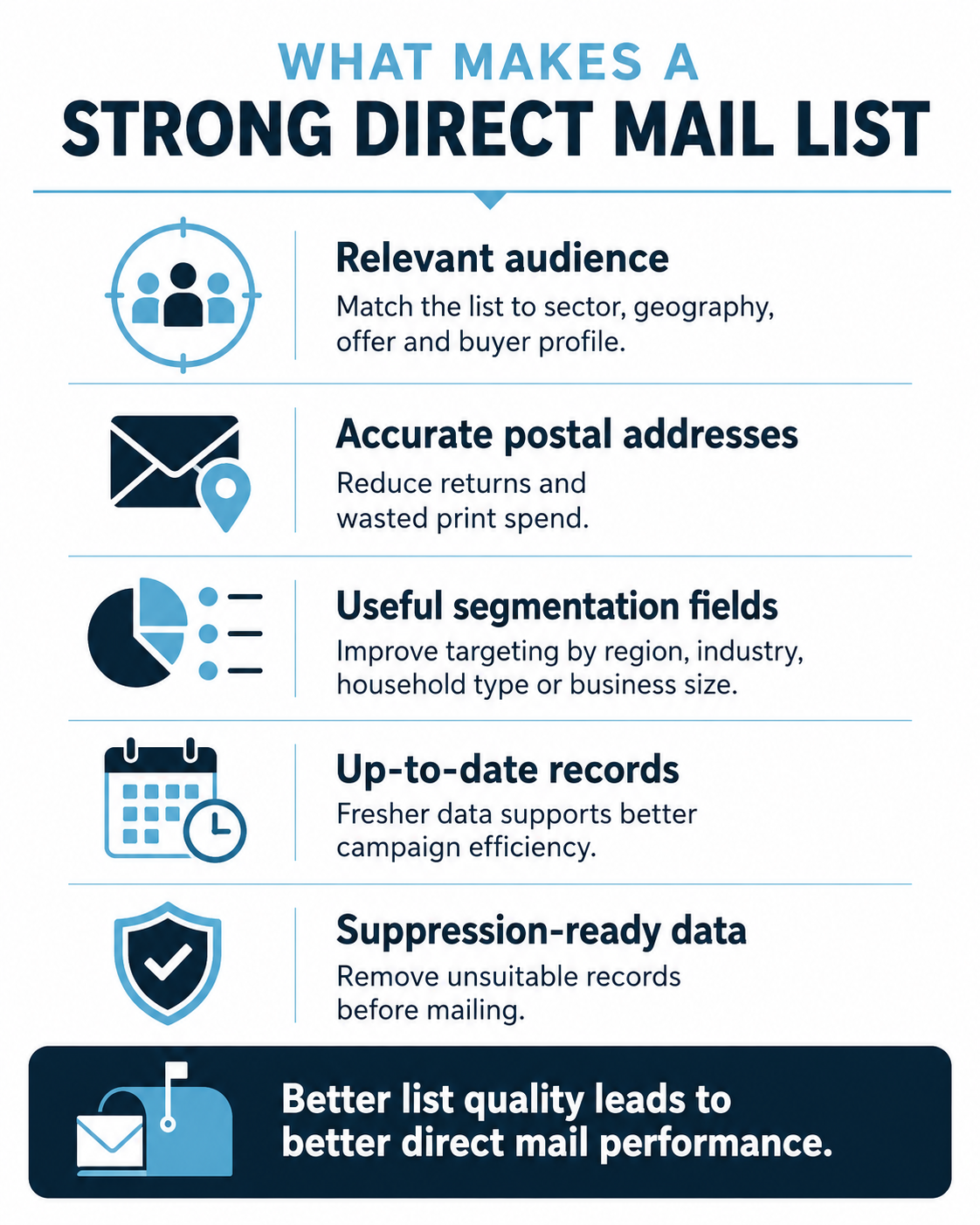
A good B2B direct mail list gives the campaign enough structure to make targeting meaningful. Business name and address are only the start. A more useful list should support selection by industry, region, company size, turnover band, site type, job title, decision-maker level and operational need.
For example, a supplier of workplace safety equipment might want operations managers at manufacturing companies with more than 50 employees. A professional services firm might want managing directors at small and medium-sized businesses within a defined region. A construction product supplier might want architects, specifiers and procurement managers. In each case, the campaign depends on identifying a specific business audience.
B2B postal data is also useful for account-based marketing. A company can send targeted mail to named organisations, then support that activity with sales follow-up, email or LinkedIn activity. This is not a volume-first approach. It is a relevance-first approach, where the postal item is one touchpoint in a wider sales process.
Useful B2B fields include company name, postal address, contact name where appropriate, job title, department, seniority, SIC code, sector, employee count, turnover band, website and telephone number. Not every campaign needs every field, but the provider should be able to explain which fields are available and how they support the planned campaign.
The best B2B list is not necessarily the largest list. It is the list that most closely fits the commercial offer. A smaller audience of well-matched prospects often gives a clearer test than a large list that includes many organisations unlikely to buy.
What Good B2C Lists Include
A good B2C direct mail list is built around consumer relevance. It may use geography, age band, household profile, property type, lifestyle indicators, interests or other permitted segmentation data. The aim is to match the offer to households that are more likely to have a need, interest or reason to act.
For a home improvement company, property type and location may matter more than age. For a local leisure business, catchment area and household profile may be more useful. For financial services, life stage, affluence indicators and household composition may be relevant, subject to appropriate compliance checks.
B2C data needs careful handling because it relates to people in their private lives. The campaign should be clear about the sender, respectful in tone and easy for recipients to opt out of future postal marketing. Citizens Advice explains that people can take steps to reduce unwanted junk mail, including using preference services, which is a useful reminder that consumer expectations matter as much as legal permissions.
B2C lists can be effective when they are targeted and responsible. They are less effective when they are too broad, poorly explained or based on weak assumptions. If a recipient cannot understand why the mailing is relevant to them, the list or the offer may not have been selected carefully enough.
AccuraData’s B2C Data service helps businesses build more focused consumer audiences for direct marketing. The practical benefit is not just access to names and addresses. It is the ability to select a segment that fits the product, service, geography and campaign objective.
UK Compliance for Postal Marketing
Postal marketing is not regulated in exactly the same way as email, text or live telephone marketing. That distinction is important. The rules for direct mail are often more flexible than the rules for electronic marketing, but personal data law still applies where a named person, household or identifiable individual is involved.
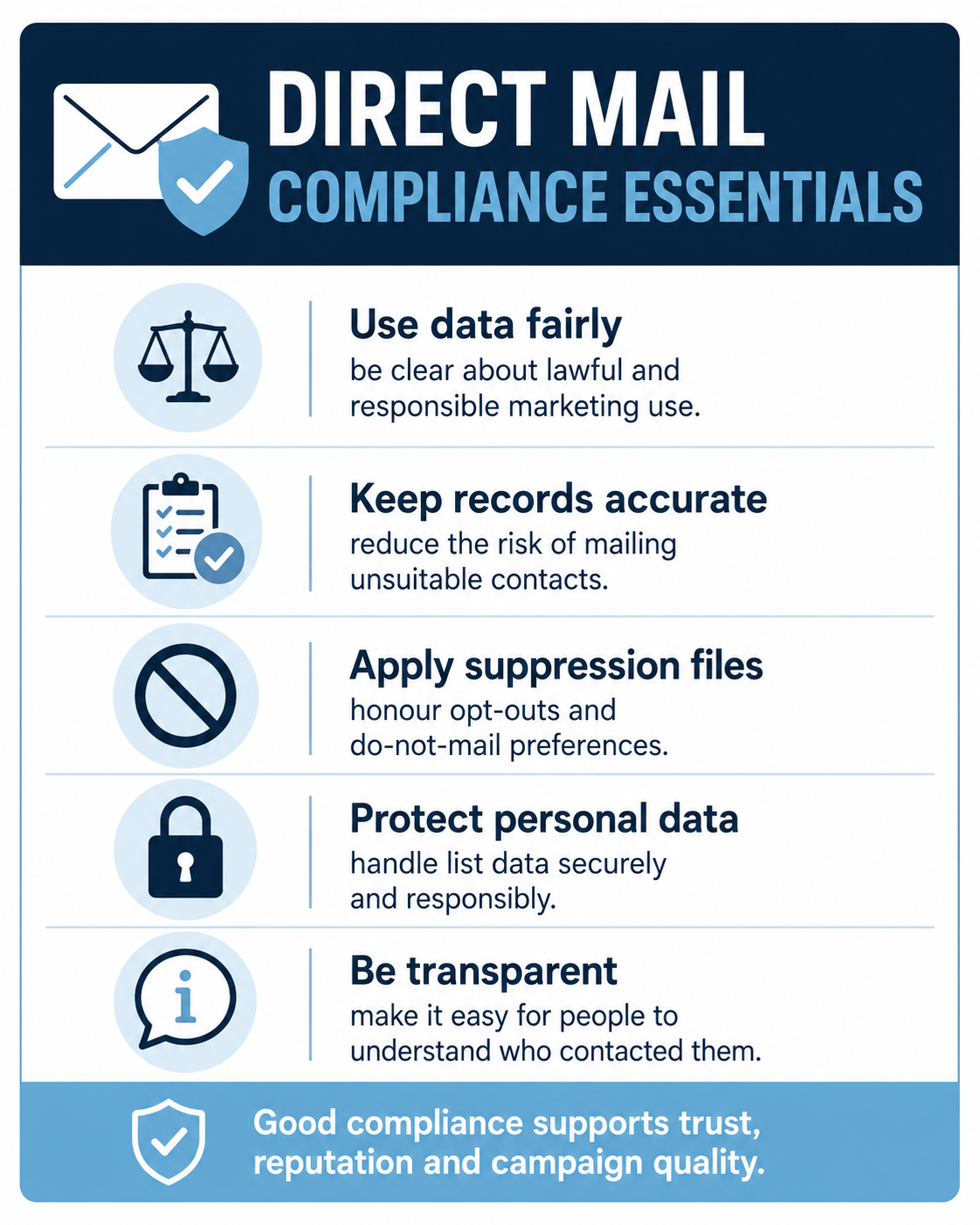
ICO guidance on marketing and data protection states that consent is not needed for direct marketing by post, but it also explains that if you put someone’s name on a letter or flyer, or use other information that identifies them, you need a lawful basis for using their personal data. That makes postal marketing a data protection issue, not just a print and postage issue.
This means organisations should understand their lawful basis, the source of the data, the purpose of the campaign, the privacy information given to recipients and how objections will be handled. Legitimate interests may be appropriate in many postal marketing contexts, but it should be assessed rather than assumed.
ICO guidance on planning direct marketing activity says organisations should build data protection and PECR compliance into the planning stage. That point matters because compliance is much harder to fix after the list has been selected, artwork has been approved and print has already been produced.
PECR is more relevant to electronic communications and telephone marketing than to ordinary postal marketing, but it still matters for multi-channel campaigns. If a direct mail campaign is followed by email, text or telephone contact, those channels must be assessed under their own rules. The ICO direct marketing and PECR hub is a useful starting point for understanding how different direct marketing channels are treated.
Marketing content also needs to be accurate and responsible. The ASA CAP Code covers non-broadcast advertising, sales promotions and direct marketing communications, while GOV.UK advertising law guidance says advertising and marketing should be accurate and honest. A mailing list can put your offer in front of people, but the creative still needs to comply with advertising standards.
MPS, Suppression and Respecting Preferences
Suppression is one of the most important parts of responsible postal marketing. A suppression file is used to exclude people or addresses that should not receive a mailing. This may include internal do-not-mail records, complaints, deceased records, goneaways, duplicate records and people registered with relevant preference services.
The Mailing Preference Service says it is designed to stop personally addressed unsolicited mail. Its consumer registration guidance also explains that prospect mailing lists can be cleaned against the MPS file so that matched names and addresses are not sent the mailing. This is a practical way to respect people who have said they do not want unsolicited addressed mail.
MPS suppression is not only about compliance and reputation. It can also reduce waste. If a recipient has clearly indicated that they do not want unsolicited mail, sending more mail to that person is unlikely to be a good use of print or postage budget. Suppression can improve the commercial efficiency of the campaign by removing unsuitable recipients before production.
Internal suppression is just as important as external suppression. If someone complains, asks not to be contacted, returns mail or is marked as no longer at the address, the organisation should keep that information up to date and apply it before future mailings.
Businesses should also ask data providers what suppression checks have been applied. A provider that cannot explain its approach to suppression, data recency and address quality may not be the right partner for a campaign that needs to protect brand reputation.
Address Quality, Data Cleansing and Waste Reduction
Postal campaigns have physical costs. If the list contains duplicate households, outdated addresses or poorly formatted records, those costs become visible in print, fulfilment, postage and returned mail. Data cleansing is therefore a performance issue as well as a compliance issue.
Royal Mail data cleansing services describe benefits such as enhancing address details with PAF information, reducing waste by removing goneaways and duplicates, and removing opt-outs to comply with GDPR. That is why data quality should be reviewed before print volumes are locked.
Good cleansing can include address standardisation, postcode validation, duplicate removal, deceased suppression, goneaway checks, MPS suppression, internal opt-out matching, household deduplication and business name standardisation. Not every campaign needs every process, but every campaign benefits from asking what has been checked.
AccuraData supports this through data cleansing and enrichment, helping businesses improve the quality and usefulness of marketing data before campaigns go live. For direct mail, that can mean fewer wasted mail pieces, better segmentation and cleaner reporting.
Data cleansing should not be treated as an optional last-minute step. It should happen before segmentation, print counts and response forecasts are finalised. Otherwise, the business may be planning around a list that is larger on paper than it is in practice.
How to Choose the Right Direct Mail List
Choosing a direct mail list starts with the campaign objective. A list for local awareness will be different from a list for high-value B2B prospecting. A list for customer reactivation will be different from a cold consumer acquisition list. The clearer the objective, the easier it is to specify the audience.
Start by defining who the campaign should reach. For B2B, this may mean sector, location, company size, decision-maker level and site type. For B2C, it may mean geography, household type, property profile, life stage or interest category. Then define who should be excluded. Exclusions are often just as important as inclusions because they reduce waste and protect relevance.
Next, ask what fields are available and how recent the data is. A list that includes useful segmentation fields can support better creative, better testing and better reporting. A list that only includes addresses may still be useful, but it gives less control over relevance.
Businesses should also ask how the data was sourced, how it is maintained, which suppression checks are applied, how duplicates are managed, and what can be supplied after delivery to support campaign measurement. A good provider should be able to answer these questions clearly.
AccuraData’s strength is that it does not treat a direct mail list as a standalone spreadsheet. It helps businesses select data that fits the campaign. Its existing article on why the list behind a direct mail campaign matters explains the same principle: the data behind the campaign often decides whether the creative reaches a relevant audience.
Planning a Direct Mail Campaign Around the List
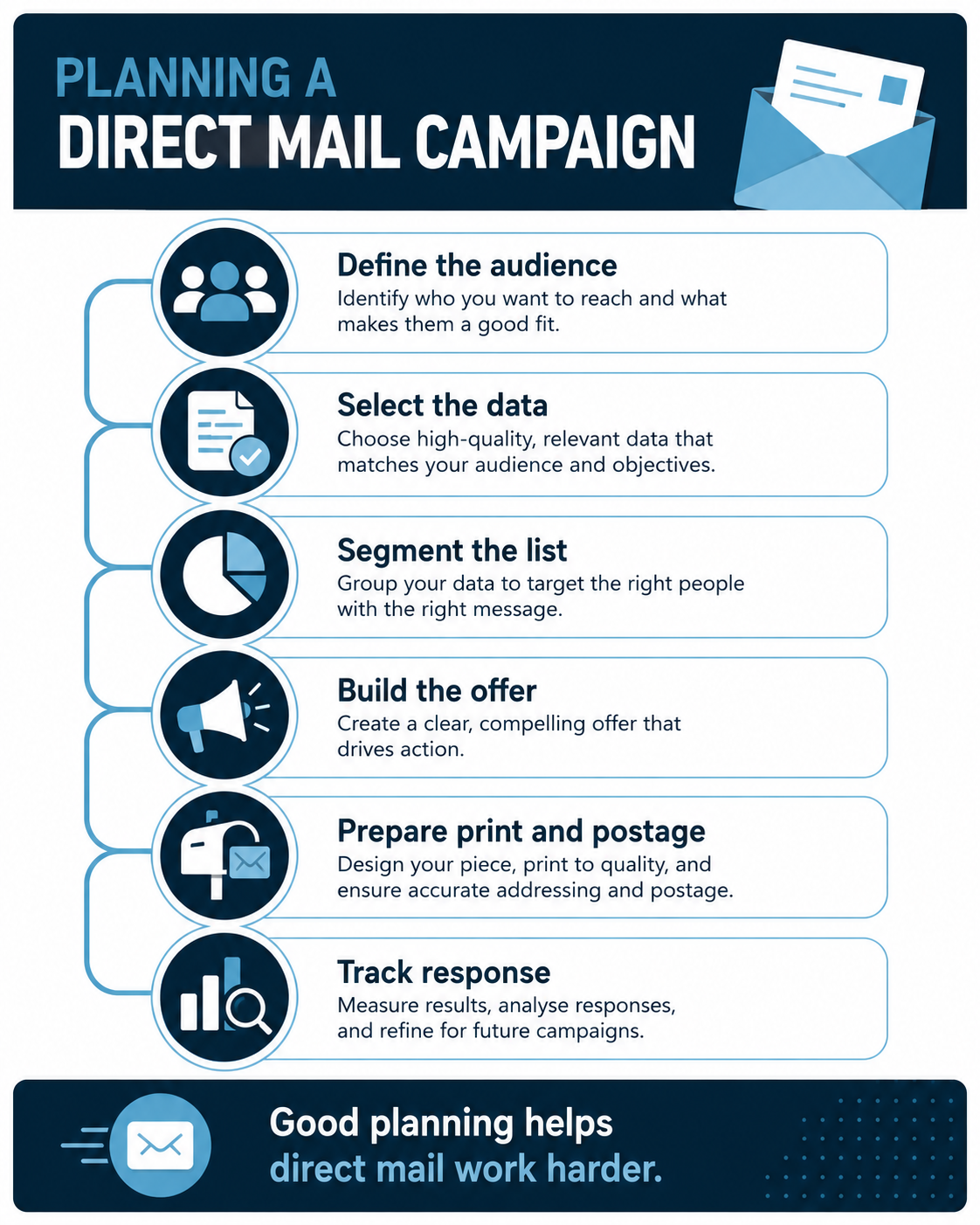
Once the list has been chosen, the campaign should be planned around the audience rather than forcing one generic message onto every record. A well-selected list gives you clues about what the recipient may care about, what language to use and what proof points to include.
For B2B recipients, the copy may need to focus on cost savings, operational improvement, risk reduction, service quality or revenue growth. It may also need to speak to the job function. A finance director, facilities manager and managing director may all care about the same product for different reasons.
For B2C recipients, the copy may need to focus on convenience, trust, local availability, value, lifestyle, urgency or personal benefit. If the list is segmented by geography, local references can make the mailing feel more relevant. If it is segmented by household type, the offer and imagery should reflect that audience carefully.
Campaign planning should include the format, message, offer, call to action, landing page, QR code, phone number, reply mechanism and follow-up plan. The list tells you who is being contacted. The creative tells them why they should care. The response mechanism tells them what to do next.
Testing is useful where volume allows. A business might test two offers, two audience segments, two formats or two creative routes. The aim is to learn which combination of list, message and offer produces the strongest response.
Measuring Direct Mail List Performance
Direct mail measurement should be planned before the mailing goes out. This includes deciding what counts as a response, how it will be tracked and how the results will be matched back to the list. Good measurement helps separate creative performance from list performance.
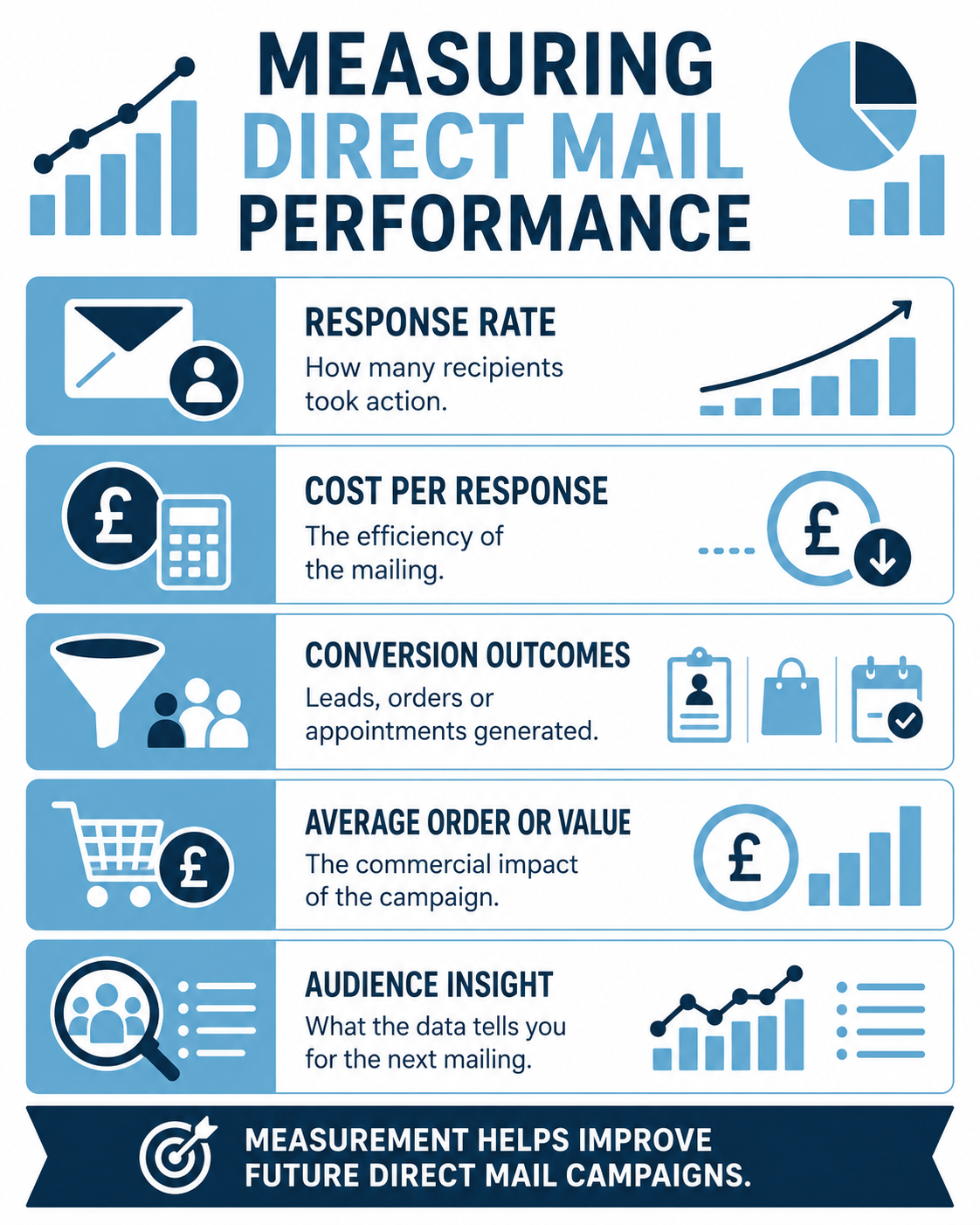
JICMAIL’s 2025 Response Rate Tracker explains that it uses aggregated campaign-level data across thousands of campaigns to provide benchmarks for response, ROI, CPA and average order value. These benchmarks are useful for planning, but each campaign still needs its own tracking because sector, audience, offer and format can change the outcome.
Tracking options include unique phone numbers, QR codes, personalised URLs, reply forms, voucher codes, dedicated landing pages, postcode-level response analysis and sales team outcome tracking. The best method depends on the campaign type and what action the recipient is asked to take.
A campaign should be reviewed by audience segment. If one region, sector, property type or job role performs strongly, that insight can guide future activity. If another segment performs poorly, the audience selection or creative may need to change. This is where a well-structured list becomes more valuable than a flat address file.
Measurement should include more than immediate sales. Some mailings generate calls, store visits, website visits, quote requests, brochure requests, appointments, donations, renewals or later sales conversations. The right metric depends on the objective set before the mailing.
Common Direct Mail List Mistakes
The first common mistake is buying too much data. A large list can feel like better value, but volume does not help if many records do not match the offer. It is usually better to mail a smaller, relevant audience than a larger audience with weak fit.
The second mistake is ignoring suppression. If opt-outs, MPS matches, duplicates and outdated records are not removed, campaign waste increases and brand perception can suffer. Suppression should be part of the list preparation process, not a manual clean-up after complaints arrive.
The third mistake is treating B2B and B2C data in the same way. Business audiences and consumer audiences respond to different messages and need different segmentation. The list, creative and compliance assessment should reflect that difference.
The fourth mistake is failing to measure at segment level. If every response is grouped together, the business cannot see which part of the list worked. That makes the next campaign harder to improve.
The fifth mistake is using direct mail without a follow-up plan. If the campaign generates visits, calls or enquiries, the business needs a process for handling them quickly. In B2B campaigns, sales teams should know which organisations were mailed and what offer was sent.
How AccuraData Supports Direct Mail Lists
AccuraData supports direct mail activity by helping businesses choose the right audience, improve data quality and prepare list selections that match the campaign objective. This matters because direct mail performance depends heavily on who receives the message.
For business campaigns, AccuraData can supply targeted B2B Data covering UK organisations by sector, location, company size and other useful selection criteria. This can support prospecting, account-based marketing, professional services outreach, event promotion and multi-channel lead generation.
For consumer campaigns, AccuraData can supply targeted B2C Data to help businesses reach defined consumer segments. This can support local marketing, retail promotion, home services, financial services, leisure, events and other campaigns where household selection is important.
AccuraData can also help with data cleansing and enrichment where a business already has a customer or prospect database that needs to be prepared for postal marketing. This is useful when internal records are old, duplicated, incomplete or inconsistent.
The value of working with AccuraData is practical. Instead of starting with a vague request for a mailing list, clients can discuss the campaign, audience, exclusions, data fields, segmentation, compliance considerations and delivery format. That makes the list more useful when it reaches the marketing, print or sales team.
A Practical Direct Mail Lists Checklist
Before buying or using Direct Mail Lists, work through a simple planning checklist. This helps keep the campaign focused and reduces the risk of waste.
- Define the campaign objective before choosing the list.
- Decide whether the campaign needs B2B data, B2C data or both.
- Select the audience by relevance, not just volume.
- Check the available segmentation fields and how they support the offer.
- Ask how the data was sourced, maintained and updated.
- Apply appropriate suppression, including internal opt-outs and relevant preference files.
- Clean and deduplicate the list before print volumes are confirmed.
- Plan the creative, offer and call to action around the selected audience.
- Set up response tracking before the mailing is sent.
- Review results by segment and use the findings to improve the next campaign.
This checklist is not a substitute for legal advice, and every organisation should assess its own compliance position. It does, however, provide a practical structure for using postal data more carefully and commercially.
Final Thoughts on Direct Mail Lists
Direct Mail Lists can be highly useful when they are accurate, targeted and used responsibly. They give businesses a way to reach physical households, business sites and decision-makers with a message that can be held, kept and acted on. The channel is not about sending print to as many addresses as possible. It is about selecting the right audience and giving them a clear reason to respond.
Compliance should be built into the process from the start. The ICO makes clear that postal marketing does not usually require consent, but personal data still needs a lawful basis and responsible handling. MPS suppression, internal opt-outs, data cleansing and transparent messaging all help protect both recipients and the sender’s reputation.
Performance also depends on data quality. Good postal data reduces waste, supports better segmentation and gives marketers clearer reporting. A well-structured list can show which audience groups are most responsive, helping future campaigns become more focused and cost-effective.
AccuraData is a strong partner for UK businesses that need reliable Direct Mail Lists because it combines audience targeting, B2B and B2C data expertise, data cleansing and practical campaign understanding. Whether you need a new prospect list, a cleaner customer database or a more structured approach to postal marketing, AccuraData can help you build direct mail activity around better data from the beginning.