
Purchase Email Database is an awkward search phrase, but it reflects a real business question: how can a company buy email data without wasting budget, harming deliverability or creating compliance risk? For UK organisations, the answer is not to buy the biggest file available. The answer is to choose a relevant, well-maintained database, understand the lawful basis for use, apply proper suppression processes and run campaigns with clear measurement from the beginning.
When you purchase email database records can support lead generation, market entry, event promotion, account-based marketing, product launches and customer acquisition. It can also go wrong quickly when the data is old, poorly segmented, badly documented or used without a suitable campaign process. The data behind an email campaign affects who receives the message, how relevant the message feels, how many records bounce, how many people opt out and whether sales teams have useful prospects to follow up.
This article explains how to purchase an email database in a responsible and commercially useful way. It covers compliance under UK GDPR and PECR, the difference between B2B and B2C email data, what to ask before buying, how to judge data quality, how to prepare campaigns, how to measure performance and how AccuraData can support both the database and the campaign delivery. AccuraData supplies targeted B2B Email Data and also provides managed Email Marketing Services for businesses that want a complete campaign solution rather than a spreadsheet and a hope for the best.
What Does It Mean to Purchase an Email Database?
To purchase email database records is to buy access to a structured set of email contact records for marketing or sales activity. In a B2B setting, those records usually relate to named people at companies, such as directors, owners, department heads, managers or specialists in a particular function. A useful business email database may include the company name, contact name, job title, business email address, telephone number, postal address, industry sector, SIC code, company size, turnover banding and location.
A database is different from a simple list of addresses. A list may contain only one field, such as an email address. A proper database provides the context needed to select the right audience and write relevant campaigns. Without that context, the sender is forced to treat every recipient the same, which usually weakens performance. With good segmentation fields, a campaign can be tailored by sector, role, seniority, region and business type.
AccuraData’s B2B Email Data page explains that targeted business email marketing lists can be selected using criteria such as industry sector, company size, geographic location, job function, seniority level, employee count, turnover and SIC code. Those fields matter because campaign relevance starts before the first line of copy is written. A message to finance directors in manufacturing companies should not look the same as a message to estate agency owners, HR managers or construction procurement teams.
In practice, when you purchase email database records, it should be treated as audience planning. The purchase is not only a data transaction. It is a decision about who your business wants to reach, what you can reasonably say to them, and how you will handle the response. The more carefully the database is selected, the more likely it is that the campaign will feel useful rather than random.
Why Businesses Buy Email Databases
Businesses often buy email databases because building a list manually takes time. Sales teams may know the type of company they want to reach but lack contact details for the right decision-makers. Marketing teams may need to test a new sector, promote a webinar, launch a product or support a new business development campaign. A targeted database gives them a structured starting point.
Email also remains a measurable channel. Litmus research on email marketing ROI reports that many marketing leaders receive strong returns from email, with a significant share reporting returns between $10 and $50 for every $1 spent. Benchmarks are not promises, but they show why email continues to be used by businesses that manage their data, audience and campaigns properly.
The reason email can perform well is that it is direct. The sender can choose a defined audience, place a message in front of them, track engagement and pass warm prospects to sales. However, email is only direct in a useful sense when the data is accurate. If the database contains invalid addresses, irrelevant contacts or old job titles, the campaign will create noise, bounces and wasted follow-up.
A purchased email database can therefore be useful when it is selected for fit rather than volume. Buying 50,000 broad contacts may feel impressive, but a smaller database of 2,000 well-matched decision-makers may produce better results. The database should mirror the business objective, not simply maximise the number of records delivered.
B2B and B2C Email Databases Are Not the Same
One of the most important distinctions when buying email data is the difference between B2B and B2C databases. B2B databases are designed for business-to-business communication. They usually contain business contacts at companies or organisations. B2C databases are designed for consumer marketing and relate to individuals acting in a personal capacity.
This distinction matters because the legal rules and recipient expectations are different. The ICO guidance on electronic mail marketing says that organisations must not send marketing emails or texts to individual subscribers without specific consent, unless the limited soft opt-in exception applies. That is particularly important for consumer email data.
B2B email marketing has a different framework. The ICO guidance on business-to-business marketing explains that the PECR rule on direct marketing by electronic mail does not apply to corporate subscribers, which means B2B marketing emails can be sent to corporate bodies without consent under PECR. The same ICO guidance also says that the sender must not disguise or conceal its identity and must provide a valid address for opt-outs.
This does not mean B2B email data is free from data protection requirements. A named business email address, such as firstname.lastname@company.co.uk, can still be personal data. UK GDPR can still apply. That means the sender needs a lawful basis for processing, accurate data, transparency and a way to respect objections. The difference is that a well-targeted B2B campaign may often be assessed through legitimate interests, depending on the facts of the campaign.
AccuraData’s core strength is targeted B2B data. For clients buying email databases to reach UK business decision-makers, AccuraData can help select records by role, sector, location, company profile and campaign purpose. That makes the database more useful and helps the campaign avoid broad, irrelevant sending.
Is It Legal to Purchase an Email Database in the UK?
Buying an email database is not automatically unlawful in the UK. The legal question is how the data was sourced, what type of recipient is being contacted, what the sender intends to send, what the recipient was told, what lawful basis applies and how opt-outs will be handled. A responsible buyer should never treat the supplier’s reassurance as the whole compliance answer. The buyer should understand the data and the campaign process.
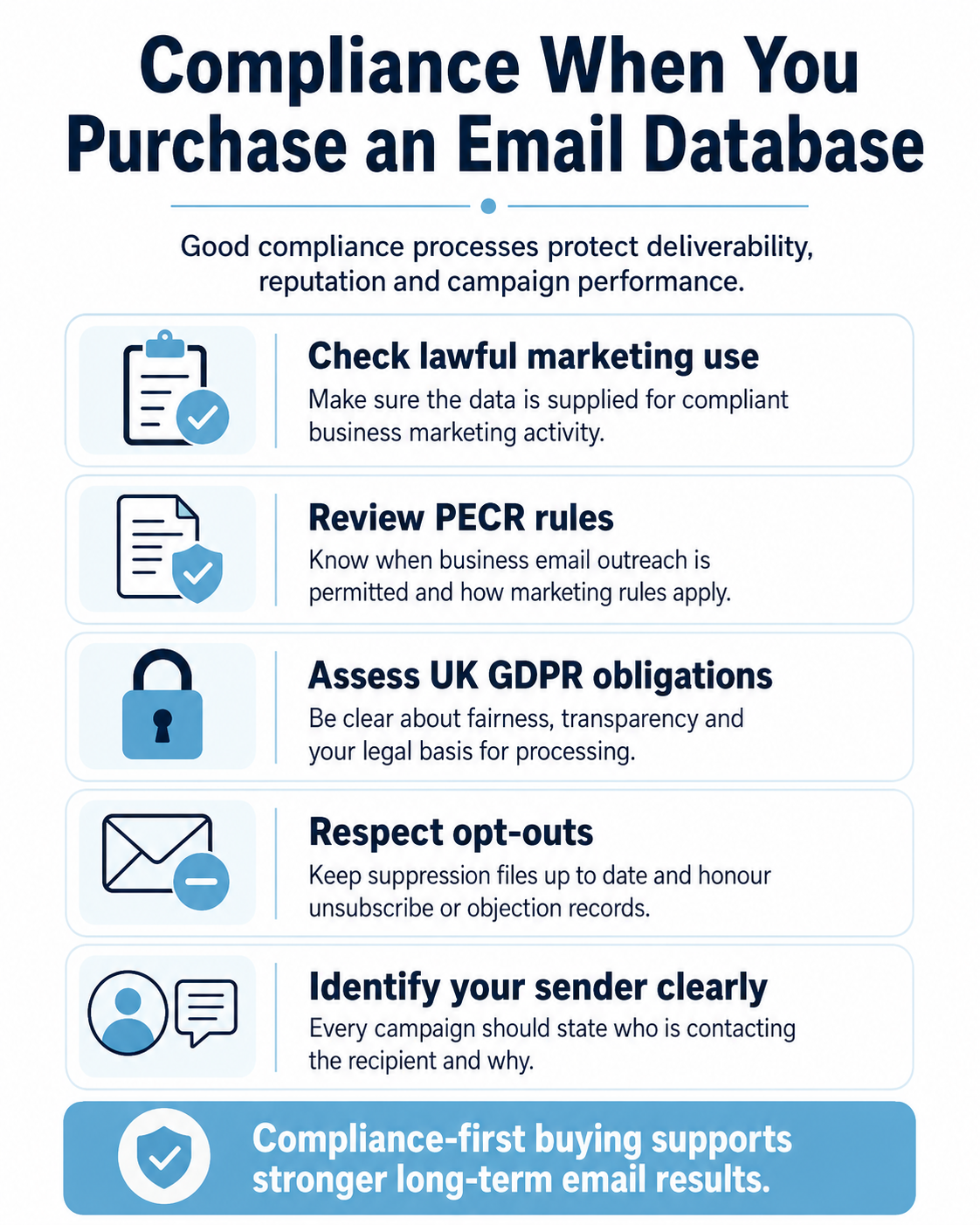
The ICO guidance on choosing a lawful basis for direct marketing explains that organisations need a valid data protection reason when using people’s information to send direct marketing. The two lawful bases most likely to apply to direct marketing are consent and legitimate interests. Which basis is appropriate depends on the context, the audience and the nature of the campaign.
For B2C email marketing, consent is normally central because PECR restricts marketing emails to individuals unless consent or the limited soft opt-in applies. A purchased consumer list should therefore be treated with particular caution. The sender should understand exactly how consent was obtained, whether the sender or category of sender was named, what the recipient was told, and whether there is evidence of that consent.
For B2B email marketing to corporate subscribers, consent under PECR may not be required. However, UK GDPR still requires a lawful basis where personal data is used. The ICO guidance on legitimate interests states that direct marketing may be a legitimate interest, but it does not automatically apply in every case. The organisation must consider the purpose, necessity and balance of the processing.
A practical way to reduce risk is to document a legitimate interests assessment before a B2B campaign. This should explain why the campaign is relevant, why the selected audience is appropriate, why the contact details are necessary, how the impact on recipients is limited and how objections will be handled. A narrow, relevant database is much easier to justify than a broad file sent to every contact with no clear business connection.
What to Check Before You Buy
Before buying an email database, ask questions that test both compliance and performance. A credible provider should be able to explain the data fields, targeting options, update process and compliance position clearly. Vague answers are a warning sign. Data quality is not something that can be fixed by a good subject line after the campaign has launched.
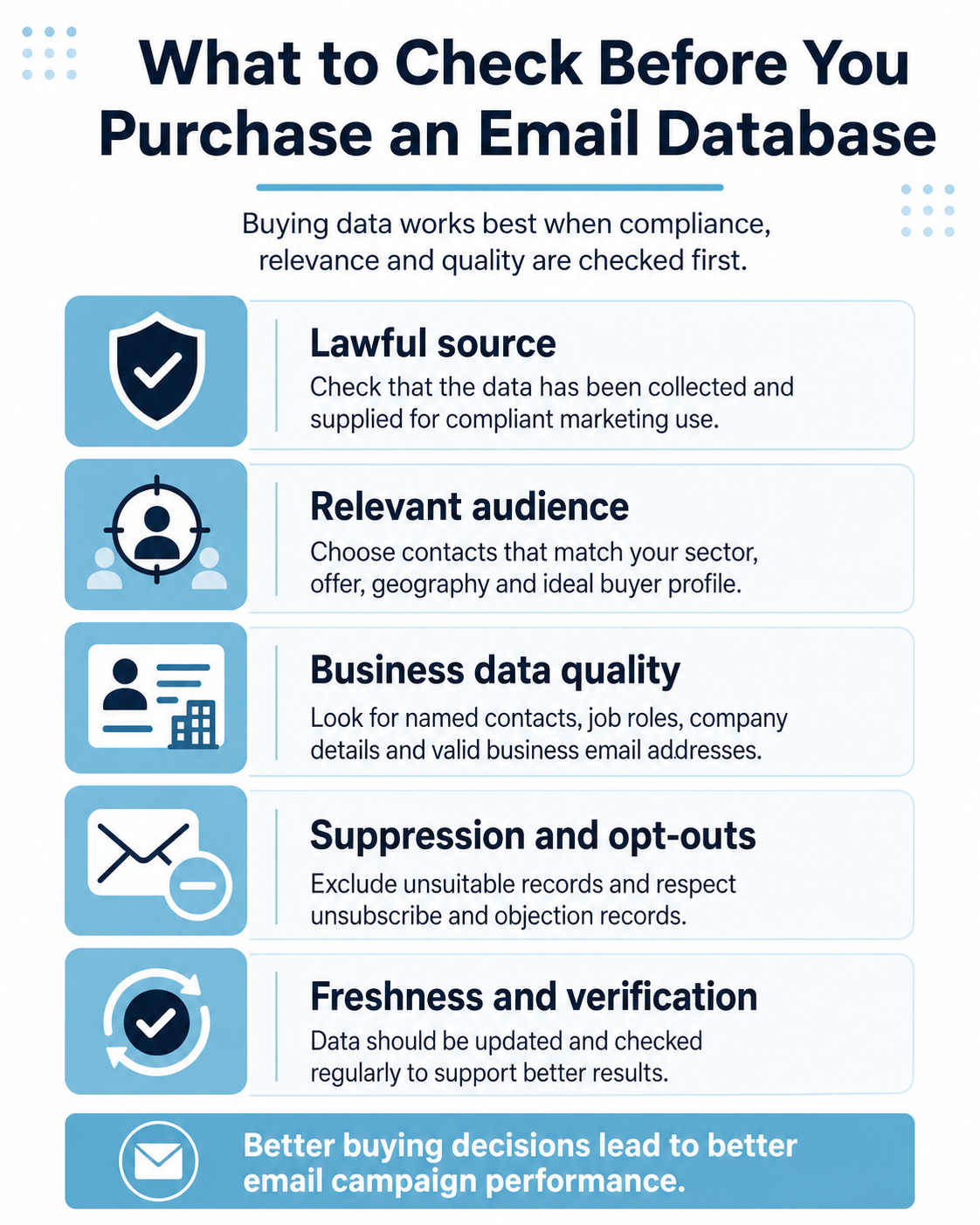
Useful questions include:
- Who is included in the database and how are contacts selected?
- Is the data B2B, B2C or a mixture of both?
- What fields are included beyond the email address?
- How recently has the data been verified?
- Can the list be filtered by sector, location, role, seniority, company size or other criteria?
- What lawful basis or permission framework supports the intended use?
- What documentation is supplied with the data?
- How are unsubscribes, objections and suppression lists handled?
- Can the provider also clean, segment or manage your campaign data?
- What happens if records bounce or do not match the agreed audience?
What Good Email Database Quality Looks Like
A good email database is accurate, relevant, segmented and documented. Accuracy means the email address is formatted correctly, active and linked to the right person or role. Relevance means the contact matches the campaign audience. Segmentation means the data includes enough information to write different versions of the campaign for different groups. Documentation means the buyer can understand the source, use and compliance position of the data.
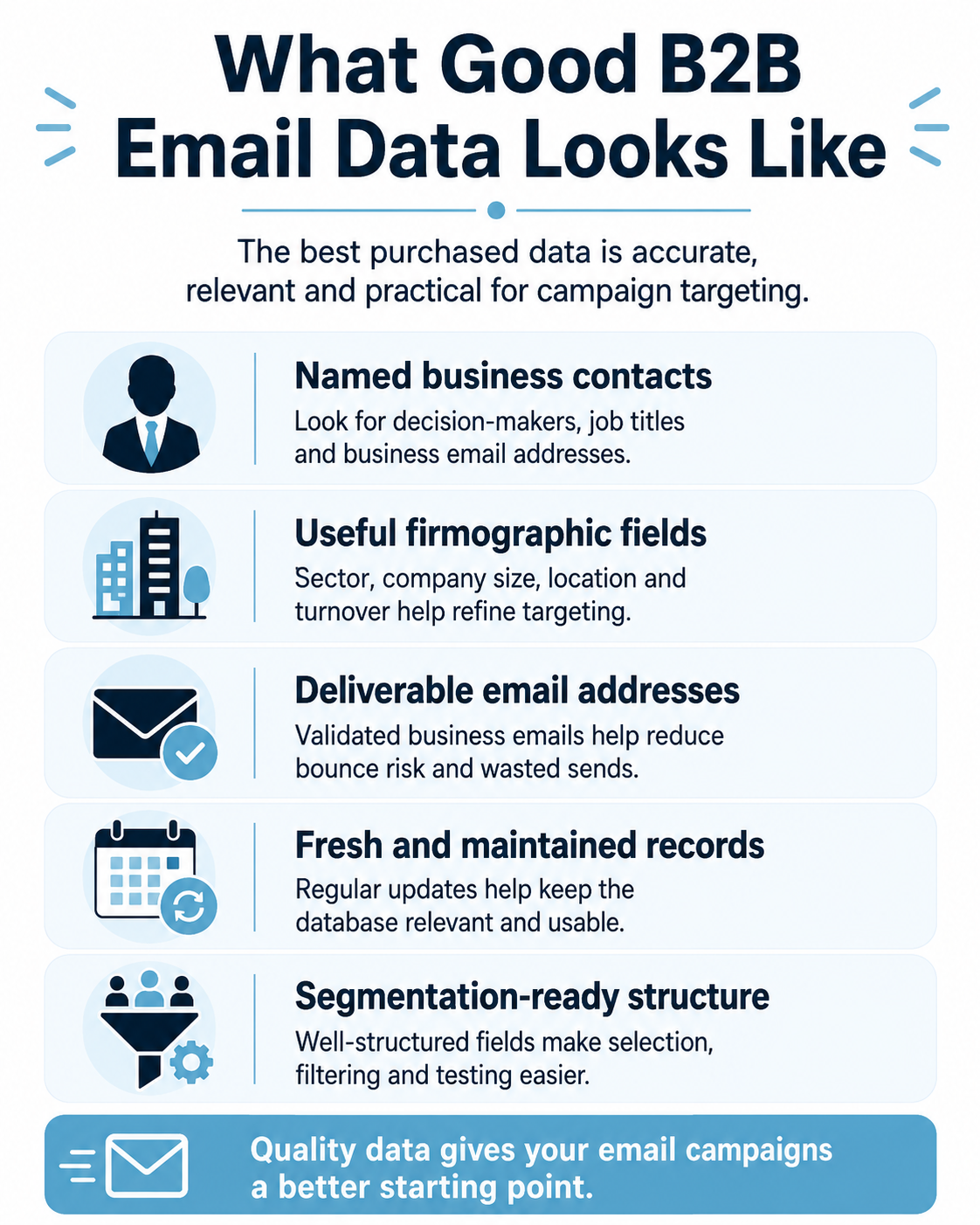
Data quality changes over time. People move roles, companies merge, departments restructure and email addresses become inactive. Apollo’s discussion of B2B data decay notes that B2B contact data can decay at roughly 2.1% per month on average, with changes to title, phone, email and company compounding the problem. That is why a purchased database should be fresh, maintained and checked before use.
Poor data affects more than the campaign report. Invalid addresses can increase bounce rates. Irrelevant contacts can increase opt-outs and complaints. Old job titles can lead to awkward follow-up. Incomplete segmentation can force marketers to send generic content. Each of these problems weakens the commercial value of the campaign.
AccuraData’s B2B email databases are maintained using verification, research, cleansing and database management processes. The company’s Data Cleansing and Enrichment service can also help organisations improve their existing databases before a campaign, which is useful for businesses that already hold data but do not trust its accuracy.
Compliance Best Practice When Using a Purchased Email Database
Compliance should be planned before the send. It should not be a final check after the copy and audience have already been approved. The first step is to identify whether the data is B2B or B2C, whether the recipient is a corporate subscriber or individual subscriber, and what legal basis supports the planned communication.
The ICO guidance on PECR electronic mail compliance says PECR applies to anyone who sends or instigates the sending of direct marketing by electronic mail. It also explains that if one organisation asks another to send marketing on its behalf, both parties may have responsibilities. This is important when a business buys data and also asks a provider to send the campaign.
For a B2B email campaign, basic compliance actions include making the sender identity clear, including a valid unsubscribe or opt-out route, maintaining a suppression list, screening each campaign against previous opt-outs, keeping records of the lawful basis, and using the data only for the agreed purpose. For individual consumer marketing, evidence of consent is usually far more important.
Transparency also matters. If a recipient asks where their data came from, your organisation should be able to answer. A reputable data partner should be able to support that explanation. This does not mean every campaign needs a long privacy statement in the email body, but your privacy information should be accessible, accurate and consistent with how the data is being used.
The best compliance process is also good marketing practice. Clear identity builds trust. Respecting opt-outs protects reputation. Sending only to relevant contacts reduces wasted activity. Documenting decisions helps teams stay consistent as campaigns scale.
Deliverability Best Practice After You Purchase an Email Database
Even a compliant database can underperform if deliverability is ignored. Deliverability is the ability of emails to reach inboxes rather than bounce, land in junk folders or be blocked. It is affected by data quality, sender reputation, authentication, email content, sending volume, engagement and complaint rates.
Google’s email sender guidelines explain the importance of authentication, including SPF, DKIM and DMARC, and set expectations for senders to avoid practices that look abusive. These technical foundations matter because mailbox providers need to trust that the sender is legitimate and that recipients are not being harmed by the mail stream.
When using a purchased database, avoid uploading the full list and sending at maximum volume without preparation. Segment the database first. Start with the most relevant audience. Keep the first campaign modest, useful and easy to opt out of. Monitor bounces, complaints, unsubscribes, clicks and replies. If a segment performs badly, pause and review the data, message and targeting before sending more.
List hygiene is central. Remove duplicates, suppress previous opt-outs, validate email addresses and avoid role accounts where they are not appropriate for the campaign. A purchased database should be used with care because recipients may not know the sender yet. The first email has to earn attention quickly and professionally.
AccuraData can help reduce these risks by supplying targeted data and by supporting campaign management. Its Email Marketing Services can include audience selection, campaign preparation, broadcast setup, scheduling, delivery, reporting and warm prospect identification. That joined-up process is useful because deliverability is connected to both the data and the campaign operation.
Performance Best Practice: Relevance Beats Volume
The biggest performance mistake when buying an email database is judging value by the number of records alone. A large database may look cheaper per contact, but cheap records can become expensive when they create bounces, irrelevant sends, low engagement and poor sales follow-up. Relevance is usually a stronger predictor of campaign usefulness than raw list size.
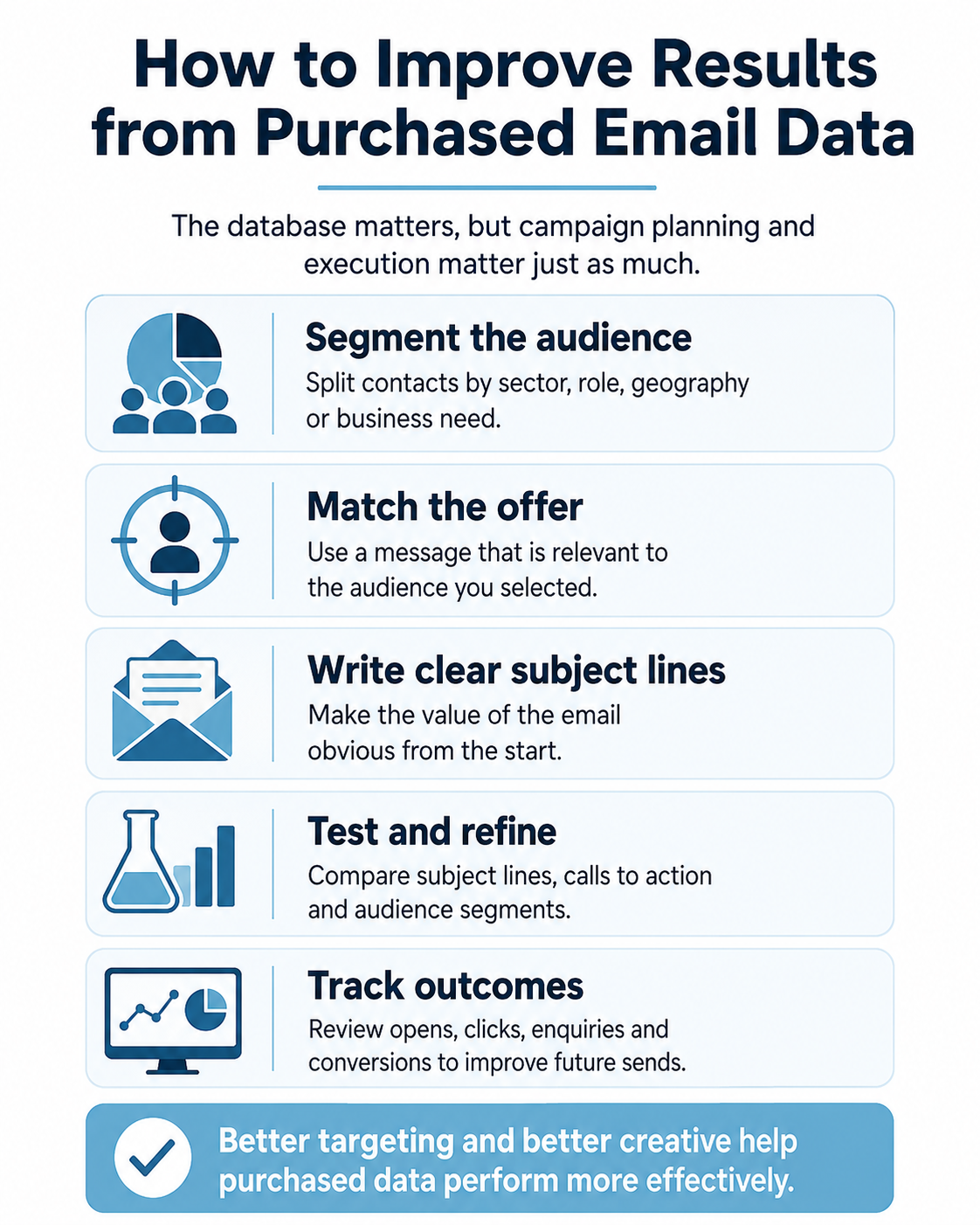
Start with an ideal customer profile. Define the sectors, roles, company sizes, regions and business situations that make a contact worth approaching. Then buy data around that profile. For B2B campaigns, a useful audience definition might include specific job functions, seniority levels, employee size bands, turnover ranges and SIC codes. AccuraData’s B2B Email Data can be tailored around these criteria.
The campaign message should then reflect the audience. A database filtered by job title and sector allows the email to speak to a real business context. A procurement director, finance director, managing director and marketing manager may all work in the same industry, but they do not evaluate the same problems in the same way. Segmentation allows the sender to adjust the angle, evidence and call to action.
A good purchased database also supports follow-up. Email engagement should not be treated as a vanity metric. Clicks, replies, repeat engagement, downloads and meeting requests are signals that sales teams can use. AccuraData’s campaign support can help identify warmer prospects so sales activity is focused on people who have shown a level of interest.
How to Brief a Data Provider
A strong brief helps the provider build a better database. If the brief is vague, the data will be vague. Instead of asking for “marketing managers in the UK”, explain the campaign objective, the product or service, the buyer profile, the sectors to include or exclude, the region, the desired seniority, the company size range and any red flags. Tell the provider how the campaign will be used and what result would count as success.
A good brief should include the following information:
- The campaign objective, such as lead generation, event promotion, product launch or account-based outreach.
- The target market, including sectors, regions, company size, turnover or other firmographic filters.
- The decision-makers or influencers you want to reach.
- The product or service being promoted and the type of business problem it solves.
- Any sectors, roles or company types to exclude.
- Whether you need email addresses only or wider contact data for multi-channel follow-up.
- Whether the provider will supply data only, cleanse your data or run the campaign as well.
- The expected campaign timing, volume and reporting requirements.
How to Prepare the Campaign After Buying the Database
Once the data is supplied, do not send immediately. First, review the fields and make sure the database matches the brief. Check the segmentation options, remove any contacts that should not be used, apply your suppression file and confirm the campaign versioning. If the database contains several audience groups, prepare tailored messages rather than one generic email.
The subject line should be clear, not gimmicky. The opening line should show why the message is relevant. The body should focus on one problem, one offer and one next step. A cold B2B email should not try to explain everything about the company. It should give the recipient enough context to understand the relevance and decide whether to click, reply or request more information.
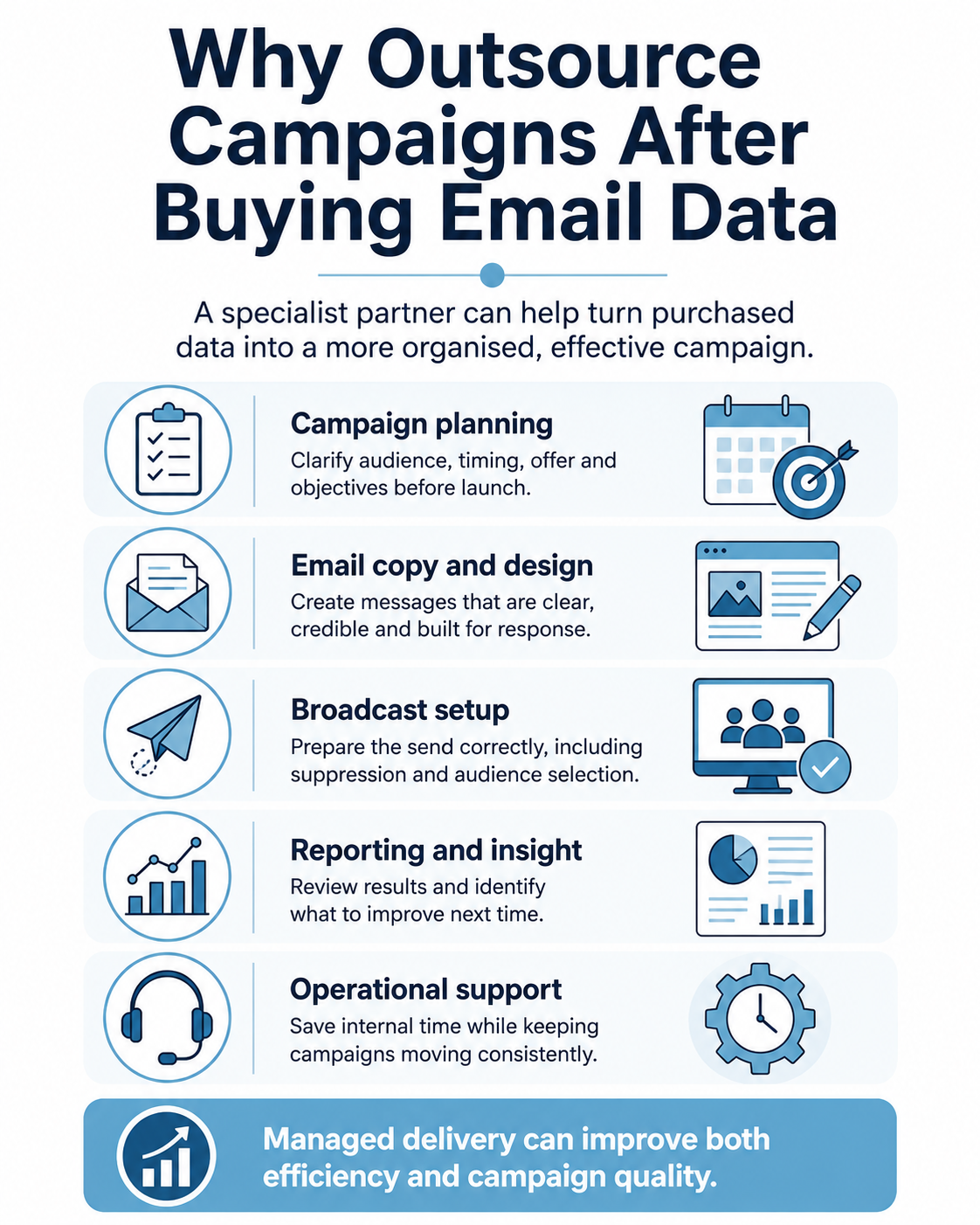
For businesses that would rather not manage this process internally, AccuraData can run the campaign as part of its Email Marketing Services. The service can include strategy, audience selection, copywriting, email design, broadcast delivery, reporting and support for follow-up sales activity. This helps clients avoid the common problem of buying a database but not having the time or technical process to use it properly.
AccuraData’s Outsourced Email Marketing article explains how outsourced support can cover data sourcing, campaign deployment, platform management, content production, deliverability management, compliance review and reporting. For many businesses, this is more useful than buying data alone because the quality of execution determines how much value the database creates.
Measuring Campaign Results
Measurement should be agreed before the campaign launches. If the objective is meeting generation, then opens alone are not enough. If the objective is market education, clicks and repeat engagement may matter more. If the objective is event attendance, registrations and attendance quality matter more than the size of the list. The performance framework should reflect the commercial goal.
Useful measures include delivered emails, bounces, unsubscribes, spam complaints, clicks, replies, conversions, warm prospects, booked calls, qualified opportunities and revenue influenced. Open rates can still provide a rough signal, but they should be interpreted carefully because privacy features and automated activity can distort them. Clicks, replies and pipeline activity are usually more reliable indicators of real interest.
Campaign measurement should also feed back into the database. Which sectors clicked most? Which job titles replied? Which company sizes ignored the message? Which segments produced unsubscribes? This insight helps refine future purchases and future campaigns. A database purchase should not be treated as a one-off transaction. It should improve your understanding of the market.
AccuraData can provide post-campaign reporting through its Email Marketing Services, including open-rate data, click-through data and engagement insight. That reporting can help sales teams prioritise warm prospects rather than starting from the full list.
Common Mistakes When Buying Email Databases
Many problems with purchased email databases follow the same pattern. The buyer focuses on price and volume, then discovers that the data is too broad, too old or too poorly documented to use effectively. Another common mistake is buying data before defining the campaign objective. This leads to a database that may be technically large but commercially weak.
A second mistake is treating compliance as the supplier’s problem. The supplier should provide data responsibly, but the sender still needs to use it properly. If your organisation is the one promoting its products or services, you need to understand the compliance position, the lawful basis, the opt-out process and the campaign content.
A third mistake is failing to suppress previous objections. If someone has already opted out of your marketing, they should not be included simply because they appear in a newly purchased file. Your own suppression list should be applied to every new database before sending. This is good compliance and good relationship management.
A fourth mistake is sending one generic email to everyone. If you pay for segmentation fields, use them. Tailor the message to the audience. Even small changes by sector, role or company size can make the message feel more relevant and improve the quality of engagement.
Why Choose AccuraData When You Purchase an Email Database?
AccuraData is a strong partner for businesses that want to purchase an email database because it connects data quality with practical campaign use. The company supplies UK-focused B2B email data, supports audience targeting and can also help run the email campaign through its marketing services. That combination matters because the database and the campaign are not separate in real performance terms.
AccuraData’s B2B Email Data service is designed for businesses that need tailored email marketing lists built around campaign objectives and audience requirements. Data can be filtered by industry, company size, geography, job function, seniority, employee count, turnover and SIC code targeting. That helps clients buy data that fits the campaign rather than a generic file.
For businesses with existing records, AccuraData’s Data Cleansing and Enrichment service can improve database accuracy before a campaign. This is valuable when an internal CRM has grown over time but contains duplicates, old email addresses, incomplete fields or contacts that no longer match the target audience.
For businesses that want campaign delivery as well as data supply, AccuraData’s Email Marketing Services can support the full process. This can include campaign data supply, email copywriting, email design, broadcast management and post-campaign reporting. The result is a more complete solution for teams that need lead generation support but do not want to manage every technical and operational step internally.
The practical benefit is focus. Instead of buying a database from one place, asking another person to clean it, using another platform to send it and manually interpreting the results, businesses can work with AccuraData across the data and campaign layers. That can make the process easier to manage and more accountable.
When Should You Buy Data and When Should You Clean Existing Data?
Buying a new email database makes sense when your existing CRM does not cover the audience you want to reach. For example, a business entering a new region or sector may need new records. A company launching a service to a different job function may also need a fresh database. In these cases, buying targeted B2B email data can save months of manual research.
Cleaning existing data makes sense when you already have useful records but do not trust their accuracy. Old CRMs often contain duplicates, incomplete job titles, outdated companies, invalid email addresses and inconsistent formatting. Sending to that database without cleaning can damage deliverability and waste sales time.
A blended approach is often best. Clean the existing database first, then purchase additional targeted records to fill gaps. This gives the business a clearer view of the total audience and prevents duplicate or conflicting records. It also allows marketing and sales teams to separate warm CRM contacts from cold prospect contacts and write the right message for each group.
AccuraData can support both approaches. It can supply new B2B email data, cleanse existing data and help manage the campaign. This is useful for businesses that want to improve their outbound marketing without rebuilding every process internally.
A Practical Checklist Before You Purchase Email Database Records
Before committing to a purchase, use a practical checklist. The aim is to protect compliance, reduce wasted spend and make the campaign easier to measure.
- Define the campaign objective before requesting data.
- Choose B2B or B2C data deliberately and understand the different rules.
- Confirm the audience criteria, including sector, role, seniority, company size and location.
- Ask how the data is sourced, verified and maintained.
- Confirm what documentation will be supplied with the database.
- Check whether the database can be segmented for tailored messaging.
- Apply your own suppression list before any send.
- Set up SPF, DKIM and DMARC before broadcasting at scale, using guidance such as Google’s sender requirements.
- Create a clear unsubscribe or opt-out process and record objections properly.
- Measure results beyond opens, including clicks, replies, conversions and sales follow-up outcomes.
Final Thoughts
The decision to purchase an email database should not be rushed. A good database can help a business reach decision-makers faster, test new markets and support measurable lead generation. A poor database can damage deliverability, waste sales time and create compliance risk. The difference is rarely the file format. It is the quality, relevance, documentation and campaign process behind the data.
For UK B2B organisations, the best results usually come from a targeted approach. Define who you want to reach, buy only the records that match that audience, document the compliance position, use clear opt-outs, protect deliverability and measure the campaign in terms of commercial outcomes. Treat the database as the foundation of the campaign, not a commodity bought by the thousand.
AccuraData can help businesses buy better email databases and use them more effectively. Whether you need a targeted B2B Email List, support cleaning your existing data, or a managed outsourced email marketing process that includes campaign planning, creative, delivery and reporting, AccuraData provides a practical route to more responsible and more effective B2B email outreach.
If your business is considering whether to purchase email database records for a new campaign, the starting point should be simple: buy the right audience, use the data responsibly and make sure every campaign gives you something measurable to improve next time.