
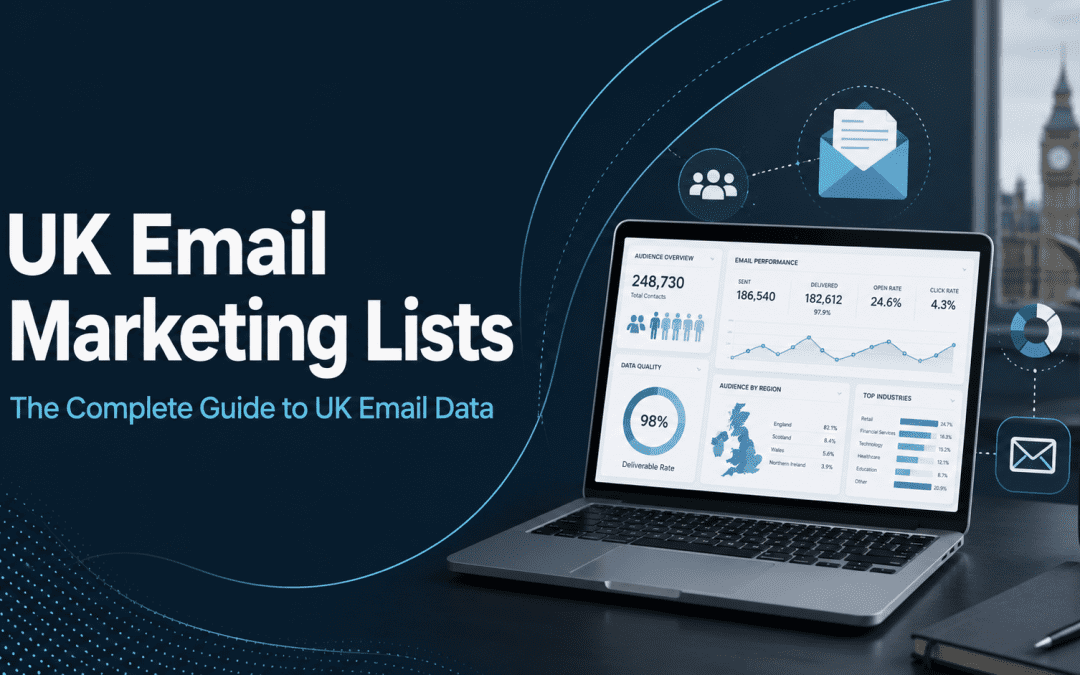
UK Email Marketing Lists can be a powerful tool when they are accurate, well segmented and used responsibly. They help businesses reach defined audiences, introduce products and services, nurture leads and support sales teams with measurable campaign activity. They can also cause problems when they are poorly sourced, out of date or used without a clear understanding of UK data protection rules.
This guide explains what UK Email Marketing Lists are, how they differ from general CRM data, how B2B and B2C email lists should be treated, and what businesses should look for when buying or using UK Email Data. It also explains why AccuraData is a strong partner for organisations that need targeted B2B Email Data, managed Email Marketing Services or support with data quality before a campaign goes live.
The aim is practical rather than theoretical. If you are considering buying an email list, refreshing an existing database or outsourcing an email campaign, the important questions are simple. Who are you contacting? Why are you contacting them? Is the data accurate? Is the use lawful? Can the campaign be measured? Will the list help your team create real opportunities?
What Are UK Email Marketing Lists?
UK Email Marketing Lists are structured datasets that contain email contact records for people or organisations in the United Kingdom. They may be used for direct marketing, lead generation, sales outreach, customer retention, newsletter activity, event promotion or account-based marketing. In everyday language, they are also called UK Email Data, email marketing data, business email lists, consumer email lists or email databases.
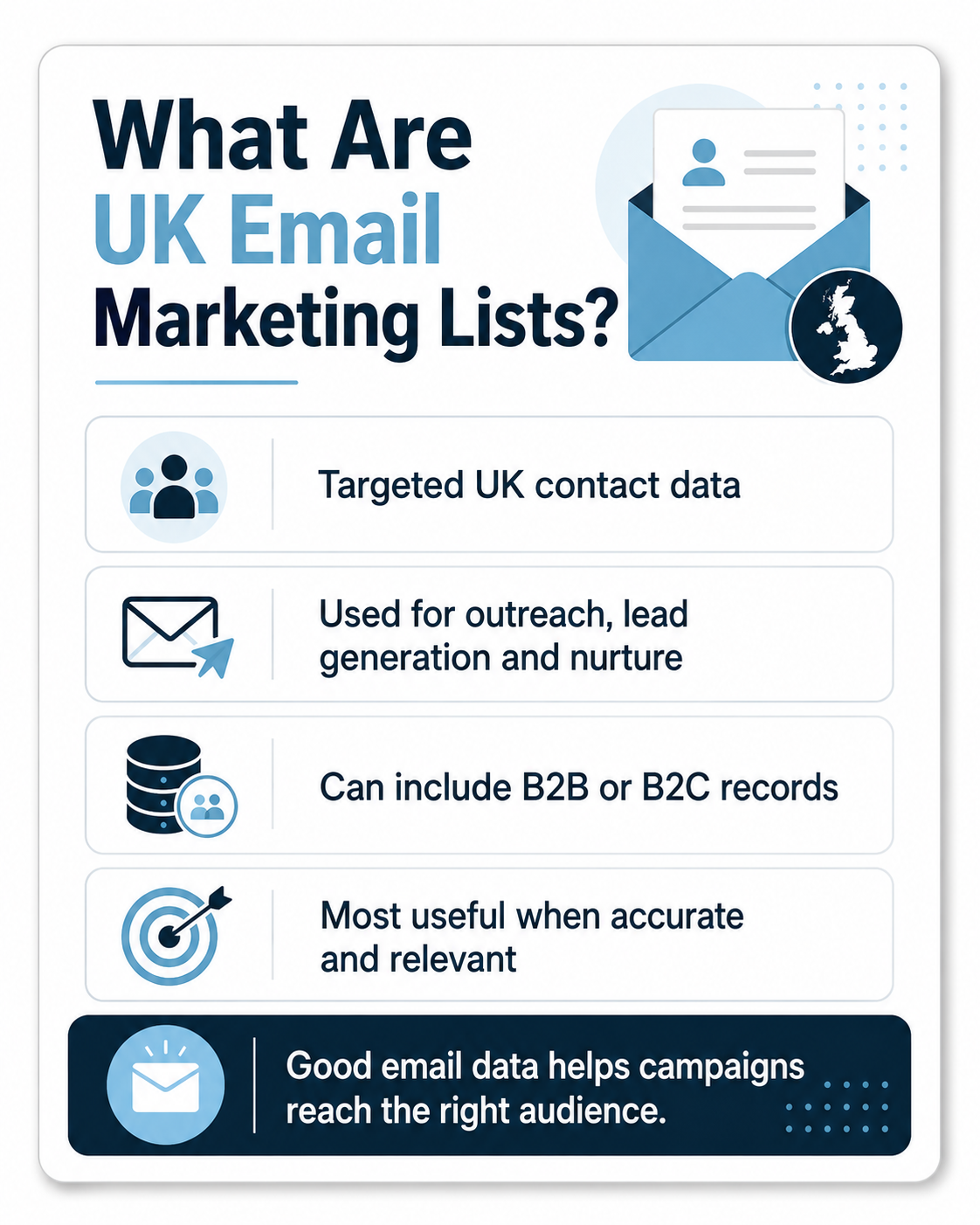
A useful email marketing list is more than a column of email addresses. In a B2B context, it may include company name, contact name, job title, seniority, department, industry classification, employee size, turnover banding, geographic location, website, telephone number and postal address. AccuraData describes these types of fields in its B2B Email Data service because they allow campaigns to target specific decision-makers rather than sending one generic message to a broad audience.
In a B2C context, email data may relate to individual consumers rather than business contacts. This can include name, email address, postcode, demographic information, stated interests or buying preferences. The marketing rules and audience expectations are different, so businesses should not treat B2C and B2B email lists as interchangeable. AccuraData offers targeted B2C Data Lists separately because consumer data needs its own sourcing, permission and compliance approach.
The most important point is that a list is only valuable if it is relevant to the campaign. A large list of poorly matched contacts is rarely better than a smaller, carefully selected audience. Relevance affects open rates, clicks, replies, opt-outs, complaints, deliverability and sales follow-up. It also affects whether the campaign feels like useful communication or unwanted noise.
UK Email Data, CRM Data and Newsletter Subscribers: What Is the Difference?
Many businesses use the phrase email list to mean several different things. That can cause confusion when planning a campaign. UK Email Data usually refers to contact data that has been sourced, supplied or maintained for marketing use. CRM data refers to records already held inside a business system. Newsletter subscribers are people who have actively signed up to receive communications from a brand.
Each type of data has value, but each carries different assumptions. Newsletter subscribers may know the business already. CRM contacts may include customers, old prospects, event attendees and dormant leads. Purchased or supplied UK Email Marketing Lists are often used to reach a new audience that does not yet have a relationship with the sender. Because the relationship is different, the message, compliance checks and expectations should also be different.
A newsletter can often be more conversational because the recipient has chosen to hear from the organisation. A cold B2B outreach email needs to explain relevance quickly and professionally. A reactivation email to a CRM contact should acknowledge the existing relationship where appropriate. A campaign to a purchased list should be especially careful with targeting, transparency and opt-out handling.
AccuraData can support both new data acquisition and existing database improvement. For businesses with old, incomplete or inconsistent records, data cleansing and enrichment can make an existing list more useful before money is spent on creative, software or sending volume. For businesses that need a new audience, targeted data supply can help define the market more quickly.
Why UK Email Marketing Lists Still Matter
Email remains useful because it is direct, measurable and flexible. A campaign can be built around a specific industry, location, job function, service need or buying stage. It can support cold outreach, account-based marketing, event attendance, product education, customer retention or sales follow-up. Unlike some channels, email also leaves a useful record of engagement that can help sales teams prioritise warm contacts.
Email performance still depends on execution. The DMA Email Benchmarking Report 2025 reported that delivery rates rose to 98% in 2024 and that unique click rates reached 2.3%, which shows that email can still generate measurable engagement when campaigns are run properly. These figures are benchmarks rather than guarantees. A poor list, weak targeting or irrelevant content can perform far below the average.
Return on investment is one reason businesses continue to use email. Litmus research on email marketing ROI states that email drives an average return of $36 for every dollar spent. Other Litmus material reports that many companies see returns between 10:1 and 36:1 from email activity. These figures should not be treated as automatic results. They depend on list quality, message quality, permission practices, testing, reporting and the sales process behind the campaign.
For UK businesses, the list itself is one of the most important variables. If the data is inaccurate, a strong offer may never reach the right person. If the contacts are poorly matched, the email may be ignored. If the data is not handled correctly, the campaign may create compliance and reputational risk. UK Email Marketing Lists should therefore be chosen, checked and deployed with care.
B2B vs B2C UK Email Marketing Lists
The difference between B2B and B2C email lists is not just the type of audience. It changes how the campaign is planned, how the data is selected, how compliance is assessed and how results are judged. A B2B list is designed for business-to-business marketing. A B2C list is designed for consumer marketing.
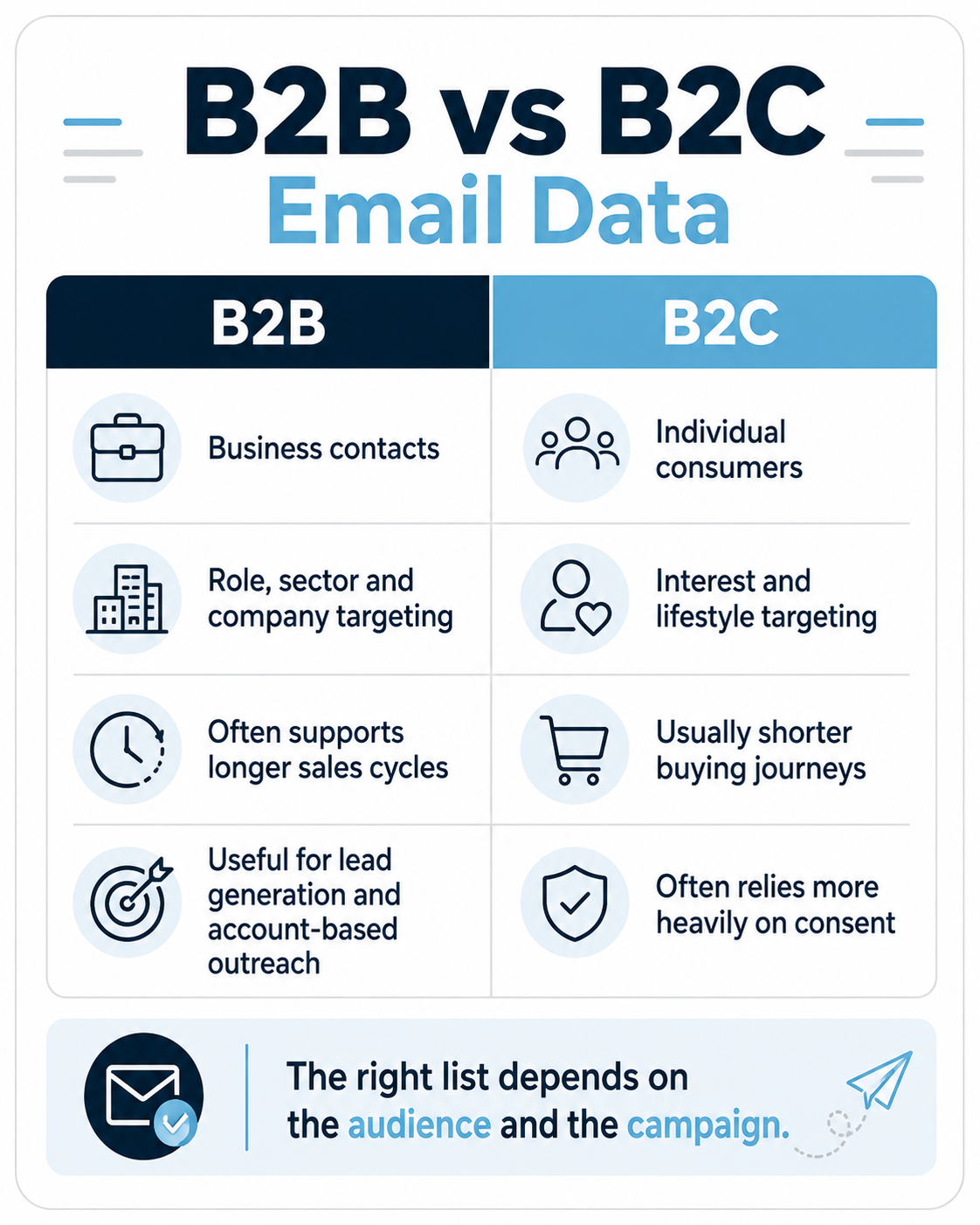
B2B UK Email Marketing Lists usually contain business records. A typical record might include a named contact at a limited company, their business email address, job title, department, location and company details. The campaign normally targets a business need, such as software, finance, professional services, recruitment, manufacturing supply, training, property services or outsourced support. The buying decision may involve several people and a longer sales cycle.
B2C UK Email Marketing Lists relate to individuals acting as consumers. The buying decision is usually personal rather than organisational. A B2C campaign might promote retail products, home improvement, travel, insurance, events or consumer services. The legal and practical expectations are stricter because the recipient is an individual subscriber rather than a corporate body.
The ICO guidance on business-to-business marketing explains that B2B marketing involves direct marketing to another business or business contact and that PECR rules vary by marketing method and recipient type. This distinction matters because the rules for emailing a corporate subscriber are not the same as the rules for emailing an individual consumer.
B2B Email Marketing Lists
B2B lists are most useful when they are built around decision-making relevance. A campaign aimed at finance software should not be sent to every person in every company. It should reach finance directors, financial controllers, managing directors or operations leaders in organisations that match the target profile. A campaign aimed at construction materials may need architects, specifiers, project managers or procurement contacts. Good B2B data allows that level of targeting.
The main value of B2B UK Email Data is segmentation. Businesses can select contacts by sector, SIC code, region, employee count, turnover banding, job title and seniority. That means copy can be written for the actual recipient. A managing director at a small professional services firm does not need the same message as a procurement manager at a large manufacturer.
B2B lists also support multi-channel campaigns. Email may introduce the offer, but telephone follow-up, direct mail or LinkedIn activity may help move the conversation forward. AccuraData’s wider B2B Lead Generation Solutions can support this type of audience targeting across channels, which is valuable when a business needs more than one touchpoint to create a sales opportunity.
B2C Email Marketing Lists
B2C lists are different because they involve direct marketing to individual consumers. The need for consent is usually much stronger. The ICO electronic mail marketing guidance states that organisations must not send marketing emails or texts to individuals without specific consent, unless the limited soft opt-in exception applies. This makes consent quality and evidence especially important for consumer email campaigns.
B2C data can still be valuable when sourced and used correctly, but it needs careful permission management. Businesses should understand how the consumer data was collected, what the individual was told, whether they gave clear consent, how preferences are managed and how opt-outs are handled. A B2C campaign built on weak permission can create complaints quickly.
The campaign style also differs. B2C emails often rely on personal interests, life stage, location or buying behaviour. B2B emails usually rely on job role, business problem, organisational profile or commercial responsibility. Confusing the two can damage relevance. A consumer-style promotion may not work in a B2B buying committee, while a technical B2B message may feel too dry for a consumer audience.
Are UK Email Marketing Lists Legal?
Buying or using UK Email Marketing Lists can be legal, but legality depends on the type of data, how it was sourced, who is being contacted, what the message contains and how the business manages rights and objections. The law does not simply ask whether a list was purchased. It asks whether personal data is processed fairly, lawfully and transparently, and whether electronic marketing rules have been followed.
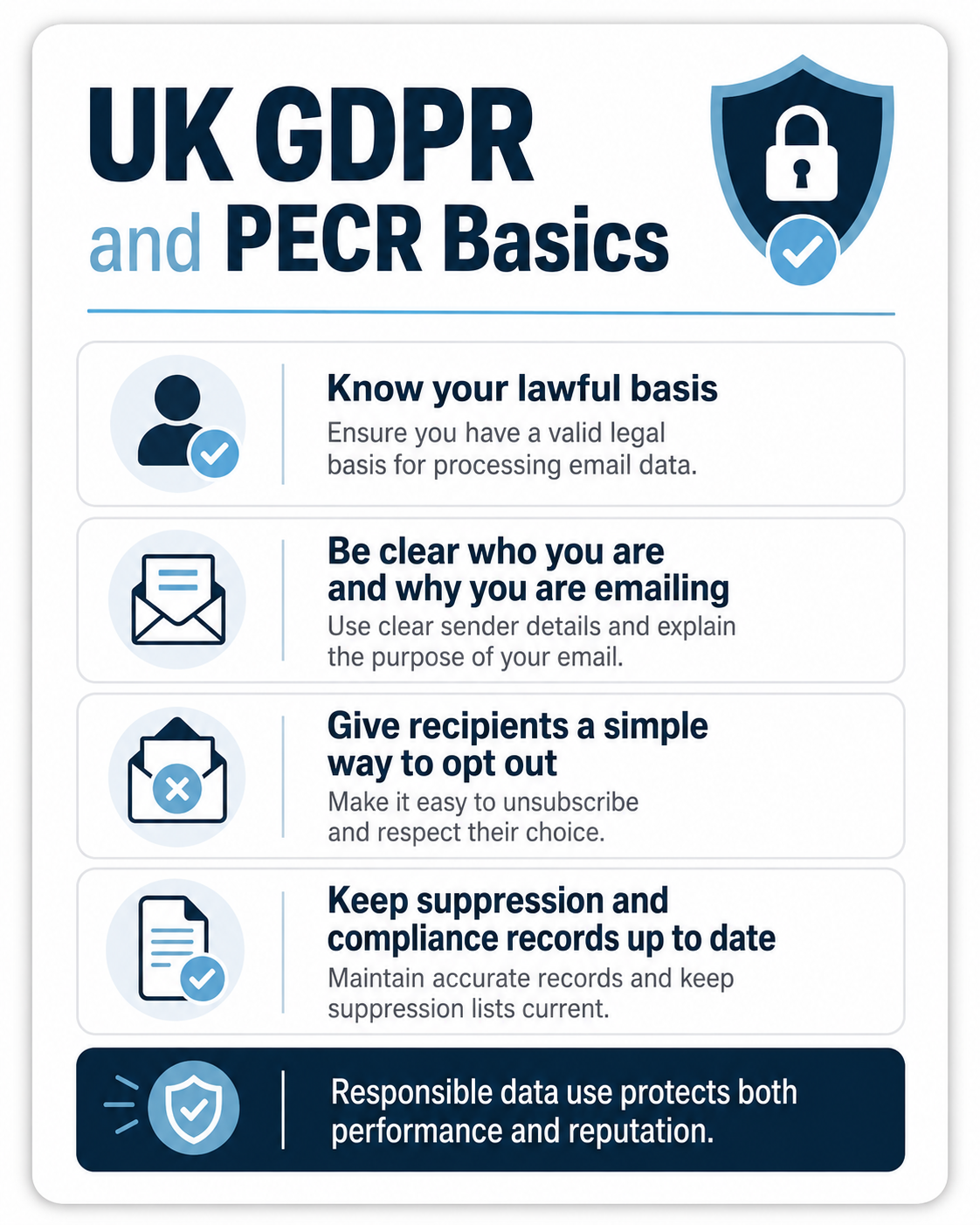
Two frameworks matter most for UK email marketing. UK GDPR governs the processing of personal data. PECR governs privacy rules for electronic communications, including direct marketing by email. The ICO’s direct marketing and electronic communications guidance is the most useful starting point because it explains that PECR rules differ depending on the channel and the type of recipient.
A business email address that identifies a person, such as firstname.lastname@company.co.uk, can still be personal data. That means UK GDPR may apply even where PECR allows B2B marketing to corporate subscribers. A generic address such as info@company.co.uk may be different, but many useful B2B campaigns rely on named contacts, so businesses should treat compliance seriously.
For B2B email marketing, the ICO electronic mail marketing guidance says that marketing emails or texts can be sent to companies, while also noting that it is good practice to keep a do-not-email or do-not-text list of companies that object. That does not remove the need to comply with UK GDPR where personal data is involved. Businesses still need a lawful basis, clear information, data accuracy, security and respect for objections.
For B2C email marketing, consent normally plays a much larger role. If you are emailing individual consumers, you should be able to show that consent was specific, informed and freely given, unless a valid soft opt-in applies. Consumer lists therefore need a higher standard of permission evidence than many B2B corporate marketing lists.
This article is practical marketing guidance, not legal advice. Any organisation planning a sensitive or high-volume campaign should review its own compliance position and seek professional advice where needed. A quality provider should still be able to explain how the data was sourced, what documentation is supplied and how opt-outs and suppression lists are managed.
UK GDPR and Lawful Basis for Email Data
UK GDPR requires a lawful basis when processing personal data. The ICO guide to lawful basis explains the available lawful bases and stresses that the chosen basis should fit the purpose and context of the processing. In email marketing, this assessment should happen before the campaign is launched, not after a complaint arrives.
For B2B outreach, legitimate interests may be appropriate in some circumstances. The ICO guidance on legitimate interests explains that organisations should identify a legitimate interest, show that the processing is necessary and balance that interest against the individual’s rights and expectations. This is often called a legitimate interests assessment.
A legitimate interests assessment should be practical. It should explain why the campaign is relevant, why the chosen data is needed, why the recipient could reasonably expect this type of contact, how privacy impact is reduced and how objections will be honoured. The more targeted and relevant the campaign, the easier it is to justify as a professional communication rather than broad, intrusive marketing.
Consent may be more appropriate or required in other situations, especially where the recipient is an individual consumer or where sensitive context is involved. The key is to avoid treating one lawful basis as a universal answer. Good campaign governance starts by matching the lawful basis to the audience, the source of the data and the planned use.
PECR and Email Marketing Rules
PECR sits alongside UK GDPR and deals specifically with electronic marketing channels. It covers marketing by email, text, telephone and other electronic communications. For email lists, the practical question is often whether the recipient is an individual subscriber or a corporate subscriber.
The ICO electronic mail marketing guidance explains that organisations must not send marketing emails or texts to individuals without specific consent, unless the soft opt-in applies. It also explains that companies can be sent marketing emails or texts, but businesses should keep suppression records where companies object. This distinction is central to the difference between B2B and B2C email lists.
The soft opt-in is a limited exception for existing customers in certain circumstances. It is not a general permission to email anyone. Businesses relying on the soft opt-in need to understand the conditions, including the need to give people an opt-out when details are collected and in every later message. For purchased B2C lists, soft opt-in will rarely apply because the recipient is usually not an existing customer of the sender.
PECR compliance is also about process. Every campaign should include a clear identity, a way to opt out and a working suppression process. If someone objects, they should not be contacted again for that type of marketing. A good list provider should help reduce risk by supplying data with appropriate documentation and by supporting suppression management where relevant.
What Makes a High-Quality UK Email Marketing List?
A high-quality list is accurate, relevant, recent, segmented and supported by clear compliance information. It should not require days of cleaning before it can be used. It should match the target audience closely enough that the campaign can be written with a clear recipient in mind.
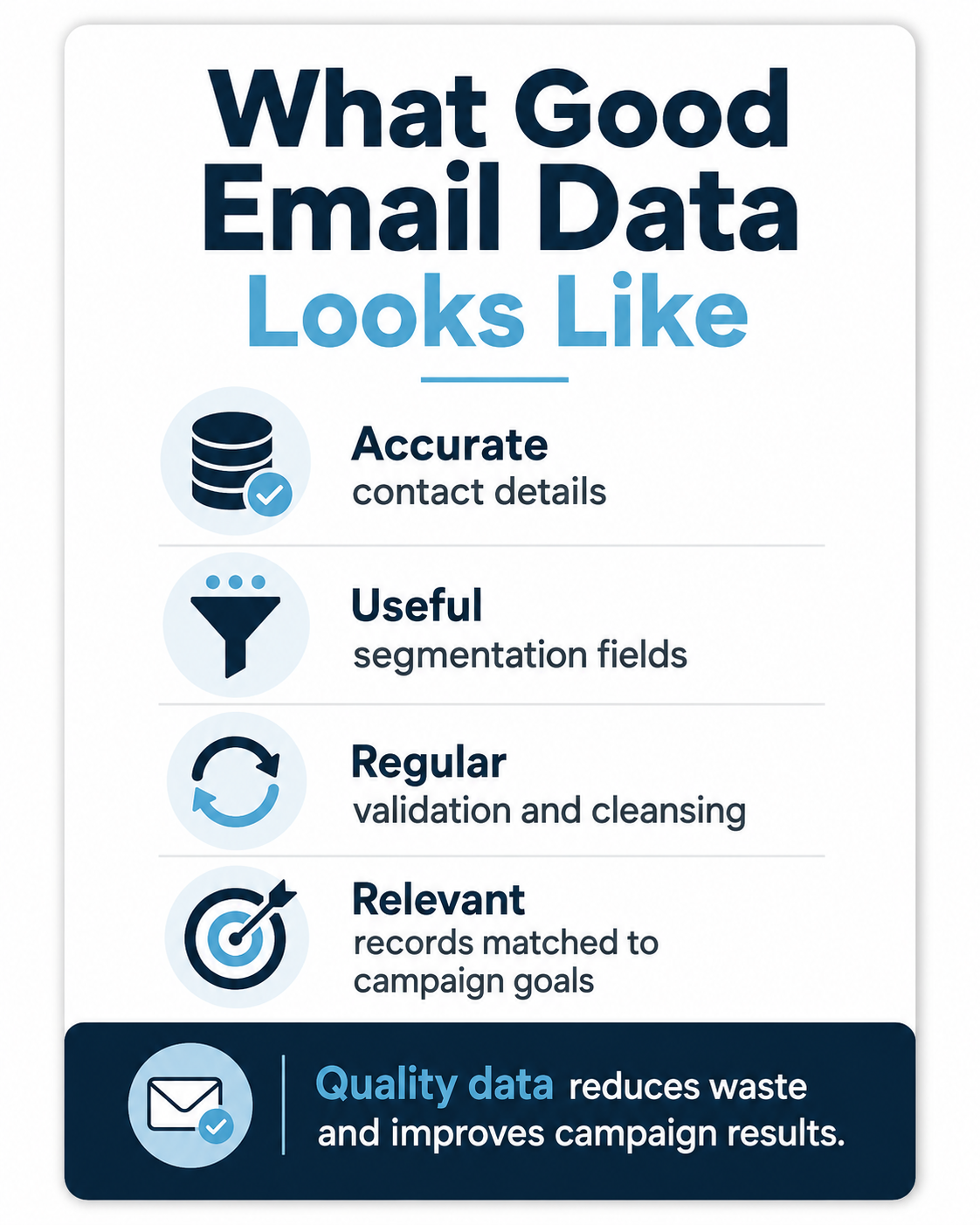
Accuracy is the first requirement. Invalid emails produce bounces, and high bounce rates can harm sender reputation. Outdated job titles create poor targeting. Wrong company records waste sales time. Duplicate records create embarrassing repeated contact. Data quality problems also make campaign reporting harder because the results reflect the weakness of the list rather than the strength of the offer.
Recency is also important because people move jobs, companies close, roles change and inboxes become inactive. A list that was accurate two years ago may now be unsuitable for a new outbound campaign. UK Email Data should be verified and refreshed regularly. AccuraData’s data cleansing and enrichment services are designed to help improve list quality before campaigns are deployed.
Relevance is the second requirement. Good email marketing lists are built around the campaign objective. If the objective is to reach UK architects, the list should not include every construction-related business. If the objective is to reach HR decision-makers, the data should be filtered by job function and seniority. Precision usually beats volume.
Segmentation is the third requirement. Useful segmentation fields might include geography, company size, sector, job role, seniority, purchase stage, previous engagement or stated interest. Segmentation helps the message feel more relevant and helps reporting become more useful. If one segment performs better than another, the business can learn where demand is strongest.
Compliance evidence is the fourth requirement. A responsible provider should be able to explain the source of the data, the basis for processing, what privacy information is provided and what documentation accompanies the list. If a supplier cannot answer basic questions about sourcing, accuracy or lawful use, that is a warning sign.
What Should Be Included in B2B UK Email Data?
A B2B email list should include enough information to help sales and marketing teams identify, understand and follow up with the right contacts. An email address alone is not enough. The campaign needs context.
Core fields usually include business name, contact name, business email address, job title, seniority, department, postal address, telephone number where available, industry classification, location, company size and other firmographic details. AccuraData’s B2B Email Data can be tailored around sectors, locations, roles and campaign objectives so that the resulting audience is not generic.
Job title and seniority are especially important. The same company may have many potential contacts, but not all of them are relevant. A managing director may be the right contact for a strategic consultancy offer. A marketing manager may be better for campaign services. A procurement lead may be right for supplier introductions. A technical director may be right for specialist equipment or software.
Company attributes also matter. Employee count, turnover banding and industry classification help businesses avoid sending to organisations that are too small, too large or outside the target market. A product designed for SMEs may not suit enterprise buyers. A service priced for multi-site operators may not suit sole traders. Good data helps the campaign avoid those mismatches before money is spent on sending.
How to Choose a UK Email Marketing List Provider
Choosing a provider should not be based on the largest database or the lowest cost per record. Cheap data can become expensive if it creates bounces, complaints, poor engagement or wasted sales time. A good provider should make the campaign easier to run, not create extra work.
Start by asking how the data is sourced. The provider should be able to explain its sources and verification process in plain English. Vague answers suggest weak governance. Then ask how recently the data was checked. Old data may still look complete in a spreadsheet, but it may not perform in the inbox.
Ask how the list can be segmented. If the provider can only offer broad categories, the campaign may be too generic. A stronger provider should help refine the audience by sector, region, company size, job role and seniority. The goal is not simply to buy email addresses. The goal is to reach a commercially relevant audience.
Ask what compliance documentation is supplied. For B2B lists, you may need evidence around sourcing, lawful basis, data processing terms and suppression handling. For B2C lists, consent evidence is especially important. The provider should also explain what responsibilities remain with the organisation using the data.
Ask whether the provider can support the campaign beyond data delivery. AccuraData combines targeted data with Email Marketing Services, which means clients can access support with audience selection, campaign preparation, broadcast setup, delivery, reporting and warm prospect identification. This is useful for businesses that want results from the data, not just a spreadsheet.
How to Use UK Email Marketing Lists Effectively
Buying a list is only the start. The way the list is used has a major effect on results. A well-targeted list can underperform if the message is weak, the offer is unclear, the sending domain is poorly configured or the sales team does not follow up. A strong campaign treats data, content, delivery and follow-up as one connected system.
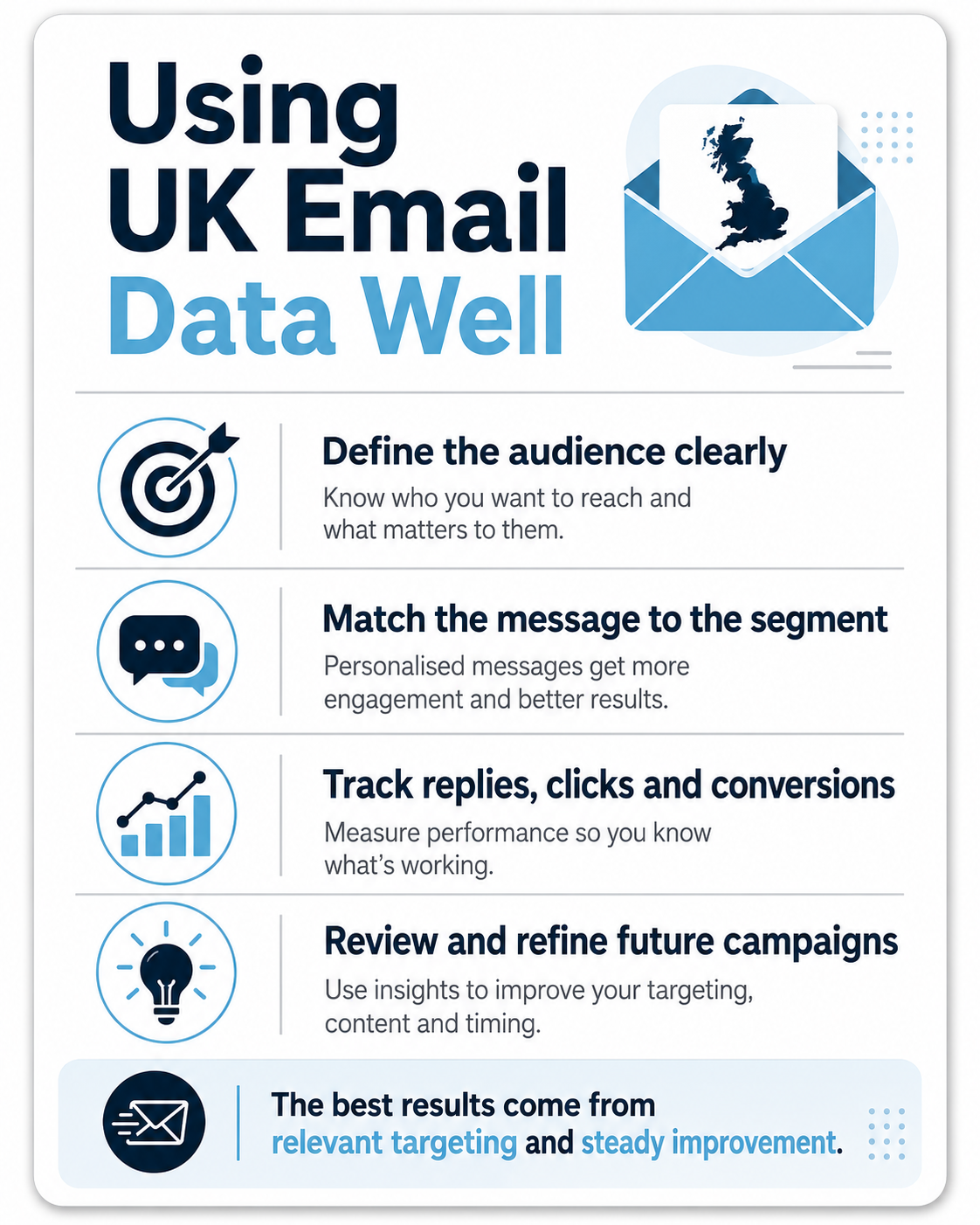
Begin with one objective. Do you want replies, bookings, downloads, webinar registrations, enquiries or sales conversations? The objective shapes the audience, subject line, email copy, landing page and reporting. Without a clear objective, the campaign can become unfocused and hard to measure.
Next, segment the list before writing. Write for the segment, not the entire database. If you are contacting finance directors, speak to financial pressure, risk, cost or reporting. If you are contacting operations managers, speak to efficiency, process and delivery. If you are contacting marketing managers, speak to pipeline, engagement and measurable outcomes.
Then write a clear email. The recipient should quickly understand who you are, why the message is relevant and what action you want them to take. Avoid long introductions, vague claims and excessive sales language. Good B2B email copy is usually specific, useful and direct.
Use a simple follow-up plan. One email rarely tells the whole story. A sequence might include an introduction, a value-led follow-up, a case study, a reminder and a final polite close. The sequence should not become aggressive. The aim is to stay visible while respecting the recipient’s time and preferences.
Finally, connect the campaign to sales activity. If a contact clicks, replies or engages several times, the sales team should receive that context. AccuraData’s Email Marketing Services can support campaign reporting and warm prospect identification, helping businesses turn engagement into follow-up conversations.
Deliverability: Why List Quality Affects Inbox Placement
Deliverability is the ability of an email to reach the inbox rather than being rejected, filtered or sent to spam. List quality is one of the main drivers of deliverability because mailbox providers watch how recipients respond. If many addresses bounce, complain, ignore messages or mark emails as spam, future messages can become harder to deliver.
Technical setup matters too. Google’s email sender guidelines recommend that senders set up SPF, DKIM and DMARC for their domains and state that unauthenticated messages may be marked as spam or rejected. Authentication does not make a poor list good, but it helps prove that messages are genuinely coming from the sending domain.
List hygiene should be ongoing. Remove invalid addresses, suppress opt-outs, avoid repeated sending to disengaged contacts and monitor bounce patterns. A list that performed well six months ago may need cleaning before the next campaign. This is especially true for B2B data because people change roles and companies regularly.
Content also affects deliverability indirectly. Relevant messages earn more opens, clicks and replies. Irrelevant messages earn more ignores and complaints. This is another reason to treat UK Email Marketing Lists as targeting tools rather than volume tools. The better the match between list, message and offer, the healthier the campaign is likely to be.
Measuring the Performance of UK Email Marketing Lists
A list should be judged by campaign outcomes, not by record count alone. A larger list is not better if it produces weak engagement or poor sales follow-up. The right metrics depend on the objective, but most email campaigns should review delivery rate, bounce rate, open rate, click-through rate, replies, unsubscribe rate, complaints, conversions and sales outcomes.
Delivery and bounce rates show whether the data is technically usable. Clicks and replies show whether the message created interest. Conversions show whether the campaign produced the desired action. Sales outcomes show whether the list helped create pipeline or revenue. These measures should be reviewed by segment so that the business can see which audiences are worth further investment.
The DMA Email Benchmarking Report 2025 provides useful market context, but every business needs its own benchmarks. Sector, audience, brand awareness, offer strength and campaign type all affect results. The most useful comparison is often against your own previous campaigns.
A good provider should help interpret performance. If bounce rates are high, the issue may be data freshness. If clicks are low but delivery is strong, the issue may be message relevance. If clicks are strong but conversions are weak, the landing page or offer may need work. If engagement is concentrated in one segment, future campaigns should prioritise that audience.
Common Mistakes with UK Email Marketing Lists
The first mistake is buying the cheapest list available. Low-cost data may be old, generic or poorly verified. The short-term saving can lead to wasted campaign spend, weak engagement and lost sales time. Price matters, but quality and fit matter more.
The second mistake is treating the list as the campaign. A list gives access to an audience. It does not replace planning, message development, compliance checks, deliverability management or follow-up. A campaign built only around volume will usually produce disappointing results.
The third mistake is ignoring B2B and B2C differences. Sending consumer-style email to business contacts can feel irrelevant. Treating consumer contacts as if they are corporate subscribers can create compliance risk. B2B and B2C email data should be sourced, documented and deployed differently.
The fourth mistake is failing to suppress objections. If a person or organisation opts out, that decision should be recorded and respected. Suppression lists are not just a compliance task. They also protect brand reputation and campaign performance.
The fifth mistake is not refreshing data. B2B roles change, domains close, companies merge and people move. Old data can make even a well-written campaign underperform. Regular cleansing and validation help maintain performance over time.
When Should You Outsource Email Marketing List Management?
Outsourcing can be useful when a business needs campaigns to run consistently but lacks the internal time, tools or specialist knowledge. It can also help when the campaign depends on accurate data, careful segmentation and compliance-aware delivery.
An outsourced partner can help define the audience, source or clean the list, prepare the message, manage the broadcast, monitor performance and identify warm prospects. This gives internal teams more time to focus on sales conversations, customer relationships and strategy.
AccuraData’s Outsourced Email Marketing guide explains how managed support can help businesses run email campaigns without taking every technical and creative step in-house. This is particularly useful for organisations that need reliable execution rather than another software platform to manage.
Outsourcing works best when there is collaboration. The client brings product knowledge, customer insight and sales priorities. The provider brings data quality, campaign experience, compliance awareness and operational delivery. Together, the campaign can be more focused than either party could achieve alone.
Why Choose AccuraData for UK Email Marketing Lists?
AccuraData is a strong choice for UK businesses because its email marketing support starts with data quality. Many campaigns fail before the first email is sent because the audience is wrong or the data is stale. AccuraData helps clients build campaigns on targeted, verified and relevant records.
For businesses that need new prospects, AccuraData can supply B2B Email Data tailored by sector, location, company size, job function and seniority. For businesses that already have a database, AccuraData can support data cleansing and enrichment to improve accuracy and usability. For businesses that want the campaign managed, AccuraData provides Email Marketing Services covering strategy, copywriting, design, delivery, reporting and warm prospect identification.
This joined-up approach matters. Data affects targeting. Targeting affects relevance. Relevance affects engagement. Engagement affects deliverability. Deliverability affects results. When these areas are handled separately, campaigns can become fragmented. AccuraData helps bring them together.
AccuraData is also UK-focused. That matters because UK marketing data needs UK compliance knowledge, UK business coverage and practical understanding of how UK sectors are structured. A campaign aimed at UK manufacturers, legal firms, construction companies or professional services businesses should be built around the realities of those markets, not a generic global dataset.
The best UK Email Marketing Lists are not simply bought and blasted. They are selected, checked, segmented and used as part of a responsible campaign plan. AccuraData can help at each stage, from audience planning through to reporting and sales handover.
A Practical Checklist Before Buying UK Email Marketing Lists
Before buying or using UK Email Data, ask the following questions. They will help you avoid poor-quality lists and weak campaign performance.
- Is this a B2B or B2C campaign, and are the rules being applied correctly?
- Can the provider explain where the data comes from and how it is verified?
- Is the list segmented by the fields that matter to the campaign?
- How recently was the data checked or refreshed?
- What compliance documentation is provided with the data?
- How will opt-outs and suppression requests be managed?
- Is the sending domain correctly authenticated using SPF, DKIM and DMARC?
- What follow-up process will turn engagement into sales conversations?
- How will results be measured by segment, not just as an overall campaign average?
- Who will clean and update the list before the next campaign?
If a provider cannot give clear answers, pause before buying. A reputable supplier should welcome these questions because they show that the campaign is being planned seriously.
Final Thoughts on UK Email Marketing Lists
UK Email Marketing Lists can give businesses a practical route to new prospects, stronger outreach and more measurable campaign activity. The value is not in the number of records alone. The value is in reaching the right people with the right message, using data that is accurate, relevant and handled responsibly.
B2B and B2C lists should be approached differently. B2B UK Email Data is usually about reaching business decision-makers and influencers with relevant commercial messages. B2C email data is about contacting individual consumers, where consent and permission evidence are usually much more central. Treating the two in the same way is one of the easiest ways to create poor results and unnecessary risk.
The best outcomes come from combining quality data, clear targeting, good creative, reliable deliverability, lawful processing and structured follow-up. That is where AccuraData can help. Whether you need targeted B2B Email Data, managed Email Marketing Services, data cleansing and enrichment or wider B2B lead generation support, AccuraData can help you build email campaigns on stronger foundations.
If your current email marketing lists are producing weak engagement, poor deliverability or limited sales value, the channel may not be the problem. The issue may be the audience, the data quality, the compliance process, the message or the follow-up. Improve those foundations, and UK Email Marketing Lists can become a reliable part of your sales and marketing strategy.