
Email marketing remains one of the most practical, measurable and commercially useful channels available to UK businesses. It can introduce your brand to new prospects, nurture existing relationships, support sales teams, promote products, educate buyers and keep your business visible between direct conversations. When it is planned properly, email marketing also gives you something many channels struggle to provide: a direct line to a defined audience, a clear record of engagement and a structure that can be improved campaign by campaign.
The appeal is easy to understand. Email does not rely on rented attention in the same way as paid social or search advertising. A well-managed email list becomes an asset. A relevant B2B email campaign can speak directly to decision-makers, segment messaging by sector or job role, and give sales teams useful signals about who may be ready for a follow-up conversation. Research published by Litmus on email marketing ROI shows that many organisations report returns between 10:1 and 36:1 from email marketing activity, which explains why email remains a core part of many marketing plans.
That does not mean email marketing is easy. Good results depend on far more than writing a message and pressing send. A campaign needs clear objectives, accurate data, a sensible audience strategy, compliant processing, strong creative, careful scheduling, deliverability management, measurement and follow-up. Poor email marketing can waste budget, annoy recipients, damage sender reputation and make future campaigns harder to deliver.
This guide explains how email marketing works from start to finish. It covers planning, list building, audience segmentation, legal requirements, campaign content, deliverability, measurement, testing and optimisation. It also explains how AccuraData supports UK organisations with high-quality B2B Email Data and managed Email Marketing Services for businesses that want expert support rather than managing every campaign internally.
What Is Email Marketing?
Email marketing is the process of sending targeted messages to a group of contacts by email for a business purpose. That purpose might be lead generation, customer retention, event promotion, product education, relationship nurturing, account management, recruitment, market research or sales follow-up. In B2B marketing, email is often used to reach decision-makers, influencers and operational contacts within defined organisations.
There are different types of email marketing. A newsletter keeps an existing audience informed. A promotional campaign encourages a specific action. A nurture sequence builds understanding over time. A cold B2B outreach campaign introduces your organisation to relevant contacts who may not yet know you. A customer campaign helps retain, upsell or cross-sell to people already in your database. Each type needs a different plan, but all rely on the same foundations: good data, relevant messaging, lawful processing, reliable delivery and clear measurement.
For UK businesses, email marketing should also be understood as both a marketing activity and a data activity. When you use someone’s name, job title, business email address or other identifiable details, you are processing personal data. The ICO guidance on choosing a lawful basis for direct marketing makes clear that organisations need a valid data protection reason when using personal information for direct marketing. That is why campaign planning should include compliance from the beginning rather than treating it as an afterthought.
Email marketing works best when it is treated as a structured programme, not a one-off send. One campaign can create short-term activity, but a planned programme builds recognition, insight and trust. Over time, a business can learn which audiences respond, which offers resonate, which subject lines attract attention, which landing pages convert and which sales follow-up process produces genuine opportunities.
Why Email Marketing Still Matters
Email has been around for decades, yet it remains highly relevant because it sits close to commercial intent. People use email to receive documents, review proposals, discuss business decisions, organise projects and respond to suppliers. In B2B sales, many buying conversations still begin or continue in the inbox. That gives email marketing a practical role that is different from awareness-focused channels.
Another strength is control. A social media post may reach only a fraction of your followers. Paid advertising disappears when the budget stops. Email gives you a more direct way to reach a selected audience, provided your data is accurate and your sending practices are sound. You can also segment campaigns around industry, seniority, location, company size, previous engagement and other useful attributes.
Email is also measurable. Open rates are not perfect, especially because privacy features and bot activity can distort the picture, but clicks, replies, conversions, enquiries, meeting bookings and pipeline contribution can all be tracked. Litmus research on the state of email notes that campaign reporting is moving beyond simple engagement proxies towards measures such as revenue accountability, list churn and lifetime value. That direction matters because the goal is not just to send more emails. The goal is to understand what email contributes to the business.
For smaller teams, email marketing offers a cost-effective route to market. For larger teams, it supports demand generation, lead nurturing, account-based marketing and customer communications at scale. The organisations that get the most from email are usually not the ones that send the most. They are the ones that plan carefully, maintain high data standards, tailor messages to the audience and improve the process over time.
The Foundations of Successful Email Marketing
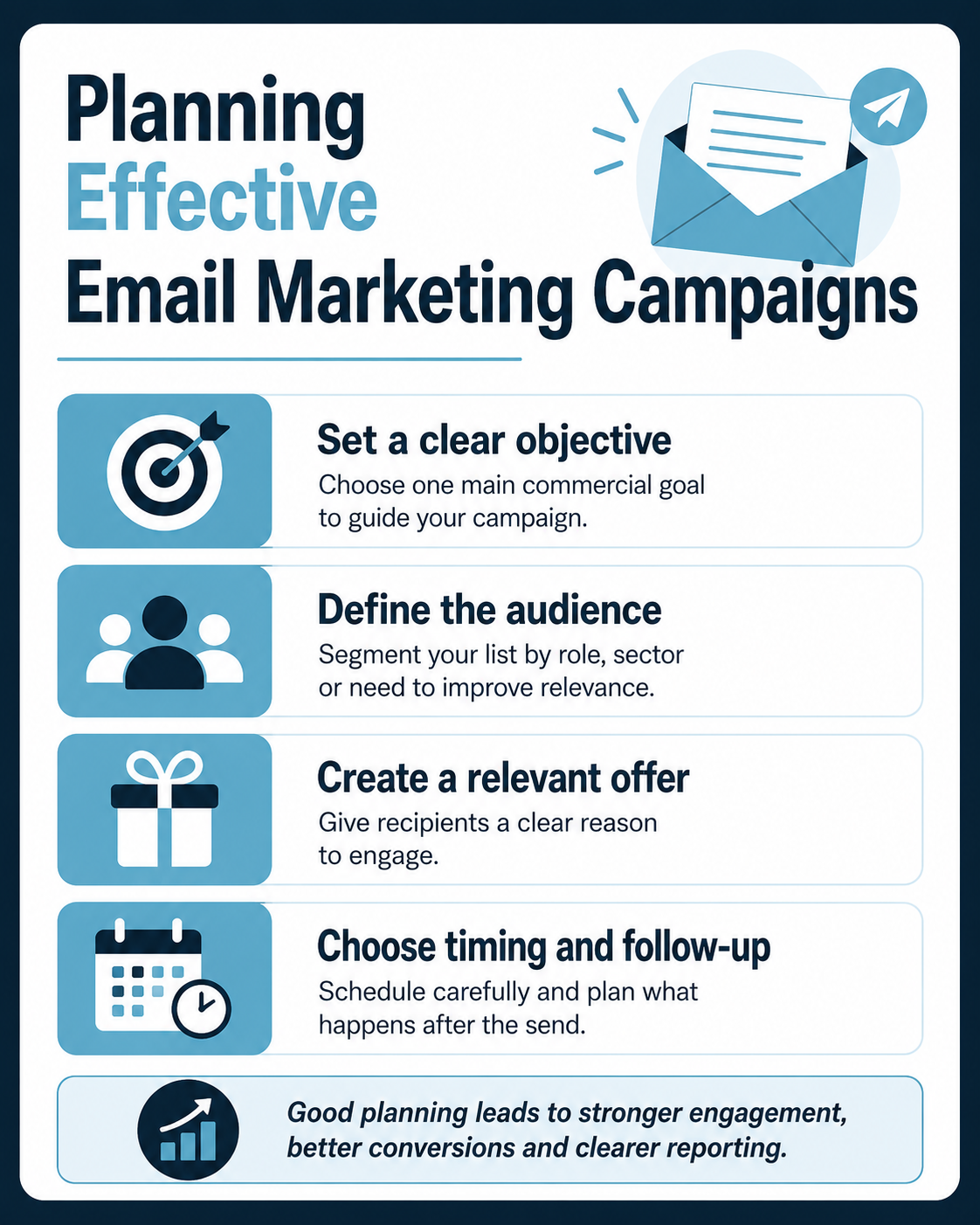
A strong email marketing programme starts before the first email is written. The early planning stage decides whether the campaign will feel relevant or generic, whether it will reach the right people, and whether the results can be interpreted properly afterwards. A good plan answers five simple questions. Who are we trying to reach? Why are we contacting them? What action do we want them to take? What data do we need? How will we know if the campaign has worked?
The first question is the most important. Many campaigns underperform because the audience is too broad. A message written for everyone usually lands with no one. In B2B email marketing, audience definition should be specific. Instead of targeting “UK businesses”, a campaign might target finance directors at manufacturing firms with 50 to 250 employees in the Midlands. Instead of targeting “construction companies”, it might target procurement managers at principal contractors working on commercial projects. The more precisely the audience is defined, the easier it becomes to create relevant content.
The second foundation is the offer. Every email needs a reason to exist. That reason does not always have to be a discount or a hard sales proposal. It could be a guide, audit, consultation, product comparison, event invitation, industry insight, case study or service introduction. The offer should make sense for the audience’s likely stage of awareness. A cold audience may need a helpful introduction. A warm audience may respond to a stronger call to action.
The third foundation is data quality. Accurate contact data improves relevance, deliverability and sales follow-up. Stale records create bounces, wrong-person outreach and wasted time. Research by Apollo on B2B data decay discusses how B2B contact data can decay at around 2.1% per month, which means database maintenance is not optional for long-running campaigns. AccuraData’s data cleansing and enrichment services are designed to help organisations keep contact data more accurate, useful and campaign-ready.
The fourth foundation is compliance. UK email marketing must take account of UK GDPR and PECR. In practice, this means understanding the type of recipient, the lawful basis for processing, the need for transparency, the right to object, unsubscribe handling and record keeping. For B2B campaigns, legitimate interests may be appropriate in some circumstances, but ICO guidance on legitimate interests explains that direct marketing is not automatically covered in every case. The assessment depends on the circumstances.
Email Strategy: Start With the Business Objective
Email marketing should begin with the commercial objective, not the email template. A campaign designed to generate immediate sales meetings will look different from one designed to warm up a new market. A campaign promoting a webinar will use different timing and copy from a campaign that introduces a high-value professional service.
Useful objectives include generating new enquiries, increasing sales meetings, reactivating past prospects, educating a defined market, supporting account-based sales, promoting events, improving customer retention or gathering interest in a new service. The objective should be specific enough to guide the campaign structure. “Get more leads” is too vague. “Generate qualified conversations with HR directors at UK companies with 100 to 500 employees” is much more useful.
Once the objective is clear, the campaign can be planned around the buyer’s likely context. Are they aware of the problem? Are they comparing suppliers? Are they already using a solution? Are they likely to need education before taking action? The more accurately the campaign reflects the buyer’s situation, the more useful the email will feel.
AccuraData often supports this stage by helping clients define the audience before the data is supplied or the campaign is prepared. That can include sector selection, seniority filters, geographic targeting, company size bands and decision-maker roles. AccuraData’s wider B2B lead generation solutions are built around the idea that better targeting creates better campaign outcomes.
Building and Managing an Email Data List
Your email list determines who sees your message. That makes it one of the most important parts of the campaign. Lists can come from several places. They may include existing customers, past enquiries, newsletter subscribers, event attendees, CRM contacts, inbound leads or third-party B2B data. The right approach depends on the campaign goal and the lawful basis for the data.
An owned list usually contains people who have already engaged with the organisation. That can make it useful for newsletters, customer updates, product launches and nurture campaigns. A targeted B2B prospecting list is different. It is used to reach decision-makers in organisations that match a defined customer profile. That type of list needs careful sourcing, clear documentation and strong segmentation.
A good B2B email record should include enough detail to support relevant outreach. At minimum, this may include name, job title, company name, business email address, industry, location and company size. Additional fields such as seniority, department, turnover banding and SIC code can make segmentation much more powerful. AccuraData’s B2B Email Data service allows UK organisations to build targeted lists using criteria such as industry sector, job title, seniority, company size and geographic location.
List management should not stop once the campaign starts. Bounces should be removed. Unsubscribes must be honoured. Replies should be reviewed. Engaged contacts should be flagged for follow-up. Inactive contacts may need a different nurture approach or suppression. Without these steps, a campaign becomes less accurate over time and can create avoidable deliverability problems.
Email marketing lists also need regular validation because contact data changes constantly. People leave jobs, companies merge, domains change and inboxes become inactive. A list that performed well six months ago may not perform the same way today. Regular cleansing protects the campaign and helps sales teams avoid wasting time on records that can no longer produce a meaningful conversation.
Email Campaign Compliance in the UK
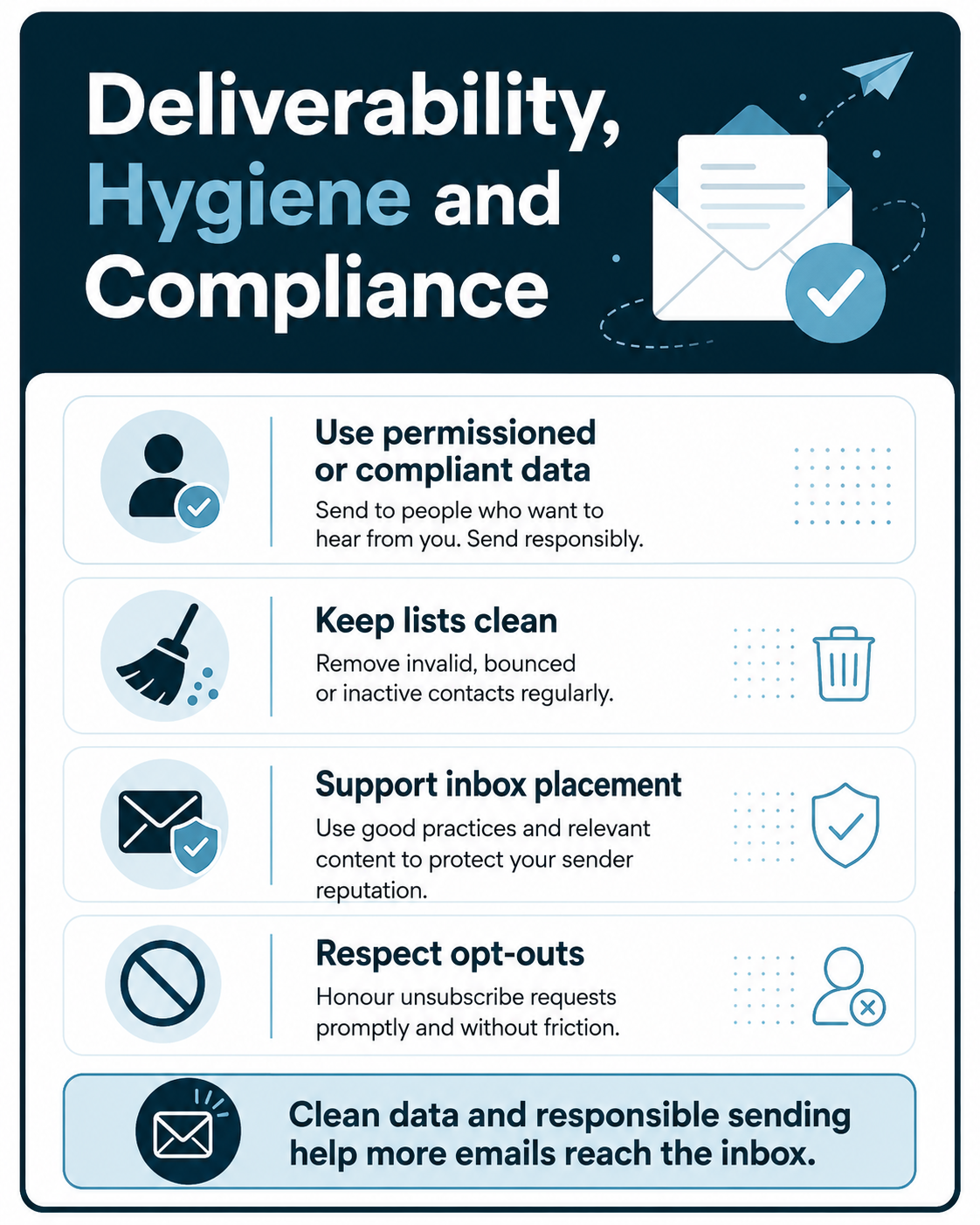
Compliance is a core part of email marketing in the UK. It is not separate from campaign performance. A campaign that ignores privacy rules may generate complaints, harm brand trust and create regulatory risk. A campaign that handles data responsibly is usually better targeted, easier to defend and more respectful of the recipient.
Two frameworks matter most: UK GDPR and PECR. UK GDPR deals with the processing of personal data. PECR deals with privacy rules for electronic communications, including marketing by email. Business contacts can still be personal data when the record identifies an individual, such as a named business email address. The ICO’s business-to-business marketing guidance explains how B2B marketing sits within the direct marketing rules and points organisations towards legitimate interests guidance where relevant.
In many B2B email marketing situations, organisations consider legitimate interests as the lawful basis for processing personal data. The ICO states that consent and legitimate interests are the two lawful bases most likely to apply when sending direct marketing messages, as set out in its direct marketing lawful basis guidance. Legitimate interests still requires a proper balancing exercise. You should consider the purpose of the processing, the necessity of the processing and the impact on the individual.
Transparency also matters. Recipients should be able to understand who contacted them, why their data is being used and how they can object or opt out. Every marketing email should make it easy for the recipient to stop further marketing. Suppression lists must be maintained so that opt-outs are not contacted again by mistake.
This is one area where outsourced support can be valuable. AccuraData provides B2B data and campaign support with compliance documentation appropriate to the activity. For organisations that need a reliable partner, AccuraData’s email marketing campaign management service can support audience selection, campaign preparation, broadcast delivery and reporting while keeping data quality and compliance at the centre of the process.
Segmentation: Sending the Right Message to the Right People
Segmentation is the process of dividing your email list into smaller groups so that each group receives a more relevant message. It is one of the most important ways to improve email marketing performance because relevance affects opens, clicks, replies, complaints and conversions.
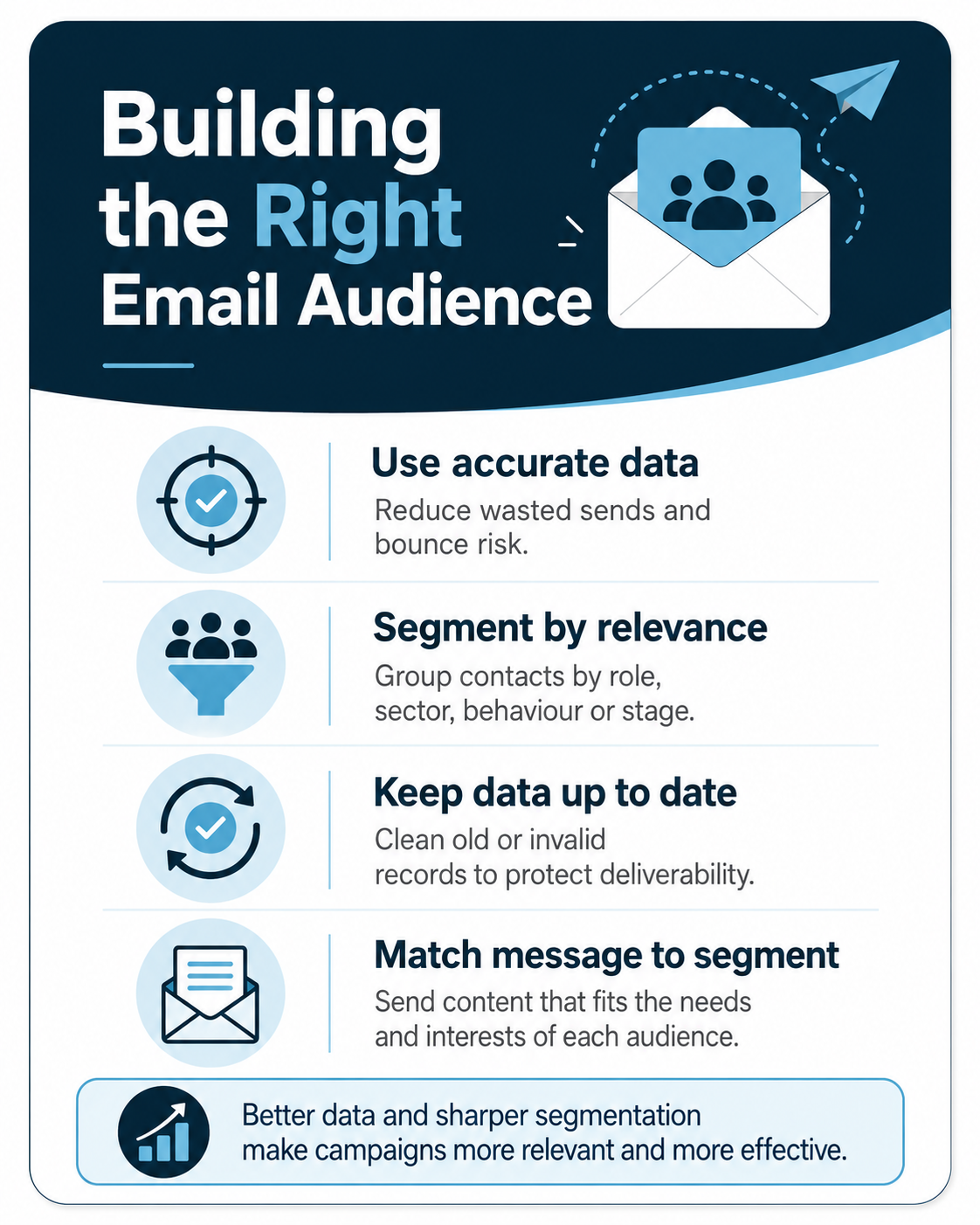
Common B2B segmentation criteria include industry, company size, location, job title, seniority, department, technology use, purchase stage and previous engagement. A finance director and an operations manager may both influence a purchase, but they usually care about different outcomes. A smaller business may need a simple, practical message, while an enterprise buyer may need evidence, implementation detail and risk management.
Data supports better segmentation when it is complete and accurate. For example, if your database includes company size and sector, you can tailor one message to small professional service firms and another to mid-market manufacturers. If you know the recipient’s job function, you can emphasise the benefits they are most likely to care about. HubSpot marketing statistics report that segmented emails have previously driven materially stronger open and click performance than unsegmented campaigns, which reinforces the commercial value of good targeting.
Segmentation should not become overcomplicated at the start. Many businesses can make a large improvement by moving from one broad email to three or four meaningful audience groups. The key is to segment in a way that changes the message. If a segmentation rule does not affect the subject line, opening paragraph, offer or call to action, it may not be useful yet.
Personalisation Without Becoming Intrusive
Personalisation means using what you know about the recipient to make the message more relevant. It does not mean inserting a first name into a generic email and calling it tailored. Good personalisation reflects the recipient’s industry, role, challenges, stage of interest or previous behaviour.
For B2B campaigns, practical personalisation might include referencing the recipient’s sector, addressing a common issue for their role, adjusting the case study used in the email, highlighting a relevant service line or changing the call to action based on seniority. The aim is to make the recipient feel that the message belongs in their inbox.
There is a balance to strike. Overly detailed personalisation can feel uncomfortable, especially if the recipient does not understand how the data was gathered. UK GDPR principles such as fairness, transparency and data minimisation should guide the process. Use enough data to be relevant, but avoid using unnecessary detail that may feel intrusive.
A simple test is to ask whether the personalisation helps the recipient. If it clarifies relevance, it is usually useful. If it only proves that you have collected information about them, it may not add value. Strong email marketing respects the recipient’s time and privacy while still making the message specific enough to matter.
Writing Email Marketing Content That People Actually Read
Email copy needs to work quickly. Recipients often decide within seconds whether to continue reading. That means the subject line, preview text and opening sentence carry a lot of weight. They need to show relevance without sounding exaggerated.
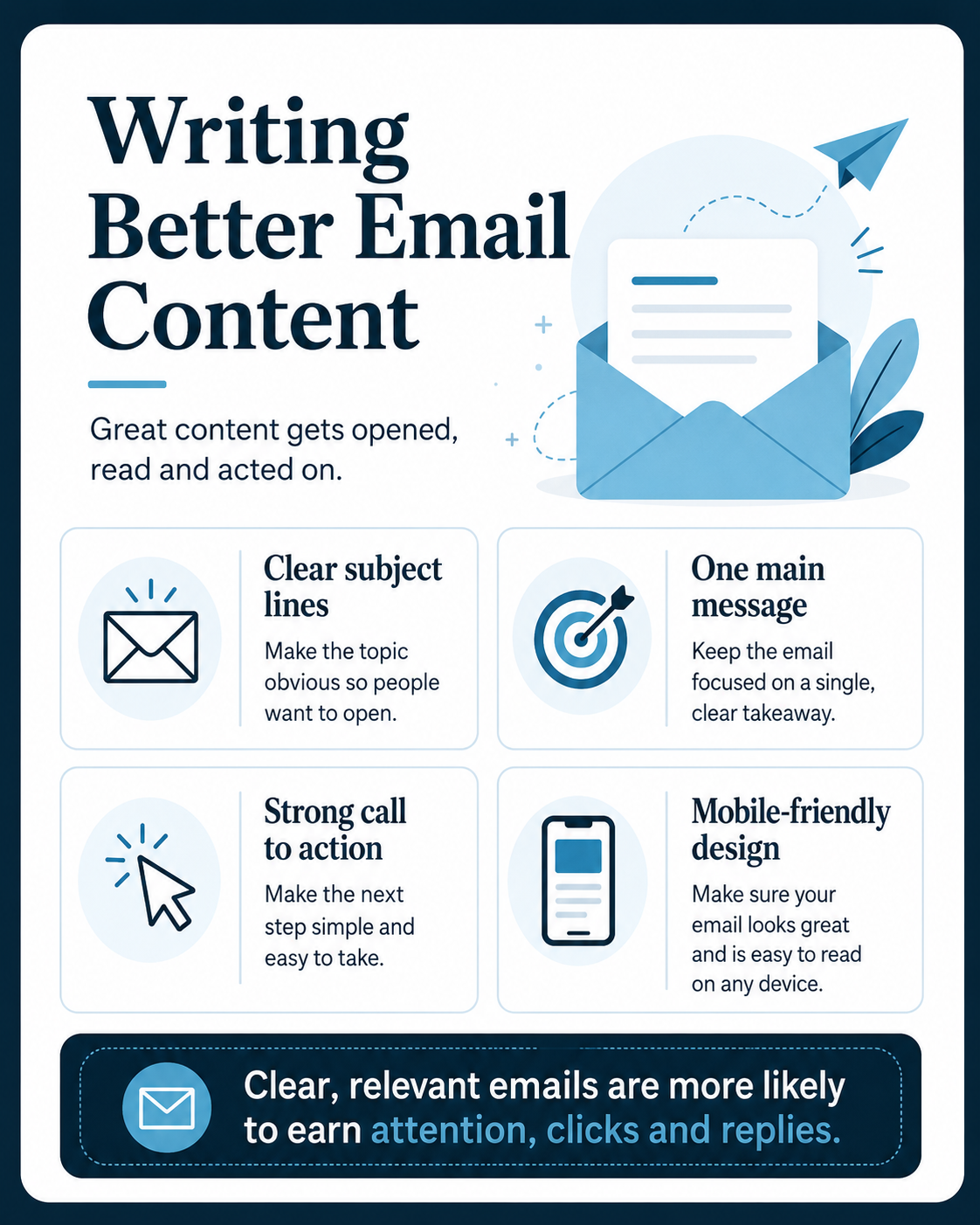
A strong subject line is clear, specific and connected to the recipient’s likely interest. It should not rely on tricks, false urgency or vague curiosity. A subject line such as “Reducing recruitment costs in multi-site care businesses” is more useful than “Quick question” if the campaign is aimed at care sector operators. Clear subject lines also help avoid disappointment, which can lead to lower trust and higher unsubscribe rates.
The body of the email should focus on one main idea. Many campaigns fail because the message tries to do too much. It introduces the company, lists several services, explains a full proposition, includes multiple links and asks for a meeting all in one message. Better email marketing usually keeps the reader’s next step simple.
The best structure is often straightforward. Start with the reason the message is relevant. Explain the problem or opportunity in plain language. Add enough proof or detail to build confidence. Make one clear request. This could be to read a guide, book a call, reply with a question, download a resource or review a relevant service page.
Tone matters too. B2B email does not have to be stiff. It should sound professional, human and useful. Avoid jargon unless the audience genuinely uses it. Avoid claims that cannot be supported. If your offer is complex, explain it in simple terms first, then provide additional detail for those who want it. Businesses that need help turning technical or data-led propositions into readable campaign messages can use AccuraData’s copywriting services alongside email marketing support.
Email Design and User Experience
Email design should support the message rather than compete with it. The most effective design is not always the most elaborate. It is the design that helps the recipient understand the content, scan the key points and take the next step.
Mobile rendering is especially important because many recipients check email on phones. Even in B2B, people read messages while travelling, between meetings or outside office hours. A campaign should use readable font sizes, clear spacing, obvious buttons, concise copy and layouts that adapt to different screen sizes.
Accessibility should also be considered. Good contrast, descriptive link text, logical heading structure, readable copy and alt text for meaningful images help more people use the email. Design choices that improve accessibility often improve general usability too. A clear email is easier for everyone to read.
The design should also match the level of relationship. A cold B2B outreach email may perform better as a simple, direct message. A newsletter or customer update may benefit from richer branding and multiple content blocks. A product launch might need a visual layout with clear benefit sections. The format should serve the campaign objective and audience context.
Deliverability: Getting Email Marketing Into the Inbox
Deliverability is the ability of your emails to reach recipients’ inboxes rather than being rejected, blocked or filtered into spam. It is affected by technical setup, sender reputation, list quality, engagement, complaint rates, authentication, content and sending behaviour.
Google’s email sender guidelines recommend that senders set up SPF, DKIM and DMARC for their domains. These authentication standards help mailbox providers verify that emails are genuinely being sent by the domain they claim to come from. Google also advises senders to meet its minimum authentication requirements because unauthenticated messages may be marked as spam or rejected.
Spam complaints are another key signal. Google’s sender guidelines FAQ says senders should keep reported spam rates below 0.1% and avoid ever reaching 0.3% or higher. This matters because complaints are a strong sign that recipients did not expect or value the email. Better targeting, clearer messaging and easy unsubscribe handling help reduce complaint risk.
List quality is equally important. Invalid addresses create bounces. Role accounts and outdated records can lower engagement. People who never interact with your emails may reduce future inbox placement. This is why high-quality data and regular list hygiene are essential. AccuraData’s email marketing lists are designed to support targeted, responsible B2B campaigns, while its data cleansing services help organisations improve the quality of existing records.
Deliverability should be monitored throughout the campaign. Watch bounce rates, unsubscribe rates, spam complaints, engagement patterns and reply quality. A sudden increase in bounces or complaints should trigger a pause and review. Sending more emails is rarely the answer to poor deliverability. The better response is to improve targeting, clean the data, review the message and check the technical setup.
Email Marketing Campaign Types
Different campaign types serve different business goals. Understanding the purpose of each type helps you choose the right structure, frequency and measurement approach.
A lead generation campaign introduces your business to a relevant prospect audience and encourages a response or enquiry. It often works best when the message is specific, concise and focused on a clear business problem. A nurture campaign builds trust across several emails, often by sharing useful content, case studies, guides or invitations. A customer campaign speaks to existing clients and may focus on retention, product education, service updates or cross-sell opportunities.
A reactivation campaign targets contacts who previously engaged but have gone quiet. The aim is to identify whether there is still interest and to give people a simple way to reconnect. An event campaign promotes webinars, workshops, exhibitions or briefings. It usually needs a sequence that includes invitation, reminder, confirmation and follow-up. An account-based campaign targets a selected group of companies with carefully tailored messaging and sales alignment.
The important point is that no single template suits every purpose. A campaign aimed at senior decision-makers should respect their time. A campaign to operational managers may need more practical detail. A campaign to existing customers can assume more familiarity than a cold prospecting email. The format, tone and call to action should follow the campaign type.
How to Plan an Email Marketing Campaign
A good campaign plan should be simple enough to use and detailed enough to guide decisions. Start with the objective, then define the audience, data source, offer, message, sequence, design, compliance requirements, delivery schedule and measurement plan.
The planning process should include sales input where the campaign is designed to generate leads. Sales teams often know which objections appear most often, which buyer roles matter most and what makes a conversation valuable. Their insight can improve targeting and messaging. In return, marketing should define how engaged prospects will be passed to sales, what information will be included and how quickly follow-up should happen.
Timing should be planned carefully. B2B recipients may respond differently depending on the day, season, sector and workload. A campaign aimed at accountants during tax deadlines will face different conditions from one aimed at retailers before a major trading period. Testing can help, but common sense and sector knowledge should guide the first schedule.
Before sending, create a checklist. It should cover data selection, suppression lists, unsubscribe links, contact details, subject line, preview text, link checks, mobile rendering, plain text version, tracking, sender authentication, compliance review and follow-up ownership. This checklist reduces avoidable mistakes and makes the campaign easier to repeat.
Operating an Email Marketing Campaign Day to Day
Operating an email campaign means managing the live process, not just sending the email. Before launch, make sure the campaign owner knows who is responsible for data, content, design, platform setup, approval, reporting and follow-up. Confusion at this stage leads to delays and missed opportunities.
Once the campaign is live, monitor early signals. Delivery problems, high bounce rates, unusual unsubscribe levels or unexpected replies should be reviewed quickly. A good campaign team does not wait until the end to discover something went wrong. It watches the campaign while there is still time to act.
Reply handling is also important. Some replies will be sales opportunities. Some will be questions. Some will be objections. Some will be opt-out requests. Each type needs a clear process. A fast, helpful response can turn engagement into a conversation. A slow or poorly handled reply can waste the interest the campaign created.
Outsourcing can help businesses that do not have the internal time, platform knowledge or email marketing experience to manage this properly. AccuraData’s managed email marketing services can support campaign preparation, email broadcast setup, delivery, open-rate and click-through reporting, warm prospect identification and sales follow-up support.
Measuring Email Marketing Performance
Measurement should connect campaign activity to business outcomes. Basic metrics are useful, but they are not the full story. A high open rate means little if nobody clicks, replies or converts. A lower open rate can still be valuable if the audience is more senior, more relevant or more likely to buy.
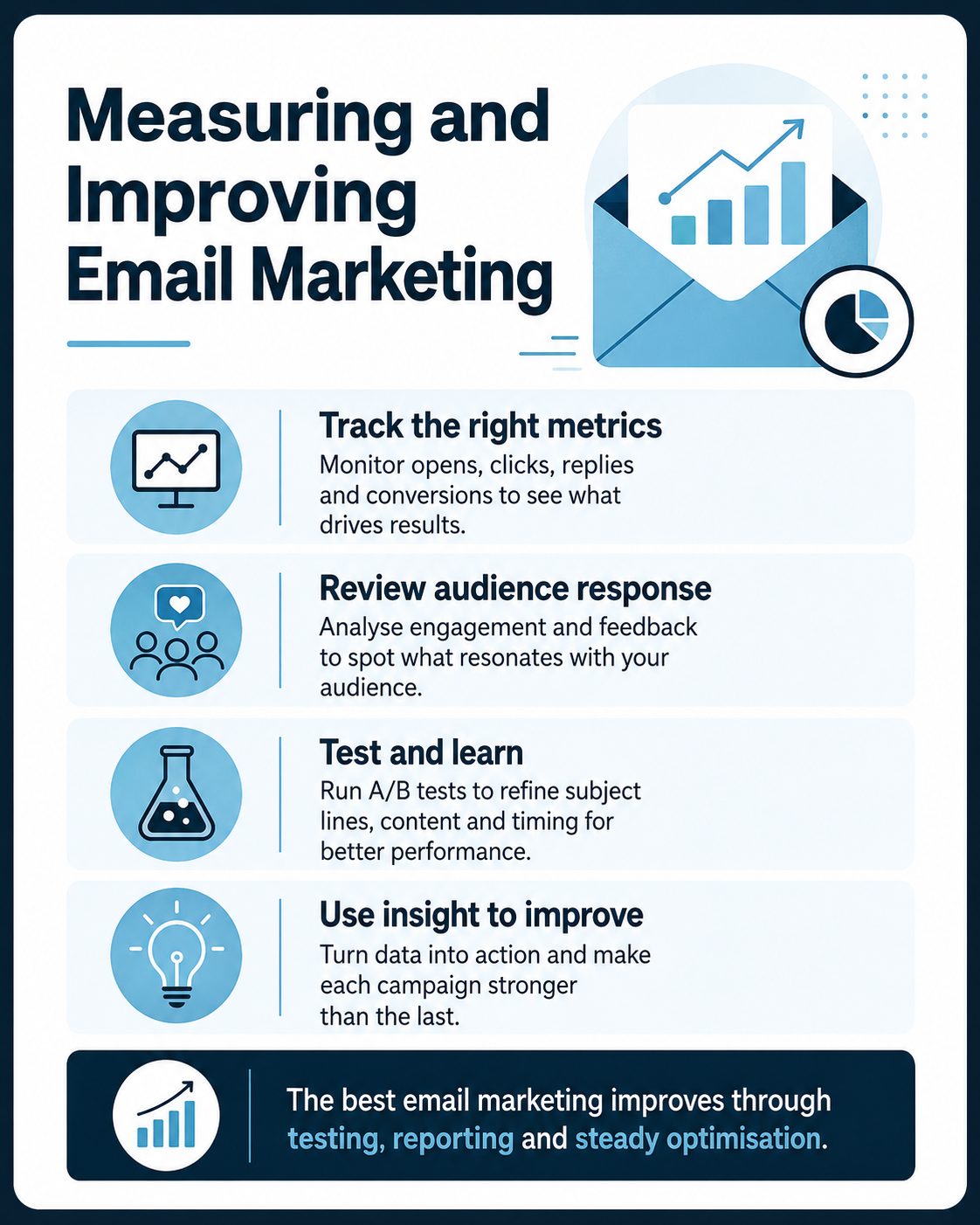
Core email marketing metrics include delivery rate, bounce rate, open rate, click-through rate, click-to-open rate, unsubscribe rate, spam complaint rate, reply rate, conversion rate and revenue or pipeline contribution. Each metric answers a different question. Delivery and bounce rates reveal data and technical health. Opens suggest initial attention, though they can be unreliable. Clicks show active interest. Replies and conversions show commercial progress.
Benchmarks can help provide context. Mailchimp email marketing benchmarks show that average open and click performance varies significantly by industry, which means every business should compare like with like where possible. A niche B2B campaign to a senior audience may behave very differently from a broad consumer newsletter.
Do not measure email in isolation when the purpose is lead generation. Track what happened after the click or reply. Did the contact book a meeting? Did the sales team reach them? Did the enquiry become an opportunity? Did the opportunity convert? This is where email becomes more than a marketing report. It becomes part of the revenue process.
AccuraData’s reporting can help identify warm prospects from campaign engagement, which gives sales teams a clearer follow-up list. This is particularly useful when campaigns are built around targeted B2B data and the follow-up process is planned before the send.
Improving Email Marketing Over Time
Email marketing improves through disciplined learning. Every campaign creates evidence. The value comes from reviewing that evidence and applying it to the next campaign. Improvement should focus on audience, data, message, offer, creative, timing, deliverability and follow-up.
Testing is useful, but it should be structured. Test one meaningful variable at a time where possible. Subject lines, calls to action, send times, email length, offer type, audience segment and landing page alignment can all be tested. If too many things change at once, it becomes difficult to know what caused the result.
A/B testing should also be interpreted with care. Small sample sizes can produce misleading results. A subject line that wins one test may not win across a different audience or campaign type. The goal is not to find universal rules. The goal is to build a better understanding of your audience.
Improvement also means knowing when to stop sending to certain contacts. If a contact never opens, clicks or responds after a sensible number of attempts, continued sending may harm deliverability and brand perception. Suppression can be a positive action. It protects the list and keeps future campaigns focused on people who are more likely to engage.
Email Marketing and Sales Follow-Up
Email marketing often works best when it is connected to sales activity. Marketing creates awareness and signals interest. Sales turns that interest into conversations, proposals and revenue. The connection between the two should be planned before the campaign launches.
Sales follow-up should be timely and relevant. If someone clicks a pricing page, downloads a guide or replies with a question, the sales team should know what they engaged with and why it matters. A generic follow-up call that ignores the contact’s behaviour wastes useful context.
Warm prospect identification is one reason many businesses choose outsourced email campaign support. A managed campaign can help separate casual engagement from meaningful intent. That allows internal teams to spend more time on the contacts most likely to respond.
For B2B organisations with longer sales cycles, email can continue to support the relationship after initial follow-up. Prospects who are not ready now can be nurtured with useful content, sector updates, case studies or invitations. The aim is to stay relevant without overwhelming them.
Common Email Marketing Mistakes
Many email marketing problems are avoidable. The first common mistake is poor targeting. A broad list and a generic message usually lead to weak results. The second is poor data hygiene. Invalid records, duplicates and outdated contacts increase bounce rates and waste time. The third is unclear messaging. If the recipient cannot quickly see why the email matters, they will move on.
Another mistake is measuring the wrong things. Open rates can be useful, but they should not be treated as the final measure of success. Clicks, replies, conversions, pipeline and retained customers matter more. A campaign with fewer opens but stronger sales conversations may be the better commercial campaign.
Over-sending is also common. When results are weak, some teams increase frequency instead of improving relevance. That can make the problem worse. If recipients are not engaging, review the audience, offer, data and message before increasing volume.
Finally, many businesses fail to connect email with follow-up. A campaign that generates interest but does not have a clear sales process will leave value on the table. Every campaign should define who follows up, when they follow up, what they say and how outcomes are recorded.
When to Outsource Email Marketing
Outsourcing email marketing can make sense when a business wants better campaigns but does not have the time, tools or expertise to manage every part internally. It can also help when the campaign depends on accurate B2B data, segmentation, copywriting, design, broadcast setup, reporting and sales handover.
An outsourced partner can bring structure to the campaign. That includes audience planning, data selection, compliance checks, messaging, email build, testing, delivery and performance review. This can be especially valuable for small teams where marketing staff are already managing multiple channels and sales teams need more qualified conversations.
Outsourcing does not mean handing over responsibility without involvement. The best results come from collaboration. The client understands the market, product and sales process. The provider brings campaign expertise, data quality, technical execution and reporting. Together, they can build campaigns that are more targeted and easier to improve.
AccuraData is well placed for this because its email marketing support is powered by data. The business can help with targeted B2B lists, client-supplied data, strategy, copywriting, design, campaign management, broadcast delivery and reporting. The Outsourced Email Marketing guide on the AccuraData blog explains how outsourced support can help businesses run email campaigns without stretching internal teams.
Why Choose AccuraData for Email Marketing?
AccuraData is not just an email sender. Its strength is the combination of data quality, audience targeting, compliance awareness and campaign delivery. Many email campaigns fail because the data behind them is weak. AccuraData helps solve that problem by supporting campaigns from the contact data layer through to reporting.
For businesses that need new prospects, AccuraData can supply targeted B2B email data filtered by sector, location, company size, seniority and job function. For businesses that already have a list, AccuraData can support data cleansing and enrichment so that campaigns are built on cleaner records. For businesses that need execution, AccuraData can manage the campaign process, including copy, design, delivery and performance reporting.
This matters because email marketing is connected. Data affects targeting. Targeting affects relevance. Relevance affects engagement. Engagement affects deliverability and sales outcomes. When these areas are managed together, the campaign has a better chance of producing useful results.
AccuraData’s positioning is particularly strong for UK B2B organisations that want practical campaign support rather than a purely software-led solution. The team can help clients identify the right audience, prepare the right message, deploy the campaign responsibly and highlight engaged contacts for follow-up. Businesses can speak to AccuraData through the contact page to discuss data, campaign management or outsourced email marketing support.
A Practical Email Marketing Workflow
A simple workflow can make email marketing easier to manage. Start by defining the campaign objective. Then select the audience and confirm the lawful basis for processing. Clean and segment the data. Develop the offer and message. Write the subject line, preview text and body copy. Build the email, test links and rendering, check compliance requirements, schedule the send and prepare follow-up.
After sending, review delivery and bounce rates first. If there are data or technical problems, deal with them quickly. Then review engagement metrics such as clicks, replies and conversions. Pass warm prospects to sales with the context needed for a useful follow-up. Record outcomes so that the next campaign can be improved.
This workflow can be repeated and refined. Over time, your organisation should build a record of which audiences respond, which messages work and which campaign types produce genuine business value. The best email marketing programmes become more effective because they learn from their own evidence.
Email Marketing Best Practice Checklist
The following checklist is a useful starting point for UK businesses planning email marketing campaigns. It should be adapted to the campaign type, sector and audience.
- Define one clear campaign objective before writing the email.
- Build the audience around relevance, not volume.
- Use accurate, recent and well-segmented data.
- Confirm the lawful basis and document the compliance position.
- Write a clear subject line and preview text.
- Keep the email focused on one main message and one primary call to action.
- Authenticate the sending domain using SPF, DKIM and DMARC.
- Make unsubscribe or opt-out handling simple and reliable.
- Monitor bounces, complaints, clicks, replies and conversions.
- Feed campaign insight back into sales and future marketing activity.
This checklist is not a replacement for professional advice, but it provides a useful structure. If your business needs support with the data, campaign preparation or delivery process, AccuraData’s Email Marketing Services can provide a more complete managed solution.
Final Thoughts on Email Marketing
Email marketing works when it respects the audience and supports a clear commercial purpose. It is not about sending as many emails as possible. It is about reaching the right people with relevant messages, using data responsibly, measuring what happens and improving each campaign over time.
The businesses that succeed with email usually treat it as a system. They invest in good data, segment properly, write clearly, maintain compliance, protect deliverability, support sales follow-up and review results honestly. That system can be built internally, outsourced to a trusted partner or managed through a combination of both.
AccuraData can help UK businesses at several points in that system. Whether you need targeted B2B Email Data, managed Email Marketing Services, data cleansing, campaign strategy or support identifying warm prospects, AccuraData offers a practical route to more targeted, responsible and measurable email marketing.
If your current email marketing is not producing the conversations, leads or insight you need, the issue may not be the channel itself. It may be the data, the targeting, the message, the process or the follow-up. Fix those foundations, and email marketing can become one of the most reliable tools in your growth strategy.