
There is a persistent narrative in marketing circles that telephone outreach is a relic of a previous era, overtaken by digital automation, social selling, and AI-driven lead generation. The data tells a different story. The DMA’s Response Rate Report found that B2B telemarketing achieves a 5.6% response rate, compared to 0.6% for email and 4.4% for direct mail. B2B telemarketing delivers up to £10 for every £1 spent when campaigns are properly structured and built on quality contact data. And in sectors where purchasing decisions are high-value, complex, or relationship-dependent, the telephone remains the channel through which real buying conversations happen.
The businesses achieving these results are not making high volumes of poorly targeted calls and hoping for the best. They are running structured B2B telemarketing campaigns built on verified contact data, compliant processes, well-prepared calling scripts, and the discipline to measure and improve performance at every stage. This guide covers all of it: what B2B telemarketing actually involves, how to build the data infrastructure that makes it work, what UK law requires of every business making outbound calls, how to construct a call approach that generates conversations rather than hang-ups, and how to measure what is working so that the next campaign performs better than the last.
What B2B Telemarketing Is and Why It Still Works
B2B telemarketing is the practice of making outbound telephone calls to other businesses for the purpose of generating leads, qualifying prospects, booking appointments, conducting research, or directly closing sales. It is a direct channel: there is no algorithm mediating the interaction, no inbox filter deciding whether the message gets seen, and no delay between the moment of contact and the prospect’s response. When a decision-maker picks up the phone, the conversation that follows in the next two minutes either opens a commercial opportunity or closes it, based almost entirely on the quality of the preparation and the approach behind the call.
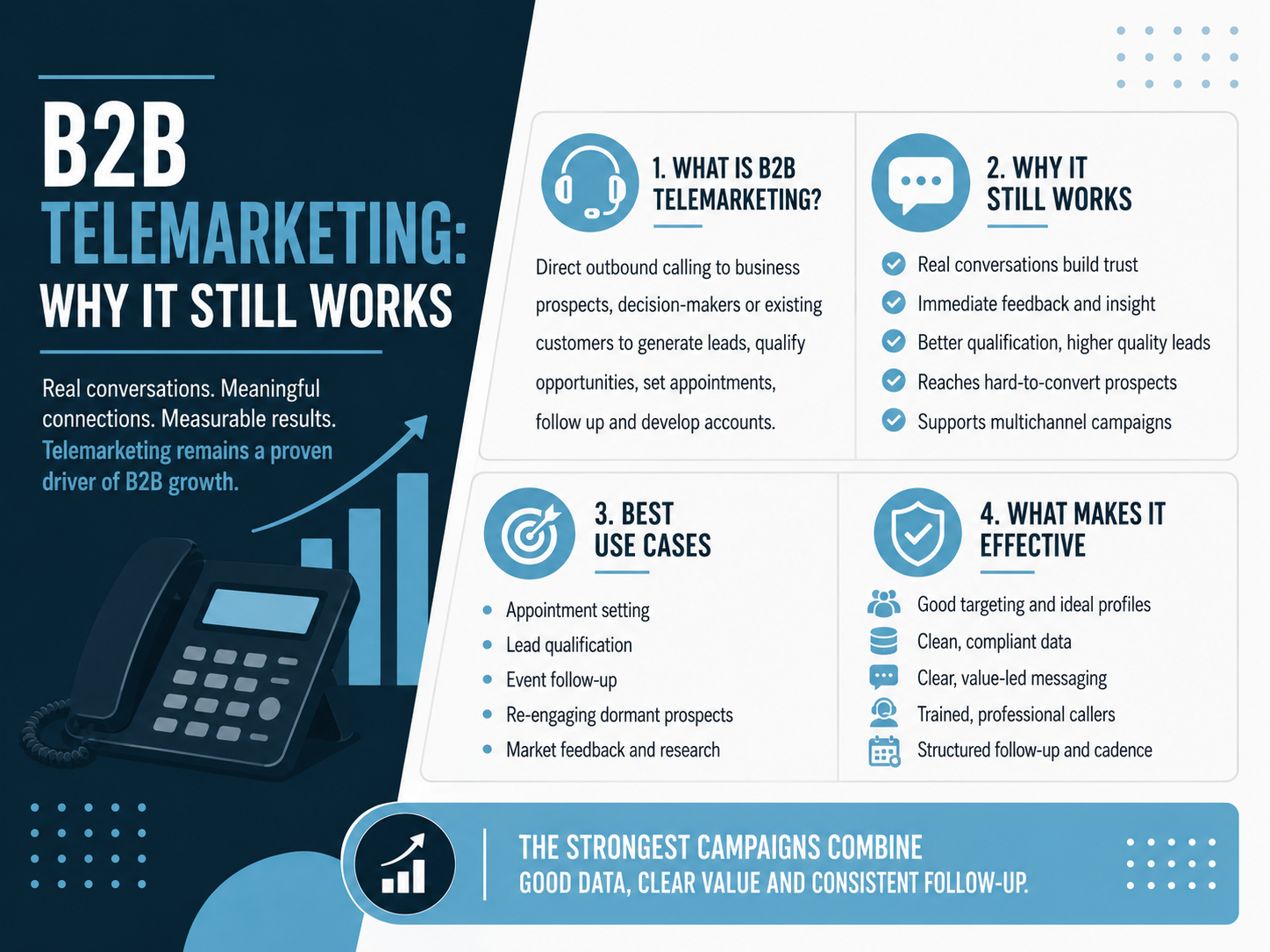
The reason B2B telemarketing continues to generate strong results despite the proliferation of digital channels is partly the nature of B2B purchasing itself. High-value B2B purchases are rarely made on the basis of a single digital touchpoint. They involve multiple conversations, objection handling, discovery of specific requirements, and the building of a degree of confidence in the supplier that is difficult to establish through written communication alone. 50 to 60% of B2B buyers still prefer phone contact during the sales process, and 78% of decision-makers prefer a personal call when evaluating a new product or service. The telephone is not competing with digital outreach for the attention of B2B buyers. It is handling the part of the buying journey that digital outreach cannot resolve.
The channel also provides an immediacy of feedback that no other marketing format matches. Every call produces real-time data about how a prospect responds to a proposition, what objections they raise, which elements of a pitch generate interest, and what timing or trigger would make them more receptive. This feedback loop, aggregated across hundreds of calls, gives B2B telemarketing teams a live intelligence source about buyer priorities and market conditions that can be used to refine messaging, improve targeting, and inform the positioning of the broader sales and marketing programme.
The UK Legal Framework for B2B Telemarketing
Before any outbound calling campaign launches, the legal framework governing B2B telemarketing in the UK needs to be properly understood. The consequences of getting it wrong have become significantly more serious following the Data (Use and Access) Act 2025, which raised maximum PECR penalties from £500,000 to UK GDPR levels of up to £17.5 million or 4% of global annual turnover. The ICO is an active enforcement body: it issued more than £2.59 million in fines for nuisance call, text, and email violations between April 2023 and early 2024 alone, and investigations frequently begin from a single complaint.
PECR and the TPS/CTPS Requirement
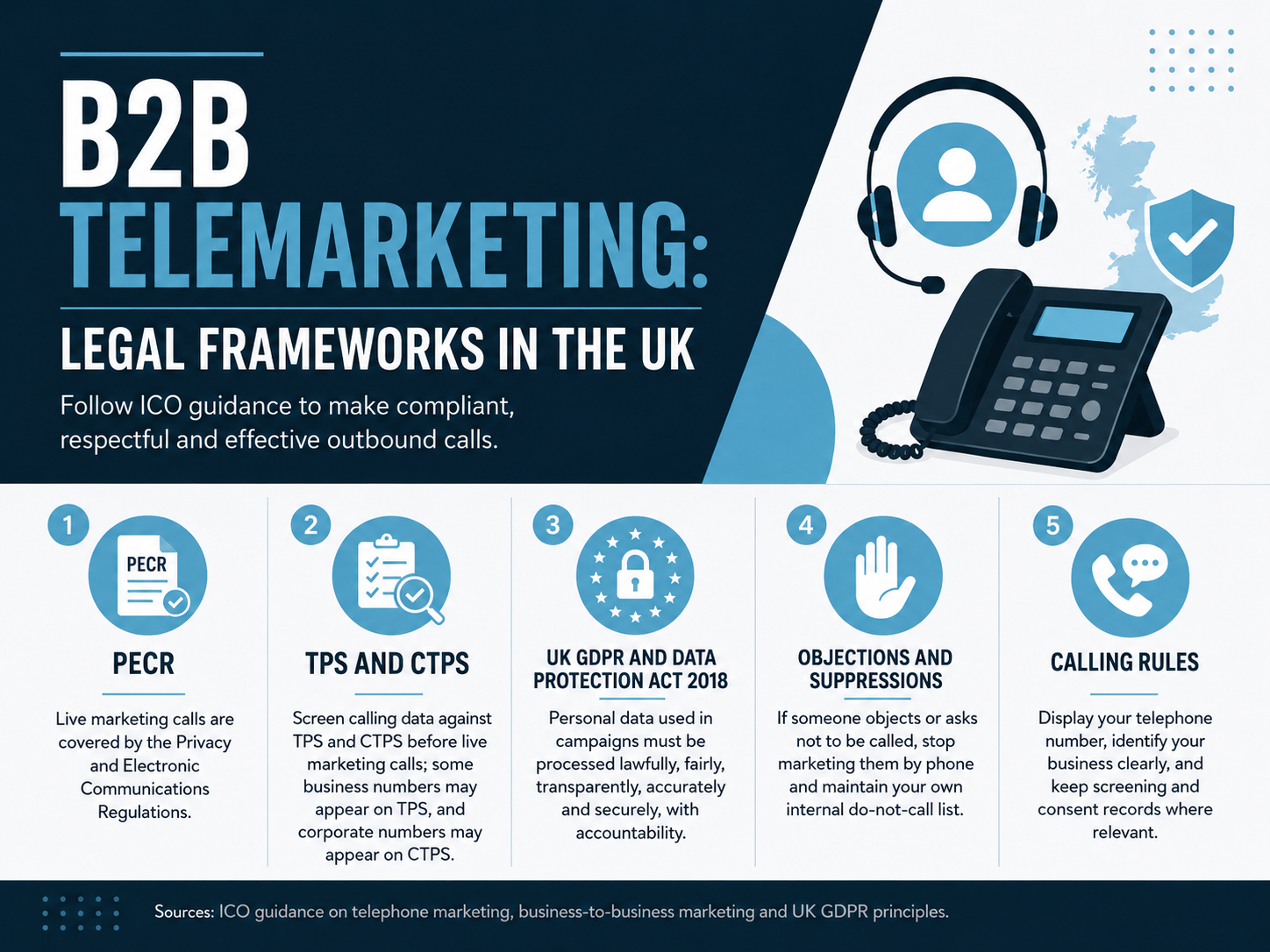
The primary legislation governing outbound calling in the UK is the Privacy and Electronic Communications Regulations 2003 (PECR). Under PECR, businesses are prohibited from making unsolicited live marketing calls to numbers registered on the Telephone Preference Service (TPS) or the Corporate Telephone Preference Service (CTPS), unless the individual or organisation has given specific prior consent to receive calls from that business. The only exception to this rule is documented, explicit consent that names the calling organisation.
The TPS covers individual consumers, sole traders, and most partnerships. The CTPS covers limited companies, LLPs, Scottish partnerships, and government bodies. For B2B telemarketing campaigns targeting incorporated businesses, the CTPS is the register that must be screened. However, a B2B calling list will frequently contain numbers belonging to sole traders or small partnerships, which fall under TPS rules rather than CTPS. Both registers must be screened before calling to ensure full compliance. As the ICO states directly, organisations must not make live marketing calls to a number registered with TPS or CTPS unless the subscriber has consented.
The 28-day re-screening rule applies to both registers. Calling lists must be screened against TPS and CTPS at least every 28 days, because new numbers are added to both registers continuously. A list that was clean last month may contain newly registered numbers this month. As ProvenWorks documents, the TPS register currently contains more than 17 million UK phone numbers, and the misconception that a one-time screen at data purchase removes the need for ongoing checks is both common and legally incorrect. Responsibility for compliance rests with the business making the calls. AccuraData’s TPS and CTPS checking service screens your calling data against both live registers at competitive rates, returning clear results before every campaign launch.
B2B Cold Calling and UK GDPR
PECR’s consent requirements for corporate subscribers differ from those governing consumer calls: you do not need prior opt-in consent to call a limited company for marketing purposes, provided the number is not on the CTPS. However, UK GDPR applies to any personal data processed during B2B telemarketing activity, including the contact records used to identify who to call. Where individual names and direct telephone numbers are held, those are personal data, and processing them requires a lawful basis. For B2B telemarketing, that basis is almost always legitimate interests.
Legitimate interests requires a documented balancing test: the business must establish that it has a genuine commercial interest in calling, that calling is necessary to pursue that interest, and that the interest does not override the individual’s reasonable privacy expectations. This documentation must exist before the calls are made. Every call must also be made transparently: the caller must identify the organisation they are calling on behalf of, must provide a contact number if requested, and must honour any request not to be called again by adding the number to an internal do-not-call list immediately.
Rules on Caller Identification and Record-Keeping
Beyond TPS/CTPS compliance and the GDPR lawful basis requirement, B2B telemarketing operations must adhere to several additional rules under PECR and ICO guidance. Caller ID must not be withheld on marketing calls. The calling organisation must be identifiable to the recipient. A freephone or geographically local contact number must be provided if the recipient asks for one. And records must be kept of when calling lists were screened, what suppression was applied, and how any complaints or objections were handled. As TALK-Q’s outbound call regulations guide highlights, since 2018 company directors can be held personally liable under ICO enforcement action, preventing rogue operators from escaping penalties by dissolving their company and restarting.
AccuraData: We supply verified B2B telemarketing data with TPS and CTPS screening applied before delivery. Our data cleansing and enrichment service includes telephone number validation, TPS and CTPS screening, and a 28-day re-screening arrangement for ongoing campaigns. Every dataset comes with a Data Processing Agreement and documentation of the lawful basis for the records it contains.
Building the Contact Data Infrastructure for B2B Telemarketing
The single most important determinant of B2B telemarketing performance is the quality and precision of the contact data behind the campaign. A calling team working from a poorly segmented, unverified list will spend the majority of its time in non-conversations: disconnected numbers, gatekeepers at companies where no decision-maker has been identified, people who have left the business, and contacts at companies that do not fit the target profile. This is not a failure of the calling team. It is a failure of the data. Improving data quality is the single most effective leverage point available to any business that wants to improve its telemarketing campaign results.
Decision-Maker Level Contacts
The foundation of a useful B2B telemarketing list is named decision-makers in relevant roles. A company name and a switchboard number is not a telemarketing contact. It is an obstacle. The contact that produces a conversation is the named individual with the authority to make or meaningfully influence the purchasing decision that the campaign is targeting. For most B2B campaigns, this means filtering by job title and seniority before a single call is made: owners and managing directors for SME-targeted campaigns; finance directors or procurement managers for campaigns targeting operational spend; IT decision-makers for technology propositions; marketing directors or heads of marketing for agency and media pitches.
A B2B telemarketing database that includes direct dial numbers alongside named contacts is significantly more valuable than one with only company-level telephone numbers, because it removes the gatekeeper problem for a meaningful proportion of the list. Direct dials for senior decision-makers are harder to compile and more expensive to maintain than switchboard numbers, but the increase in conversation rates they produce justifies the investment in data quality several times over across the lifetime of a campaign.
Firmographic Segmentation
Beyond individual contact details, the firmographic attributes of the companies being called determine how relevant the campaign is to the recipients and how well the calling team can prepare for each conversation. Industry classification to SIC code level, employee count, estimated annual turnover, geographic location, and trading status are the fields that allow a B2B telemarketing list to be divided into meaningful segments. A supplier of specialist manufacturing software should not be calling accounting practices. A provider of commercial cleaning services has different ideal customer sizes than a provider of enterprise procurement software. Firmographic segmentation focuses calling resource on the companies where conversion probability is highest, rather than distributing it evenly across an undifferentiated list of business names.
The practical impact of precise segmentation is significant. Salespeople who use a targeted approach see 28 to 37% higher conversion rates than those relying on undifferentiated outreach. The preparation that goes into a call to a specifically profiled prospect, including research into the company’s industry, likely challenges, and current size relative to the offer, produces meaningfully better conversation quality than a generic opening to a poorly defined audience.
Telephone Number Validation
Telephone numbers in a B2B database degrade for the same reasons that email addresses do: businesses change their numbers, individuals leave organisations, companies restructure and consolidate locations. A number that was correct twelve months ago may now be disconnected, reassigned, or routing to a department that has nothing to do with the decision-maker originally identified. Running telephone number validation against live network data before a campaign launches removes disconnected and incorrectly formatted numbers from the active calling list, so that calling resource is spent on numbers with a realistic chance of connecting.
The commercial case for this step is straightforward. A calling team dialling a list where 15% of numbers are invalid spends 15% of its time listening to disconnection tones rather than having conversations. On an eight-hour calling day, that is over an hour of productive time lost per caller, before the reputational impact of repeated attempts to reach disconnected numbers with a dialler is taken into account. AccuraData’s telephone number validation service removes this waste before it affects your campaign.
Structuring a B2B Telemarketing Campaign
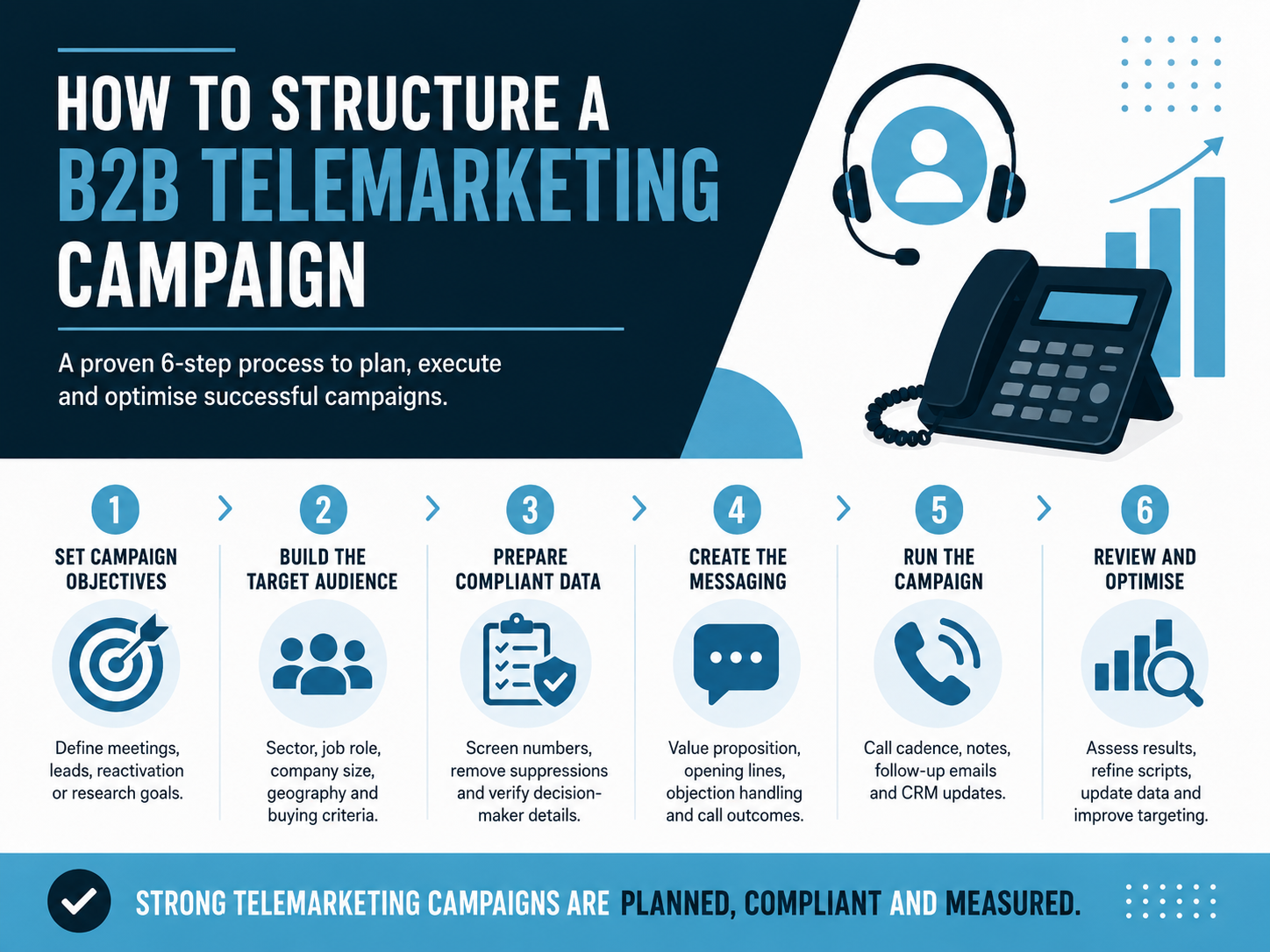
A well-structured B2B telemarketing campaign has clearly defined objectives, a defined audience with verified contact data behind it, a prepared call approach, a process for managing and progressing responses, and a measurement framework that tells the team what is working and what needs changing. Each of these elements depends on the others, and weakness in any one of them limits the performance of the whole.
Defining Clear Campaign Objectives
The objective of a B2B telemarketing campaign shapes everything about how it is run: who is called, what is said, how success is defined, and how leads are managed after a call. The most common campaign objectives are appointment setting, where the goal is to book a meeting between a prospect and a sales person; lead qualification, where the goal is to determine whether an inbound enquiry or marketing response meets the criteria for a sales conversation; direct sales, where the product or service is simple enough to be closed over the phone; and event or webinar invitation follow-up, where the goal is to convert a registered interest into a confirmed attendance.
Each of these objectives requires a different call structure, a different measure of success, and a different definition of a qualified outcome. Running a campaign that conflates lead qualification with appointment setting produces teams that neither qualify properly nor book meetings effectively. Clarity of objective is the prerequisite for everything else in the campaign structure.
Preparing the Calling Script
The term ‘script’ creates resistance among experienced callers because it implies a robotic, word-for-word recitation that removes the conversational quality that makes B2B telemarketing effective. A better way to frame it is a structured call guide: a framework that covers the opening statement, the primary qualifying questions, the core value proposition framed around the prospect’s likely pain points, the handling of the most common objections, and the specific ask that concludes the call. The framework provides consistency and ensures that every call covers the essential elements, while leaving the experienced caller free to adapt their language and emphasis based on how the conversation develops.
The opening statement deserves particular attention, because it determines whether the prospect stays on the phone for the next ninety seconds or brings the call to an end. A strong opening is brief, identifies the caller and their organisation clearly, and establishes relevance to the prospect’s specific context within the first two sentences. Generic openings that could have been said to anyone (“I’m calling about our fantastic new product…”) generate instant disengagement. Specific openings that reference the prospect’s industry, their company size, or a challenge common to their sector demonstrate that the call is relevant to them rather than to a generic list.
Objection handling preparation is where many B2B telemarketing campaigns underinvest. The most common objections in any B2B calling campaign are predictable, and a prepared response to each one should be part of every caller’s preparation. The standard objections, “we’re not looking at this right now”, “we already have a supplier”, “send me something by email”, all have effective responses that acknowledge the objection while keeping the conversation open. The best callers do not argue with objections. They acknowledge the concern and immediately pivot to a specific, relevant reason why a short conversation is worth having regardless.
Call Timing and Volume
The timing of B2B telemarketing calls has a measurable impact on connection and conversation rates. Mid-morning and early afternoon on Tuesdays, Wednesdays, and Thursdays consistently produce the highest contact rates for B2B outreach, while Monday mornings and Friday afternoons produce the lowest. This reflects the working rhythms of most decision-makers: Monday mornings are consumed by planning and catch-up, Friday afternoons are winding down, and mid-week mornings represent the period when most professionals are engaged with operational work rather than administrative tasks.
Call volume is a metric that should be tracked but not optimised in isolation. Success rates drop by 61% if calls exceed five minutes, which indicates that quality of conversation matters more than length. Making six or more contact attempts can boost contact rates by 70%, but only when those attempts are spaced intelligently and varied in approach rather than calling the same number repeatedly in quick succession. A calling cadence that combines telephone attempts with email touches in between produces better contact rates than either channel alone and builds the kind of multi-touch familiarity that makes decision-makers more receptive to engaging.
Multi-Channel Integration: B2B Telemarketing Within a Broader Sales Sequence
The most effective B2B telemarketing does not operate as a standalone channel. It operates as one element of a coordinated outreach sequence in which email, telephone, and where appropriate direct mail reinforce each other at each stage of the prospect’s journey. The research is consistent on this point: salespeople who combine phone calls with emails and LinkedIn messages achieve conversion rates 28 to 37% higher than those using a single channel. The compounding effect of a prospect encountering the same supplier through multiple channels, each adding a piece of the commercial case, builds the recognition and credibility that a cold call alone cannot establish in two minutes.
A typical integrated sequence for a B2B telemarketing campaign might begin with an introductory email to the target contact, followed by a telephone call two to three working days later that references the email. If the call does not connect, a follow-up email can be sent referencing the attempt before a further call is made. For high-value targets, a direct mail piece to the contact’s business address adds a physical touchpoint that stands out in a way that digital communications cannot replicate. Each touchpoint builds on the last, and the telephone call is where the conversation that moves the prospect into the sales pipeline actually happens.
This multi-channel approach requires that the same contact record holds verified email addresses, direct telephone numbers, and postal addresses, enabling all three channels to be deployed from a single dataset without the complexity of managing separate lists for each. AccuraData’s B2B contact data includes all three contact formats where available, and every dataset is TPS and CTPS screened before delivery, making it genuinely ready for multi-channel deployment from day one.
Measuring B2B Telemarketing Performance: The Metrics That Matter
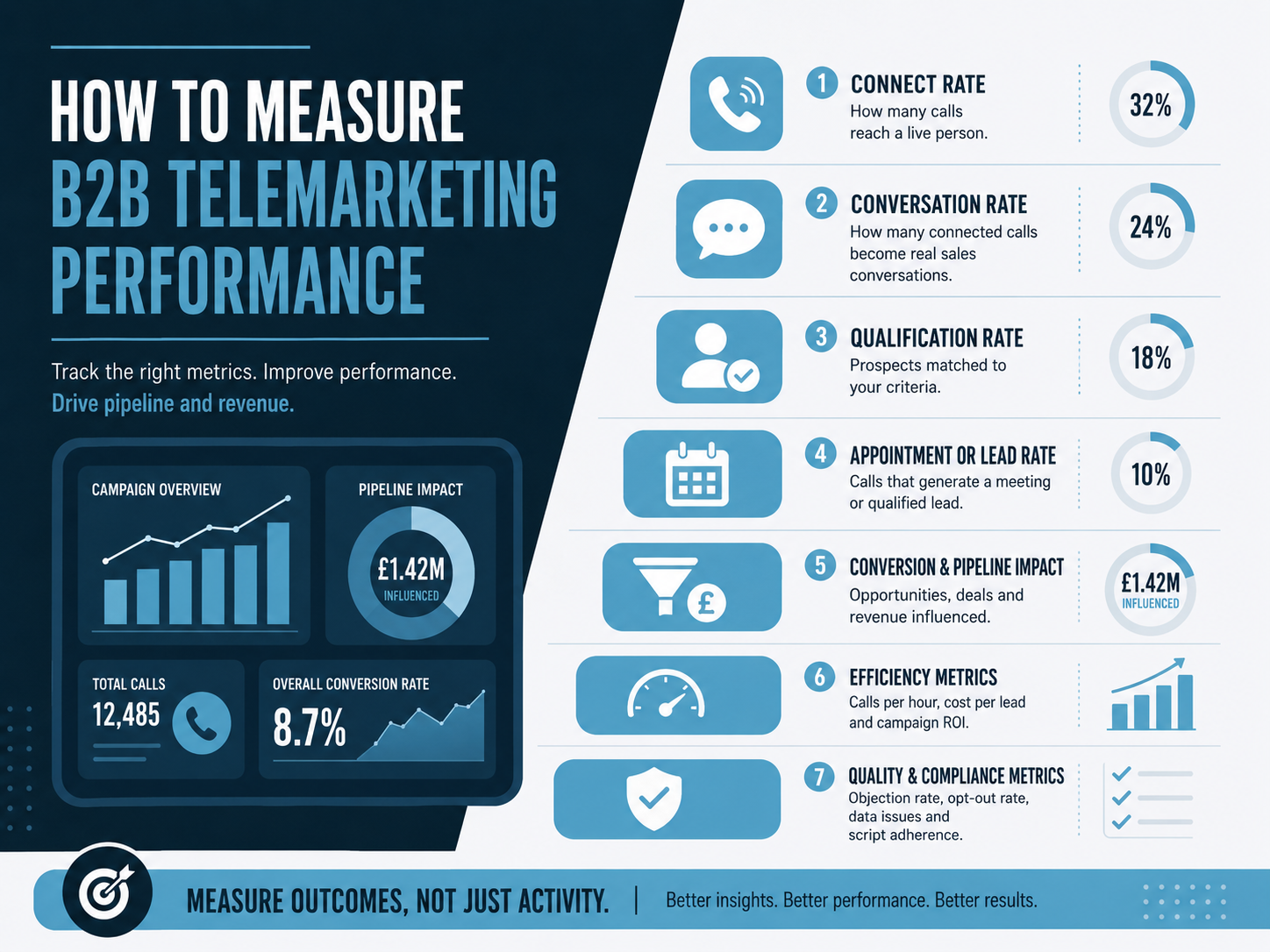
Measuring the performance of a B2B telemarketing campaign requires tracking metrics at both the activity level and the outcome level. Activity metrics, such as calls made, connection rate, and average call duration, tell you how the team is operating. Outcome metrics, such as qualified conversation rate, appointment rate, and pipeline generated, tell you whether the campaign is achieving its commercial objectives. Both sets of metrics are necessary, because high activity with poor outcomes indicates a data quality or messaging problem, while low activity with strong outcome rates per conversation indicates a dialling efficiency issue that is leaving pipeline on the table.
Call-to-Connection Rate
The call-to-connection rate measures the proportion of dialled numbers that result in a live conversation with a relevant person. This metric is the most direct indicator of data quality: a low connection rate suggests that a significant proportion of numbers in the telemarketing list are invalid, routed to wrong contacts, or being answered by gatekeepers who are blocking access to decision-makers. Industry benchmarks for B2B calling connection rates vary by sector and target role, but consistent rates below 15 to 20% of dials resulting in meaningful contact are a signal that the underlying data needs attention before additional calling resource is deployed.
Qualified Conversation Rate
Of the calls that result in a conversation, the qualified conversation rate measures the proportion that meet the criteria for a qualified lead: the prospect has the right profile, a relevant need, and some level of openness to exploring further. Around 65% of connected calls result in a substantial discussion, but a substantial discussion is not the same as a qualified conversation. Training and script quality determine what proportion of those discussions actually progress to a qualified outcome, and monitoring this rate at the individual caller level reveals where coaching and reinforcement is most needed.
Appointment Rate and Pipeline Value
For appointment-setting B2B telemarketing campaigns, the appointment rate, the proportion of dials or conversations that result in a booked meeting, is the primary performance indicator. The standard for securing a qualified meeting after 100 dials is between 1% and 3%, with higher rates achievable through better data quality, better targeting, and more experienced callers. Tracking the pipeline value attributed to appointments generated through B2B telemarketing allows the campaign’s ROI to be calculated at deal level and compared directly with the cost of the data, the calling time, and any additional campaign infrastructure.
Cost Per Qualified Lead
Cost per qualified lead divides the total campaign cost, including data, calling time, management, and technology, by the number of qualified leads generated. This metric is the clearest financial summary of B2B telemarketing efficiency and the one that most directly enables comparison with other lead generation channels. When B2B telemarketing is structured correctly around verified data and well-trained callers, the cost per qualified lead it produces is typically lower than that achieved through paid digital channels for complex, high-value B2B offers, because the conversation-based qualification is more efficient than the digital funnel journey required to reach the same point of intent.
Common B2B Telemarketing Mistakes and How to Avoid Them
Most underperforming B2B telemarketing campaigns share a recognisable set of problems that are addressable before they become entrenched. Understanding where campaigns most commonly fail is the most practical guide to building one that does not.
Starting with the Wrong Data
The most common root cause of B2B telemarketing underperformance is a calling list that has not been properly verified, segmented, or screened. Unverified numbers waste calling time on disconnections. Unsegmented lists produce generic opening statements that generate immediate disengagement. Unscreened lists risk CTPS and TPS violations that can generate ICO complaints and damage the business’s regulatory standing. All three problems are preventable through proper data hygiene and procurement from a supplier that verifies and screens before delivery. The temptation to prioritise list size over list quality is the single most consistent mistake in the channel.
Calling Without a Defined Objective
Sending a calling team out without a single, clearly defined objective for each call produces teams that are neither qualifying prospects nor booking appointments effectively, because they are trying to do both at once with no clear definition of what success looks like. Before any B2B telemarketing campaign launches, the objective must be specified: what does a successful call look like? What is the qualifying criterion for a lead to progress? What is the specific ask at the end of every call? Clarity on these questions produces callers who know where they are trying to take each conversation and who can evaluate their own performance against a concrete standard.
Neglecting the 28-Day Re-Screening Requirement
Campaigns that run for more than 28 days without re-screening their calling data against the TPS and CTPS registers are accumulating legal risk with every day that passes. This is one of the most common compliance failures in outbound calling operations, and it is also one of the most straightforward to prevent. Building the 28-day re-screening step into the campaign calendar as a fixed operational milestone, rather than treating it as something to be remembered, is the practice that keeps ongoing B2B telemarketing compliant rather than inadvertently building up exposure over time.
No Process for Managing Call Outcomes
Every call produces an outcome: a booking, a qualified lead, a callback request, a rejection, a wrong number, or a request not to be called again. Campaigns that do not have a systematic process for recording, acting on, and following up each outcome type are leaking value at every stage. Callback requests that are not followed up at the agreed time produce the worst possible impression with a prospect who has already shown interest. Opt-out requests that are not immediately added to a suppression list generate the compliance exposure that follows a business into every subsequent campaign. A simple but consistently applied outcome management process prevents both.
How AccuraData Supports B2B Telemarketing Campaigns
AccuraData provides the verified, compliant contact data that B2B telemarketing campaigns need to perform from day one. Our B2B contact lists are available segmented by SIC code industry classification, employee count, turnover banding, geographic region, and job title, covering decision-maker roles across finance, operations, IT, marketing, HR, and procurement. Every telephone number in a dataset we supply is validated against live network data and screened against the TPS and CTPS registers before delivery.
For businesses that already have a calling list and need it screened and cleaned before their next campaign, our TPS and CTPS checking service screens against both live registers and returns clearly formatted results that make suppression straightforward before the first call is made. For campaigns running beyond 28 days, we offer re-screening arrangements that keep the list compliant throughout the campaign lifecycle without requiring the campaign to be paused and rebuilt.
Our datasets include email addresses and postal contact data alongside telephone numbers where available, enabling the kind of multi-channel outreach sequences that produce the 28 to 37% conversion uplift the research attributes to co-ordinated telephone and email outreach. Every dataset we supply comes with a Data Processing Agreement and documented compliance information. Speak to our team to discuss what our B2B telemarketing data looks like for your specific target audience, what segmentation is available, and what a campaign built on verified, screened contact data can realistically deliver.
B2B Telemarketing Works When Everything Behind It Is Built Properly
The businesses getting strong results from B2B telemarketing are not doing anything fundamentally different from what was effective ten years ago. They are calling the right people, with a relevant proposition, from a verified and compliant list, using callers who are prepared for the conversations they are going to have and who know how to move a prospect towards a qualified next step. What has changed is the compliance environment around it, which is more stringent and more consequential than it has ever been, and the quality bar for contact data, which has risen alongside the expectations of the buyers being called.
A B2B telemarketing campaign that invests properly in data quality, segmentation, TPS and CTPS compliance, caller preparation, and systematic outcome management will consistently outperform one that treats any of these elements as an optional extra. The telephone is still where the conversation happens. The data is what puts the right people on the line.