
If you run a business that sells to other businesses, you are already working with a list of some kind. It might live inside a CRM, a spreadsheet shared across the sales team, or a collection of contacts built up over years of networking and inbound enquiries. The question is rarely whether you have an email list of businesses it is whether the one you have is accurate enough, large enough, and structured well enough to support the outreach you want to run.
For most B2B teams, the honest answer is that their existing data covers only a fraction of the market they could be reaching. That is where a purchased email list of businesses fills the gap. Rather than relying entirely on contacts your team has met personally or who have come inbound, a well-built business email database gives you direct access to verified decision-makers across the sectors, regions, and company sizes that match your ideal customer profile. Done correctly, it is one of the most efficient ways to build pipeline in B2B sales. Done poorly, it is a compliance risk and a budget drain.
At AccuraData, we supply validated email lists of businesses across the UK, covering a wide range of sectors and job functions at competitive rates. This guide explains what a quality business email list looks like, what the law requires when you use one, how to get the most from your data once you have it, and why the difference between verified and unverified data shows up immediately in campaign performance.
Why an Email List of Businesses Remains the Most Direct B2B Channel
Email has a staying power in B2B marketing that no other channel has managed to displace. Social platforms change their algorithms. Paid search costs fluctuate. Cold calling hit rates have declined. Email, by contrast, is the one channel that reaches every business professional, across every sector and seniority level, in the place they check most frequently throughout the working day.
The data on this is consistent and compelling. 91% of B2B marketers in 2025 report that email is their primary channel for lead generation, with the average open rate for B2B emails sitting at 36.7%, up from 34.2% the previous year. Almost three-quarters of B2B buyers say they prefer to be contacted through email as their first point of contact with a new supplier, making it the most popular channel by a considerable margin. And the return on investment that email delivers, averaging £35 for every £1 spent in the UK according to DMA data, consistently outperforms every other digital channel.
For businesses without an existing list of business email addresses that covers their full target market, the practical implication is straightforward. Every week that passes without a structured outreach programme reaching the right decision-makers is a week of pipeline that is not being built. A verified business email list is the mechanism that makes reaching those decision-makers possible at scale, without the time and resource cost of building a database contact by contact through manual prospecting.
Crucially, it is not just the volume of email that drives results. 52% of email marketing professionals report doubling their ROI through campaigns built on segmented, well-targeted data rather than broad broadcast sends. The email list of businesses you work from is where that targeting begins. The more accurately it reflects your ideal customer profile, the more relevant your outreach can be, and the stronger the response rates that follow.
What Makes a Business Email List Worth Buying
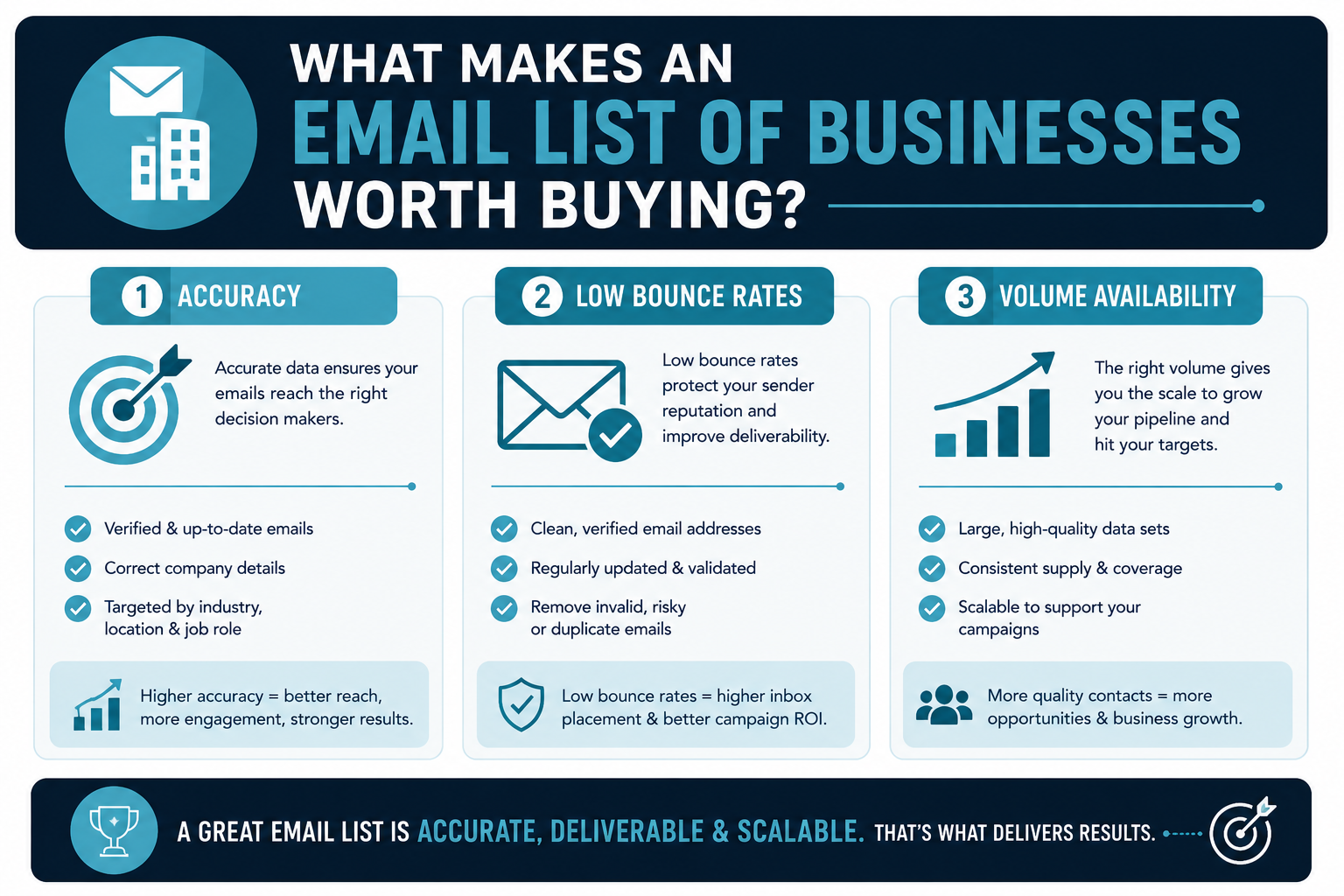
The market for business email lists in the UK includes providers at very different ends of the quality spectrum. The gap between the best and the worst is significant, and it shows up fast in campaign performance. Understanding what separates a high-quality email database of businesses from one that will damage your sender reputation and waste your outreach budget is the most valuable thing you can know before making a purchase.
Verified Email Addresses at Mailbox Level
The most common failure mode in low-quality business email lists is that email addresses have not been verified beyond a basic format check. A correctly formatted address on a live domain can still be invalid: the specific mailbox may not exist, the individual may have left the company, or the address may be associated with a role that has since been eliminated. Active mailbox verification, which sends a signal to the address to confirm it is live and accepting mail, is the check that separates genuinely verified data from data that merely looks clean. Anything less leaves bounce risk in your list that will progressively damage your domain’s sender reputation.
AccuraData: Every business email list we supply goes through active mailbox-level verification before delivery. We remove invalid, inactive, and role-based addresses before the data reaches you, so your campaign starts from a foundation of addresses that are genuinely live.
Named Decision-Makers, Not Generic Inboxes
A business contacts email list that returns company names and generic info@ or enquiries@ addresses is of very limited use for B2B outreach. Those addresses tend to see low engagement, are frequently monitored by administrative staff rather than decision-makers, and generate high unsubscribe rates when used for targeted campaigns. The contacts that produce results are named individuals in specific roles: owners, directors, finance managers, operations leads, IT decision-makers, marketing professionals. A quality email list of businesses should specify the job titles and seniority levels available within its dataset so you can verify that it contains the decision-maker types relevant to your offer before you purchase.
Rich Segmentation Fields
The commercial return from a targeted business email list depends heavily on whether it contains enough information to support meaningful segmentation before you send. Industry classification down to SIC code level, employee count banding, estimated annual turnover, geographic region, and job function are the fields that allow you to divide your list into groups and tailor your messaging for each one. According to B2B email marketing benchmarks from SQ Magazine, advanced segmentation produces 78% higher click-through rates than unsegmented sends. That uplift is only accessible if the business email database you purchase contains the fields to segment it meaningfully.
Recency of Verification
Contact data decays at approximately 2.1% per month, compounding to over 22% annually. A list of business emails that was verified a year ago is already carrying a significant proportion of stale records before a single campaign has been run against it. Always ask any supplier when the data was last verified, at what level, and how frequently their refresh cycle runs. Data verified within the past 30 to 90 days is meaningfully more reliable than data verified at some unspecified point in the past.
Transparent Sourcing and Compliance Documentation
A reputable business email list provider should be able to tell you exactly where their data comes from, confirm that it meets UK GDPR and PECR requirements, and provide a Data Processing Agreement as standard. If a provider cannot or will not supply this documentation, they are introducing compliance risk into your campaigns as well as performance risk. The sourcing question is particularly important: data compiled from public registries, company websites, and verified business directories carries a different legal profile from data scraped from social media or assembled through unverified third-party sources.
Is Buying an Email List of Businesses Legal in the UK?
This is the question most B2B marketers either skip entirely or over-complicate to the point where they avoid purchased data altogether out of excessive caution. The truthful, practical answer is that buying and using a business email list in the UK is legal, provided it is done correctly. The regulatory framework governs how the data is used, not whether it is purchased.
The two pieces of legislation that apply are UK GDPR and the Privacy and Electronic Communications Regulations (PECR). Under PECR, the consent requirements that apply to consumer marketing do not apply in the same way to corporate subscribers. Emailing a limited company for B2B marketing purposes does not require prior opt-in consent in the same way that emailing an individual consumer does. This is the legal basis that makes purchasing and using a B2B email list of businesses a workable commercial practice for UK organisations.
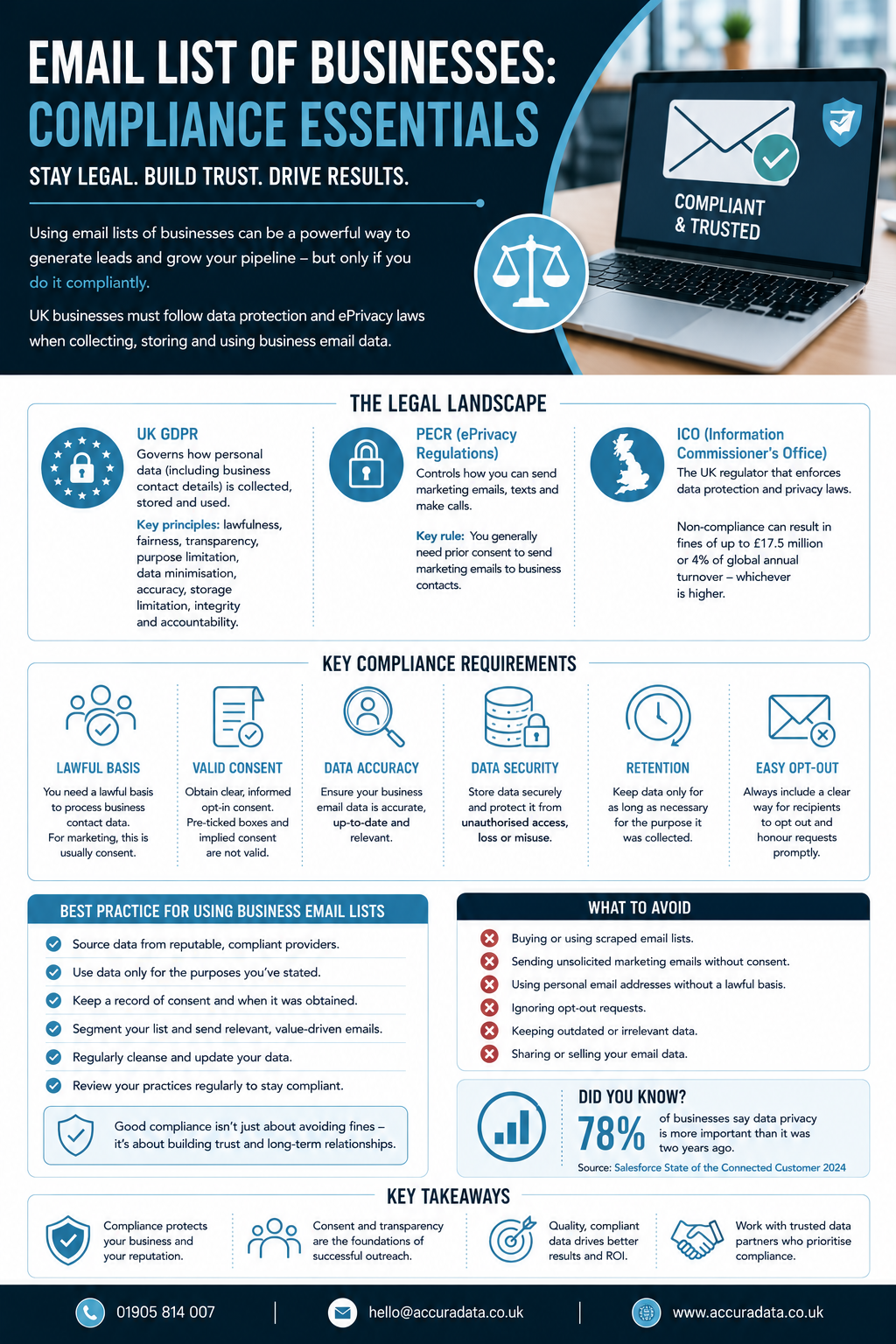
UK GDPR does apply to any contact record that identifies a named individual. A business email address in the format firstname.lastname@company.co.uk is personal data under GDPR, and processing it requires a lawful basis. In B2B outreach, that basis is almost always legitimate interests, which requires a documented balancing test demonstrating that your commercial interest is proportionate and does not override the individual’s privacy rights. Every outreach email must also carry a clear and functional opt-out mechanism, and opt-out requests must be honoured immediately and added to a suppression list to prevent future contact.
The practical compliance requirements when using a business email list are therefore: document your legitimate interests assessment, include a clear opt-out in every communication, maintain and apply your suppression list before every send, and be transparent about the source of your data if a recipient asks. These are manageable obligations, not prohibitive ones, and they are the baseline that any responsible B2B outreach programme should already be meeting.
AccuraData: Every email list of businesses we supply comes with a Data Processing Agreement as standard. We operate in full compliance with UK GDPR and PECR, and we can explain the source and lawful basis for every record in our database. For clients who also run telephone outreach, our data cleansing and enrichment service includes TPS and CTPS screening to ensure your calling data is fully compliant before your team picks up the phone.
Which Businesses Benefit Most from a Targeted Email List of Companies
Virtually any B2B business can benefit from a well-built email list of businesses, but some sectors see particularly strong returns because of the nature of their sales process and the structure of their target market.
Professional Services
Accountancy firms, legal practices, consultancies, and financial services businesses typically have high deal values and long sales cycles. A targeted business email list that allows them to reach finance directors, managing directors, and practice owners directly, filtered by company size and sector, gives their business development teams a structured pipeline to work rather than relying entirely on referrals and existing relationships. The ROI from a single converted contact in professional services can justify the cost of a full campaign several times over.
Technology and SaaS
Software businesses selling into the SME market have a large addressable audience and a product proposition that typically needs to reach a specific decision-maker, often an IT manager, operations director, or business owner, rather than a broad job function. A business email database filtered by company size, industry, and role gives SaaS sales teams a precisely defined audience to work rather than a generic list of company names. The higher the specificity of the targeting, the more relevant the outreach, and the stronger the conversion rates that follow.
Suppliers to Specific Sectors
Businesses supplying products or services to a defined industry vertical, such as construction, manufacturing, hospitality, retail, or healthcare, can use a segmented email list of businesses to reach only the companies within their target sector at the relevant company size. This precision targeting is particularly valuable for suppliers whose product or service is not universal across industries, where sending to an undifferentiated list of businesses would produce low relevance and poor engagement for a significant proportion of contacts.
AccuraData Sector Examples: We supply specialist email lists filtered to specific professions and sectors, including estate agents, architects, and many more industry verticals across the UK. If your target market is a specific sector or profession, speak to our team about what filtered data looks like for your audience.
Recruitment and Training Providers
Businesses in the recruitment, HR services, and professional training sectors need to reach HR directors, people managers, and business owners across a wide range of industries. A list of business email addresses filtered by job function, allowing outreach specifically to HR and people-focused roles, provides a direct route to the decision-makers who control recruitment and training budgets without wasting outreach resource on contacts outside that remit.
How to Use a Business Email List Effectively
Purchasing a business email list is only the first step. The return you generate from that data depends on how well you deploy it. The businesses achieving strong results from purchased email lists of businesses are not necessarily those with the most sophisticated email platforms or the largest sending volumes. They are the ones who treat the data strategically from the moment it arrives.
Segment Before You Send
Even within a single business email list built for a relatively focused target market, there will be meaningful differences between contacts that warrant different messages. A business owner at a five-person company has different priorities from a department head at a company with 200 employees. A contact in London faces a different trading environment from one in rural Scotland. Segmenting your B2B business email list by industry, company size, geography, and seniority before drafting your campaign allows you to write to each group’s specific context rather than sending a message that is relevant to everyone in theory but tailored to no one in practice.
Open with Relevance
The opening line of a cold outreach email has one job: to demonstrate immediately that this message is relevant to the person receiving it. Generic openers that could have been sent to anyone, regardless of industry, role, or context, are the single most common reason cold emails go unread. If your email list of businesses is properly segmented, you know enough about each group to open with something specific. Reference the type of business they run, the challenges common to their sector, or the specific function they perform. The investment in writing segment-specific versions of your outreach pays back in higher open rates and response rates that justify the extra time several times over.
Structure a Multi-Touch Sequence
A single cold email rarely generates a response from a prospect who has never heard of your business, regardless of how good the copy is. The businesses generating consistent pipeline from purchased business email lists typically run a structured multi-touch sequence: an initial email, followed by one or two carefully spaced follow-ups, and for higher-value targets, a telephone call using the direct dial numbers that a quality business contact email list should also include. Each touchpoint reinforces the previous one, and the cumulative effect of consistent, relevant communication builds the recognition and credibility that eventually generates a reply.
Manage Deliverability from Day One
The deliverability of your campaign is determined before you send a single email. It starts with the quality of the email list of businesses you are working from, continues with how you warm up your sending domain if you are new to outbound email, and is maintained through careful monitoring of bounce rates, unsubscribe rates, and spam complaint rates throughout the campaign. The average bounce rate for a well-managed B2B email campaign sits at around 2.48%. Sustained bounce rates substantially above that level are a signal that the underlying list quality needs attention before the campaign continues. Running your business email list through AccuraData’s email verification service before your first send removes the invalid addresses that drive bounce rates above safe thresholds.
Honour Opt-Outs and Maintain Your Suppression List
Every contact who opts out of your communications must be removed from your active business email list and added to a suppression file that is checked before every subsequent send. Failing to honour opt-outs is not just a compliance failure under UK GDPR and PECR. It is a practical campaign quality issue: continued contact with people who have asked not to be contacted generates spam complaints that accumulate into deliverability damage affecting your entire sending domain. A clean suppression list, maintained consistently and applied rigorously, is one of the most important list management practices any business running regular outreach should have in place.
What to Avoid When Buying a Business Email List
The failure modes in the market for business email lists are well-documented enough that avoiding them is largely a matter of knowing what signals to look for before committing to a purchase.
The most reliable warning sign is price. Research across the data industry consistently finds that unrealistic pricing is a direct indicator of data quality problems. Building and maintaining a genuinely verified, regularly refreshed business email database is expensive. Providers who cannot price in a way that reflects those costs are almost certainly cutting corners on verification, refresh frequency, or compliance processes. A list that costs a fraction of what comparable data should cost is not a bargain. It is a risk that tends to manifest in your bounce rates, your deliverability, and your ICO exposure before the first campaign has finished.
The second warning sign is vagueness. A reputable email list of businesses provider should answer direct questions about data sourcing, verification methodology, refresh frequency, and compliance documentation clearly and specifically. Evasive or generic answers to any of these questions should be treated as a disqualifying signal. Transparency is not a differentiator in quality data supply; it is a baseline expectation.
The third is an unwillingness to provide a sample before purchase. Any established business email list provider should offer a representative sample that can be checked against a live email verification tool before a commitment is made. Testing a sample of 50 to 100 records tells you more about the actual quality of a dataset than any marketing material, and a provider who resists this step is giving you a clear signal about what that test would reveal.
How AccuraData Builds and Delivers Its Email Lists of Businesses
AccuraData supplies validated email lists of businesses to UK organisations across a wide range of sectors, deal sizes, and campaign types. Our approach to data quality is built around the principle that a business email list should work from the moment it is delivered, not require significant cleaning, filtering, or remediation before it is usable. Every record we supply goes through active mailbox-level verification before delivery. We remove invalid addresses, role-based inboxes, and records associated with dissolved or dormant companies before the data reaches you. What you receive is a clean, structured dataset that reflects the market as it currently exists, not as it looked when the data was first collected.
Our business email lists are available segmented by industry SIC code, employee count, estimated turnover, geography, and job function. For clients targeting specific decision-maker types, we can filter to owners, directors, department heads, and functional specialists across finance, operations, IT, marketing, HR, and procurement. For clients running multi-channel campaigns, every dataset includes telephone numbers and postal addresses alongside verified email contacts, enabling a coordinated outreach sequence from a single data source.
Our pricing is competitive and transparent. We do not charge in a way that makes regular data refresh prohibitive, because we understand that a business email list is a depreciating asset if it is not kept current. For clients running ongoing outbound programmes, we can build a supply arrangement that keeps your data fresh against the 28-day screening requirements for telephone outreach and the broader recency standards for email campaigns. And for clients who have existing data that needs cleaning before use, our data cleansing and enrichment service covers email verification, telephone number validation, TPS and CTPS checking, and live Companies House checks in a single submission.
Every engagement with AccuraData includes a Data Processing Agreement as standard, and we can explain the sourcing and lawful basis for every record in our database if asked. We are registered with the ICO and operate within the UK GDPR and PECR framework on every data supply engagement. For clients who want to understand what our email list of businesses looks like for their specific target audience before committing, we offer a consultation with no obligation. Get in touch with our team and we will give you a clear picture of coverage, segmentation options, and pricing for your target market.
A Validated Email List of Businesses Is Where B2B Pipeline Starts
The UK has 5.7 million private sector businesses. Your target market is a defined subset of that number, characterised by a specific set of industries, geographies, company sizes, and decision-maker roles. The gap between the contacts your team has developed organically and the full size of the market you could be reaching is, for most businesses, substantial. A verified, segmented email list of businesses is the tool that closes that gap, giving your sales and marketing teams direct access to the decision-makers they need to reach without the time and resource cost of building the data contact by contact.
The quality of the business email list you work from determines the quality of everything that follows: the deliverability of your campaigns, the relevance of your targeting, the productivity of your sales team, and the compliance of your outreach. Getting that foundation right is not an optional extra layer on top of your marketing strategy. It is the starting point that makes every other investment in outreach, copy, automation, and follow-up work harder and more efficiently.
AccuraData provides competitive, validated email lists of businesses built specifically for UK B2B outreach. If you want to understand what our data looks like for your target market, speak to our team. The conversation starts with who you want to reach, and everything else follows from there.