
The Telephone Preference Service, often shortened to TPS, is one of the most important compliance checks for any UK organisation that uses telephone marketing. It affects sales teams, fundraising teams, appointment setters, contact centres, B2B prospecting teams, customer engagement teams and any business using telephone data for direct marketing.
At its simplest, the Telephone Preference Service is the UK’s official Do Not Call register for people who do not want unsolicited live sales and marketing calls. The TPS explains that it covers landlines and mobile numbers, and that there is also a Corporate Telephone Preference Service, known as CTPS, for businesses.
For organisations, TPS compliance is not just a legal housekeeping task. It is a core part of responsible data use. Poor telephone screening can lead to complaints, wasted agent time, brand damage and enforcement risk. Clean, compliant calling data helps teams focus on people who can lawfully be contacted, while reducing friction with those who have already opted out of unsolicited calls.
This guide explains what the Telephone Preference Service is, why it exists, how TPS screening works, how it affects data-led operations, and how organisations can avoid falling foul of the rules.
What is the Telephone Preference Service?
The Telephone Preference Service is a central opt-out register for UK landline and mobile numbers. Individuals can add their number to record that they do not want unsolicited live sales and marketing calls. Registration is free for the person adding their number.
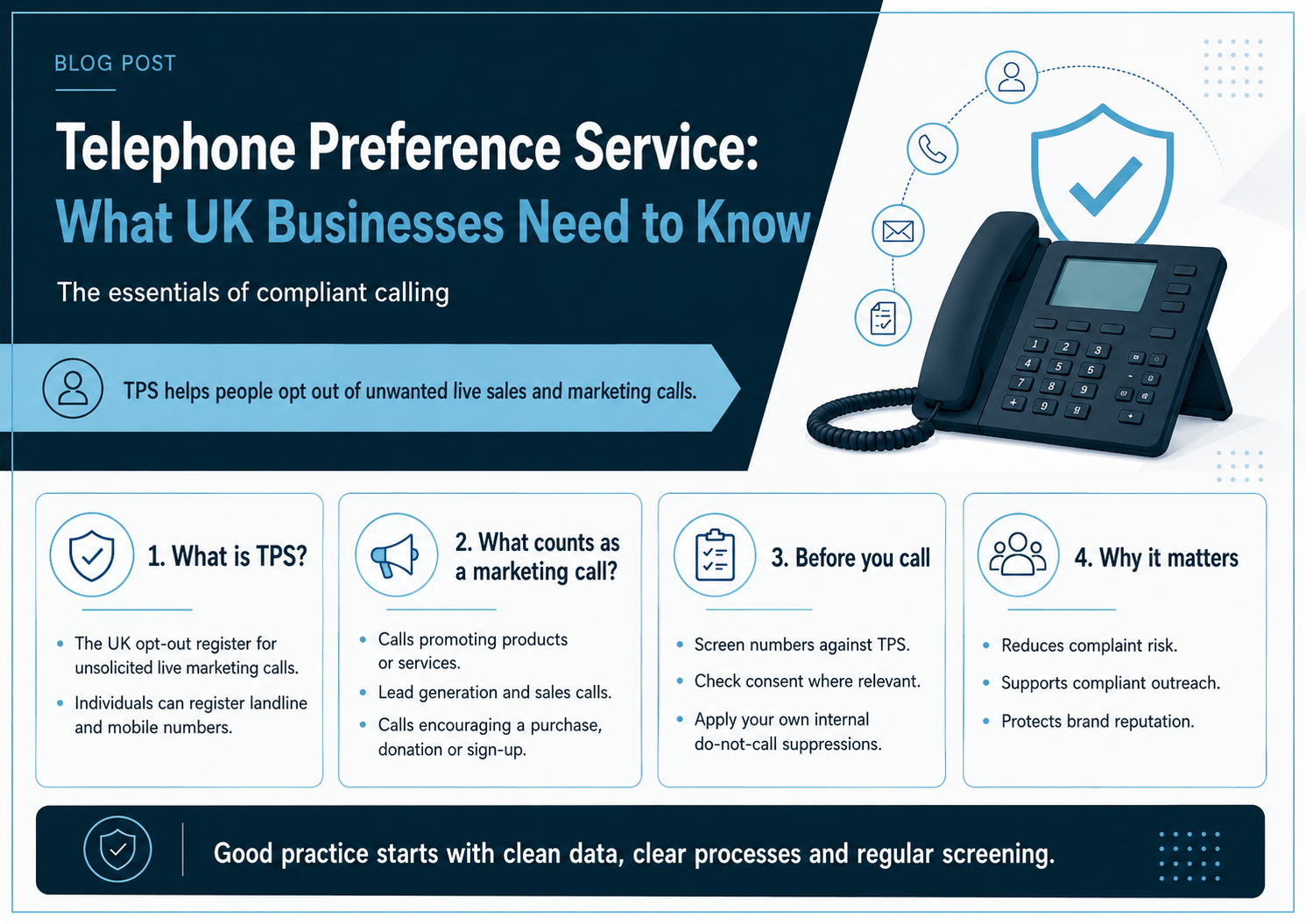
The Corporate Telephone Preference Service works in a similar way but applies to corporate subscribers. The ICO states that TPS and CTPS are statutory registers of those who do not want to receive live marketing calls, with CTPS being the corporate version.
A TPS registration acts as a general objection to unsolicited live direct marketing calls. In practice, that means organisations must not make live marketing calls to numbers listed on TPS or CTPS unless the person or business has specifically agreed to those calls.
The word unsolicited matters. A call is solicited when someone has specifically asked you to call them about marketing information. If they have not asked for that call, it is usually treated as unsolicited for PECR purposes, even if the person is an existing customer or has not complained before.
Why does the Telephone Preference Service exist?
The Telephone Preference Service exists to reduce unwanted sales and marketing calls. Unwanted calls can be intrusive for individuals and disruptive for businesses. They also create mistrust in legitimate marketing when organisations ignore preferences, use outdated data or fail to respect objections.
The legal framework behind TPS sits mainly within the Privacy and Electronic Communications Regulations, usually known as PECR. The ICO explains that PECR covers privacy rights in relation to electronic communications, including marketing calls, emails, texts and faxes. The underlying regulations are published on legislation.gov.uk.
For telephone marketing, PECR creates rules around when live marketing calls can be made, when consent is required, and when TPS or CTPS registrations must be respected. The Information Commissioner’s Office is responsible for enforcement in this area, while Ofcom also provides guidance on nuisance calls and messages.
In other words, TPS is not just a consumer preference tool. It is part of the UK’s wider privacy and communications regime.
How does TPS registration work?
A person can register a landline or mobile number with the Telephone Preference Service. The TPS says that registering is free and quick, and that the official register covers both landline and mobile numbers.
The ICO states that numbers must appear on the TPS or CTPS register for 28 days before the registration takes effect. This 28-day period is important for organisations because it affects how frequently calling files should be checked. A file that was compliant several weeks ago may no longer be compliant today.
For mobile numbers, TPS also provides a text-to-register option. The TPS website states that mobile users can register by texting TPS and their email address to 85095, with no charge to send the message or receive confirmation from that number.
Once a number is registered and the registration has taken effect, organisations making unsolicited live marketing calls must treat that registration as a general objection. The fact that a number is publicly available, listed in a directory or obtained from a third-party supplier does not override a TPS or CTPS registration.
Telephone Preference Service and PECR: the key rules
For many live marketing calls, PECR does not always require prior consent before calling. However, organisations must not call someone who has objected to their calls, and they must not make unsolicited live marketing calls to numbers registered with TPS or CTPS unless the recipient has specifically agreed to receive calls from that organisation.
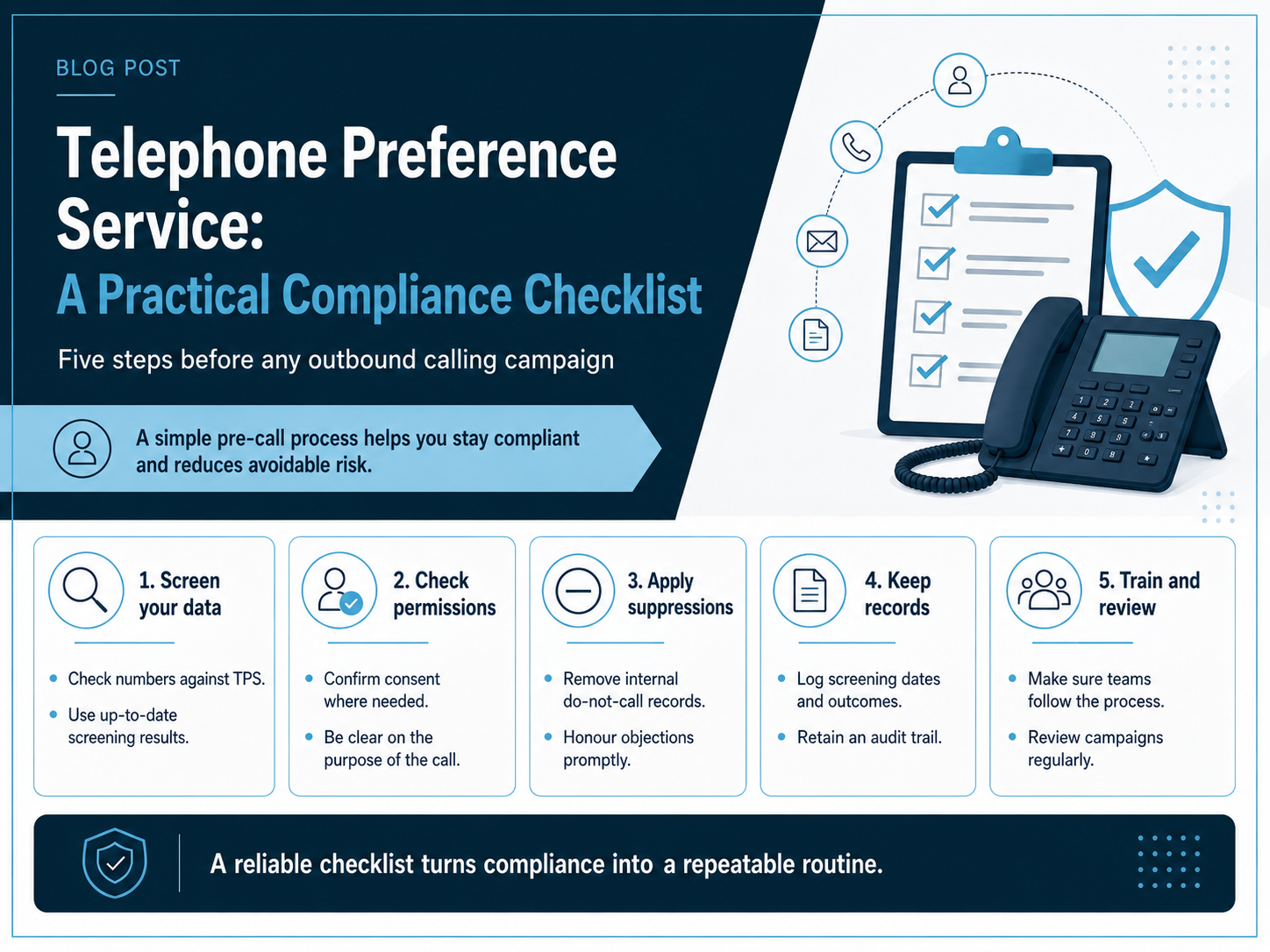
That makes TPS screening a practical requirement for most outbound calling activity. The ICO says organisations must check phone numbers against TPS and CTPS before making live marketing calls, and that they should keep their own suppression lists for people who object directly.
There are stricter rules for some sectors and call types. Automated marketing calls that play a recorded message require specific consent. General marketing consent, or consent for live calls, is not enough for automated calls.
Claims management services are also treated differently. The ICO states that organisations can only make direct marketing calls about claims management services if the person being called has specifically consented to those calls.
Pension scheme marketing calls are subject to strict criteria. In general, these calls can only be made in limited circumstances involving trustees, pension scheme managers or firms authorised by the Financial Conduct Authority, and the recipient must either have consented or the relationship must meet strict criteria.
For ordinary commercial live calling, the practical rule is clear: screen against TPS or CTPS, screen against your own suppression list, and do not call people who have objected unless you have valid, specific permission to do so.
TPS, CTPS and B2B Telephone Marketing
Many organisations assume that the Telephone Preference Service only applies to consumer marketing. That is a common misunderstanding.
The TPS covers individuals, while CTPS covers companies and other corporate subscribers. The ICO’s business-to-business marketing guidance states that businesses can object to live marketing calls and that organisations must respect objections recorded through TPS and CTPS.
This matters because not every business contact is treated the same way. Sole traders and some partnerships may be closer to individual subscribers, while limited companies and other corporate bodies may fall within CTPS. In practice, B2B telephone marketing teams should avoid relying on assumptions about the type of number they are calling. Screening both registers is often the safer operational approach.
B2B data also changes quickly. People move roles, companies change numbers, switchboards are reconfigured, and direct dials can be reassigned. A compliant telephone marketing process should treat TPS and CTPS screening as a recurring data quality control rather than a one-off task.
How the Telephone Preference Service Impacts Data-led Operations
For a data-led organisation, the Telephone Preference Service affects much more than the final call. It should influence how telephone data is collected, bought, stored, enriched, segmented, activated and audited.
The first impact is data acquisition. If an organisation buys a prospecting file, it remains responsible for how that data is used. The ICO says that if a third party claims to have screened a list, organisations should make sure this happened recently, because a TPS or CTPS registration can become active after the supplier’s check.
The second impact is database hygiene. A CRM containing phone numbers should not be treated as call-ready simply because the numbers are already stored. Contacts may have registered with TPS after entering the database. A customer may have opted out during a previous call. A supplier may have screened a file before delivery, but that screen may become stale.
The third impact is campaign planning. Before an outbound campaign goes live, teams need clarity on the purpose of the call, the audience type, the legal basis for processing personal data, the PECR rules for the call type, and the suppression process. The ICO advises organisations to plan direct marketing activity before it starts so that data protection and PECR compliance are built in.
The fourth impact is reporting. Organisations should be able to show when data was screened, which suppression lists were applied, what rules were used, and what records were removed from the campaign. This is especially important when multiple teams, suppliers or systems are involved.
Good data governance makes telephone marketing more efficient. TPS screening removes unsuitable records before agents spend time on them. It also helps sales and marketing teams concentrate on contacts where a call is more likely to be lawful, relevant and welcome.
Can you Call Someone Who is Registered with TPS?
In some circumstances, yes. TPS registration is not an absolute ban on every possible call. It is a general objection to unsolicited live direct marketing calls.
The ICO says that an organisation may call a number registered on TPS or CTPS if the person has specifically told that organisation that they do not object to receiving its live marketing calls. Consent must meet the UK GDPR standard, and the organisation should keep evidence showing who consented, when they consented and how they consented.
This means an existing customer relationship does not automatically override TPS. Nor does silence, inactivity or a failure to untick a box. The ICO is clear that organisations must be able to demonstrate that the person has actively agreed to the calls where they rely on consent.
If a person later withdraws consent or tells the organisation not to call again, the organisation must respect that objection. That objection should be recorded on the organisation’s own suppression list and used in future campaign screening.
What Counts as Consent for Telephone Preference Service Purposes?
Consent for live marketing calls must be more than a vague permission statement buried in small print. Where an organisation relies on consent to call a TPS-registered number, the consent should clearly cover live marketing calls from that named organisation.
For example, a clear opt-in box that says the person agrees to receive live marketing phone calls from the organisation about its services is more likely to support compliant calling than a broad statement about being contacted by selected partners. The ICO guidance on live calls explains that organisations must be able to demonstrate the agreement they rely on.
Consent also needs to be easy to withdraw. If someone changes their mind, the organisation must stop calling them for marketing purposes. A good CRM process should record this as a suppression event, not just as a note on an individual contact record.
Where consent has been collected verbally, the organisation should be able to evidence what was said, when it was said, who collected it and which number it applies to. Without reliable records, it may be difficult to show that a TPS-registered number can lawfully be called.
How Often Should Call Data Be Screened Against TPS?
The ICO’s guidance highlights the 28-day period for TPS and CTPS registrations to take effect and warns that if a third party checked a list more than 28 days ago, an organisation may inadvertently call numbers where the registration has since become active.
For operational purposes, this means screening should be built into the campaign process at a frequency that prevents stale checks. A practical approach is to screen before campaign launch, rescreen active calling pools regularly, and always screen again when older data is reused.
High-volume calling operations may need more frequent checks because campaign files can change daily. Lower-volume teams still need a repeatable process because the risk is linked to whether the number is registered or suppressed, not simply to call volume.
The safest question is not whether this data was ever screened. It is whether the data was screened recently enough for this campaign, against the right registers and the organisation’s own suppression list.
Common Telephone Preference Service Compliance Mistakes
Many TPS breaches come from process gaps rather than deliberate misuse. The same problems appear again and again in outbound sales and marketing operations.
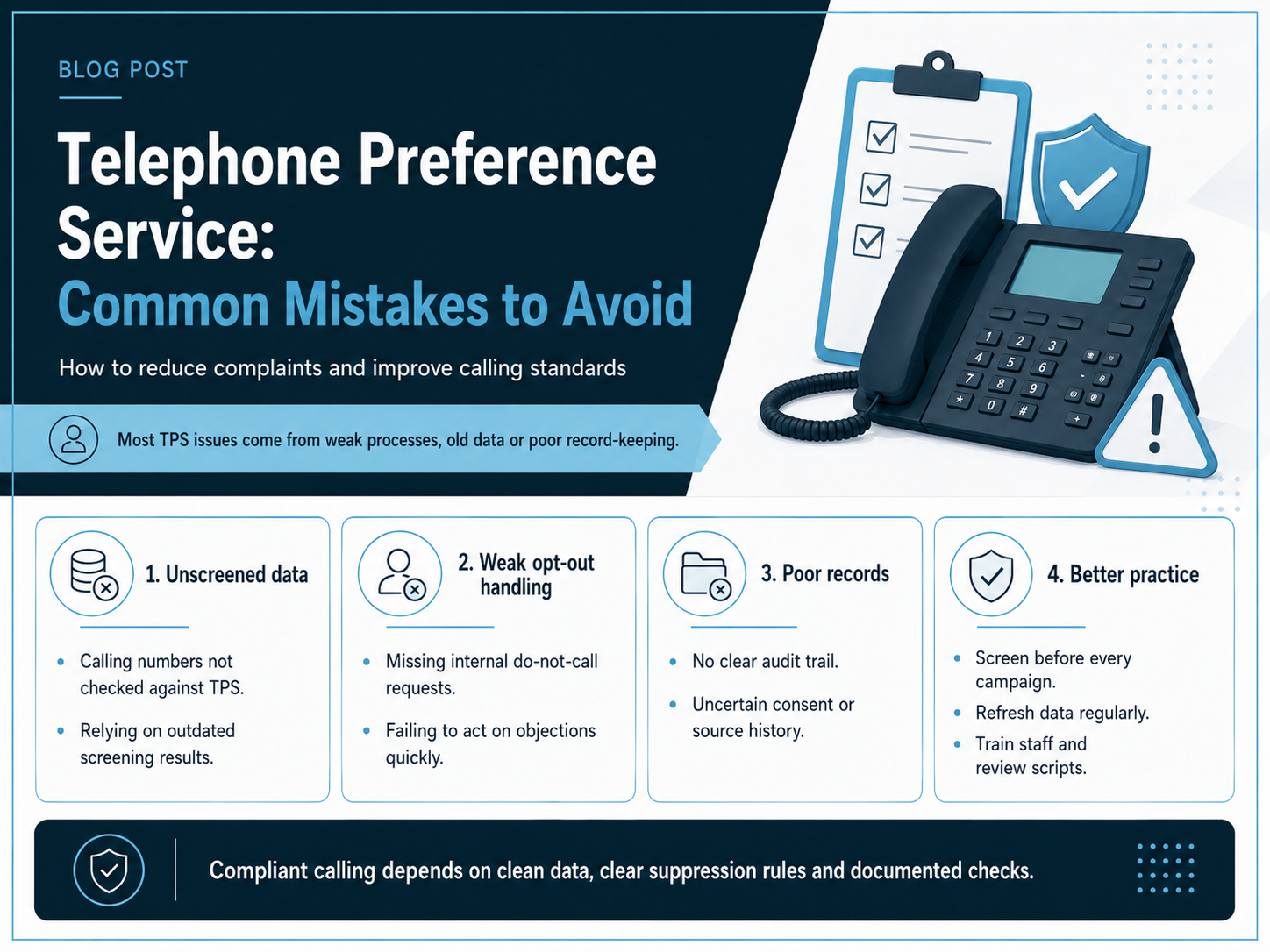
One common mistake is relying entirely on a supplier’s assurance. A third-party data provider may say a file has been TPS screened, but the organisation making or instigating the calls still needs confidence that screening was done properly and recently. The ICO advises checks on third-party calling arrangements and supplier responsibilities.
Another mistake is forgetting the internal do-not-call list. TPS and CTPS are not the only suppression sources. If someone has told your organisation not to call, that objection must be respected even if the number is not on TPS.
A third mistake is assuming public data is fair game. A telephone number being publicly available or appearing in a directory does not override TPS, CTPS or a previous objection.
A fourth mistake is treating existing customers as automatically callable. Existing customers may still be registered with TPS, may have opted out, or may not reasonably expect a marketing call. Consent and objections need to be recorded clearly.
A fifth mistake is failing to identify the caller. The ICO says live marketing callers must say who is calling, display their number or an alternative contact number, and provide a contact address or freephone number if asked.
A Practical TPS Compliance Workflow for Data-led Teams
A strong TPS workflow should be simple enough for teams to follow and robust enough to stand up to scrutiny.
Start by defining the campaign. Is it a live marketing call, an automated call, a service call, a research call or another type of contact? Different rules may apply depending on the purpose and content of the call.
Next, classify the audience. Are you calling individuals, sole traders, partnerships, limited companies, public bodies or mixed B2B data? If the audience is mixed, do not rely on a single register unless you are sure it is sufficient.
Then screen the data. Apply TPS, CTPS where relevant, and your own internal suppression lists. Remove or suppress numbers that should not be contacted. Keep a record of the screening date, source, file name and outcome.
After that, check consent exceptions. If you plan to call a TPS-registered number because you believe you have specific consent, confirm that the consent is valid, recorded and linked to that organisation, channel and number.
Before launch, brief callers. Agents should know who they are calling on behalf of, how to identify the organisation, how to handle objections, how to record opt-outs, and how to escalate complaints.
Finally, monitor the campaign. Track opt-outs, complaints, invalid numbers, call outcomes and any supplier issues. Feed this data back into your CRM and suppression processes.
TPS Compliance and Customer Trust
Telephone marketing still has a role in many UK organisations, especially where human conversation helps qualify demand, explain complex services or support account-based selling. But calling only works when it is backed by disciplined data governance.
TPS compliance supports trust in three ways. It respects stated preferences, reduces unwanted contact and helps organisations avoid wasteful outreach. It also gives marketing and sales teams cleaner inputs, which improves productivity and reduces reputational risk.
A well-managed telephone database should be accurate, permission-aware and regularly screened. It should show not only who can be contacted, but why they can be contacted, when the data was checked and what restrictions apply.
For data-led teams, that level of control is not bureaucracy. It is what makes outbound activity scalable.
How AccuraData can Support Compliant Telephone Marketing
AccuraData helps organisations improve the quality, usability and compliance-readiness of their marketing data. For teams using telephone data, that means building processes that support accurate targeting, appropriate suppression and better campaign governance.
The Telephone Preference Service should not be treated as a last-minute obstacle before a calling campaign. It should be part of the data workflow from the moment telephone data enters the business.
With the right data management approach, organisations can reduce risk, improve calling efficiency and give sales teams cleaner, more reliable records to work from.
Final thoughts on the Telephone Preference Service
The Telephone Preference Service is central to responsible UK telephone marketing. It gives individuals a way to opt out of unsolicited live sales and marketing calls, and it gives organisations a clear compliance obligation.
The key points are straightforward. Screen against TPS and CTPS where relevant. Keep your own do-not-call list. Do not rely on stale checks or public availability. Record consent properly. Respect objections immediately. Make sure every supplier, sales team and contact centre understands the rules.
Telephone marketing depends on trust. The organisations that take TPS compliance seriously are better placed to protect that trust, reduce complaints and run more effective data-led campaigns.