
CEO Email Addresses can be valuable when your business needs to speak to the people who shape budgets, strategy and supplier decisions. For many B2B campaigns, a general inbox or junior contact is not enough. If your product or service affects the direction of a company, the decision is often influenced by the CEO, managing director, owner, founder, finance director or another senior decision-maker. Having accurate direct contact details helps your outreach start closer to the person with authority, rather than passing through layers of generic routing, old contacts or unsuitable departments.
This does not mean every campaign should go straight to the chief executive, and it does not mean that senior contacts should be approached without care. Good outreach to CEOs and directors depends on relevance, timing, data quality and responsible use. It also depends on compliance. A named work email address can still be personal data, even when it relates to a business role. That means organisations need to understand UK GDPR, PECR, unsubscribe management and data sourcing before they use CEO email data for sales or marketing.
This article explains why direct CEO and director email addresses matter, where they can come from, how they can benefit your business, what compliance checks should sit around them and how AccuraData can help supply targeted, verified B2B Email Data for campaigns that need to reach senior business contacts.
Why CEO Email Addresses Matter in B2B Prospecting
The main reason businesses look for CEO Email Addresses is simple: the senior contact can influence whether a supplier is considered at all. In smaller companies, the CEO, managing director or owner may be directly involved in almost every meaningful purchase. In larger organisations, the CEO may not approve every supplier, but they can influence priorities, budgets and the internal importance of a problem. When a message speaks to strategic outcomes, such as cost reduction, risk management, growth, compliance, operational efficiency or competitive advantage, a senior recipient may be the right starting point.
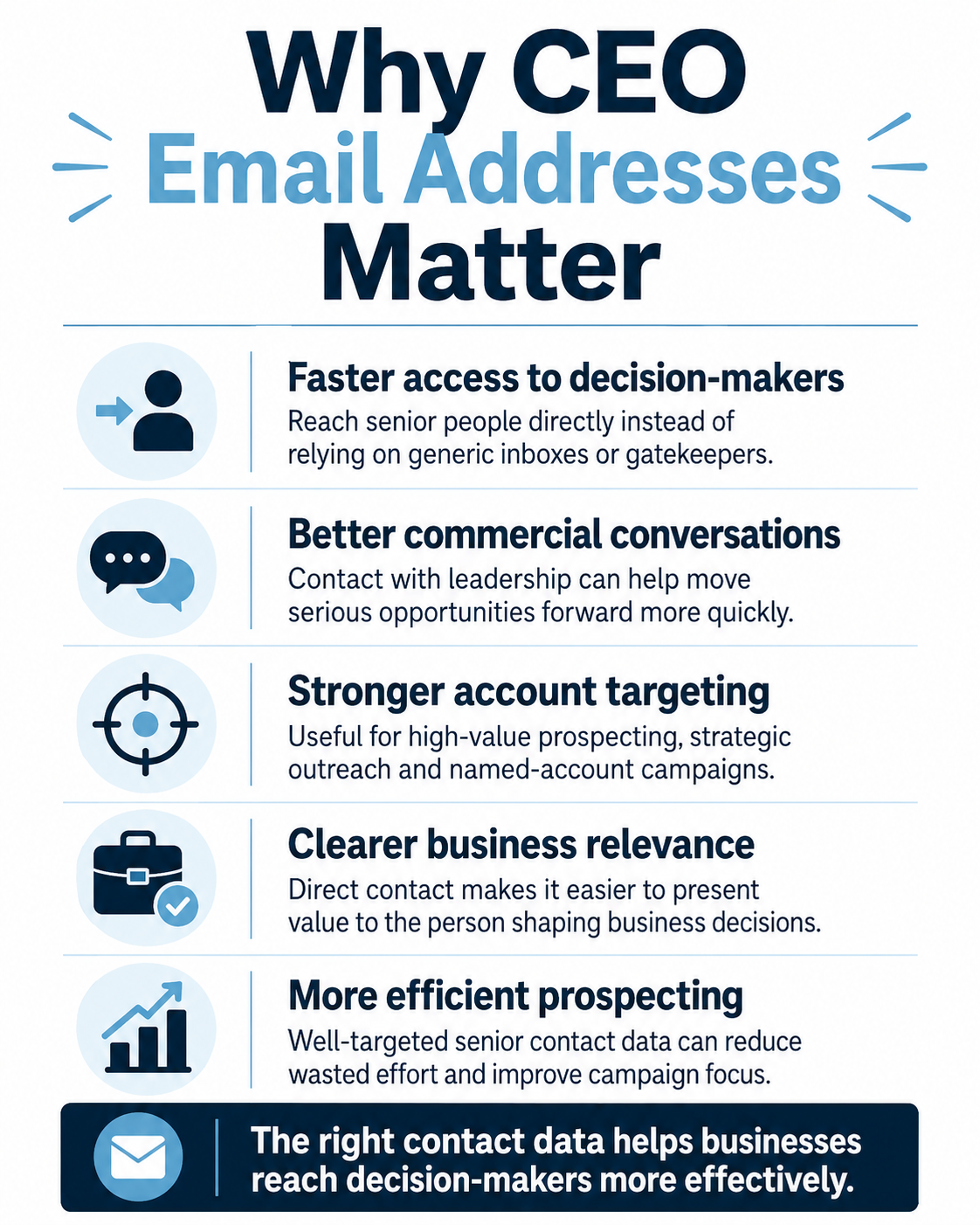
Modern B2B buying is rarely the responsibility of one person. Forrester research reported that the average business buying decision involves many people and often crosses more than one department. This makes CEO outreach useful in a specific way. It is not always about asking the CEO to make the whole decision. It is often about gaining visibility, securing internal sponsorship, asking for direction to the right team or positioning your business as relevant to a wider organisational problem.
A direct CEO or director email address can also reduce waste. If your message is sent only to generic inboxes, it may be filtered by administrative teams, ignored by departments that do not own the need or forwarded too late to influence a decision. A named executive contact gives your team a clearer route into the account. It also allows better personalisation because you know the role and likely commercial priorities of the recipient.
Senior outreach is especially important for businesses selling higher-value services, professional advice, software, consultancy, finance, facilities, recruitment, training, energy solutions, outsourced support, data services or other products where the buyer needs confidence in the supplier. Harvard Business Review has also written about the need for a clear strategy when selling to CEOs, which reflects a practical reality: senior decision-makers are busy, but they can be receptive when the message is relevant, concise and commercially credible. The key is to use C-suite strategy, not volume-led noise.
What Counts as a CEO or Director Email Address?
A CEO email address usually means a direct business email address for the person who holds the most senior executive position in a company. In UK campaigns, the relevant senior contact might also be listed as managing director, founder, owner, partner, director, chief executive, principal, practice owner or senior partner. The right title depends on the size and structure of the business.
It is also useful to separate direct email addresses from generic email addresses. A generic address might be info@, sales@, enquiries@ or office@. These can still be useful for some campaigns, but they do not give you the same route to a named decision-maker. A direct address, such as a named business mailbox, allows your message to reach a specific person. It can support personalisation by role, industry, location and company size.
Direct contact does not remove the need for judgement. In some companies, the CEO is not the best first contact for a specific campaign. If you sell HR software, the HR director may be the better route. If you sell finance automation, the finance director may be more relevant. If you sell construction materials, the procurement director or operations director may be the right person. CEO Email Addresses are most powerful when they are part of a wider decision-maker strategy, not when they are treated as a universal shortcut.
Public business information can help identify directors and company officers. The Companies House register provides free company information, including officer information and registered office details. However, publicly available company records are not the same as permission to use any contact detail for any purpose. Companies House explains that some director details are public, including name and service address, while other details are private. This distinction matters when building or buying a marketing database, because a lawful data source still needs proper purpose, transparency and responsible processing.
How Direct CEO Contact Details Benefit Your Business
The first benefit is targeting. A campaign aimed at chief executives can be built around executive-level problems rather than general product features. Instead of writing about a list of functions, your message can explain how you help with growth, risk, operational drag, lost revenue, missed opportunities, compliance exposure or inefficient processes. This gives your outreach a sharper commercial focus.
The second benefit is speed. A direct senior contact can reduce the number of internal handoffs required before your proposition is assessed. If the CEO is not the correct owner, a relevant and well-written message may still prompt a referral to the right person. That can be more useful than waiting for a generic inbox to decide whether your message matters.
The third benefit is account quality. CEO and director email data is often used when the target market is more important than the total volume of records. A smaller, better-selected audience of senior contacts can be more useful than a large untargeted database. For example, a software company selling into manufacturing firms may need 500 well-matched managing directors and operations leaders more than 20,000 mixed contacts across unrelated sectors.
The fourth benefit is better alignment between sales and marketing. If marketing builds campaigns around named senior roles and sales follows up with the same account context, the customer journey feels more joined up. This is one reason businesses use structured B2B email lists rather than relying only on ad impressions or broad industry directories. The list gives the team a defined market to approach, measure and improve.
The fifth benefit is improved measurement. When you know the role, sector, location, company size and campaign segment for each senior contact, you can evaluate which audiences responded. You can see whether chief executives responded differently from finance directors, whether owner-managed businesses engaged more than corporates, or whether certain sectors produced more replies. Over time, this helps refine your ideal customer profile.
Where CEO Email Addresses Can Come From
There are several lawful and practical routes to building a database of CEO and director email addresses. The right route depends on your budget, timeframe, compliance requirements and whether you need a small list of named accounts or a broader market selection.
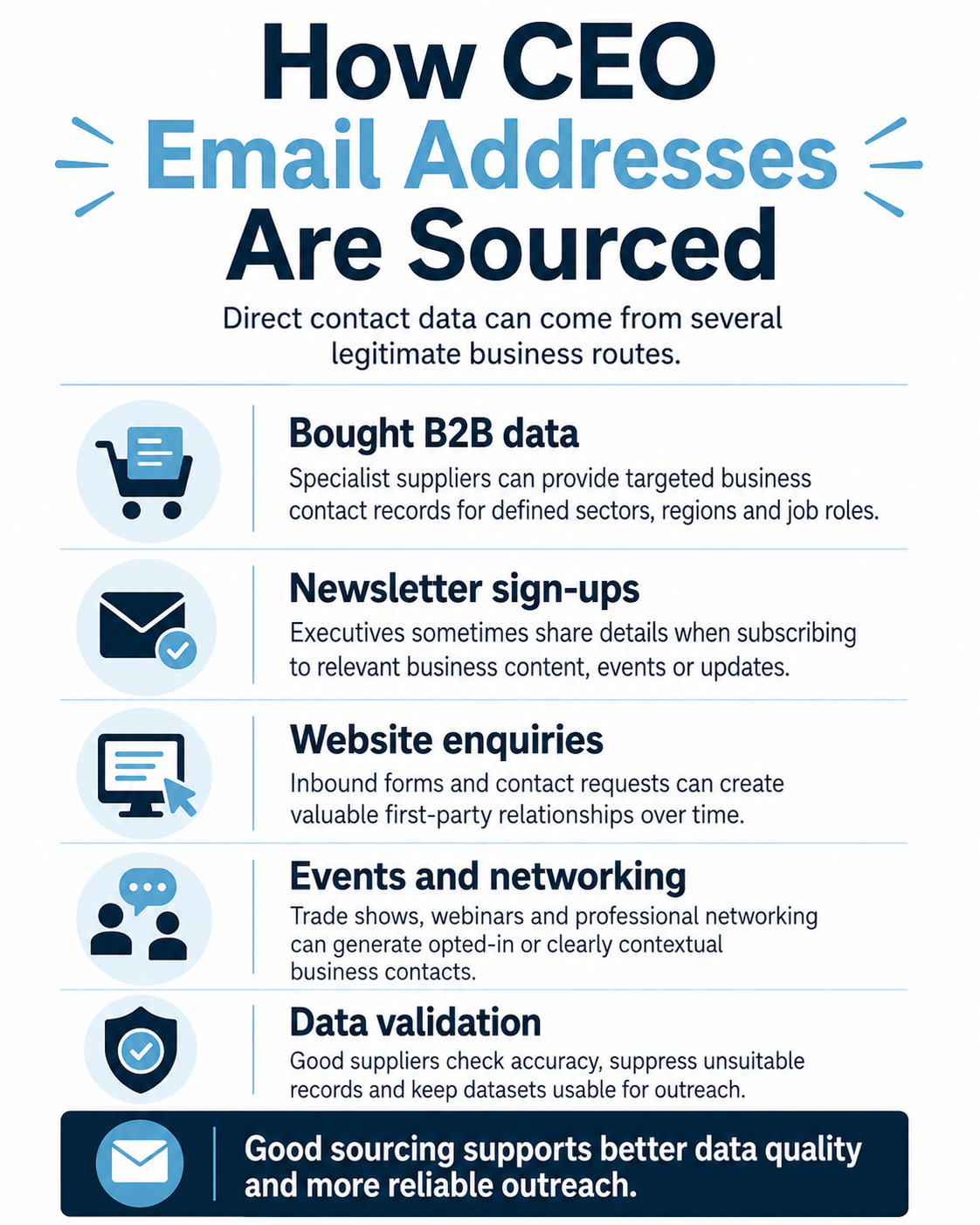
The first route is first-party data. This means contacts gathered through your own business activity, such as enquiries, customers, event registrations, webinar sign-ups, gated content downloads, sales conversations and newsletter subscriptions. First-party data can be highly valuable because the relationship is already known. It still needs to be managed carefully, with privacy information, opt-out options and appropriate records of source and consent or lawful basis. The ICO’s guidance on direct marketing planning is useful here because it encourages organisations to think about compliance before campaigns begin, not after data has already been collected.
The second route is newsletter subscriptions. A newsletter sign-up can create a clear route to regular communication, but the wording at the point of collection matters. People should understand what they are signing up to, who will contact them and how they can unsubscribe. If you plan to send sales-led messages as well as editorial updates, make that clear. A vague “keep me updated” box is weaker than a clear explanation of the type of emails the person will receive.
The third route is account research. Sales and marketing teams often build target account lists from public company information, trade directories, event attendee lists, professional networks and sector research. This can help identify the right companies and titles, but it does not automatically provide a verified email address. Manual research can also be slow. It is useful for account-based marketing, but it may not be efficient for a wider market campaign.
The fourth route is purchased B2B data. A supplier can provide targeted CEO, director or senior decision-maker email addresses based on your campaign criteria. This can be faster than building a database internally, especially if you need coverage across sectors, regions or company sizes. The quality of the provider matters. A good supplier should explain data sourcing, verification, segmentation, suppression and the compliance basis for use. AccuraData’s B2B Data and email list services are designed to support targeted UK business outreach with data that can be selected around sector, role, geography and campaign objectives.
The fifth route is customer and CRM enrichment. If you already have company records but lack senior contact details, enrichment can add missing roles, job titles, direct emails, telephone numbers or postal information where available. This can be useful when your internal database has grown over time but is incomplete. AccuraData can support businesses that need a cleaner, more usable database before launching a targeted campaign.
Bought CEO Email Lists: What to Look For
A bought list is only useful if it is accurate, relevant and suitable for your intended use. The lowest-cost supplier is not always the best option. Poor data can create bounced emails, irrelevant outreach, complaints and wasted sales time. It can also damage sender reputation if too many records are invalid or poorly matched to the campaign.
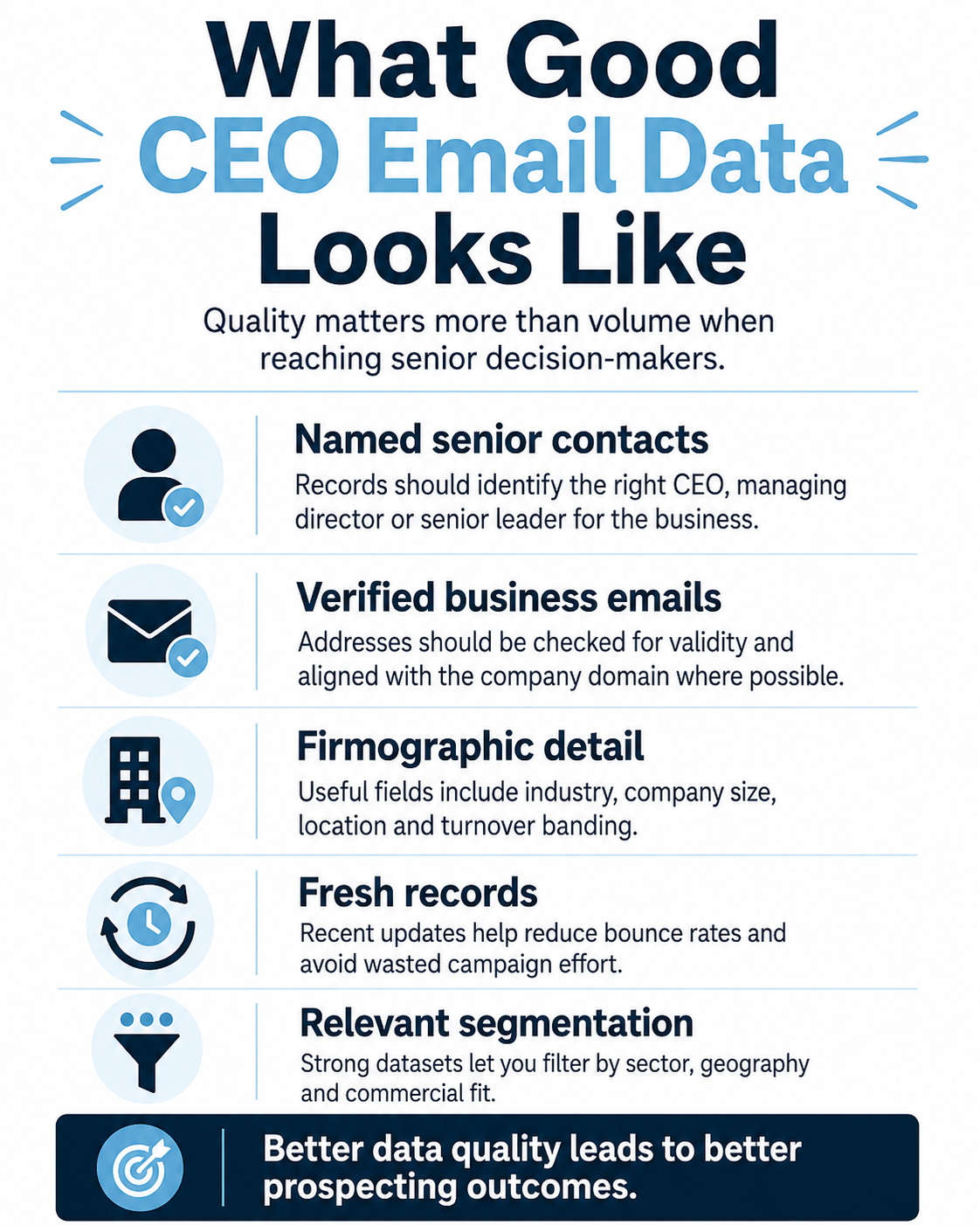
When reviewing a supplier, start with relevance. Ask whether the data can be selected by sector, company size, turnover band, location, seniority, job title, decision-maker type and other firmographic criteria. CEO Email Addresses should not be sold as a generic mass file if your campaign is aimed at a defined market. If your target audience is owner-managed engineering firms in the Midlands, the list should reflect that. If you want CEOs of fast-growing technology companies, the selection should be built around that profile.
Next, look at data quality. A good CEO email list should include fields that make the campaign practical. These can include first name, surname, job title, company name, company website, industry, location, phone where relevant, postal address where relevant and date or source indicators. AccuraData’s guidance on business email data explains why a useful business list needs more than just an email column. The richer the record, the easier it is to segment, personalise and report.
Verification is also important. Email addresses change when people move jobs, companies restructure or domains are updated. A list that looked accurate last year may be weak today. Strong suppliers should validate business emails before supply and should remove obvious bad records, duplicates and unsuitable contacts. This is especially important for senior contacts because they often have gatekeeping systems, stricter mailbox filtering and lower tolerance for irrelevant campaigns.
Finally, check documentation. You should understand how the data can be used, what suppression has been applied, what contract terms govern delivery and what privacy obligations sit with your business as the campaign sender. The DMA Code is useful as a broader ethical framework for responsible data and marketing practice, because it links trust with effectiveness. In practice, that means buying data should not be treated as a quick spreadsheet purchase. It should be treated as part of a controlled marketing process.
Newsletter Subscriptions and First-Party CEO Data
Many businesses prefer first-party data because it is collected directly through their own channels. A CEO who subscribes to your newsletter, downloads a guide, registers for a webinar or asks for a consultation has created a clearer relationship with your business than a cold prospect. This can improve relevance and make future outreach easier to justify.
However, first-party data still needs governance. You should record where the contact came from, what the person was told at the time, what they subscribed to and whether they have opted out later. You should also keep your privacy information clear and easy to find. If you collect a director’s email address for one purpose and later use it for a different type of marketing, consider whether that use is still fair and expected.
A practical approach is to build newsletter subscriptions into a wider database strategy. A newsletter can attract senior readers by offering useful insight, not simply sales messages. For example, a business selling compliance software might send practical updates about regulatory changes. A consultancy might share board-level operational advice. A training provider might publish leadership and workforce development insights. The goal is to earn attention before asking for a meeting.
Bought CEO email data and first-party subscriptions can also work together. Purchased data can help you reach a carefully selected market for an initial campaign. Engagement signals from that campaign can then feed a first-party nurture process. People who click, reply, request information or subscribe can move into a warmer audience segment. AccuraData’s Email Marketing Services can support this type of activity, including campaign preparation, broadcast delivery, reporting and warm prospect identification.
Compliance Considerations for CEO Email Addresses
Compliance is central to any campaign using CEO Email Addresses. In the UK, two areas matter most for email marketing: PECR and UK GDPR. PECR covers rules for electronic marketing, while UK GDPR applies when you process personal data. A named business email address usually identifies a person, so UK GDPR should be considered even when the email address is used in a work context.
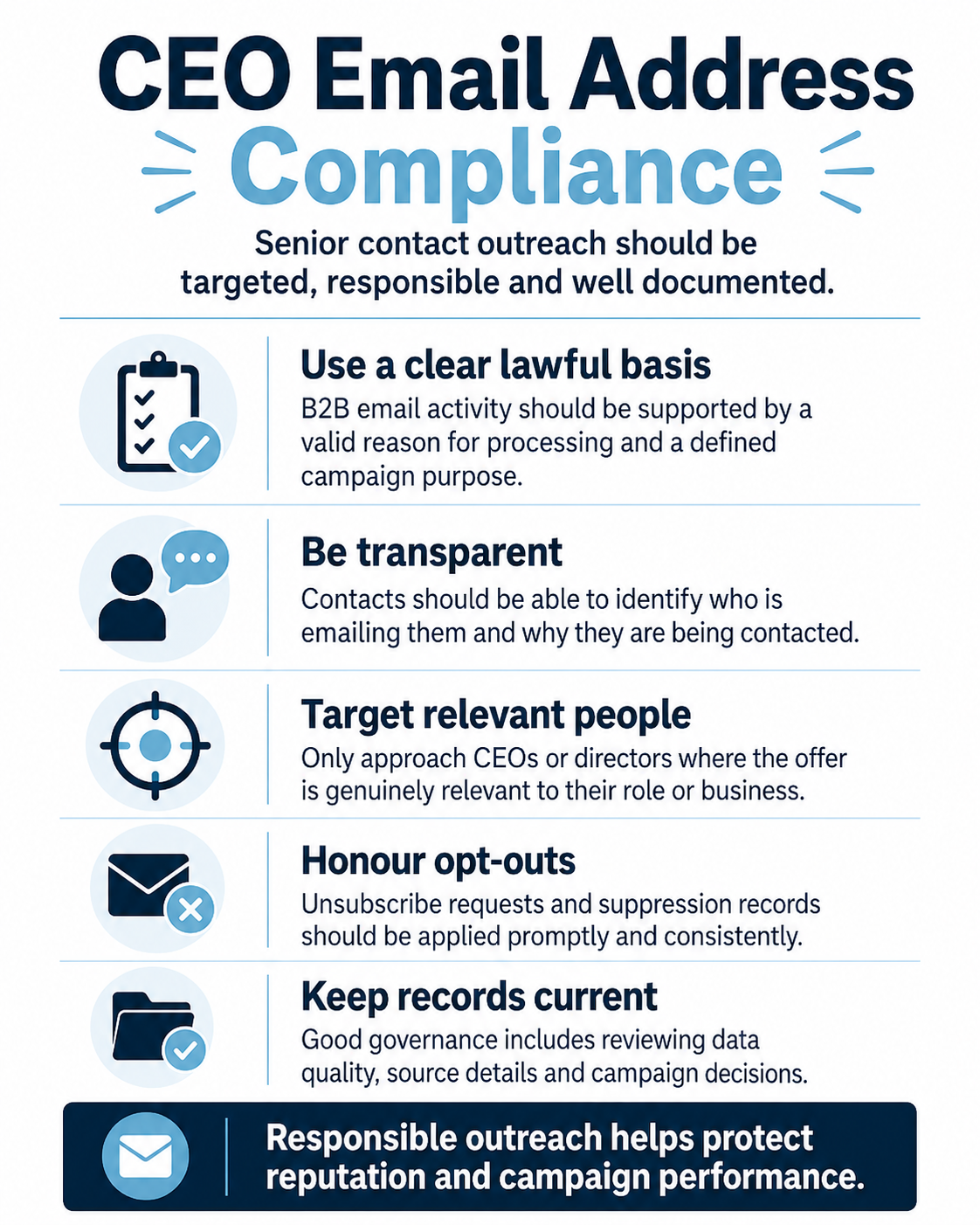
The ICO’s B2B marketing guidance explains that the PECR rule on direct marketing by electronic mail does not apply to corporate subscribers. This means that B2B marketing emails can be sent to corporate bodies without PECR consent. However, the sender must still identify itself, provide contact details and give the recipient a way to opt out. UK GDPR also still applies where personal data is involved.
The position is different for individual subscribers, which can include sole traders and some partnerships. The ICO’s email marketing rules explain that marketing emails to individuals generally require specific consent unless the soft opt-in applies. This matters because some CEO and owner contacts may be attached to very small businesses, sole traders or partnerships. A responsible supplier and sender should understand the difference between limited companies, corporate bodies and individual subscribers.
Legitimate interests may be a suitable lawful basis for some B2B marketing activity, but it is not automatic. The ICO’s legitimate interests guidance explains that direct marketing may be a legitimate interest, depending on the circumstances. A business should consider the purpose of the campaign, whether the processing is necessary and whether the person’s interests, rights and expectations override the business interest. Many organisations document this through a Legitimate Interest Assessment.
Good compliance also means keeping suppression records. If a CEO, director or company asks not to receive further emails, that request must be respected. Suppression does not mean deleting all evidence of the person immediately if you need to retain a minimal record to avoid contacting them again. It means keeping enough information to honour the opt-out while avoiding unnecessary use of the data.
Security matters too. A CEO email database is a business asset and a privacy responsibility. It should be stored securely, shared only with appropriate users and protected against unauthorised access. The NCSC small business guidance gives practical cyber security advice that is relevant to any organisation handling customer or prospect data. This includes protecting accounts, devices, backups and systems that hold business information.
How to Use CEO Email Addresses Without Damaging Trust
Reaching a CEO directly creates an opportunity, but it also increases the need for care. Senior contacts receive many messages. A poor email can harm your reputation quickly, especially if it looks generic, exaggerated or irrelevant. The most effective use of CEO Email Addresses starts with a clear match between the recipient and the message.
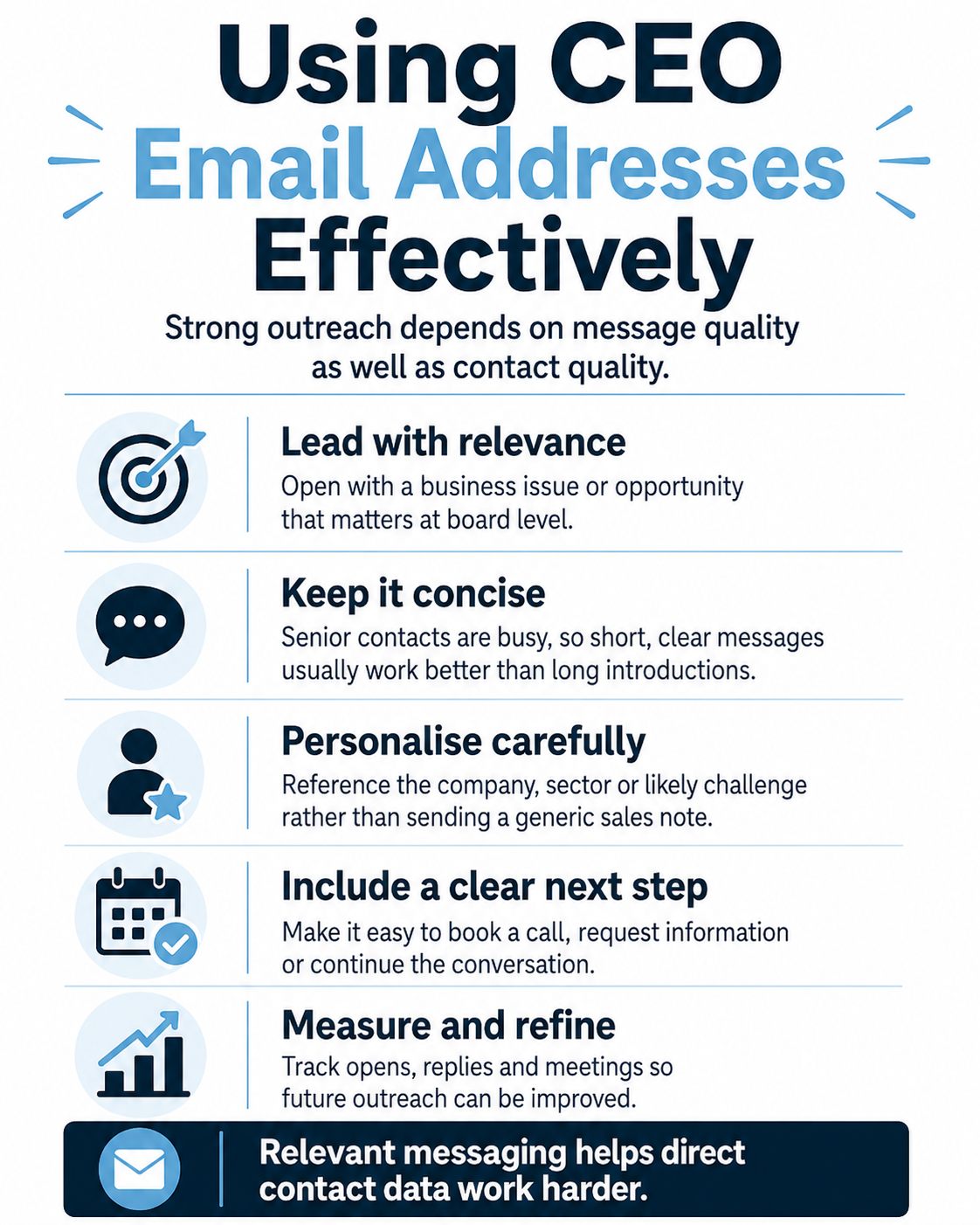
Begin with segmentation. Do not send the same message to every CEO in every sector. Split the database by industry, company size, location, need, offer type or likely pain point. A managing director of a manufacturing company is likely to care about different issues from the chief executive of a charity, a technology firm, a care provider or a professional services practice. Good segmentation makes the email more relevant and reduces the risk of complaints.
Next, write for a senior reader. CEOs usually do not need a long product description in the first email. They need to know why the issue matters, what business outcome is at stake and why the message is relevant to their organisation. Use plain English. Keep the opening concise. Avoid hype. The CAP Code is a useful reminder that marketing claims should not mislead or exaggerate performance. This is especially important when writing to senior decision-makers who are likely to judge credibility quickly.
Make the next step simple. A CEO may not want to book a full demonstration immediately. A softer call to action, such as asking whether the issue is relevant, offering to send a short summary or asking who owns the topic internally, can be more effective. The purpose of first contact is often to open a route into the organisation, not to close a sale in one message.
Be transparent. Identify who you are, the organisation you represent and why you are contacting them. Provide a clear unsubscribe option. Do not hide behind unclear sender names or misleading subject lines. The UK government’s direct marketing law guidance also stresses that marketing should be accurate, honest and follow advertising codes of practice.
Finally, measure the right things. Open rates and clicks can help, but replies, referrals, meetings, qualified opportunities and unsubscribes are more important. If a segment produces many opt-outs and no replies, review whether the audience is right. If a smaller segment produces senior-level conversations, use that insight to improve the next campaign. AccuraData’s article on email marketing campaigns covers the importance of planning, operating, measuring and improving campaigns rather than treating email as a one-off send.
How AccuraData Can Support CEO and Director Email Data
AccuraData can support businesses that need targeted CEO Email Addresses, director-level contacts and other senior B2B decision-maker data. The value is not simply in receiving a list. It is in defining the audience carefully, selecting relevant records, checking data quality and using the data in a way that supports responsible outreach.
For a typical project, AccuraData can help you identify the right market before the data is supplied. That may include sector, geography, company size, seniority, job function, trading status and other campaign criteria. This selection matters because CEO data is most useful when it is commercially relevant. A broad list of senior contacts may look impressive, but a smaller list of well-matched prospects is often more practical.
AccuraData’s B2B Email Data service can support campaigns that need verified business email contacts. The service is designed around UK-focused B2B data, flexible targeting and campaign relevance. For organisations that need broader customer acquisition support, AccuraData can also provide managed email campaign services, helping with the journey from audience selection through to reporting.
This combined approach is useful for businesses that want to avoid the gap between buying a dataset and running a successful campaign. A list on its own does not write the email, structure the offer, manage suppression, plan follow-up or interpret performance. AccuraData’s managed email campaign support helps bridge that gap, especially for teams that do not have internal resource for campaign setup and delivery.
AccuraData also supports businesses at different stages of data maturity. Some clients need a new targeted list of CEOs or directors. Others already have a CRM but need enrichment, validation or segmentation. Others need campaign delivery support because they want the data and the marketing activity handled together. The article on building email databases explains why structure, source records and validation are so important before launching outreach.
A Practical Checklist Before You Use CEO Email Addresses
Before launching a campaign, make sure your team can answer a few practical questions. Who exactly are you trying to reach? Is CEO the right title, or would managing director, founder, finance director, operations director or owner be more relevant? What sectors, company sizes and regions are in scope? What makes the offer relevant to that audience? What lawful basis and PECR position applies? How will opt-outs be handled? Who will follow up replies?
You should also check data quality. Are the email addresses validated? Are job titles current enough for the campaign? Are company names, websites and locations included? Are duplicates removed? Are suppression files applied? Is there enough segmentation information to personalise the campaign? The more complete the record, the easier it is to create a campaign that feels relevant rather than random.
Review the message before sending. Does the subject line make sense to a senior reader? Is the opening specific? Does the email explain why the recipient has been contacted? Does it avoid exaggerated claims? Does it identify the sender clearly? Does it include a clear opt-out? If the email would look weak when forwarded internally, improve it before launch.
Plan the follow-up. Senior outreach often works best when email is part of a process rather than a single isolated message. You may need a short follow-up email, a call where appropriate, a useful resource, a landing page or a salesperson ready to respond quickly. AccuraData’s guidance on UK email data explains how targeted email lists work best when combined with planning, clean data and campaign support.
Conclusion
CEO Email Addresses can help B2B organisations reach senior decision-makers with greater precision. They can reduce wasted outreach, support account-based prospecting, improve sales and marketing alignment and help your message reach people who can influence budgets, priorities and supplier choices. The benefit is strongest when the data is accurate, the targeting is careful and the outreach is relevant.
They should not be used as a shortcut for poor marketing. Senior contacts expect clarity, relevance and professionalism. They also have privacy rights. Businesses using CEO or director email data should understand PECR, UK GDPR, legitimate interests, suppression, transparency and data security before sending campaigns. Good compliance is not a barrier to performance. It is part of building trust and protecting long-term results.
AccuraData can help businesses source targeted CEO and director email data as part of a wider B2B marketing strategy. Whether you need a carefully selected list of senior prospects, support enriching your CRM or help running the campaign through managed email marketing, AccuraData provides a practical route to better data, better targeting and more confident outreach.