
Introduction
Business to Business Telemarketing continues to play a central role in effective B2B lead generation strategies, even in a landscape that is increasingly dominated by digital marketing. While channels such as email, paid media and LinkedIn outreach have all evolved significantly, many organisations are finding that these approaches alone are no longer enough to consistently engage decision-makers.
The reality is that modern buyers are overwhelmed. Senior professionals receive a constant stream of emails, messages and notifications, most of which are ignored or filtered out before they are even seen. As competition for attention increases, the challenge is no longer just about visibility, but about meaningful engagement.
This is where Business telemarketing stands apart.
A well-timed and well-executed conversation can achieve what multiple emails often cannot. It allows businesses to connect directly with the right people, understand their needs in real time, and move opportunities forward with far greater clarity. When supported by accurate data and a clear strategy, B2B Telemarketing remains one of the most reliable ways to generate high-quality leads.
This guide explores how Business to Business telemarketing works in 2026, why it continues to deliver results, and how it fits into a modern, multi-channel marketing strategy.
What is Business to Business Telemarketing?
Business to Business Telemarketing refers to the structured process of contacting other businesses via telephone in order to generate interest, qualify prospects and support the sales pipeline. While the concept itself is straightforward, its execution in a modern B2B environment requires a far more strategic approach than in the past.
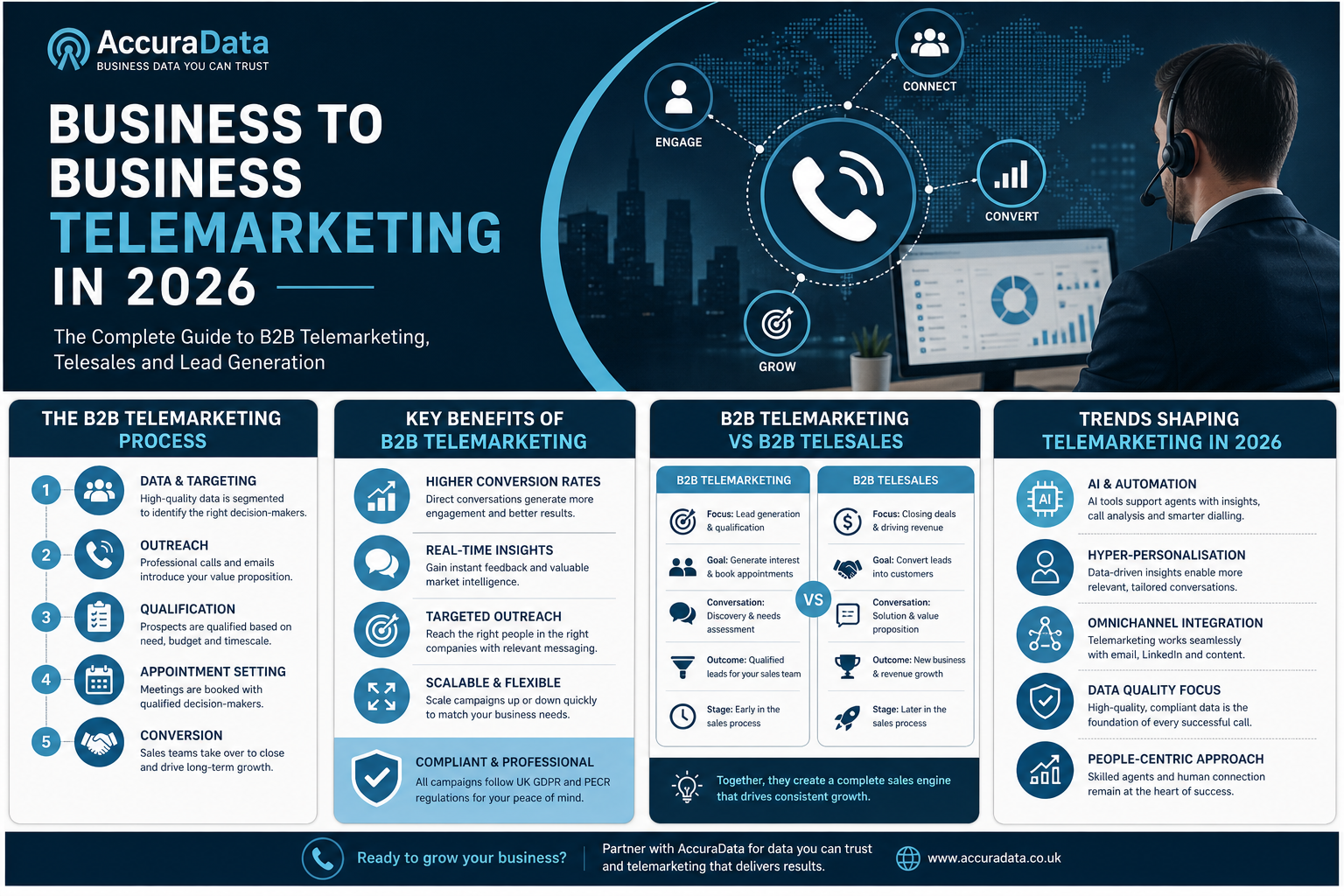
Unlike consumer telemarketing, which often relies on volume and short interactions, B2B Telemarketing is highly targeted. Campaigns are built around specific industries, company profiles and job roles, and conversations are typically more detailed and consultative in nature.
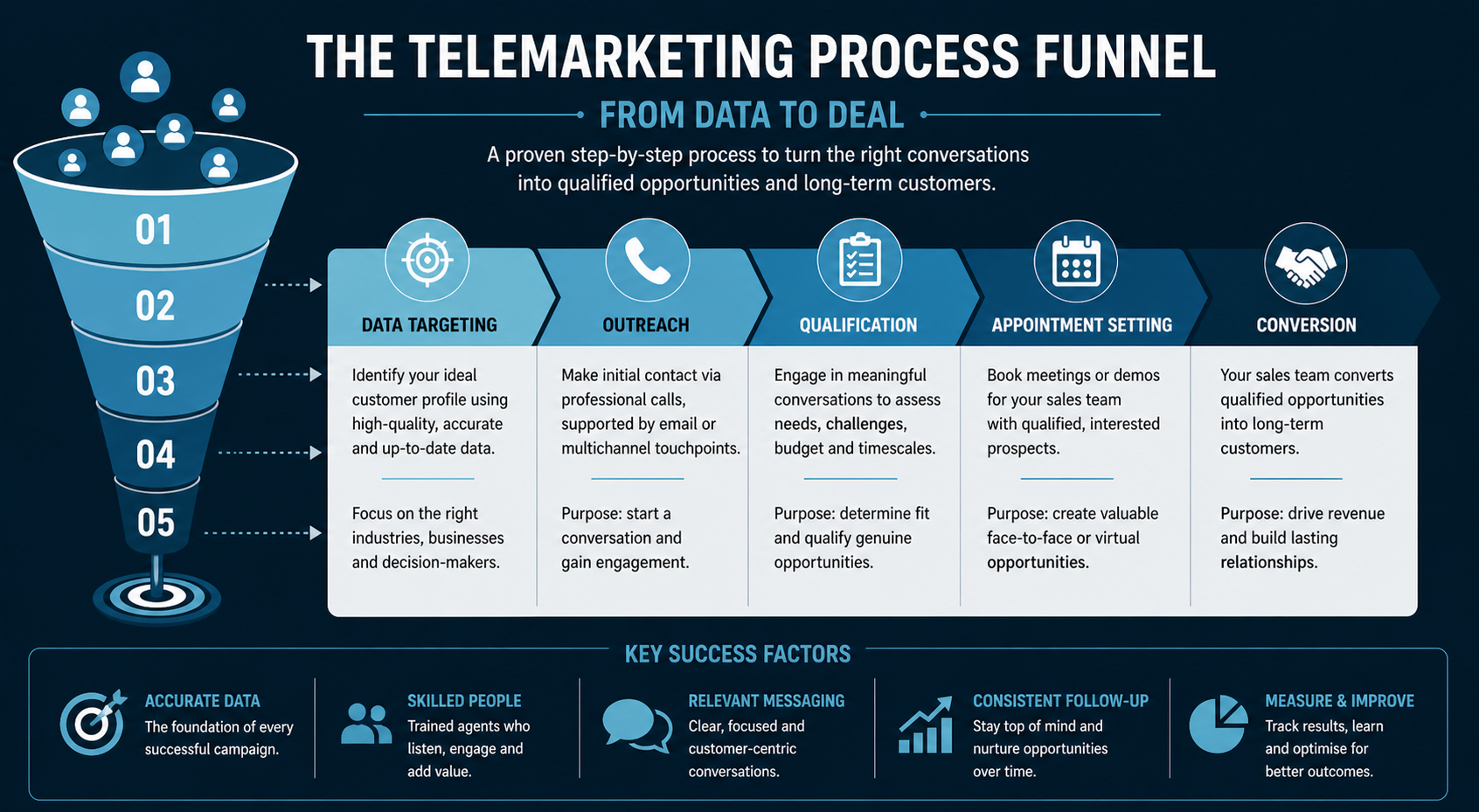
A typical Business to Business telemarketing campaign will involve:
- Identifying relevant organisations and contacts.
- Engaging with decision-makers or key stakeholders.
- Introducing a product or service in a relevant way.
- Exploring challenges and requirements.
- Qualifying whether there is a genuine opportunity.
- Booking appointments or next steps for the sales team.
In many cases, the objective is not to make an immediate sale, but to open the door to a more meaningful commercial discussion.
Closely linked to this is Business to Business telesales, which focuses on converting those qualified opportunities into revenue. While there is overlap between the two, they serve different purposes and require different approaches.
B2B Telemarketing vs B2B Telesales: Understanding the Difference
Although the terms are often used interchangeably, it is useful to distinguish between B2B Telemarketing and B2B Telesales, as each plays a specific role within the wider sales process.
B2B Telemarketing is primarily concerned with the early stages of engagement. Its purpose is to identify potential opportunities, initiate conversations and determine whether a prospect is worth pursuing further. This often involves asking questions, gathering information and building initial rapport.
B2B Telesales, on the other hand, takes over once a prospect has been qualified. The focus shifts towards presenting solutions, addressing objections and ultimately closing the deal. Conversations at this stage tend to be more commercially focused and may involve detailed discussions around pricing, implementation and value.
In practice, the most effective organisations do not treat these as separate silos. Instead, they align Business telemarketing and B2B telesales as part of a continuous process, ensuring that leads are smoothly transitioned from initial contact through to conversion.
Why Business to Business Telemarketing Still Works in 2026
Despite the growth of digital marketing, B2B Telemarketing continues to deliver strong results. The reasons for this are not difficult to understand once you consider how buyers behave today.
Direct Access to Decision-Makers
One of the biggest advantages of Business telemarketing is the ability to engage directly with decision-makers. While emails can be ignored or filtered out, a phone call creates an immediate opportunity for interaction.
This does not mean that every call will be successful, but it does mean that when contact is made, there is a genuine chance to have a meaningful conversation.
Real-Time Engagement and Adaptability
Unlike digital channels, which rely on pre-written messaging, telemarketing allows conversations to evolve in real time. Skilled agents can adjust their approach based on how the prospect responds, making the interaction far more relevant.
For example, if a prospect raises a specific challenge, the conversation can immediately shift to address that point. This level of flexibility is difficult to achieve through email alone.
Faster and More Accurate Qualification
Another key strength of B2B Telemarketing is the speed at which prospects can be qualified. Within a single conversation, it is often possible to determine:
- Whether the prospect is a good fit.
- Whether there is a genuine need.
- Whether there is budget or intent.
- Whether the timing is right.
This helps sales teams focus their efforts on the opportunities that are most likely to convert.
Stronger Relationship Building
In B2B markets, relationships matter. Buyers are more likely to engage with organisations they trust, and trust is built through interaction.
A professional and well-informed conversation can leave a far stronger impression than a series of emails. Over time, this helps build familiarity and credibility.
Access to Valuable Market Insight
Every telemarketing conversation provides feedback. Even when a prospect is not interested, they may share information about their current situation, priorities or challenges.
This insight can be used to refine messaging, improve targeting and strengthen future campaigns.
The Evolution of Business to Business Telemarketing
Business telemarketing has changed significantly over the past decade. What was once seen as a volume-driven activity has become far more focused and strategic.
From High Volume to High Relevance
In the past, success was often measured by the number of calls made. Today, the focus has shifted towards the quality of those calls.
Modern B2B Telemarketing campaigns prioritise:
- Accurate targeting.
- Relevant messaging.
- Meaningful conversations.
This shift reflects a broader change in how businesses approach lead generation.
The Growing Importance of Data
B2B Data now sits at the centre of every successful campaign. Without accurate and up-to-date information, even the best telemarketing strategy will struggle to deliver results.
Organisations are investing more heavily in:
- Verified contact data.
- Segmented databases.
- Data enrichment tools.
This allows them to reach the right people with greater precision.
Integration with Digital Channels
B2B Telemarketing is no longer a standalone activity. Instead, it is increasingly integrated with other marketing channels to create a more cohesive approach.
For example, a typical campaign might include:
- An initial email to introduce the offering.
- A LinkedIn connection request to build familiarity.
- A follow-up call to engage directly.
This multi-touch approach increases the chances of success.
A Stronger Focus on Compliance
Regulations such as UK GDPR and PECR have reshaped how businesses approach telemarketing. Compliance is no longer optional, and organisations must take care to ensure that their activities are both lawful and transparent.
This includes:
- Using and sourcing data responsibly.
- Respecting opt-out preferences.
- Maintaining accurate records.
While this adds complexity, it also encourages better practices and higher-quality data.
The Role of a B2B Telemarketing Agency
For many organisations, building an in-house telemarketing function is not always practical. This is where a B2B Telemarketing Agency can provide significant value.
A Business to Business telemarketing agency brings together the people, processes and technology needed to run effective campaigns. Rather than starting from scratch, businesses can tap into existing expertise and infrastructure.
What Does a B2B Telemarketing Agency Provide?
While services vary, most agencies will offer a combination of:
- Campaign planning and strategy development.
- Data sourcing and audience segmentation.
- Script and messaging development.
- Call execution by trained agents.
- Reporting and performance analysis.
In many cases, they will also integrate telemarketing with other channels, ensuring a consistent approach across all touchpoints.
Benefits of Working with a B2B Telemarketing Agency
There are several reasons why businesses choose to work with an external partner rather than build an internal team.
Access to Experienced Professionals
Telemarketing requires a specific skill set. Experienced agents understand how to manage conversations, handle objections and engage senior decision-makers effectively.
Reduced Operational Complexity
Recruiting, training and managing a team takes time and resources. Outsourcing removes much of this burden, allowing businesses to focus on their core activities.
Scalability and Flexibility
Campaign requirements can change over time. A B2B Telemarketing Agency provides the flexibility to scale activity up or down as needed.
Faster Time-to-Market
With established systems and processes already in place, agencies can launch campaigns more quickly than most in-house teams.
Building a Successful Business Telemarketing Strategy
A successful campaign does not happen by chance. It requires careful planning, clear objectives and consistent execution.
Defining Your Target Audience
Everything begins with understanding who you are trying to reach. The more clearly defined your audience is, the more effective your campaign will be.
This typically involves considering factors such as:
- Industry sector.
- Company size and structure.
- Job roles and responsibilities.
- Geographic location.
The Importance of Data Quality for Business to Business Telemarketing
Even the best strategy will struggle without reliable data. Outdated or inaccurate information leads to missed opportunities and wasted effort. You should cleanse your data to validate your phone numbers. TPS checking and CTPS checking will also be important.
High-quality data improves:
- Contact rates.
- Engagement levels.
- Overall campaign efficiency.
Developing a Clear Value Proposition
When speaking to a prospect, clarity is essential. They need to understand quickly:
- What you offer.
- Why it matters.
- How it can help them.
Overly complex messaging can reduce engagement, so it is important to keep communication focused and relevant.
Training and Preparation
Whether your team is internal or external, preparation makes a significant difference. Agents should have a clear understanding of the product or service, as well as the market they are operating in.
This helps them communicate more confidently and handle conversations more effectively.
Measuring Performance
Tracking performance allows you to understand what is working and where improvements can be made.
Common metrics include:
- Contact rate.
- Conversion rate.
- Appointments booked.
- Cost per lead.
Regular analysis ensures that campaigns continue to improve over time.
Compliance in Business to Business Telemarketing
Compliance is a critical consideration for any organisation operating in the UK.
Regulations such as UK GDPR and the Privacy and Electronic Communications Regulations set out how businesses can collect, store and use data for marketing purposes. It also governs the rights of data subjects.
Key principles include:
- Ensuring there is a lawful basis for processing data.
- Keeping data accurate and up to date.
- Respecting opt-out requests.
- Handling data securely.
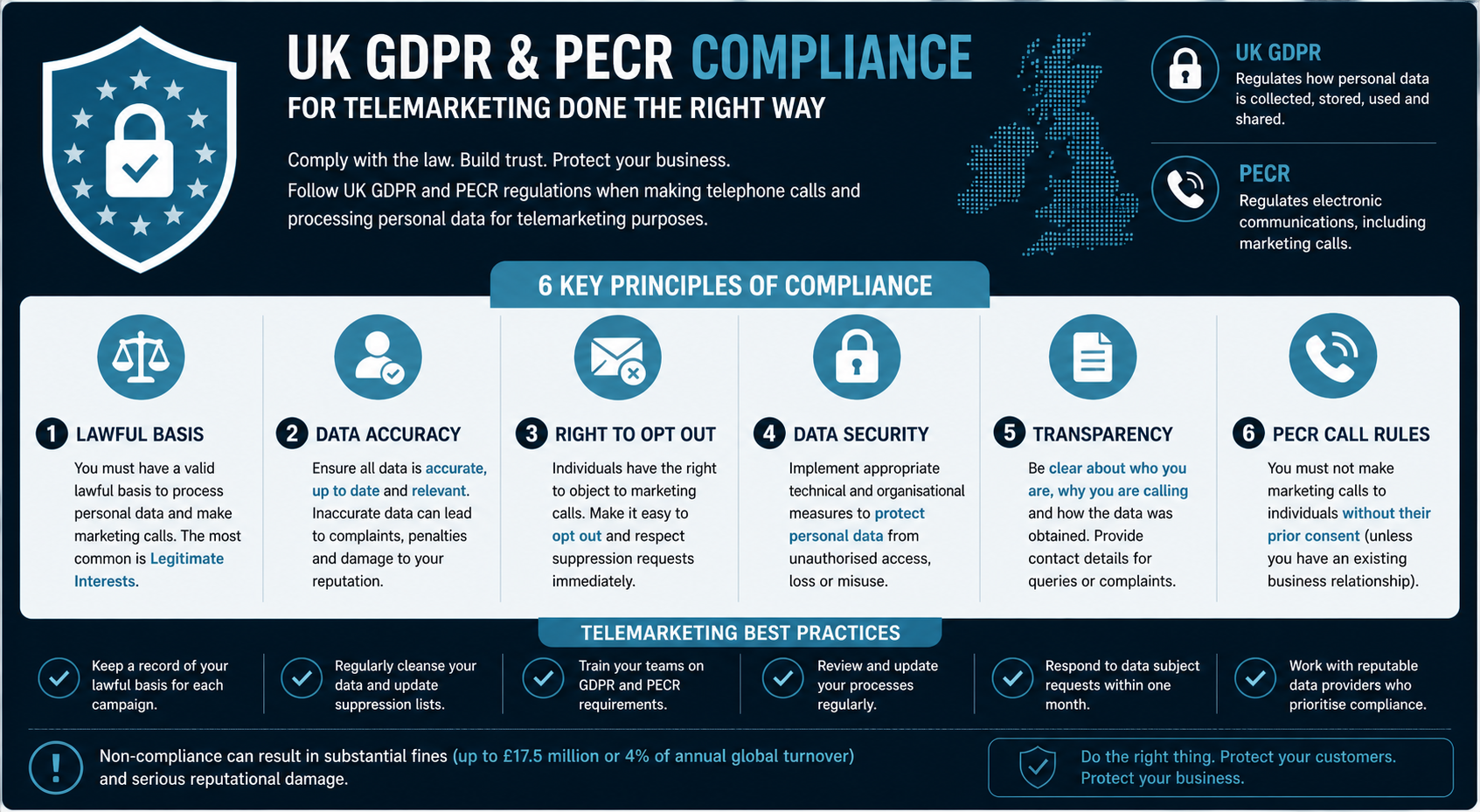
While compliance can seem complex, it is an essential part of building trust and maintaining a professional reputation.
Integrating Telemarketing with Other Channels
Business to Business Telemarketing is most effective when it is part of a broader marketing strategy rather than a standalone activity.
Email marketing can be used to introduce a message before a call is made. LinkedIn can help establish familiarity with prospects. Content marketing can build credibility and provide useful context.
When these channels are combined, they create a more consistent and engaging experience.
Common Challenges in B2B Telemarketing
Like any marketing channel, telemarketing comes with its own set of challenges, reaching decision-makers is not always straightforward, particularly in larger organisations where gatekeepers play a role. Data accuracy is an ongoing issue, as contact details and job roles change frequently. Engagement levels can vary depending on how well the campaign is targeted and how relevant the messaging is.
Finally, B2B sales cycles are often longer, which means persistence and follow-up are essential.
Advanced B2B Telemarketing Strategy
As Business to Business Telemarketing has matured, the gap between average campaigns and high-performing ones has become increasingly clear. It is no longer enough to simply have a list of contacts and a script. The organisations that consistently generate results are those that approach telemarketing as a strategic, data-led discipline rather than a tactical activity.
One of the most important developments in recent years has been the move towards deeper segmentation. Rather than grouping prospects into broad categories, businesses are now analysing audiences at a much more detailed level. This includes considering factors such as buying intent, recent company activity, industry-specific challenges and even the technology a business is currently using.
This level of insight allows telemarketing teams to approach each conversation with context. Instead of delivering a generic message, they can reference relevant challenges and tailor their approach accordingly. As a result, conversations feel more natural and are far more likely to resonate.
Another key area of development is message positioning. Different stakeholders within the same organisation often have very different priorities. A finance director may be focused on cost control and efficiency, while a marketing leader may be more concerned with lead generation performance. A sales director, on the other hand, is likely to be focused on pipeline growth and conversion rates.
Understanding these differences and adapting messaging accordingly can significantly improve engagement. It shifts the conversation away from a one-size-fits-all pitch and towards something that feels genuinely relevant.
Timing and consistency also play a crucial role. Successful Business telemarketing campaigns rarely rely on a single point of contact. Instead, they follow a structured cadence that may include multiple calls, supporting emails and other touchpoints over a period of time. This approach recognises that most prospects will not respond immediately, and that building engagement often requires persistence.
B2B Telesales: Turning Opportunity into Revenue
While B2B Telemarketing is responsible for creating opportunities, B2B Telesales is where those opportunities are converted into revenue. The transition between the two stages is critical, and when managed effectively, it can have a significant impact on overall performance.
Business to Business telesales involves a deeper level of engagement than initial outreach. Conversations tend to be longer and more detailed, with a stronger focus on the commercial aspects of the offering. This may include discussing pricing, implementation, timelines and expected outcomes.
The skills required at this stage are different. While telemarketing relies heavily on curiosity and questioning, telesales requires a greater emphasis on persuasion and negotiation. Professionals working in this area need to be able to communicate value clearly, handle objections with confidence and guide the conversation towards a decision.
Equally important is the alignment between telemarketing and telesales teams. If qualification criteria are unclear or inconsistent, there is a risk that unqualified leads will be passed through, which can waste time and reduce conversion rates. On the other hand, if the criteria are too strict, valuable opportunities may be missed.
The most effective organisations take the time to define what a qualified lead looks like and ensure that both teams are working towards the same objectives. This creates a smoother transition and improves the overall efficiency of the sales process.
Measuring Campaign Effectiveness
Understanding how well a Business to Business Telemarketing campaign is performing requires more than just tracking activity. While the number of calls made can provide some indication of effort, it does not tell the full story. What matters is the outcome of those calls.
A number of key metrics can be used to assess performance. Contact rate is one of the most fundamental, as it measures how often calls result in actual conversations. This is influenced heavily by data quality and timing.
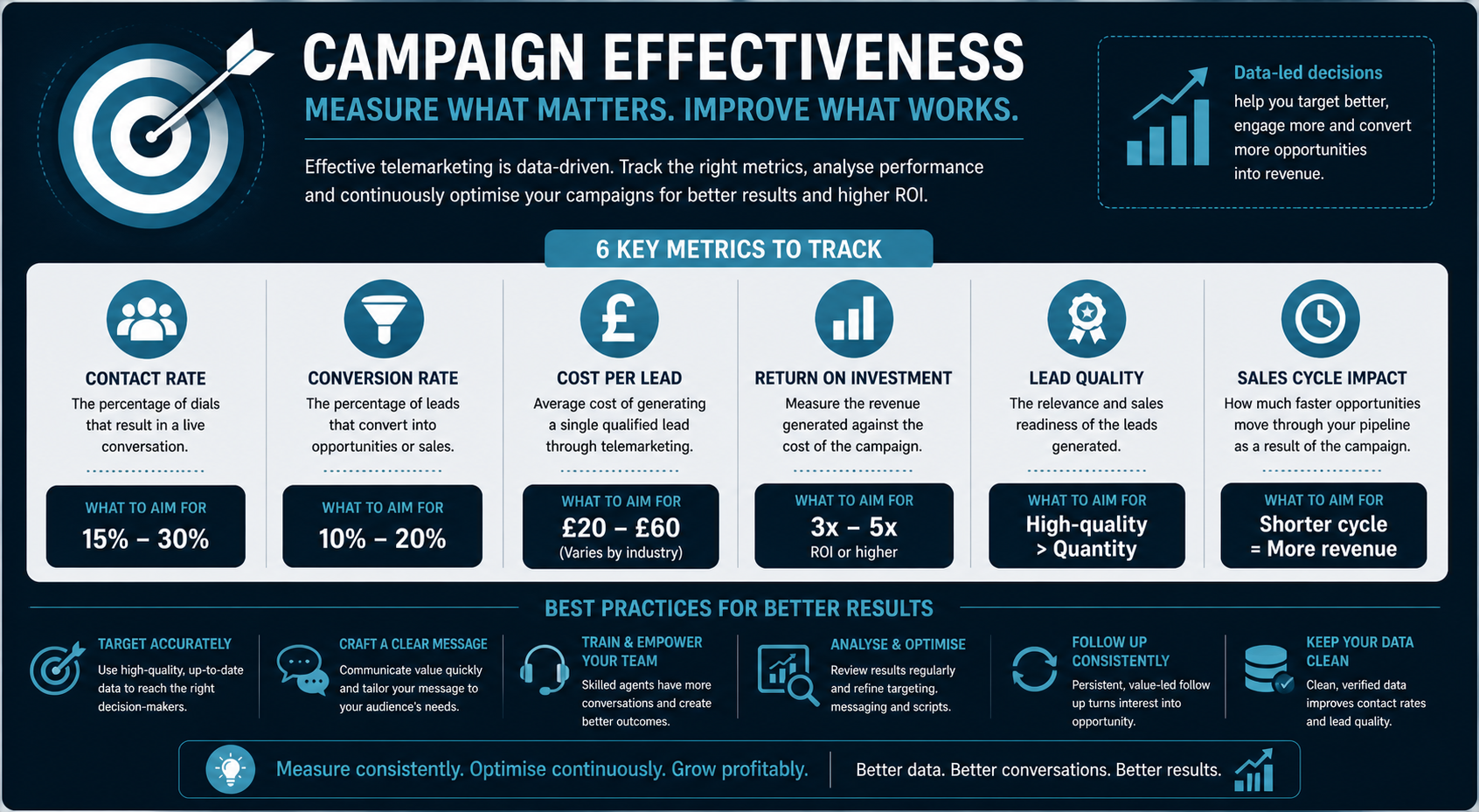
Conversion rate provides a clearer picture of effectiveness by showing how many of those conversations lead to a desired outcome, such as a qualified lead or an appointment. This is often seen as one of the most important indicators of success.
Cost per lead helps businesses understand the efficiency of their campaign by comparing the total cost against the number of leads generated. When viewed alongside return on investment, it provides a useful measure of overall profitability.
Lead quality is another critical factor. Not all leads are equal, and a smaller number of highly relevant opportunities is often far more valuable than a larger number of low-quality ones. This is why close collaboration between marketing and sales teams is so important.
Improving campaign performance is an ongoing process. It typically involves refining targeting, testing different messaging approaches and investing in training. Over time, these incremental improvements can have a significant impact.
The Role of Data in Business Telemarketing
Data sits at the heart of every successful Business telemarketing campaign. Without accurate and up-to-date information, even the most well-planned strategy will struggle to deliver results.
High-quality data improves almost every aspect of performance. It increases the likelihood of reaching the right person, makes conversations more relevant and reduces wasted effort. In contrast, poor data can lead to low contact rates, frustrated agents and missed opportunities.
One of the challenges businesses face is data decay. Contact details change, people move roles and organisations evolve. This means that data which was accurate a year ago may no longer be reliable.
To address this, businesses need to take a proactive approach to data management. This may involve regular cleansing, updating records and working with trusted data providers. While this requires investment, the impact on campaign performance is often significant.
The Importance of a Multi-Channel Approach
Business to Business Telemarketing is most effective when it forms part of a wider, integrated marketing strategy. Relying on a single channel is rarely sufficient, particularly in competitive markets.
A multi-channel approach allows businesses to engage prospects in different ways and at different stages of the buying journey. For example, an initial email can introduce a concept, while a LinkedIn interaction can build familiarity. A follow-up call can then bring everything together in a more direct conversation.
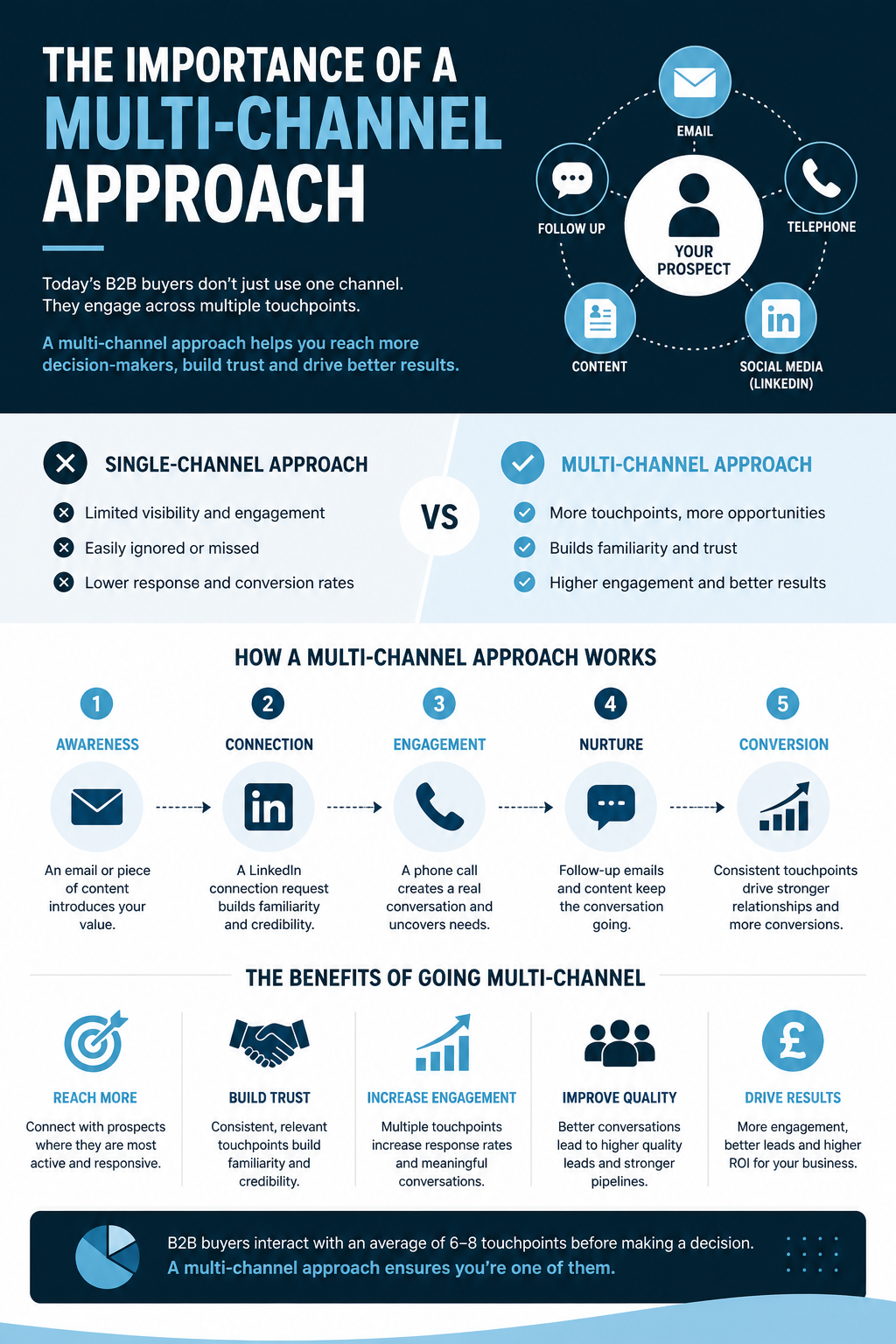
This combination of touchpoints creates a more cohesive experience. Prospects are more likely to recognise the organisation and understand its offering, which in turn makes them more receptive to engagement.
It also provides multiple opportunities to connect. If a prospect does not respond to an email, they may still engage via a phone call. If they are not available by phone, they may respond to a LinkedIn message at a later stage.
Common Mistakes to Avoid
Despite its effectiveness, Business telemarketing can underperform if certain common mistakes are not addressed.
One of the most frequent issues is an over-reliance on rigid scripts. While having a structure is important, conversations that feel overly scripted can come across as unnatural and disengaging. Skilled agents use scripts as a guide rather than a strict framework.
Another common challenge is poor data quality. Outdated or inaccurate contact information can significantly reduce contact rates and waste valuable time. Investing in reliable data is essential.
Lack of follow-up is also a major factor. Many prospects will not respond to the first attempt, and without a structured follow-up process, opportunities can be lost.
Finally, weak or unclear messaging can limit engagement. If a prospect does not quickly understand the value being offered, they are unlikely to continue the conversation.
Choosing the Right B2B Telemarketing Agency
For organisations that choose to outsource, selecting the right B2B Telemarketing Agency is a critical decision. The right partner can enhance performance significantly, while the wrong choice can lead to disappointing results.
Experience is one of the first factors to consider. Agencies that have worked across multiple industries are often better equipped to adapt their approach and handle different types of conversations.
Data quality is equally important. An agency should be able to demonstrate that it uses reliable and compliant data sources, as this underpins the success of any campaign.
Transparency is another key consideration. Clear reporting allows businesses to understand what is happening and identify areas for improvement.
Flexibility also matters. Campaigns may need to evolve over time, and a good Business to Business telemarketing agency should be able to adapt accordingly.
Finally, there is the question of cultural fit. The agency will be representing your brand, so it is important that their approach aligns with your values and tone.
Compliance as a Competitive Advantage
While compliance is often seen as a regulatory requirement, it can also provide a competitive advantage. Businesses that handle data responsibly and respect customer preferences are more likely to build trust.
Following UK GDPR and PECR guidelines ensures that data is managed properly, but it also encourages better practices overall. Clean, accurate data leads to more relevant conversations, which in turn improves engagement.
In this sense, compliance is not just about avoiding risk. It is about creating a stronger, more sustainable approach to marketing.
The Future of Business to Business Telemarketing
Looking ahead, Business to Business Telemarketing is likely to continue evolving in response to changes in technology and buyer behaviour.
Artificial intelligence is already playing a role in supporting telemarketing teams. It can provide insights into call performance, suggest improvements and help identify patterns within data. However, it is unlikely to replace human interaction entirely. The ability to build rapport and adapt in real time remains a uniquely human skill.
Personalisation will continue to become more important. As data becomes more detailed, businesses will be expected to deliver increasingly relevant conversations. Generic outreach will become even less effective.
Integration with other channels will also deepen. Telemarketing will form part of a broader ecosystem that includes digital marketing, content and automation.
Despite these changes, the core principle will remain the same. Success will come from connecting with the right people, understanding their needs and delivering value through conversation.
Conclusion
Business to Business Telemarketing remains one of the most effective and adaptable tools available to B2B organisations in 2026. While the channels surrounding it continue to evolve, its core strength has not changed. It enables direct, meaningful engagement with decision-makers.
When supported by accurate data, clear messaging and a structured approach, B2B Telemarketing delivers consistent, measurable results. It helps businesses generate high-quality leads, improve sales efficiency and build stronger relationships.
For organisations looking to strengthen their lead generation strategy, Business telemarketing offers a proven path forward. Whether delivered internally or through a specialist B2B Telemarketing Agency, it continues to provide a clear and reliable route to growth.