
UK B2B Email Lists are often treated as if they are simply collections of business email addresses. That description is technically convenient and commercially incomplete. A useful list does more than give a company somewhere to send an email. It connects a defined group of UK organisations with the people most likely to influence a purchase, records enough information to explain why those contacts belong in the audience, and gives marketing and sales teams a controlled way to turn market coverage into conversations.
That distinction matters because email performance is usually decided before the first message is written. If the audience is too broad, the campaign will sound generic. If the job roles are wrong, even a perfectly delivered email reaches the wrong people. If the records are stale, bounce rates rise and sender reputation suffers. If the supplier mixes corporate subscriber data with sole traders, ordinary partnerships or personal email addresses without making the distinction clear, the legal route changes. If the sales team does not follow up positive replies quickly, the list may generate interest without generating revenue.
The most useful way to think about UK B2B Email Lists is therefore as a route from a target account to a qualified reply. The data has to identify the right organisation, the right contact, the right email address, the correct subscriber type, the source of the record and the campaign context. The sending setup has to protect deliverability. The message has to be relevant enough to earn attention. Then the response has to flow into a sales process that can act on it.
This guide focuses exclusively on business email activity in the UK. It explains how UK B2B Email Lists can be built, purchased, validated, segmented, maintained and activated. It also explains how UK GDPR, PECR and the Data Protection Act 2018 fit together, including a point that is frequently misunderstood: a named work email address can be personal data under UK GDPR even when PECR treats the email account as part of a corporate subscriber. It also explains why personal email addresses inside a supposedly B2B file should be treated with caution.
The article then moves beyond compliance into execution. It covers the fields that make business email data useful, how to evaluate a provider, how to choose software without breaching a platform’s own terms, how to authenticate a sending domain, how to structure tests, how to improve positive reply rates and how to maintain the list after the campaign. AccuraData’s B2B Data and B2B Email Data services can support businesses that need targeted UK company and decision-maker coverage, while Data Cleansing & Enrichment and Data Appending can improve records that are already held internally.
A short compliance note is important. This article provides practical marketing and data-management information, not legal advice. The correct legal position depends on the facts, including the identity of the subscriber, how the data was obtained, the purpose of the campaign, the type of organisation being contacted and the way personal data is processed. Current guidance from the Information Commissioner’s Office should be checked where the position is uncertain.
UK B2B Email Lists Start with Accounts, Not Addresses
A business email address only becomes useful when it is connected to a commercial reason for contacting the organisation. This is the first major difference between a strong B2B list and a generic file of addresses.
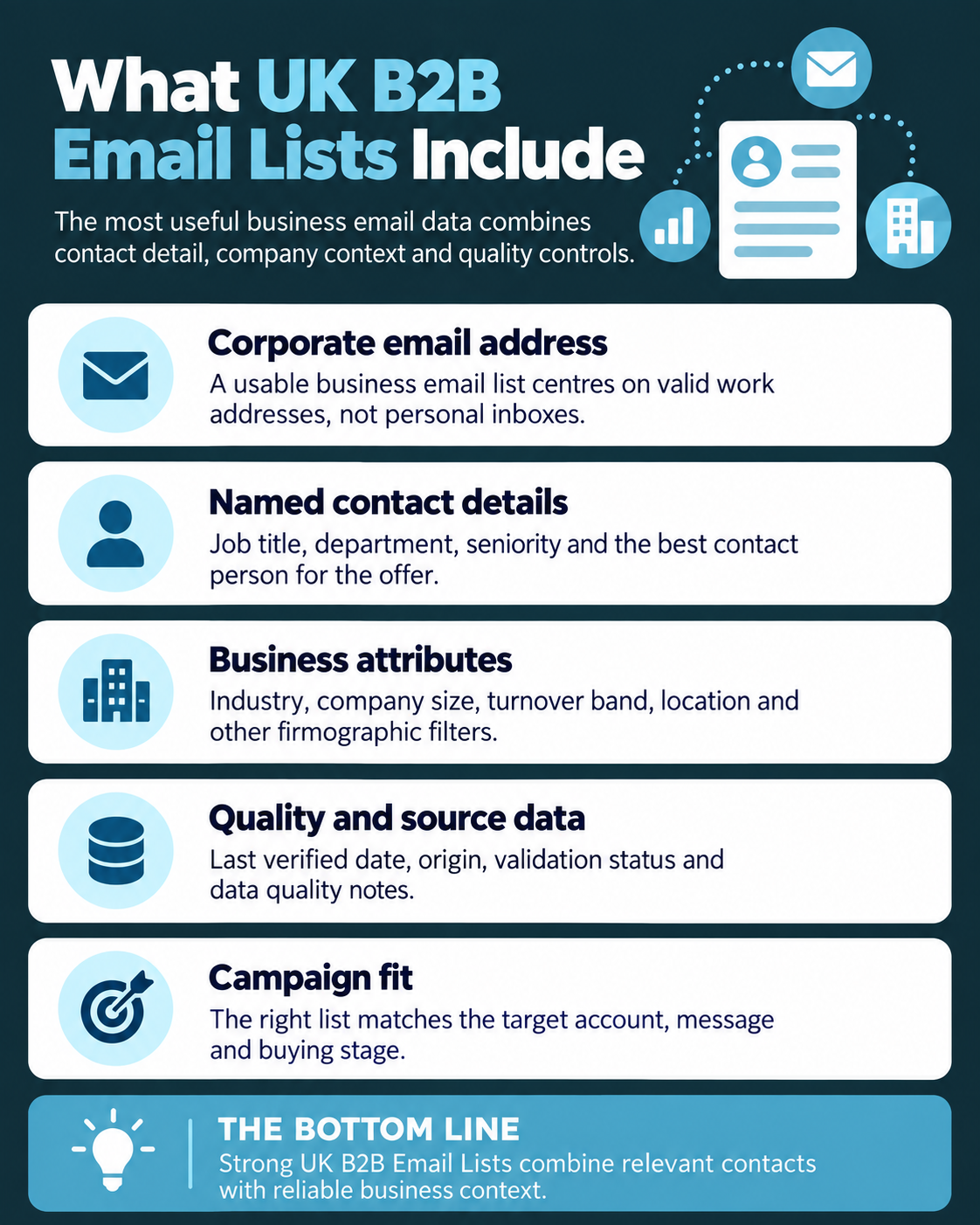
Imagine two datasets. The first contains 100,000 business email addresses with little information beyond company name and email. The second contains 12,000 contacts mapped to companies in a defined sector, with location, employee count, turnover band, job function, seniority, source, verification date and account status. The larger file may look more impressive in a quotation, but the smaller one is usually easier to segment, easier to govern and easier to turn into a credible campaign.
For that reason, the best UK B2B Email Lists begin with the account universe. Decide which companies fit the proposition before selecting people inside them. Useful account criteria can include industry, geography, employee count, turnover, ownership type, number of sites, trading status and other firmographic fields that genuinely change the likelihood of fit.
The next decision is contact depth. Some products can be sold effectively through one obvious decision-maker. Others involve several functions. A software purchase might involve operations, IT, finance and procurement. A workplace service might involve facilities, HR, operations and a managing director. A financial proposition might require the finance director, owner or commercial lead. If the list contains only one person per company, coverage can look complete while the buying group remains largely unmapped.
A stronger model records job function and seniority separately from the raw job title. Job titles vary widely between organisations, while functions such as Finance, HR, Marketing, Operations, IT and Procurement remain more stable. Seniority bands also help avoid sending an executive-level proposition to a junior administrator simply because the title contains a relevant keyword.
This account-first approach gives the marketing team a clearer question to answer: not “How many addresses can we buy?” but “How much of our target market can we reach through relevant business contacts?” That change in question improves supplier briefs, campaign segmentation and sales follow-up.
AccuraData’s article on an email list of businesses explores the wider value of market coverage. This guide goes further into the operating controls that should sit between the market definition and the actual email send.
Corporate Subscribers, Individual Subscribers and Personal Data
UK B2B email compliance becomes much easier to understand when three ideas are kept separate: the organisation being targeted, the subscriber type under PECR, and whether the email address is personal data under UK GDPR.
What is a corporate subscriber?
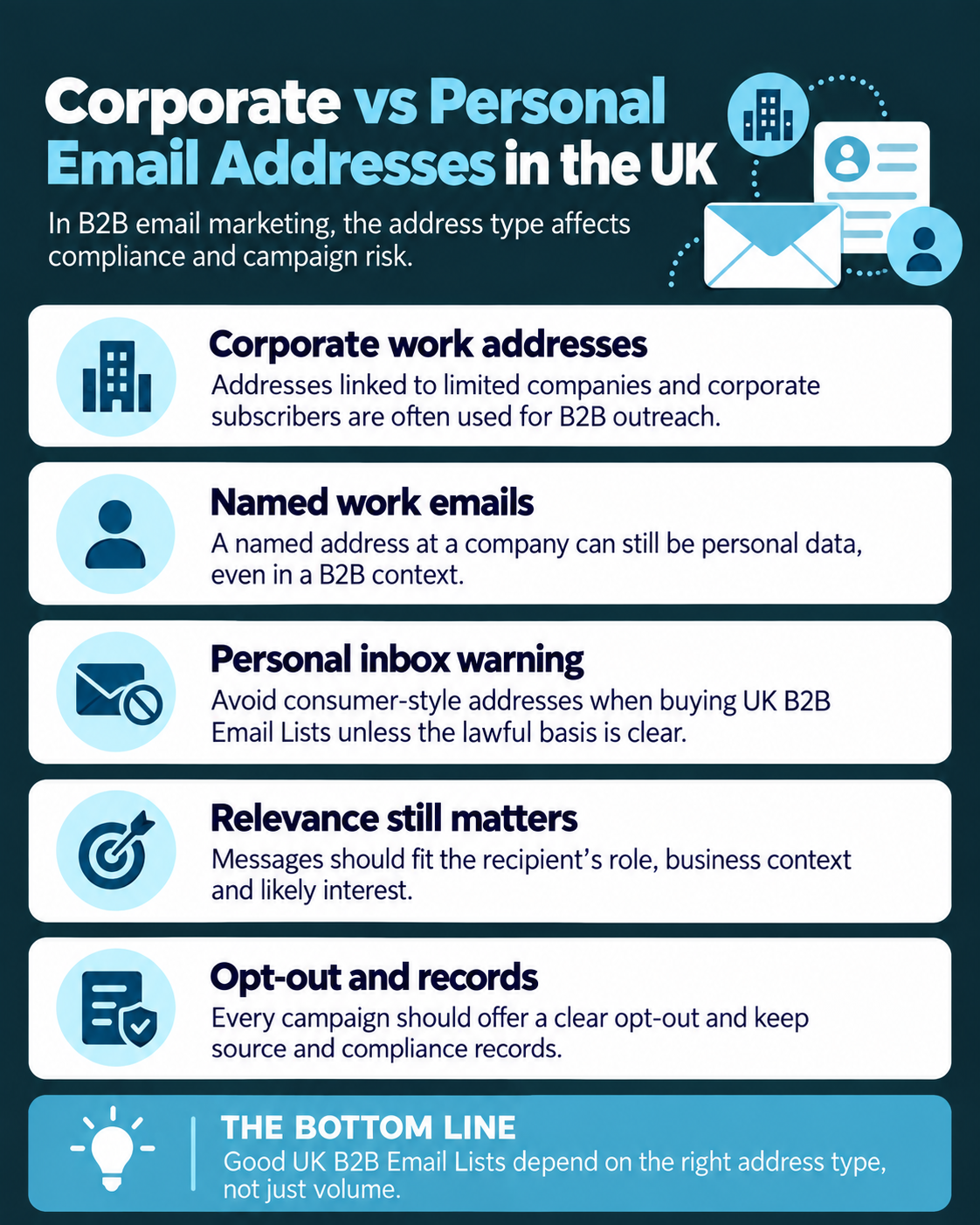
The ICO’s current B2B marketing guidance explains that PECR treats corporate subscribers differently from individual subscribers for electronic mail marketing. Corporate subscribers include organisations with their own legal personality, such as limited companies and limited liability partnerships. The ICO’s subscriber definitions also identify companies, LLPs, Scottish partnerships and some government bodies as corporate subscribers.
For unsolicited electronic marketing, this distinction is crucial. The ICO states that unsolicited electronic mail marketing can be sent to corporate subscribers without the consent or soft opt-in required for individual subscribers, provided the other requirements are met. The sender must not hide its identity and must provide a valid way to opt out.
That does not create an unrestricted right to email every company contact indefinitely. Where the address identifies an individual, UK GDPR still applies. Relevance, fairness, transparency, lawful processing, data minimisation, security and the absolute right to object to direct marketing still matter.
What is an individual subscriber in a business context?
Sole traders and many ordinary partnerships are treated as individual subscribers under PECR. This is one of the most important checks when buying UK B2B Email Lists because a supplier may describe all records as “business data” even though the legal form of the target business changes the electronic marketing rule.
A person can be operating entirely for business purposes and still be an individual subscriber. A sole trader using a business name, business website and professional-looking email address is not automatically a corporate subscriber. If the campaign includes sole traders or ordinary partnerships, the buyer needs a separate compliance route and should not assume the corporate-subscriber rule applies.
A named work email can be personal data
The ICO also makes clear that UK GDPR can apply to business contacts. If the email address identifies a person, for example firstname.lastname@company.co.uk, it is personal data even though it is used in a work context. The fact that the domain belongs to a limited company does not make the address anonymous.
This creates a two-layer position. PECR may permit unsolicited B2B email to the corporate subscriber without prior consent, while UK GDPR still requires a lawful basis and fair, transparent processing because a named individual is identifiable. This is why the phrase “B2B email does not need consent” is too simplistic to use as a compliance rule.
Generic corporate addresses are different, but not outside PECR
An address such as info@company.co.uk, sales@company.co.uk or procurement@company.co.uk may not identify a particular person, so UK GDPR may not apply to the address itself in the same way. PECR can still apply because electronic mail marketing rules are not limited to personal data.
Generic addresses can also be commercially weaker. They may be shared between several people, monitored irregularly or routed through a central inbox. For some campaigns they are useful, particularly when the buying function is not known. For high-value B2B prospecting, named decision-maker data is usually more actionable, provided the personal-data requirements are handled properly.
Personal email addresses inside B2B data need extra caution
One of the easiest ways for a buyer to create avoidable risk is to purchase a “B2B” dataset that contains personal email addresses such as Gmail, Outlook.com, Yahoo or other consumer-domain accounts without a clear reason for their inclusion.
A personal-domain address does not prove that the contact is a consumer, and a corporate-domain address does not by itself prove the subscriber classification. However, consumer-domain addresses create additional uncertainty around who the subscriber is and what permission exists. They are also harder to defend as ordinary corporate contact routes if a complaint occurs.
A sensible procurement rule for UK B2B Email Lists is therefore to ask for corporate-domain addresses by default. If a supplier proposes personal-domain addresses, ask why they are present, how subscriber status was established, what lawful basis applies and whether consent is available where needed. Unless the evidence is clear, exclude them from the B2B email audience.
That exclusion also improves data quality. Personal email addresses can follow someone between jobs, while a corporate address is more tightly linked to the organisation and role the campaign is trying to reach.
How UK GDPR, PECR and the Data Protection Act 2018 Work Together
A compliant B2B email process in the UK needs more than one legal lens. PECR governs important aspects of electronic marketing. UK GDPR governs the processing of personal data. The Data Protection Act 2018 sits alongside UK GDPR as part of the UK’s wider data protection framework.
PECR controls the electronic marketing route
The rules sit within PECR, and the ICO’s detailed electronic mail guidance explains the rules for marketing by email and other stored electronic messages. For corporate subscribers, unsolicited electronic marketing does not require the same consent or soft opt-in route that applies to individual subscribers.
However, the sender must identify itself and provide a valid contact address that allows the recipient to opt out. If a company or individual objects, that preference needs to be respected.
The rules apply whether the address came from a supplier, a public business website, an event list or internal research. “Publicly available” does not mean “free from regulation”. The ICO specifically notes that publicly available business-contact information still needs to be used in compliance with PECR and, where personal data is involved, UK GDPR.
UK GDPR governs named business contacts
When UK B2B Email Lists contain identifiable people, UK GDPR applies. The organisation using the list needs a lawful basis for processing. In many B2B direct-marketing scenarios involving corporate subscribers, legitimate interests may be considered, but it is not automatic.
The ICO’s legitimate interests guidance describes a three-part assessment: purpose, necessity and balancing. In practical terms, a B2B marketer should be able to explain why the campaign serves a legitimate commercial purpose, why processing the contact’s details is a proportionate way to achieve it, and why the contact’s rights and reasonable expectations do not outweigh that interest.
That exercise becomes easier when the list is tightly targeted. A proposition aimed at finance directors in companies that clearly fit the product is easier to justify as relevant and proportionate than a generic message sent to every available address.
Transparency is especially important with bought data
When a company obtains personal data from somewhere other than the individual, transparency obligations apply. The ICO’s data broker guidance says organisations buying or renting lists of individuals’ contact details should provide appropriate privacy information within one month of obtaining the data.
The information should explain who you are, the purposes for which the data is being used, the relevant lawful basis, the source or categories of source, retention, rights and how to object. The first marketing communication may be the practical moment to surface a clear privacy link, but the overall Article 14 timing and content obligations need to be considered separately from the message itself.
The right to object is absolute for direct marketing
Under UK GDPR, individuals have an absolute right to object to the processing of their personal data for direct marketing. The ICO’s right to object guidance states that there are no grounds to refuse such an objection.
This is why a suppression list should be treated as permanent operational knowledge. Deleting an objector completely can allow the same contact to be re-imported from a later supplier file. Retaining the minimum information needed to prevent future marketing is usually the safer approach.
The Data Protection Act 2018 is part of the same operating framework
The Data Protection Act 2018 complements UK GDPR and provides parts of the UK’s domestic data-protection framework, including enforcement and other provisions relevant to processing personal data. It should not be treated as a separate alternative to UK GDPR. A business operating UK B2B Email Lists should build one joined-up compliance model rather than a “GDPR process” and a different “DPA process”.
The practical controls are familiar: know where data came from, use only what you need, keep it accurate, protect it, explain what you are doing, respect objections and avoid holding data longer than necessary for the purpose.
Build, Buy or Append UK B2B Email Lists?
There is no single correct way to create a B2B email audience. Most mature databases combine several sources. The important point is that each source should remain visible so the business can apply the right governance and measure which acquisition routes produce useful opportunities.
Build first-party coverage when relationships matter
First-party business contacts are generated directly through the company’s own activity. Sources can include website enquiries, webinar registrations, event attendance, content downloads, demonstrations, sales conversations, customer relationships, referrals and newsletter sign-ups.
The advantage is context. A contact who downloaded a technical guide or requested a quotation arrives with a reason for being in the database. The business can record what happened, when it happened and which topic created the interaction.
The disadvantage is coverage. Organic growth only reaches people who encounter the brand or respond to an activity. A new supplier entering an established market may have a strong proposition and almost no market coverage. That is where externally sourced B2B data can accelerate access to the market.
Buy data when the coverage gap is specific
Purchasing UK B2B Email Lists makes most sense when the business can define the missing audience clearly. Examples include entering a new sector, targeting a new geography, adding decision-makers to known accounts, supporting an event launch or giving a new sales territory enough coverage to operate.
The commercial discipline is to buy the gap, not the biggest file available. If the sales proposition is only relevant to manufacturers with more than 100 employees, there is little value in paying for thousands of micro-business records simply because they reduce the headline cost per record.
AccuraData’s B2B Email Data can be filtered around business characteristics and relevant contacts rather than treated as a generic bulk list. That makes the data easier to connect to an ideal customer profile and campaign objective.
Append when the CRM already has valuable account history
Many organisations already know the companies they want to reach but are missing the current decision-maker or email field. In that situation, replacing the database can destroy useful history. Data Appending can be a better option because it adds missing fields to existing records while preserving account relationships, sales notes and prior activity.
Appending is particularly useful when the CRM contains strong company-level data but weak contact coverage. The process should use reliable match keys and should preserve the source and date of appended information.
Clean before buying more
A company can mistake a quality problem for a coverage problem. If half the CRM is duplicated, stale or missing role information, buying another 20,000 records may add more inconsistency without improving performance.
Data Cleansing & Enrichment can help businesses determine what they already own, which records remain usable and where genuine gaps exist. This can reduce the amount of new data that needs to be purchased and make the supplier brief much more precise.
What Fields Make UK B2B Email Lists Commercially Useful?
An email address is the delivery field. It is not the targeting strategy. A strong UK B2B record should contain enough company and contact information to explain why the person belongs in a campaign.
Account fields
Useful company fields can include:
- company name;
- registered or trading location;
- website and domain;
- industry or SIC classification;
- employee count or employee band;
- turnover or turnover band;
- company type;
- trading status;
- group or parent relationship;
- number of sites;
- account owner or territory; and
- a stable company identifier where available.
The exact fields depend on the campaign. A local service may care about site postcode and employee count. A software vendor may care about sector, scale and technology context. A financial service may care about company type, turnover and seniority.
Contact fields
Useful contact fields can include:
- name;
- job title;
- job function;
- seniority;
- department;
- corporate email address;
- company location;
- source;
- source date;
- verification date; and
- contact status.
Job function and seniority are especially useful because they allow more resilient segmentation than raw title text alone. “Operations Director”, “Head of Operations” and “COO” may all belong to a similar buying function despite very different titles.
Governance fields
The records that rarely appear in a sales presentation are often the fields that protect the database most effectively. Keep:
- source organisation;
- source date;
- privacy-information status;
- lawful-basis notes where appropriate;
- corporate or individual subscriber classification where relevant;
- suppression status;
- unsubscribe or objection date;
- bounce status;
- validation status;
- last-contact date; and
- campaign source.
These fields stop the email list becoming an anonymous spreadsheet. They make it possible to explain why a record is present, whether it can still be used and what happened when it was contacted.
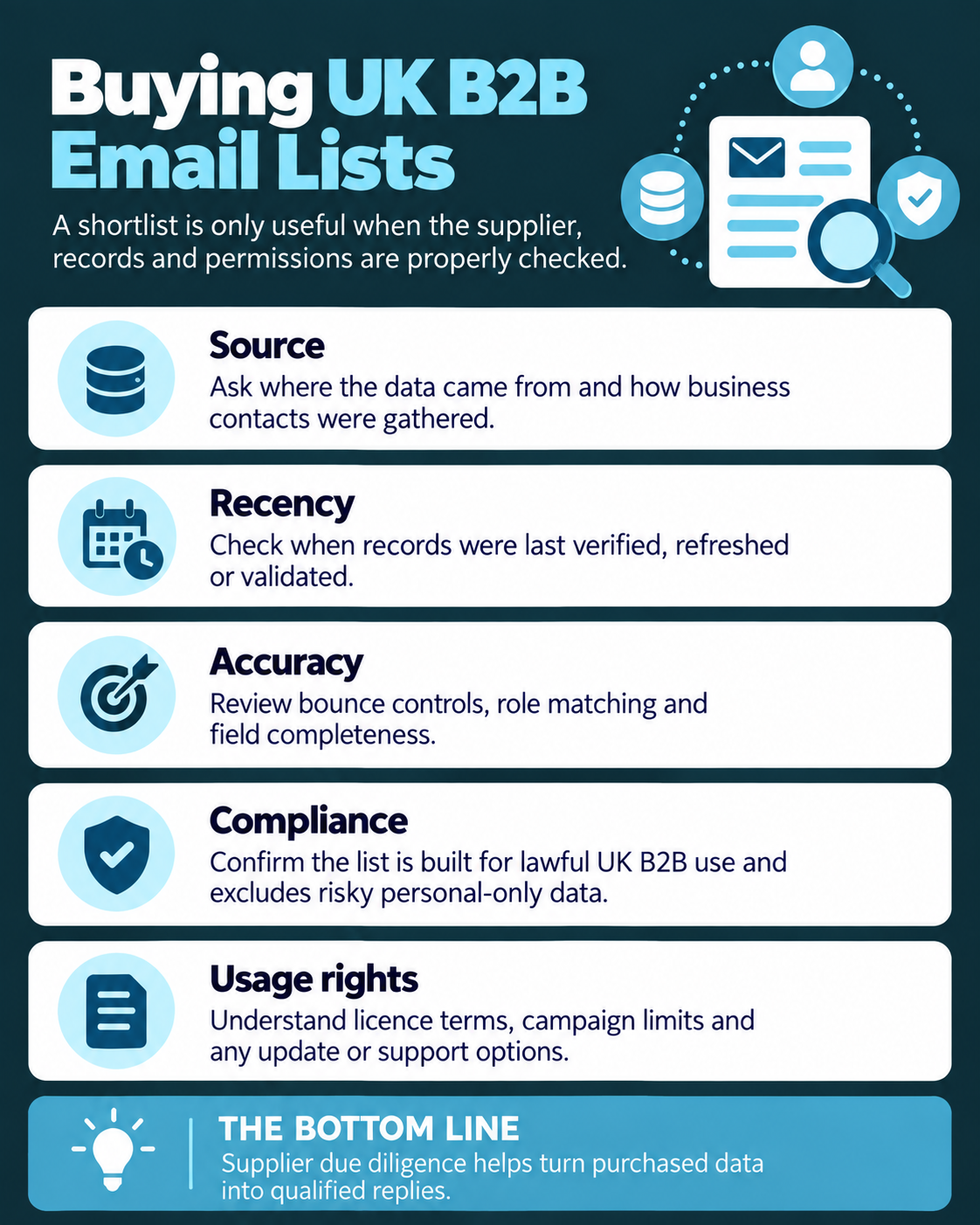
Buying UK B2B Email Lists: A Supplier Due Diligence Standard
The ICO’s guidance on organisations using data brokers is unambiguous on one point: the buyer retains responsibility. Accepting a supplier’s statement that data is “GDPR compliant” is not enough. Appropriate due diligence is required.
AccuraData’s article on B2B data providers explores supplier evaluation more broadly. For email-specific procurement, several additional questions matter.
Ask who compiled the records
The company selling the data may not have created it. Ask whether the file comes from the supplier’s own maintained database, a partner, public sources, licensed datasets or a mixture. If the answer is vague, the buyer cannot assess provenance properly.
Ask how company type is identified
A UK B2B supplier should be able to explain how limited companies, LLPs, sole traders and partnerships are distinguished. This is essential because PECR does not treat them all the same way for unsolicited electronic marketing.
Do not accept “they are all businesses” as the classification method.
Set a corporate-domain rule
If the campaign is intended to rely on the corporate-subscriber route, make corporate-domain email addresses the default requirement. Ask the supplier to identify or exclude Gmail, Yahoo, Outlook.com and other personal-domain addresses unless there is clear evidence supporting their use.
This is both a compliance control and a quality control.
Ask what “verified” means
Email verification can refer to several different checks. It may mean syntax validation, domain existence, mail-server response, mailbox testing, recent observed activity or a combination of signals. Ask which checks are performed, when they are performed and what result is stored.
A valid mailbox does not prove that the person is still in the role, that the company is still a good fit or that the record is legally appropriate for the campaign.
Ask for a representative sample
The sample should reflect the population you would actually buy. Test company fit, role relevance, domain quality, data completeness and duplicates against your CRM.
A sample is also a useful way to test the hand-off process. Can the file be imported cleanly? Are fields consistently formatted? Are company and contact identifiers clear? Is the source information usable?
Ask about recency
B2B decision-maker data ages quickly because people change roles, employers and responsibilities. Ask when company and contact fields were last reviewed and how updates are generated.
A supplier that can explain its refresh process is easier to evaluate than one that simply describes the database as “live” or “fresh”.
Ask about usage rights and replacements
Clarify whether the licence permits one campaign, repeated internal use or a fixed duration. Ask what happens if an address hard-bounces or the contact has left the company. Replacement terms should be understood before the campaign begins, not after results are poor.
Ask how objections and suppressions flow back
A good supplier should be able to explain how it handles complaints, corrections and objections. The buyer should also suppress its own previous opt-outs before activation so an old objection is not overwritten by a new import.
The ICO’s direct marketing checklist specifically highlights due diligence before buying or renting marketing information and the need for a do-not-contact process.
Personal Email Addresses in B2B Data: A Buyer’s Red-Flag Test
The presence of personal-domain addresses inside a B2B file deserves its own procurement step because it can change both legal analysis and campaign quality.
Start by separating three categories.
The first is a named corporate address, such as sarah.jones@limitedcompany.co.uk. This identifies an individual and is personal data, but if the account belongs to a corporate subscriber the PECR corporate-subscriber rule may apply.
The second is a generic corporate address, such as info@limitedcompany.co.uk. It may not identify an individual, although PECR still governs electronic marketing to the subscriber.
The third is a personal-domain address, such as sarahjones@gmail.com. This may belong to a sole trader, an employee using a personal account, a company director or someone entirely unrelated to the supposed business context. The domain itself does not provide enough evidence.
When a supplier includes category three, ask for a justification at record or source level. If the supplier cannot explain why that address belongs in the B2B list and which rule supports its use, exclude it.
This is one reason extremely cheap UK B2B Email Lists can create hidden cost. The file may technically contain addresses, but the buyer spends time removing personal accounts, fixing domains, resolving duplicates and handling complaints. The better measure is cost per usable, relevant record.
A Tool Stack for UK B2B Email Lists
The best software depends on where the contacts came from and what you intend to do with them. A critical point is that software terms can be stricter than the law. A marketing activity may be lawful under UK rules and still breach the terms of the platform chosen to send it.
CRM and segmentation tools
A CRM should normally be the source of truth for accounts, contacts, campaign ownership and sales outcomes. The sending platform can execute campaigns, but the CRM should preserve why the record exists and what happened commercially.
HubSpot segments can group contacts by properties and keep active segments updated as records change. This is useful for businesses that already use HubSpot as the sales and marketing system and have contacts that meet HubSpot’s permission requirements for email sending.
Salesforce marketing segments can group leads and contacts around common filters. Salesforce is often a strong fit where sales teams already manage complex accounts, opportunities and territories in the CRM.
Microsoft Dynamics 365 Customer Insights supports segment-based and trigger-based journeys, email activity and campaign analytics. It is particularly useful for organisations already operating in the Microsoft ecosystem and wanting campaign behaviour to remain connected to CRM data.
These products are strongest when they are used as systems for segmentation, workflow and first-party or appropriately permissioned marketing. Before importing externally purchased records into any platform, check its current acceptable-use policy.
Permission-based newsletter platforms
Tools such as Mailchimp, ActiveCampaign and similar newsletter platforms are designed around permission-based audiences. Their terms can be stricter than UK PECR’s corporate-subscriber rule.
Mailchimp’s audience requirements explicitly prohibit third-party, purchased and rented lists. ActiveCampaign’s anti-spam policy likewise says it does not allow paid or rented lists. Brevo documentation also warns against purchased contacts.
This matters because a company could buy a carefully targeted list of UK limited-company contacts, establish a lawful basis for processing named contacts, and still breach the sender platform’s contractual terms by uploading that list.
Do not solve that problem by hiding where the data came from. Choose a sending workflow that expressly accepts the use case, or use a managed service that can confirm how lawful B2B prospect data will be deployed. AccuraData’s Email Marketing Services can support campaign data, copy, design, broadcast management and reporting when a business wants the data and deployment process coordinated together.
Email validation and data-quality tools
Email validation tools can help identify malformed addresses, non-existent domains, invalid mailboxes and other technical issues. They should be treated as a deliverability control, not a legal permission engine.
Businesses with significant existing databases may prefer to combine technical validation with wider B2B data cleansing, because a technically valid email can still belong to a former employee or the wrong function.
Deliverability monitoring tools
If your organisation sends meaningful volume, use the tools provided by major mailbox providers and monitor authentication closely. Google’s sender guidelines require SPF or DKIM for all senders to Gmail and SPF, DKIM and DMARC for bulk senders. Microsoft’s high-volume sender requirements similarly enforce SPF, DKIM and DMARC for high-volume domains sending to Outlook.com consumer services.
Yahoo’s sender requirements also emphasise authentication, low complaint rates and easy unsubscribe for bulk senders.
These requirements are not substitutes for UK compliance. They are deliverability rules that determine whether technically sent messages are accepted, filtered or rejected.
Analytics and attribution tools
Email software can report delivery, clicks and replies, but revenue usually appears later in the CRM. Use campaign IDs and consistent source fields so meetings, opportunities and revenue can be traced back to the segment and supplier.
For B2B outreach, positive reply rate, meetings created, sales-accepted opportunities and pipeline often matter more than headline open rate. Open tracking can be affected by privacy features and automated security scanning, so it should not be the only measure of success.
Prepare the Sending Domain Before Using UK B2B Email Lists
Data quality cannot compensate for weak email infrastructure. Before a new outbound programme begins, the sending domain should be configured and monitored properly.
The National Cyber Security Centre’s email security guidance explains the role of SPF, DKIM and DMARC in reducing spoofing and improving trust in the sending domain.
SPF identifies which systems are authorised to send on behalf of the domain. DKIM adds a cryptographic signature that receiving systems can verify. DMARC tells receiving systems what to do when alignment checks fail and provides reporting that can help the organisation understand misuse of the domain.
These controls are now normal infrastructure, not advanced extras. Major mailbox providers increasingly require them from higher-volume senders.
The sender should also monitor bounce rates, complaint signals and abrupt changes in volume. Sending 20,000 messages on day one from an infrastructure that normally sends 100 is rarely a sensible operational choice. Use controlled waves so the team can identify data or content problems before they affect the entire audience.
The M3AAWG sender best practices are useful for understanding the wider technical behaviours expected of responsible commercial senders, even where legal permission models differ between countries.
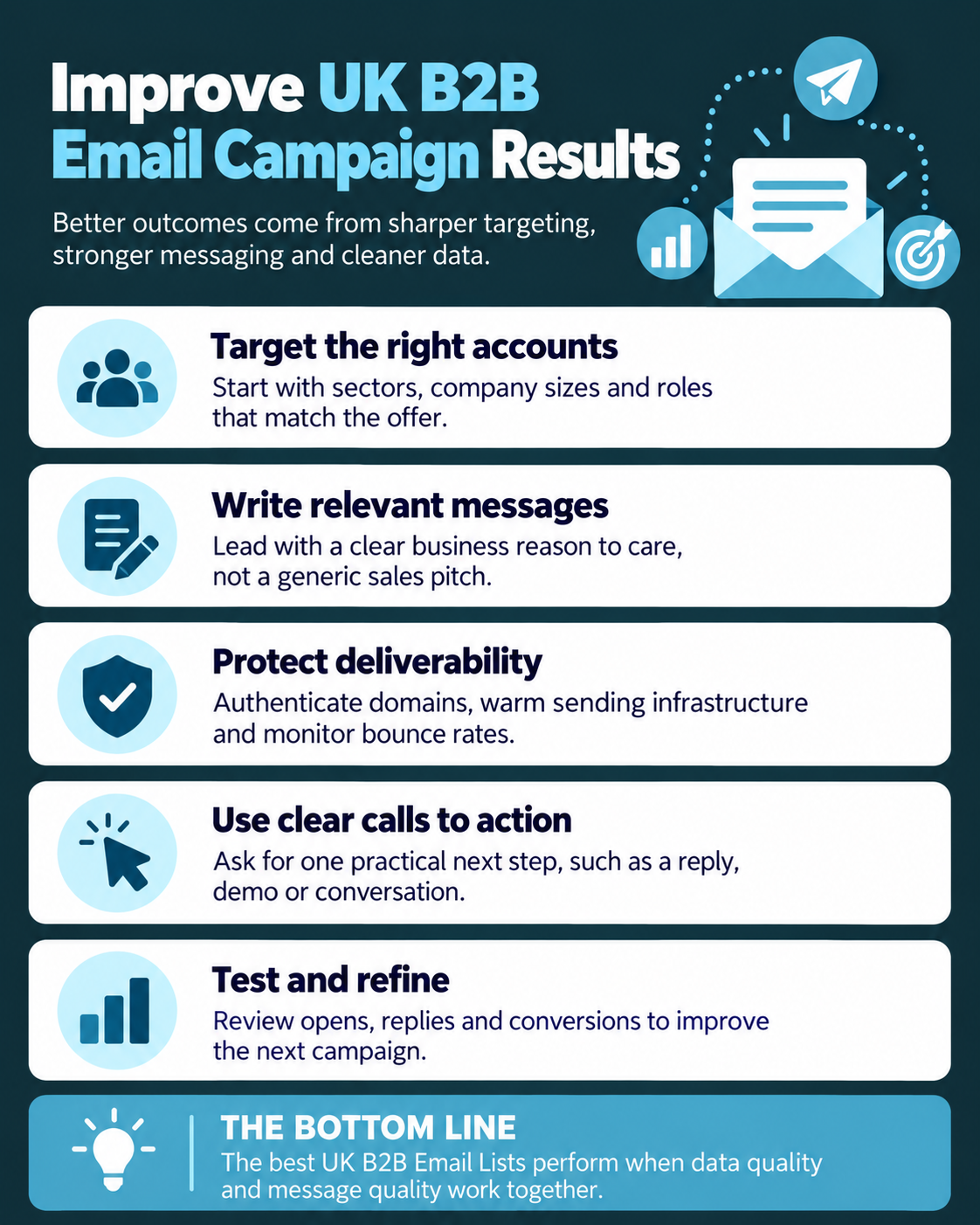
How to Increase the Success Rate of UK B2B Email Campaigns
Good B2B email performance is not created by a single subject-line trick. It is the combined effect of audience fit, timing, relevance, offer quality, deliverability and follow-up.
Narrow the segment before writing the copy
The message becomes easier to write when the audience shares a commercial reason to care. “UK businesses” is not a meaningful segment. “Operations directors at UK manufacturers with 100 to 500 employees” is much closer to a usable audience if the proposition relates to operational efficiency.
A narrow segment lets the copy refer to the business context naturally without pretending to know facts that are not in the database.
Use role-aware messaging
The same product should not always be described the same way to every function. A finance director may care about payback, cost control and risk. An operations director may care about downtime and implementation. An IT leader may care about security, integration and support.
Build message variants around function where the buying motivations differ materially. This is more useful than superficial personalisation such as inserting a first name into generic copy.
Lead with the problem, not the database field
Do not reveal targeting criteria in a way that feels intrusive. Saying “I noticed your company has 147 employees” may be accurate and still sound unnatural. Use the data to choose the audience, then write around the likely business problem.
Make the proposition easy to understand
Cold B2B email has limited attention. The recipient should be able to understand the reason for the message, the value proposition and the requested next step quickly.
Avoid opening paragraphs about your own company history. Start with the business issue. Explain the value in concrete terms. Then use one simple call to action, such as asking whether the topic is relevant, offering a short conversation or pointing to a useful resource.
Create a reason to reply now
The best offers reduce the effort required to take the next step. A short benchmark, sector-specific checklist, audit, estimate, data count, sample or diagnostic can be easier to respond to than a vague request for “15 minutes to discuss synergies”.
The offer should still match the sales process. Generating hundreds of low-intent downloads is not useful if the goal is qualified enterprise opportunities.
Test one variable at a time
Test subject lines, message length, offer, call to action, send timing and role segmentation, but avoid changing every variable simultaneously. Otherwise the team learns very little about why performance changed.
Controlled tests are especially valuable with purchased UK B2B Email Lists because early waves can expose role mismatch, bounce patterns and supplier issues before the full list is used.
Use replies as data-quality signals
Replies are not only sales outcomes. They are maintenance data.
“Jane left six months ago” is a contact update. “This is handled by Procurement” is a role-routing signal. “We are too small for this” is an account-fit signal. “Please do not email me again” is a suppression signal that must be acted on immediately.
Create standard outcome codes so this feedback flows back into the CRM.
Coordinate marketing and sales follow-up
A warm reply can lose value quickly if it sits in a shared inbox. Define ownership before the campaign launches. Decide who monitors replies, how fast positive responses are routed, what counts as a qualified opportunity and which contacts enter a nurture path instead of immediate sales follow-up.
AccuraData’s guide to email marketing campaigns covers campaign planning more broadly. For UK B2B Email Lists, the extra discipline is to connect campaign feedback to account and contact quality after every wave.
Campaign Cadence: Follow Up Without Becoming Noise
One email is easy to miss. Ten repetitive emails are easy to resent. Effective B2B cadence sits between those extremes.
The right sequence depends on the value of the proposition, the audience and whether other channels are involved. A typical approach may use an initial email, one or two relevant follow-ups and then a pause. The follow-up should add information rather than merely restate “just checking this reached you”.
Possible follow-up angles include:
- a shorter summary of the business case;
- a relevant example or result;
- a useful checklist or guide;
- a clarification of who the proposition is relevant to;
- a polite “close the loop” message; or
- a hand-off to a different channel where appropriate and lawful.
High-value accounts may justify a coordinated approach in which email supports telephone, LinkedIn activity, direct mail or account-based sales work. The email list should be one field in the account strategy rather than the entire strategy.
Always respect objections and unsubscribe requests immediately. Persistence is not a reason to override a preference.
Deliverability Is Part of Data Quality
Marketers often separate “the list” from “deliverability”. In practice they interact constantly.
A stale list creates hard bounces. Poor targeting creates low engagement and complaints. Weak suppression processes cause repeated contact with people who have already objected. Sudden high-volume sends create reputation risk. Authentication problems cause technically correct messages to be rejected.
This is why a UK B2B email programme should monitor at least four layers.
The first is address validity. Remove hard bounces and technically invalid addresses.
The second is contact validity. Check whether the person still works at the company and still holds a relevant role.
The third is campaign eligibility. Check subscriber type, suppression status, purpose and lawful basis.
The fourth is sending reputation. Monitor authentication, complaint signals, bounce trends and sending volume.
Keeping these layers separate avoids a common error: describing an email address as “clean” simply because a validation API returns “deliverable”.
Maintaining UK B2B Email Lists After the Campaign
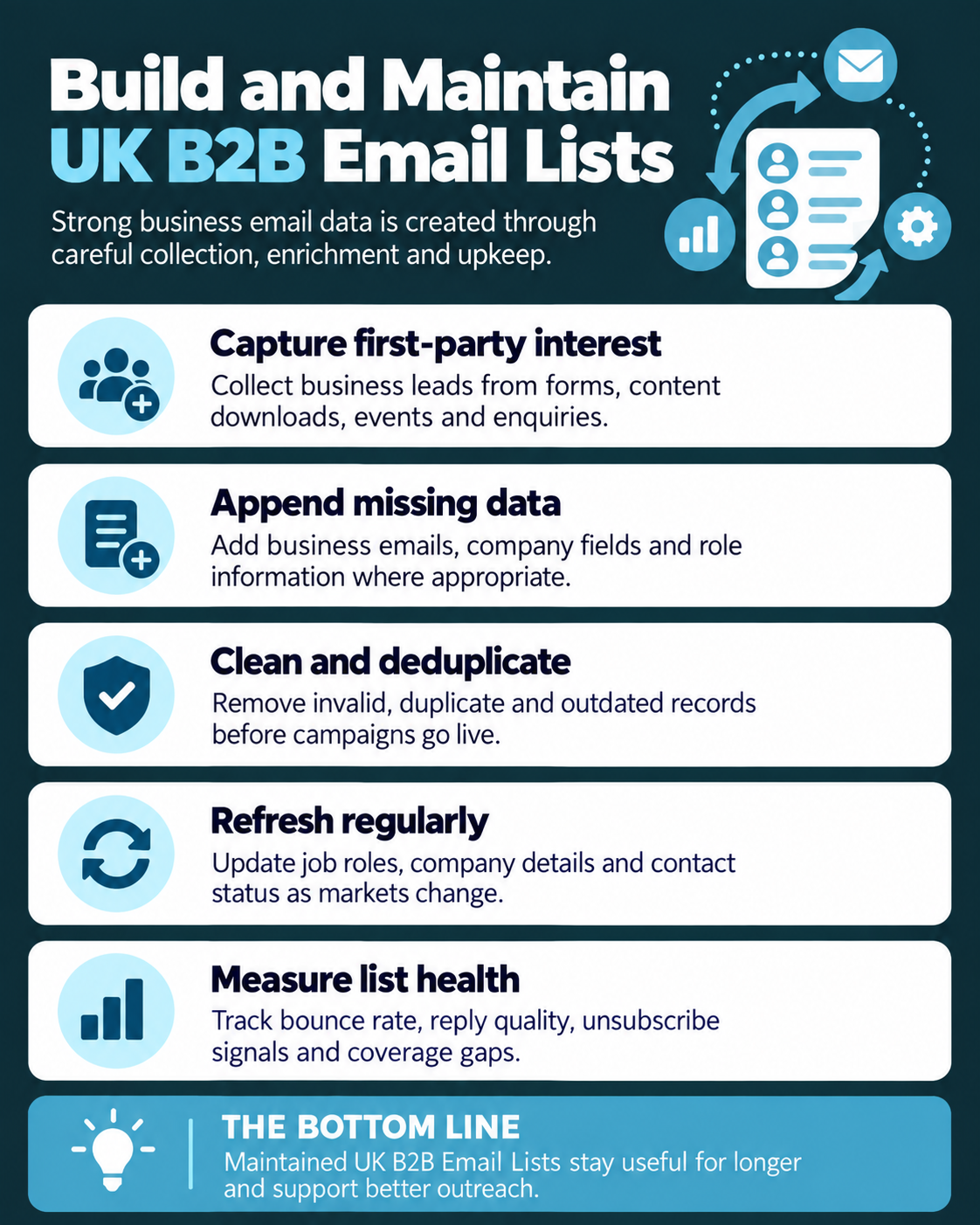
Business contact data decays because businesses change. People move jobs, companies merge, sites close, roles change and domains are reconfigured. Maintenance needs to be built into the operating model rather than scheduled only after performance collapses.
Process hard bounces immediately
A hard bounce is a clear technical signal that the address should not continue receiving messages. Suppress it and investigate whether the contact can be updated.
Preserve objections
Keep a durable do-not-email or suppression list. If a named contact objects to direct marketing, do not simply delete the row and allow the same person to be purchased again later.
Review valuable accounts more frequently
Not every record needs the same refresh frequency. High-value accounts, senior decision-makers and roles with frequent turnover deserve more regular checking than low-priority records that are rarely used.
Deduplicate at both company and person level
Duplicate contacts can arrive through multiple suppliers, event imports, CRM migrations and sales research. Company names can also vary because of abbreviations and trading names.
Use stable identifiers where possible and match more than one field. Duplicate management protects the recipient experience and improves reporting.
Keep source and date visible
Do not overwrite a source field every time the record is updated. A useful database can show where the original contact came from and when important fields were last verified.
This makes supplier performance measurable. If one source consistently creates valid decision-makers and another creates high bounce or wrong-role rates, future spend can be shifted accordingly.
Measure UK B2B Email Lists by Commercial Yield
A list should not be judged by how many rows it contains or even by how many messages were delivered. The useful question is how much commercial value the usable audience creates.
Cost per usable record
Start with the number of records that survive deduplication, account-fit checks, subscriber classification and validation. Divide the acquisition cost by that usable total.
This is more meaningful than cost per thousand purchased records.
Delivery and bounce rate
These indicate technical quality but should be interpreted with context. A low bounce rate does not prove relevance. A higher-than-expected bounce rate can indicate stale data, weak validation or domain problems.
Reply rate and positive reply rate
Reply rate shows whether the message generates reactions. Positive reply rate separates genuine commercial interest from objections, wrong-person replies and automated responses.
Meetings and sales-accepted opportunities
For many B2B campaigns, meetings and opportunities are more meaningful than clicks. Record them against campaign, segment and source.
Pipeline and revenue
Ultimately, the most valuable supplier or segment is the one that contributes profitable business. Connect opportunity value and closed revenue back to the audience source wherever possible.
Learning per campaign
Even unsuccessful sends can produce useful information if feedback is captured. A segment that repeatedly generates “too small”, “wrong department” or “not our industry” responses is telling the business how to improve its target model.
Common Mistakes with UK B2B Email Lists
Several mistakes repeatedly reduce the value of otherwise useful B2B data.
Treating every business record as a corporate subscriber
Business context is not the same as corporate legal status. Sole traders and ordinary partnerships require different PECR treatment from limited companies and LLPs.
Assuming a corporate domain removes UK GDPR
A named corporate email address can still identify an individual and therefore be personal data. PECR and UK GDPR answer different questions.
Allowing personal email domains into the file without evidence
Consumer-domain addresses can introduce classification uncertainty and weaken the link between the contact and the target account. Exclude them unless the supplier can justify their use.
Buying volume without an audience model
A large list encourages generic campaigns. Define the companies and roles first, then buy the records needed to close the coverage gap.
Using a newsletter platform whose terms prohibit purchased lists
The law and the platform contract are separate. Check the acceptable-use rules before uploading any third-party data.
Confusing validation with permission
A technically valid mailbox is not evidence of subscriber type, lawful basis or transparency.
Sending the entire list at once
Controlled waves expose problems early and allow the team to update the audience before scale magnifies them.
Ignoring reply intelligence
Replies tell you whether the account and contact model is right. If that information never reaches the database, the next campaign starts with the same assumptions.
Why AccuraData Is a Strong Choice for UK B2B Email Lists
Buying B2B email data is not simply a search for the largest list or the lowest cost per thousand. The value comes from defining the right market, selecting relevant companies, reaching suitable decision-makers, understanding what the fields mean, maintaining the data and fitting it into a lawful campaign process.
AccuraData is well positioned for that full requirement because its services cover the surrounding data lifecycle rather than a single export.
Businesses can start with targeted B2B Data to define companies and decision-makers, then use B2B Email Data for email-specific coverage. Existing CRMs can be improved through Data Cleansing & Enrichment or expanded through Data Appending. Businesses that want help beyond the file can use Email Marketing Services for campaign execution and reporting.
That combination is valuable because many B2B email problems are not really “list problems”. A company may already have the right accounts but outdated contacts. It may have accurate contacts but weak segmentation. It may have the right list but unsuitable sending software. It may have good delivery but poor sales follow-up. A supplier that can support the data and the activation process is better placed to solve the actual commercial issue.
AccuraData also provides a practical route for buyers who want a targeted count before purchase. A clear brief based on sector, location, company size and decision-maker role can be translated into a usable audience rather than a generic volume estimate.
For UK organisations looking to purchase UK B2B Email Lists, that makes AccuraData one of the strongest all-round choices for targeted business data, database improvement and managed email support.
A Practical Operating Model for UK B2B Email Lists
A useful operating model can be described as eight connected controls.
Define the target-account rule
Write the company criteria in plain language. Include industry, geography, size and exclusions that materially affect fit.
Define the contact rule
Specify functions, seniority and decision-maker roles. Decide whether one or multiple contacts per account are needed.
Classify the subscriber type
Separate corporate subscribers from sole traders and other individual subscribers before campaign activation.
Remove uncertain personal-domain addresses
Use a corporate-domain default unless the record has clear evidence supporting a different route.
Confirm source, lawful basis and transparency
Document where the record came from, why it is being processed and how privacy information will be provided.
Validate and suppress
Remove duplicates, check email quality, match against internal objections and prepare suppression handling.
Launch controlled campaign waves
Use smaller initial groups to test data quality, message fit and sending performance.
Feed outcomes back into the database
Record bounces, objections, role changes, positive replies, meetings and revenue so the next campaign starts with better information.
This model turns UK B2B Email Lists from disposable campaign files into learning assets.
Frequently Asked Questions About UK B2B Email Lists
What are UK B2B Email Lists?
UK B2B Email Lists are structured datasets containing email contact information for people or functions associated with UK businesses and organisations. A useful list normally includes company information, contact role, email address, source, verification data and enough targeting fields to explain why the record belongs in a campaign.
Is it legal to buy UK B2B Email Lists?
Buying business email data is not automatically unlawful. The buyer remains responsible for complying with UK GDPR, PECR and the wider UK data-protection framework. Due diligence, subscriber type, lawful basis, transparency, source, purpose, suppression and the intended use all matter.
Do I need consent to cold email UK companies?
PECR does not require prior consent or the soft opt-in for unsolicited electronic marketing to corporate subscribers in the same way it does for individual subscribers. However, the sender must identify itself and provide a valid opt-out route. If a named person is identifiable, UK GDPR also applies.
Are sole traders covered by the corporate-subscriber rule?
No. Sole traders are treated as individual subscribers under PECR. Many ordinary partnerships are also individual subscribers. Do not assume every business record can follow the limited-company route.
Is firstname.lastname@company.co.uk personal data?
Usually yes, because it identifies a specific individual. The fact that it is a business address does not remove UK GDPR. The PECR analysis may still treat the email service as belonging to a corporate subscriber if the organisation is a qualifying corporate body.
Is info@company.co.uk personal data?
A generic role address may not identify an individual, so UK GDPR may not apply to the address itself in the same way. PECR can still apply to the electronic marketing message because the rules are based on the subscriber and method of communication, not only on personal data.
Should UK B2B Email Lists contain Gmail or Outlook.com addresses?
Treat personal-domain addresses cautiously. They may belong to sole traders, employees, directors or unrelated individuals, and the domain gives little evidence about subscriber status. A corporate-domain-only rule is often a safer default for purchased B2B prospecting unless the supplier can provide a clear legal and factual justification.
Can legitimate interests be used for UK B2B email marketing?
Legitimate interests may be an appropriate lawful basis for some processing of named B2B contacts, especially where PECR does not require consent, but it is not automatic. A legitimate interests assessment should consider purpose, necessity and the balance between the organisation’s interests and the individual’s rights and expectations.
Do I need to tell a business contact where I got their data?
If you obtained personal data from another source rather than directly from the person, Article 14 transparency obligations can apply. The ICO’s data-broker guidance says buyers of contact lists should provide appropriate privacy information within one month of obtaining the data.
What should I ask a UK B2B email list supplier?
Ask about source, recency, company-type classification, corporate-domain coverage, verification method, role accuracy, privacy information, licensing, suppression, sample quality, replacement terms and security. A reputable supplier should be able to explain the data rather than only quote a record count.
How often should UK B2B Email Lists be cleaned?
Basic maintenance should be continuous. Process hard bounces and objections immediately. Refresh important decision-makers and high-value accounts more frequently, and review the wider file before major campaigns or after long periods of inactivity.
Which email software is best for UK B2B Email Lists?
The answer depends on the source of the contacts. CRM tools such as HubSpot, Salesforce and Microsoft Dynamics can be valuable for segmentation and sales workflow. Permission-based newsletter platforms may prohibit purchased lists even where a particular B2B use could be lawful in the UK. Always check platform terms before importing third-party data. For purchased prospect data, use a sending process that expressly accepts the use case or consider a managed B2B email service.
Can I use Mailchimp with purchased UK B2B Email Lists?
Mailchimp’s current terms prohibit purchased, rented and third-party lists. Do not upload a purchased list simply because the underlying UK B2B campaign might otherwise be legally supportable.
What makes a B2B email campaign successful?
Strong campaigns combine relevant account selection, the correct decision-maker, clean data, compliant processing, authenticated sending infrastructure, role-aware messaging, a clear offer, controlled testing and fast sales follow-up. No single subject-line technique can compensate for weak audience fit.
How should I measure UK B2B Email Lists?
Track cost per usable record, delivery, hard bounces, positive replies, meetings, sales-accepted opportunities, pipeline and revenue by segment or source. Use opens and clicks as supporting indicators rather than the sole definition of success.
Can AccuraData clean an existing B2B email list?
Yes. AccuraData’s Data Cleansing & Enrichment can support email validation, duplicate removal, contact verification, record standardisation and wider data-quality work where an organisation already owns the core database.
Can AccuraData append missing business email data?
Yes. Data Appending can be used to improve existing business records by adding missing or updated fields where appropriate, helping organisations preserve valuable account history while increasing usable coverage.
Can AccuraData provide the list and manage the email campaign?
Yes. AccuraData can supply targeted B2B email data and also provide Email Marketing Services covering campaign support such as copy, design, broadcast management and reporting.
UK B2B Email Lists Should Get Smarter After Every Send
The strongest UK B2B Email Lists are not static files that are purchased, emailed once and forgotten. They are market-access assets that improve as the business learns.
The starting point is the target account. The company should fit the proposition for a clear reason. The contact should hold a relevant function and level of influence. The email should be connected to the corporate organisation rather than an unexplained personal account. The source, subscriber status and processing rationale should be understood. The sending infrastructure should be authenticated. The message should speak to the recipient’s likely business problem rather than to the fact that they happened to appear in a dataset.
Then the campaign should make the list better. A bounce should update the record. An objection should create durable suppression. A wrong-person reply should improve the role model. A positive response should create a sales action. A closed opportunity should identify which segment and source created value.
This is where targeted external data can be much more valuable than simple list volume. It helps the business reach companies it does not yet know, but the real return comes from integrating that new coverage into a disciplined system of segmentation, compliance, sending, sales follow-up and maintenance.
For businesses that want to buy, improve or activate UK B2B Email Lists, AccuraData can support the full data layer through B2B Email Data, broader B2B Data, Data Cleansing & Enrichment, Data Appending and managed Email Marketing Services.
The goal is not to own the longest list. It is to build a reliable route from a target account to a relevant decision-maker, from a relevant decision-maker to a delivered message, and from a delivered message to a qualified commercial conversation.