
A TPS Checker is one of the most important tools for any UK business that uses telephone marketing. It helps you identify telephone numbers that are registered with the Telephone Preference Service, so your team can avoid making unsolicited live marketing calls to people who have opted out. Used properly, it protects recipients, supports compliance, reduces wasted calling time and helps your business build more trust into its outbound activity.
The need for accurate checking is not just a matter of good manners. The ICO guidance on telephone marketing explains that the TPS is a central register of individuals who have opted out of receiving live marketing calls. The same guidance explains that the Corporate Telephone Preference Service, or CTPS, works in a similar way for companies and other corporate bodies. For businesses running telemarketing campaigns, both registers can affect whether a number should be called.
This article explains what a TPS Checker is, how the Telephone Preference Service works, how TPS differs from CTPS, what UK businesses need to consider before calling, and how AccuraData can support you. That support can include buying marketing data where TPS and CTPS checks are handled for you, or using AccuraData to cleanse your own database through professional TPS and CTPS checking and data cleansing and enrichment services.
It is written for businesses that want practical guidance, not legal jargon. It does not replace legal advice, but it does explain the main ideas in a clear way so marketing, sales and operations teams can plan telephone campaigns more responsibly.
What Is a TPS Checker?
A TPS Checker is a service, process or tool that screens telephone numbers against the Telephone Preference Service register. The purpose is to identify numbers that should not receive unsolicited live sales or marketing calls unless a valid exception applies. In everyday use, the phrase TPS Checker can describe an online lookup, a batch screening service, an API connected to a calling system, or a data provider process that checks numbers before a dataset is supplied.
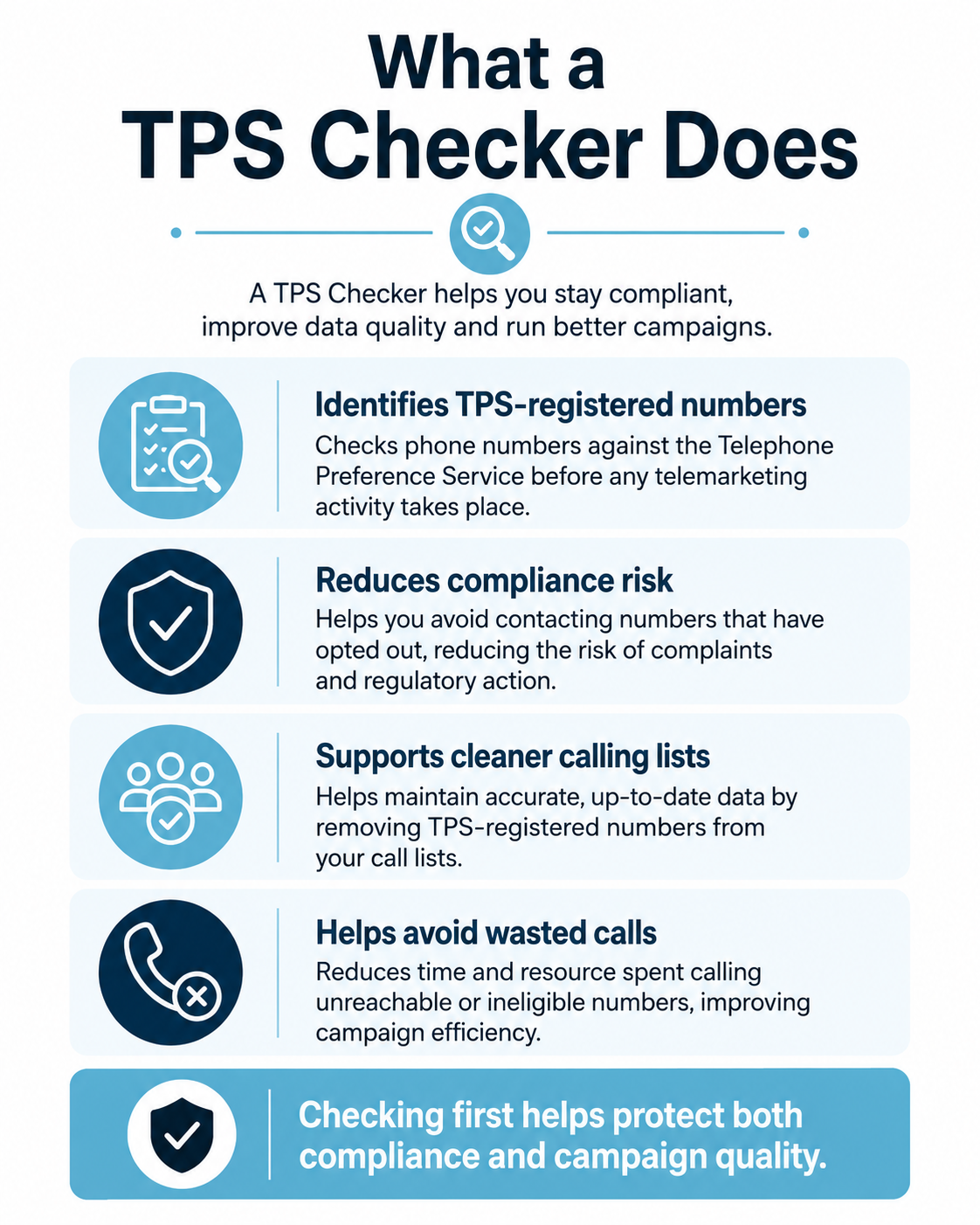
The official Telephone Preference Service describes TPS as the UK’s official do-not-call register for landline and mobile numbers. People can use it to record their preference not to receive unsolicited sales or marketing calls. That matters because a number being available in a CRM, data list, website enquiry, legacy spreadsheet or public source does not automatically mean it is suitable for a live marketing call.
A proper TPS check does more than ask whether a phone number exists. It asks whether the subscriber has registered an opt-out preference. That distinction is important. A number can be live and valid but still unsuitable for unsolicited marketing calls if it appears on TPS. A number can also be absent from TPS but still unsuitable if the person has objected directly to your organisation, if the data was collected for a different purpose, or if other compliance concerns apply.
For that reason, a TPS Checker should be part of a wider data quality and campaign governance process. It should sit alongside internal do-not-call suppression, number validation, duplicate removal, data formatting, lawful basis assessment and clear call handling procedures. AccuraData’s TPS/CTPS Checking service is designed to support this wider process rather than treating checking as a simple one-off tick box.
What Is the Telephone Preference Service?
The Telephone Preference Service is a central register for people who do not want to receive unsolicited live sales or marketing calls. Individuals can use the TPS registration service to add landline or mobile numbers. Once a number is registered and the registration has taken effect, organisations should not make unsolicited live marketing calls to that number unless they have the relevant permission or another valid basis for calling under the rules.
The TPS website states that it is the UK’s only official do-not-call register for landlines and mobile numbers. This is why marketing teams should be careful about relying on informal checks or assumptions. TPS status is a formal preference signal and should be treated as part of the campaign compliance workflow.
TPS does not mean that every call to a registered number is forbidden. The key issue is unsolicited sales or marketing calling. Service calls, transactional calls, market research calls and calls made with valid permission may be different depending on the circumstances. However, businesses should avoid trying to stretch exceptions. If a call is designed to promote products, services, aims or ideals, it is likely to be direct marketing and should be assessed carefully.
The ICO live calls guidance explains the rules for live direct marketing calls. It states that, for many types of live call, consent is not always required under PECR, but organisations must still respect TPS and CTPS registrations, previous objections and other restrictions. This means a TPS Checker is useful even where a business believes it has a legitimate reason to call.
TPS, CTPS and Internal DNC Lists
TPS is often discussed alongside CTPS and internal DNC lists. They are related, but they are not the same. TPS is mainly associated with individuals, including consumers, sole traders and partnerships in many practical contexts. CTPS is the corporate version and is designed for companies and other corporate bodies. The ICO’s telephone marketing guidance describes CTPS as working in the same way as TPS, but for companies and other corporate bodies such as limited liability partnerships, Scottish partnerships and government bodies.
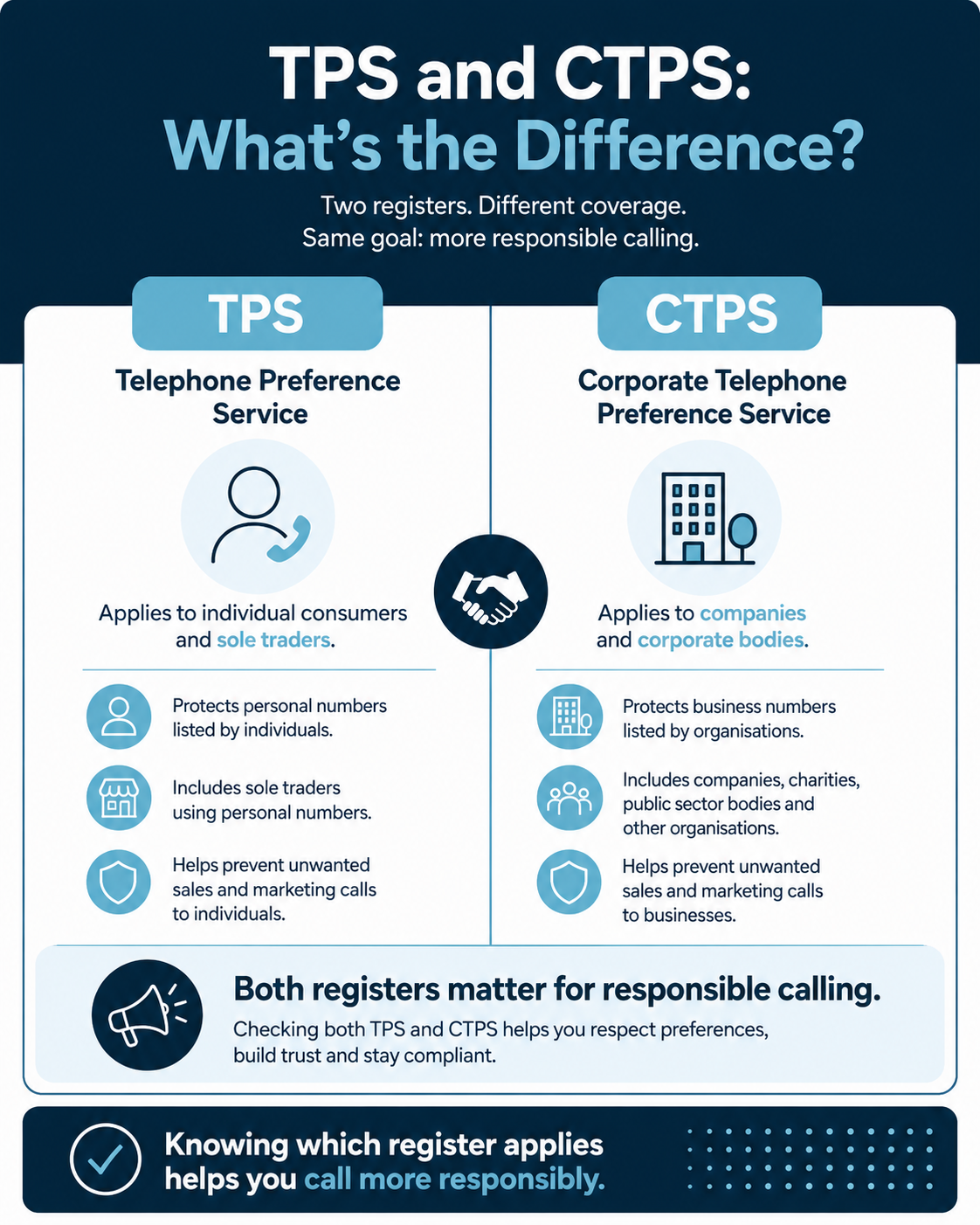
An internal DNC list, meaning an internal do-not-call list, is your own record of people or organisations that have told you not to call them. This matters because a number does not have to be on TPS or CTPS for you to stop calling it. If someone objects directly, that objection should be recorded and respected. A good campaign process screens against official registers and against your internal suppression records before calling begins.
AccuraData can help with official register screening and broader data hygiene. When you buy relevant consumer telephone data through AccuraData’s B2C Data service, the aim is to provide targeted records that support responsible campaign planning. When you already have a list, AccuraData’s data cleansing and enrichment services can help improve data quality before the list is used by your sales or customer contact team.
This distinction between external registers and internal objections is not just administrative. It is a practical risk control. If a prospect says “do not call again” and that instruction is missed, the problem is not solved by saying the number was not on TPS. Your internal process failed. Strong data management should capture and apply both official suppression and direct objections.
Why TPS Checking Matters for UK Telemarketing
TPS checking matters because telephone marketing reaches people directly. A call interrupts the recipient’s day in a way that email or postal mail may not. That directness can be commercially useful, but it also creates responsibility. A business that calls people who have opted out can damage trust quickly. It can also waste agents’ time on contacts who have already signalled that they do not want that type of call.
The ICO telephone marketing guidance is clear that TPS and CTPS are central to live marketing call compliance. The Ofcom nuisance calls guidance also notes that the ICO takes the lead in tackling live telesales calls, automated marketing message calls and spam texts. This should make compliance a board-level and management-level concern for organisations that rely on outbound calling.
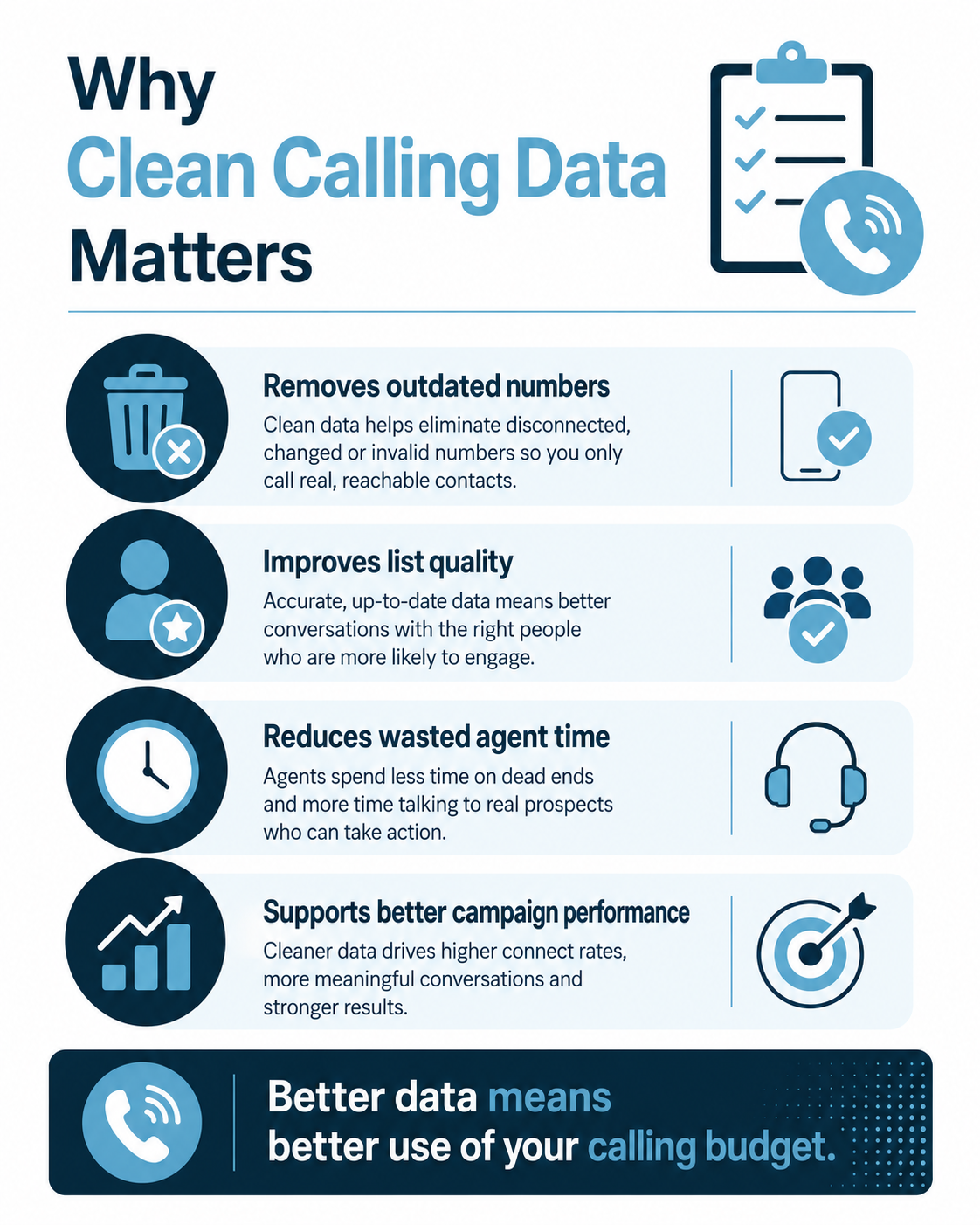
There is also a performance reason to screen properly. A calling list full of unsuitable, invalid or suppressed numbers creates avoidable cost. Sales agents spend time dialling people who should not be contacted, cannot be reached or are unlikely to engage. Managers then read campaign reports that are distorted by poor data. A cleaner list gives a clearer view of call connection rates, conversation quality, objection rates, conversion rates and follow-up opportunities.
TPS checking therefore supports both compliance and commercial efficiency. It helps teams focus on contacts that are more appropriate for the campaign. It reduces friction for recipients. It gives management more confidence in campaign results. It also demonstrates that the business is taking reasonable care over how it uses telephone data.
What Counts as a Marketing Call?
A common problem is that teams do not always recognise when a call is marketing. Some calls are obviously sales calls. Others are framed as research, account review, customer service, appointment setting or awareness activity. The label used by the caller is not the only factor. The purpose and content of the call matter. If the call promotes goods, services, brand activity, a commercial opportunity or future sales contact, it may still be direct marketing.
The ICO’s wider direct marketing and PECR guidance explains telephone marketing in the context of electronic and telephone marketing rules. Businesses should assess the campaign purpose before calling. A script that introduces a new service, asks for a meeting, offers a quote or encourages a purchase is likely to be marketing. A call that genuinely handles an existing service issue may be different, but it should not be used as a disguise for sales activity.
This matters for TPS checking because the rules are linked to the type of call being made. If a team wrongly treats a promotional call as purely administrative, it may miss the need for suppression. That is why campaign briefs should define the call type, audience, purpose and expected outcome before data is selected or cleansed.
A practical rule is to ask whether the person receiving the call is being encouraged to buy, consider, enquire, register, donate, attend, switch, renew, book or take another commercial step. If the answer is yes, the campaign should be treated with direct marketing controls, including TPS screening where relevant.
How a TPS Checker Works in Practice
A TPS Checker usually works by comparing the numbers in your file with the current register data available to licensed users or connected services. The input may be a small list of numbers, a full CRM extract or a dataset being prepared for campaign launch. The output should show which records are clear, which are matched to TPS or CTPS, and which require suppression or further review.
In a batch process, the business provides a file containing telephone numbers and any relevant identifiers. The checking provider standardises the numbers, removes obvious formatting issues, checks the records against the relevant register, and returns a marked file. Some services also flag duplicates, invalid numbers, missing fields and other quality problems. AccuraData’s TPS and CTPS screening process can be used to support this type of workflow.
TPS checking should happen close to the point of use. A list that was checked months ago may not remain compliant or accurate today. People register numbers, move house, change mobile numbers, switch jobs, object directly or become unsuitable for contact for other reasons. If a campaign will run over a longer period, re-screening should be built into the schedule.
A strong process also records what was checked, when it was checked and what action was taken. That evidence is useful for audit, management review, supplier accountability and campaign learning. It can also help a business show that it took a structured approach to responsible calling.
Buying Telephone Data That Has Been TPS Checked
Many businesses come to AccuraData because they need campaign-ready telephone data rather than a raw list that creates more work internally. Buying data can be useful when you want to reach a defined market quickly, test a new audience, support a product launch, run a consumer acquisition campaign or give a sales team a reliable prospect pool. However, the value of purchased data depends on how relevant, accurate and well managed it is.
AccuraData’s B2C Data service can support consumer marketing campaigns by helping businesses target audiences with appropriate segmentation. For business audiences, AccuraData also provides B2B telemarketing data and wider lead generation services. The key point is that data should be selected for the campaign objective, not just bought in bulk because it is available.
When buying calling data, ask how the data is sourced, what fields are included, how recently it has been checked, whether TPS and CTPS screening is applied where relevant, and what documentation is available. A good supplier should be able to explain its process in plain English. It should not rely on vague promises about being “fully compliant” without explaining what that means for the intended campaign.
AccuraData positions itself as a quality-focused partner because it combines targeted data supply with checking and cleansing support. That matters for teams that want to call with more confidence. The aim is not just to supply names and numbers. It is to help businesses connect with more relevant people using cleaner and more responsibly managed data.
Using a TPS Checker to Clean Your Own Calling Lists
Not every business needs to buy new data. Many already hold customer, prospect, enquiry or legacy sales records. The problem is that these records often become messy over time. People change numbers, move location, switch jobs, object to contact or become less relevant to the original campaign. Without regular data maintenance, a once useful list can become expensive to use.
AccuraData’s Data Cleansing and Enrichment service is designed for businesses that want to improve existing databases before campaign activity begins. This can include removing duplicates, correcting formatting issues, validating telephone numbers, appending missing information and screening numbers against TPS and CTPS where appropriate.
For telephone data specifically, AccuraData’s Live Number Cleansing service can help identify whether numbers are active, inactive, invalid or otherwise unsuitable for outbound contact. Combined with TPS and CTPS screening, this gives your calling team a much stronger starting point than an uncleaned spreadsheet exported from an old CRM.
Cleaning your own list can also protect sunk value. You may have paid to generate enquiries, attend events, build a CRM, run previous campaigns or collect customer records. Rather than discarding that data, cleansing can help reveal which records still have practical value and which should be updated, suppressed or removed from active use.
B2C Telephone Data and TPS Checking
B2C telephone data requires particular care because it involves individual consumers. Consumer calling can be effective when the audience is relevant and the data is handled responsibly, but it can also produce complaints quickly if the campaign feels intrusive. TPS screening is central because consumers can register landline and mobile numbers to opt out of unsolicited sales and marketing calls.
The official TPS register page allows individuals to record their preference not to receive unsolicited sales or marketing calls. That preference should be respected. A business planning a consumer calling campaign should therefore avoid thinking only about how many numbers it can obtain. It should think about the right audience, valid use, accurate data, suppression, script quality, call timing, internal objections and post-call handling.
AccuraData’s B2C Data lists can help businesses reach relevant consumer audiences while supporting better campaign planning. A quality provider should help match the dataset to the audience profile and campaign purpose. That may include geography, consumer attributes, interests, household characteristics or other relevant segmentation, depending on the campaign and permitted use.
The aim should never be to call the largest possible list. It should be to call a list that is accurate, relevant, properly screened and aligned with a sensible offer. A smaller, cleaner list can often produce better conversations than a large, poorly matched one.
B2B Calling, CTPS and Corporate Contacts
For B2B campaigns, CTPS becomes especially important. CTPS is the Corporate Telephone Preference Service and applies to corporate subscribers such as companies and other corporate bodies. A business calling campaign should not assume that a company number is automatically available for marketing calls. The register exists because businesses can also choose not to receive unsolicited sales and marketing calls.
The ICO telephone marketing guidance explains that CTPS works in the same way as TPS, but for companies and other corporate bodies. This is why B2B telemarketing data should be screened as carefully as consumer data. In practice, many organisations use combined TPS/CTPS checking so both individual and corporate suppression risks are addressed.
B2B calling also involves named contacts, direct lines, switchboards and departmental numbers. Some records may identify individuals, which means UK GDPR considerations can still apply even when the campaign is business-to-business. The ICO guide to lawful basis explains that organisations need a lawful basis for processing personal data. For B2B calling, legitimate interests may be considered in some contexts, but it must be assessed properly.
A strong B2B process therefore includes CTPS checking, internal suppression, clear caller identification, relevant targeting, accurate job-role selection and good call notes. AccuraData can support B2B calling teams with targeted data and cleansing services, helping reduce wasted dials and improve campaign focus.
UK GDPR, PECR and TPS Checking
TPS checking sits within a wider legal framework. PECR, meaning the Privacy and Electronic Communications Regulations, covers specific rules for electronic and telephone marketing. UK GDPR governs the processing of personal data. In a calling campaign, both can matter. A live marketing call may be assessed under PECR, while the storage, selection, cleansing and use of named contact records may involve personal data under UK GDPR.
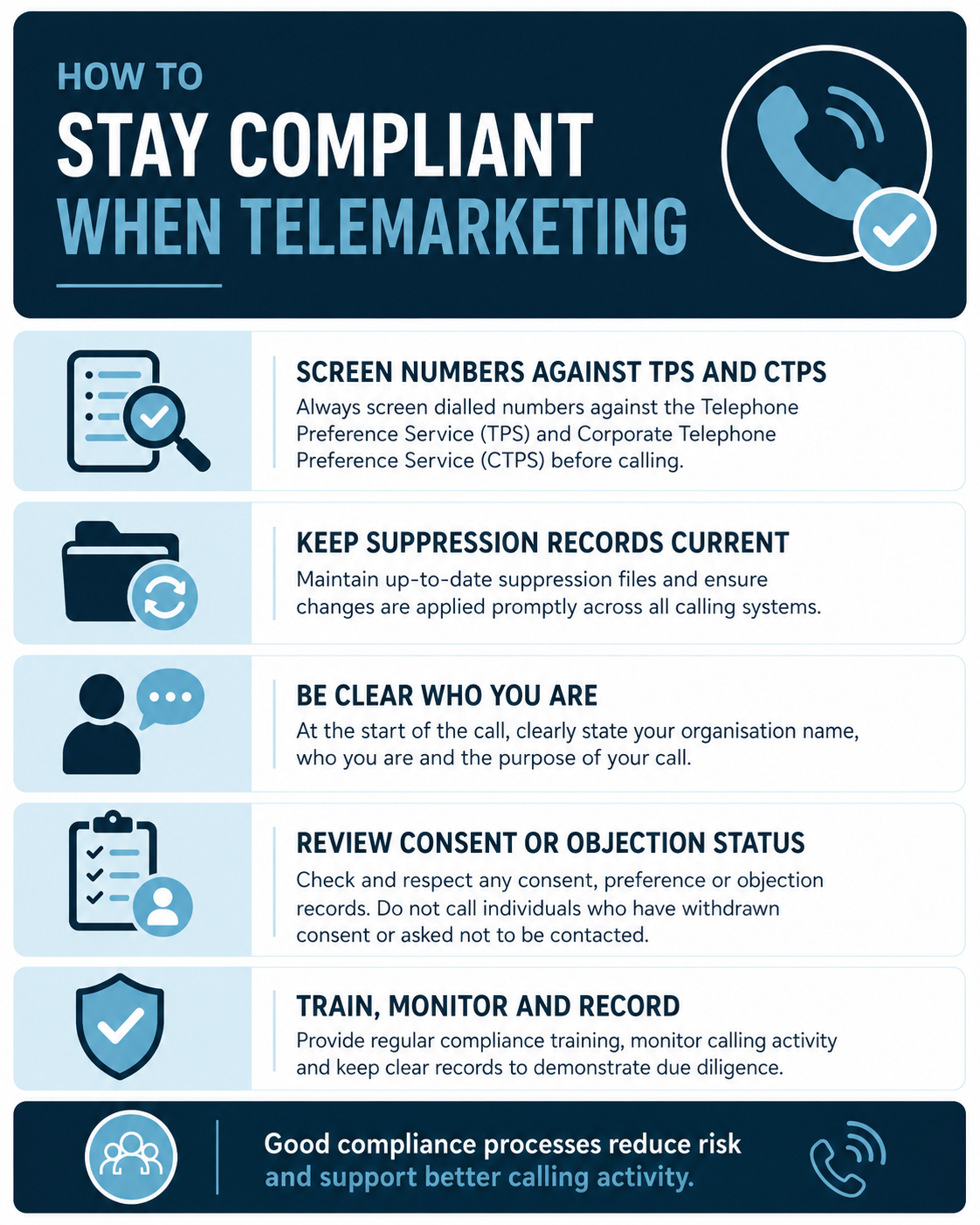
The ICO guidance on live direct marketing calls explains that, for most types of live marketing call, organisations can make unsolicited marketing calls to people and businesses if certain conditions are met. Those conditions include not calling numbers registered with TPS or CTPS unless the person has specifically told the organisation that they do not object to the call. Organisations must also avoid calling people who have previously objected.
For data processing, the ICO guide to lawful basis explains that a lawful basis is needed when personal data is processed. If a business relies on legitimate interests, the ICO guidance on legitimate interests explains that it should identify the interest, show that processing is necessary and balance that interest against the individual’s rights and expectations.
This is why responsible telemarketing is not just about running one check. It is about documenting why the campaign is relevant, what data is being used, where it came from, how it has been screened, how objections are handled and how records are kept up to date. A TPS Checker is a key part of that system, but it should not be the only control.
What a Good TPS Checking Process Should Include
A good TPS checking process starts with clear ownership. Someone should be responsible for preparing the file, checking the output, applying suppression and confirming which records are approved for use. Without ownership, checked data can still be misused because teams misunderstand the results or upload the wrong file into the dialling system.
The process should also include number standardisation. Telephone numbers can appear in many formats. They may contain spaces, brackets, country codes, leading zeros, old prefixes or typing errors. Standardisation helps improve matching quality and prevents avoidable misses. It also makes the cleaned file easier to use in CRM and reporting systems.
Next comes screening against TPS and CTPS. The output should be clear enough for non-technical users. Ideally, it should show which numbers are clear for the intended use, which are TPS or CTPS matches, which are invalid or incomplete, and which need manual review. If records are removed, the business should retain an appropriate suppression file so those numbers are not reintroduced later by mistake.
Finally, the process should feed into campaign governance. Managers should know how many records were removed, why they were removed and how many usable records remain. This makes forecasting, agent allocation and campaign reporting more reliable. AccuraData can support this with professional TPS/CTPS checking and wider data quality services.
How Often Should You Check Telephone Data?
Telephone data should be checked before campaign use, not only at the point of purchase or initial collection. The closer the screening is to the calling date, the more useful it is. A file that was clean last year may contain TPS registrations, direct objections, invalid numbers or outdated records today.
There is no single screening interval that fits every organisation. A short, one-week campaign may need one pre-launch check. A rolling campaign may need scheduled checks throughout the calling period. A CRM used by multiple sales teams may need regular cleansing and automated suppression controls. The right approach depends on call volume, risk, audience, campaign duration and how often records are added.
A practical approach is to treat TPS checking as part of campaign launch readiness. Before a list is sent to a dialler, sales team or external calling partner, it should be screened and signed off. If the campaign continues for a meaningful period, re-screening should be scheduled. If new records are added during the campaign, they should be checked before use.
AccuraData can help businesses design a practical cadence for checking and cleansing. Some clients need a one-off check before a campaign. Others need ongoing data hygiene, telephone validation and suppression management through data cleansing and enrichment.
Common TPS Checker Mistakes
The first common mistake is treating TPS checking as a one-time task. A business may buy a file, check it once and keep using it for months. That approach is risky because registration status and data quality can change. Calling data should be maintained, not frozen.
The second mistake is ignoring CTPS. B2B teams sometimes focus only on consumer TPS and forget that corporate subscribers can also register through CTPS. If your campaign includes business numbers, CTPS should be part of the screening process.
The third mistake is relying only on official register matching and ignoring internal objections. A number may not appear on TPS, but if the person has told your organisation not to call, you should suppress it. Internal do-not-call records are essential for responsible calling and should be applied every time a campaign file is prepared.
The fourth mistake is poor file management. Teams may screen one version of a list but upload another version to the dialler. They may suppress numbers but later restore them from an older backup. They may also fail to mark why a record was removed. Good file naming, version control and CRM discipline reduce these problems.
The fifth mistake is assuming that TPS status is the only legal issue. TPS checking is vital, but it does not replace lawful basis assessment, privacy information, fair processing, call script quality, caller identification, objection handling or data security.
How TPS Checking Improves Campaign Performance
TPS checking is often viewed as a compliance cost, but it can improve performance too. If your list contains numbers that should not be called, agents waste time. Some recipients may be annoyed before the conversation begins. Complaints can damage morale and make management more cautious about future campaigns. Clean data helps avoid these problems.
A screened list gives agents a better chance of speaking to relevant people. It reduces invalid calls, repeat objections and inappropriate contact. That can lead to cleaner reporting, because campaign metrics are less distorted by avoidable data issues. Managers can see how the offer, script and audience are performing rather than confusing poor data quality with weak sales execution.
Clean data also supports brand trust. The person receiving the call may never know that you screened your database, but they will notice if your team calls after they have opted out or asked not to be contacted. Respectful data use is part of how a business presents itself.
AccuraData’s role is to help businesses improve that foundation. Whether you are buying new B2C data or cleaning an existing calling file, the aim is to make the data more accurate, more usable and more suitable for the campaign.
What to Look for in a TPS Checker or Data Partner
A good TPS Checker or data partner should be able to explain how the checking process works. You should know whether it screens against TPS, CTPS or both. You should know whether it handles small files, large databases or ongoing checks. You should also understand what output you will receive and how quickly the file can be returned.
Look for a provider that understands marketing data, not just basic file processing. TPS checking is most useful when combined with data cleaning, validation, segmentation and campaign advice. If your list is full of duplicate records, old numbers and incomplete fields, a register match alone will not solve the wider problem.
Security is also important. You may be sharing customer, prospect or consumer data. Ask how the file will be transferred, who can access it, how long it will be retained and what contractual documentation is available. A serious provider should treat data handling as part of the service, not an afterthought.
AccuraData is a strong fit for businesses that want practical, UK-focused support. The team can provide TPS and CTPS checking, live number cleansing, data cleansing and enrichment and targeted data supply for campaigns that need fresh, relevant audiences.
AccuraData as Your TPS Checker and Data Quality Partner
AccuraData helps UK businesses improve the quality and usability of their sales and marketing data. For telephone marketing, that means supporting more responsible calling through data selection, TPS/CTPS screening, telephone validation, cleansing and enrichment. The service can be used before a campaign launch, before a CRM refresh or as part of a regular data maintenance programme.
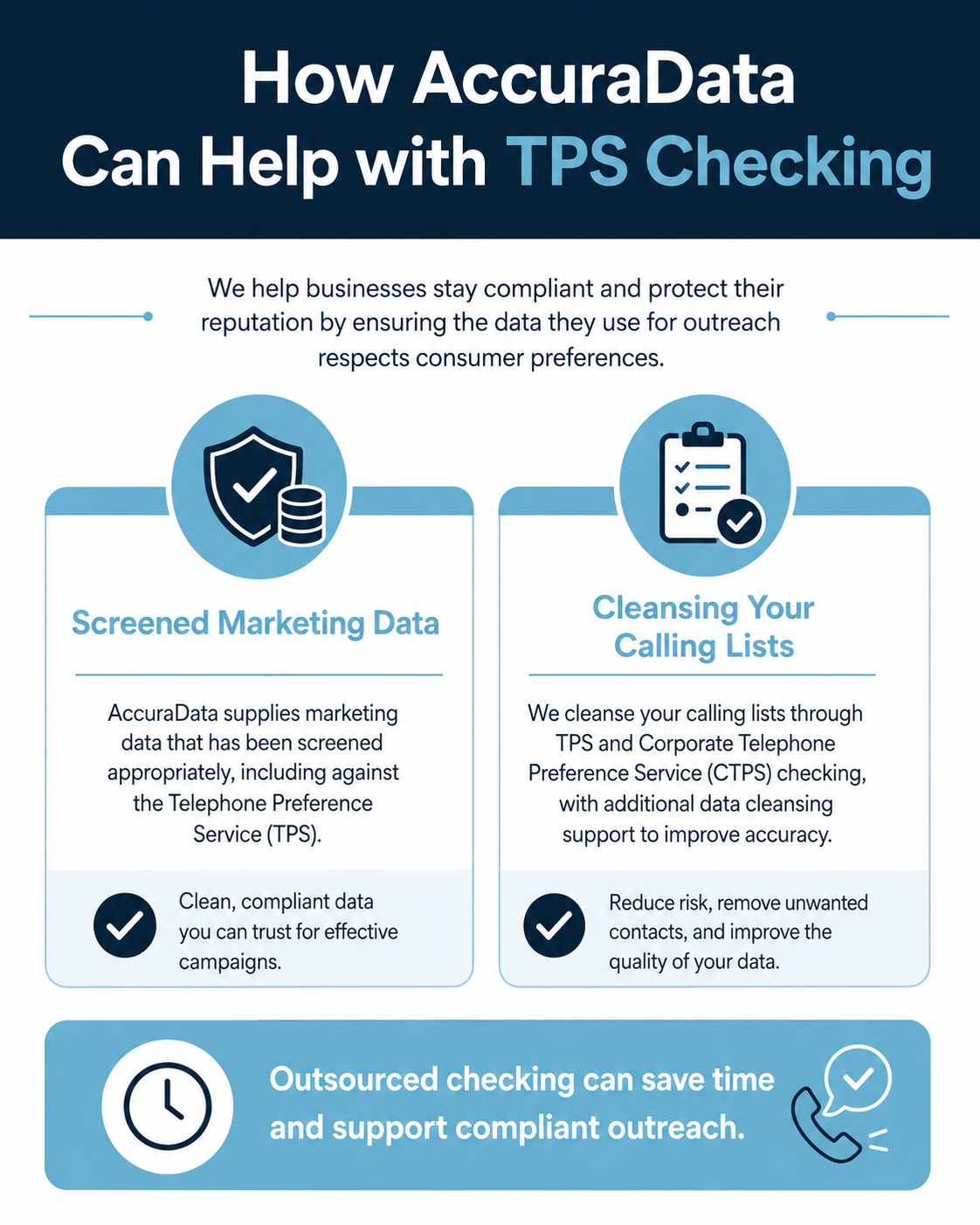
For businesses that need new consumer audiences, AccuraData’s B2C Data service can help build a more targeted prospect pool. For businesses with an existing database, AccuraData’s Data Cleansing and Enrichment service can help reduce duplicates, identify weak records and improve campaign readiness. For businesses specifically worried about calling compliance, the TPS/CTPS Checking service provides a focused route to official register screening.
The benefit of working with a data partner is that these services can be joined together. You may need new data for one campaign, cleansing for an old CRM, live number validation for a sales team, and TPS/CTPS screening before outbound activity starts. AccuraData can help you understand which service is most relevant rather than pushing a one-size-fits-all answer.
This joined-up approach is especially useful when internal teams are busy. Sales leaders want agents speaking to the right people. Marketing teams want cleaner campaign reporting. Compliance teams want evidence that checks have been completed. Operations teams want files that work inside existing systems. A quality data partner helps all of those groups work from the same clean foundation.
A Practical TPS Checker Workflow for Businesses
A simple workflow can make TPS checking easier to manage. Start by defining the campaign audience and call purpose. Then export or source the relevant telephone data. Remove obvious duplicates and correct basic formatting problems. Screen the file against TPS and CTPS where relevant. Apply internal do-not-call suppression. Validate numbers if contactability is a concern. Then approve the final call file for use.
Once the campaign starts, agents should be trained to identify objections and record them correctly. If someone asks not to be called again, that instruction should be captured immediately. If a number is wrong, invalid or connected to the wrong person, the record should be updated. If a prospect asks for information by another channel, that preference should be recorded too.
After the campaign, review the data outcomes as well as the sales outcomes. How many records were suppressed? How many numbers were invalid? How many wrong-party contacts occurred? How many objections were raised? How many calls led to a meaningful conversation? These answers help improve the next data selection and checking process.
Businesses that treat TPS checking as part of a feedback loop tend to build stronger databases over time. Each campaign improves the next one because records are corrected, suppressed, enriched or segmented based on real outcomes.
TPS Checker FAQs
Is TPS checking a legal requirement?
For live marketing calls, businesses need to respect TPS and CTPS registrations and previous objections. The ICO guidance on live marketing calls explains the conditions that apply to most types of live marketing call. In practical terms, screening against the relevant register is a key compliance step before calling.
Does TPS apply to mobile numbers?
Yes. The TPS registration service allows people to register landline or mobile numbers. Marketing teams should not assume that mobile numbers are outside the scope of TPS.
Does TPS checking replace consent?
No. A TPS Checker and consent are different concepts. A number not appearing on TPS does not automatically prove that every marketing call is appropriate. Businesses should still consider PECR, UK GDPR, lawful basis, previous objections and the purpose of the campaign.
Can AccuraData cleanse my existing list?
Yes. AccuraData can support your existing database through TPS/CTPS Checking, Live Number Cleansing and wider Data Cleansing and Enrichment. This can help prepare your own lists before outbound calling.
Can AccuraData supply data that has already been checked?
Yes. AccuraData can supply targeted campaign data and support checking processes before delivery or campaign use. For consumer campaigns, the B2C Data service helps businesses target relevant audiences while data quality and campaign suitability are considered.
Final Thoughts on TPS Checkers and Responsible Calling
A TPS Checker is more than a technical lookup. It is a core part of responsible telephone marketing. It helps businesses respect people’s preferences, avoid unsuitable calls, reduce wasted dialling time and build cleaner campaign processes. Used well, it supports both compliance and performance.
The strongest telemarketing campaigns are not built on the biggest lists. They are built on relevant audiences, accurate contact data, clear calling purpose, careful screening, good scripts, trained agents and reliable follow-up. TPS and CTPS checking should be built into that system before calling begins, not added only after a problem appears.
AccuraData can help whether you need new data or better use of data you already hold. If you need targeted consumer records, AccuraData’s B2C Data can support campaign planning. If you need your existing list screened, the TPS/CTPS Checking service can help. If your database needs broader improvement, Data Cleansing and Enrichment can help turn messy records into a more useful asset.
For any business that relies on telephone marketing, the message is simple: check before you call, keep records clean, respect objections and work with a provider that understands both data quality and UK campaign requirements.