
Email marketing campaigns remain one of the most practical ways for UK businesses to reach prospects, nurture interest and turn attention into measurable sales activity. The channel works because it is direct, controllable and measurable. A campaign can be aimed at a defined audience, written around a clear proposition, delivered at a chosen time and analysed in detail afterwards. That makes email particularly useful for B2B organisations with specific sectors, locations, job roles or company types they want to reach.
The challenge is that the gap between a good email marketing campaign and a poor one is wider than it looks. Two companies can use the same platform and send the same volume of emails, yet produce completely different outcomes. The difference usually sits in the foundations: data quality, audience selection, compliance, deliverability, campaign planning, creative relevance and follow-up. Email is rarely won by sending more. It is won by sending better, to the right people, with a clear reason for them to care.
This guide explains how email marketing campaigns work from planning through to reporting and improvement. It covers campaign objectives, data selection, segmentation, compliance under UK GDPR and PECR, email content, design, deliverability, measurement and optimisation. It also explains when outsourcing makes sense, and how AccuraData can support businesses that need targeted data, campaign management, email copy, broadcast support and post-campaign reporting through its B2B Email Data and Email Marketing Services solutions.
What Are Email Marketing Campaigns?
Email marketing campaigns are planned email communications sent to a defined group of contacts for a specific business purpose. That purpose might be to introduce a service, promote an offer, nurture a prospect, invite contacts to an event, follow up after a download, re-engage inactive subscribers or support a wider lead generation campaign. A campaign can be a single broadcast, but the strongest programmes usually involve a planned sequence of messages supported by segmentation, testing and follow-up.
A proper campaign is different from an isolated send. A send is the technical act of delivering an email. A campaign includes the planning before the send, the data behind the audience, the legal basis for contacting that audience, the copy and creative, the deliverability setup, the timing, the tracking and the actions taken after the results come in. When businesses treat email as a full campaign discipline rather than a one-off mailing task, they usually make better decisions at every stage.
The UK regulatory context matters as well. For B2B email marketing, the ICO confirms that the PECR rule on direct marketing by electronic mail does not apply to corporate subscribers, meaning B2B direct marketing emails can be sent to corporate bodies without consent under PECR. The ICO also makes clear that UK GDPR still applies where personal information is used, such as a named business email address. That is why lawful basis, transparency, opt-out handling and data minimisation remain important for B2B campaigns.
For consumer email marketing, the rules are stricter. The ICO states that marketing emails or texts to individual subscribers generally require specific consent, unless a limited soft opt-in exception applies for existing customers. This distinction is one reason why businesses need to be clear about whether they are running a B2B, B2C or mixed campaign before data is selected or creative is written.
Why Email Marketing Campaigns Still Matter
Email marketing has remained commercially important because it gives organisations direct access to an audience they can define and measure. Unlike paid social, search or display advertising, the distribution of an email campaign is not governed by an advertising auction or a social platform algorithm. The business controls the list, the message, the timing and the follow-up process. That does not mean every campaign performs well, but it does mean performance can be improved through better inputs and better management.
The Data & Marketing Association has long reported email as a high-return channel, and its email research has consistently focused on the commercial value generated by email activity. That commercial strength is not automatic. It depends on the quality of the list, the relevance of the message, the timing of the campaign, the trustworthiness of the sender and the ability to convert engagement into pipeline.
Email also supports multiple stages of the customer journey. A cold B2B email campaign can introduce a business to a new market. A nurture campaign can educate prospects who are not ready to buy. A customer campaign can encourage repeat purchase, upsell or renewal. A reactivation campaign can identify contacts who still recognise the brand but have gone quiet. This flexibility is one reason email marketing campaigns remain useful for businesses with long sales cycles, consultative selling models or defined professional audiences.
The other advantage is measurability. Email campaign reporting can show delivery, opens, clicks, unsubscribes, bounces, replies, conversions and segment-level performance. Open rates need careful interpretation because privacy features and image loading can affect reliability, but clicks, replies, conversions and sales outcomes still provide useful signals. Mailchimp’s guidance on email measurement identifies metrics such as open rate, click-through rate, bounce rate, deliverability and business impact as core areas to monitor.
Start with the Campaign Objective
Every strong email marketing campaign starts with a clear objective. Without one, the campaign becomes a collection of reasonable ideas rather than a planned route to a measurable outcome. The objective shapes the audience, the message, the call to action, the landing page, the follow-up process and the reporting criteria.
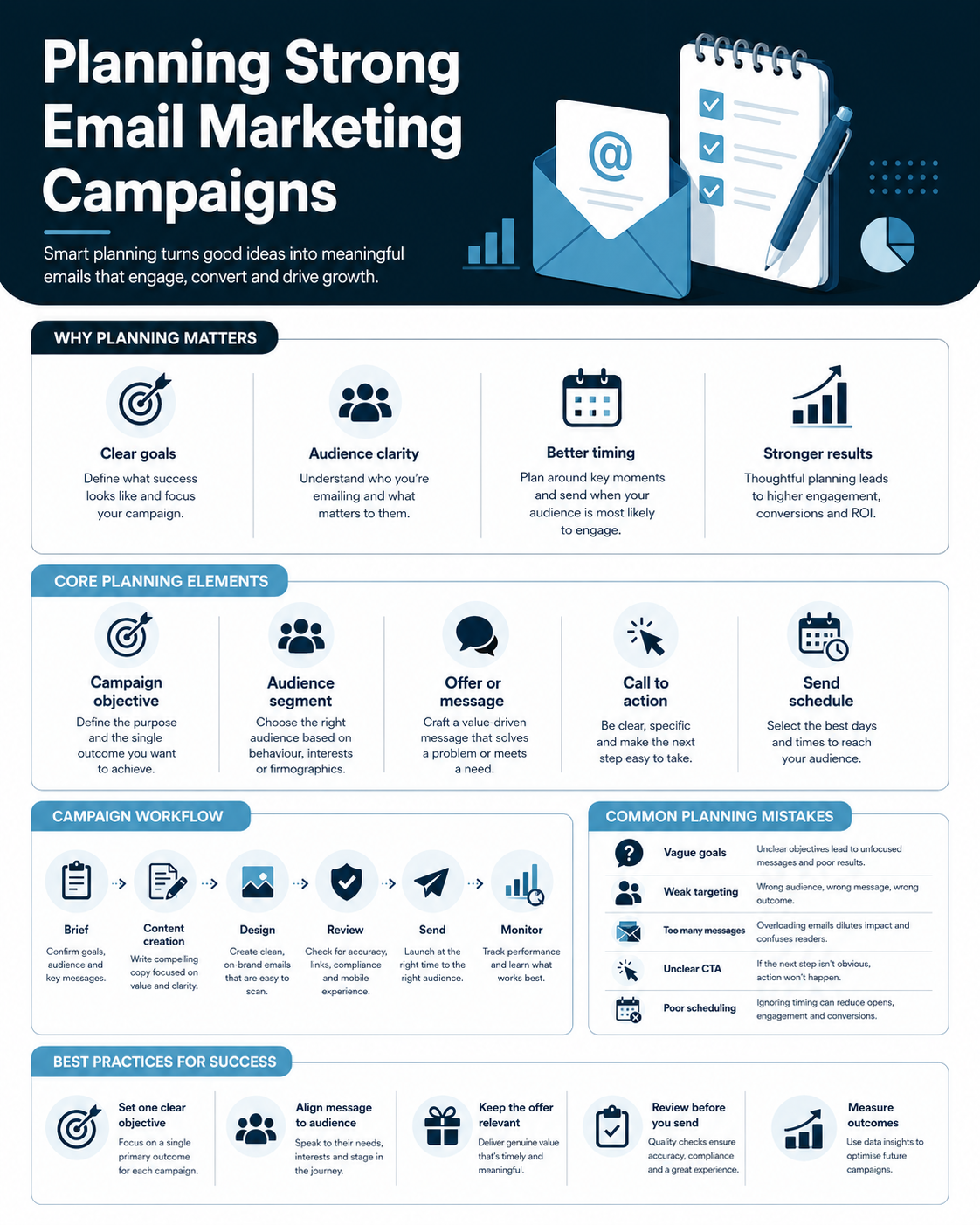
The objective should be specific enough to guide decisions. ‘Generate leads’ is useful as a broad ambition, but it is too general for campaign planning. A better objective might be to generate consultation enquiries from finance directors at UK manufacturing companies, reactivate dormant customers in a specific region, promote a webinar to HR leaders, or create warm follow-up opportunities among managing directors in professional services firms. Once the objective is this clear, the campaign becomes much easier to build.
The objective also determines what success looks like. A campaign designed to drive direct enquiries should be measured differently from a thought leadership campaign designed to warm up a cold audience. An event invitation may be judged by registrations. A nurture email may be judged by content engagement and follow-up intent. A sales campaign may be judged by replies, booked calls, opportunity value and eventual revenue. Businesses that define the measurement before sending are less likely to mistake vanity metrics for commercial performance.
This is where outsourced support can be useful. AccuraData’s Email Marketing Services can support campaign planning, audience selection, email copywriting, design, broadcast management and post-campaign reporting, which helps businesses move from vague campaign intent to a structured delivery plan.
Define the Audience Before Writing the Email
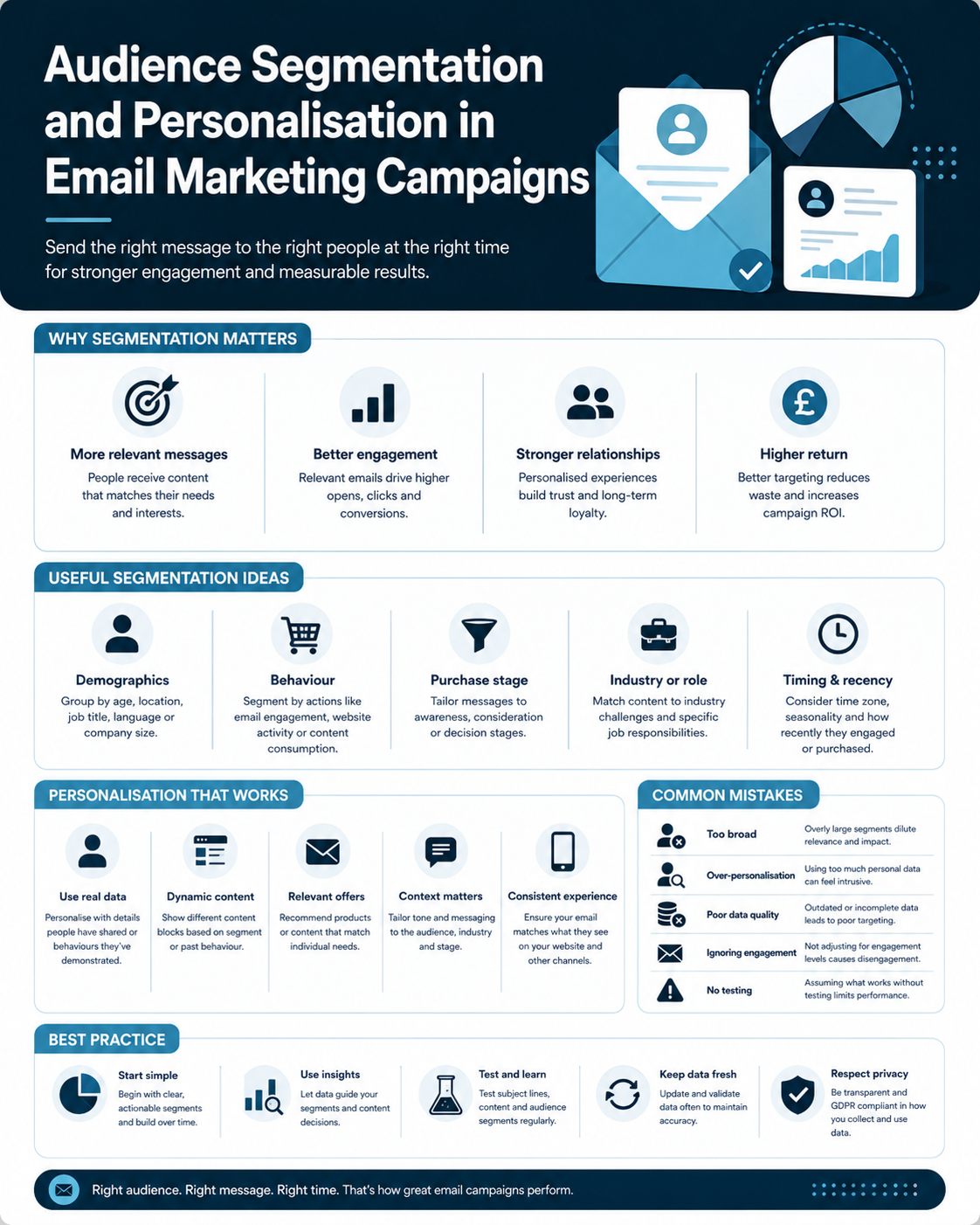
A common mistake in email campaign planning is to write the email first and then search for an audience that might fit it. In most cases, the better approach is the reverse. Define the audience first, then build the message around the audience’s role, sector, needs, timing and decision-making context.
For B2B email marketing campaigns, audience definition usually starts with firmographic and role-based criteria. Useful fields include industry sector, SIC code, company size, turnover banding, geographic location, job title, seniority level and department. These fields allow a campaign to be narrowed to people who are likely to understand the problem, influence the purchase or control the budget. AccuraData’s B2B Email Data page explains that B2B email marketing lists can be tailored using criteria such as industry sector, company size, geographic location, job function, seniority, employee count, turnover and SIC code targeting.
Segmentation matters because business audiences are rarely uniform. A small accountancy practice does not respond to the same argument as a national finance team. A facilities manager has different priorities from a managing director. A technology buyer may need technical confidence, while a business owner may care more about time savings, cost control and results. Strong segmentation lets each audience receive a message that fits its context.
Personalisation can improve campaign relevance when it is used carefully. Campaign Monitor describes email personalisation as more than adding a first name, with options including data-driven content and tailored experiences. For B2B campaigns, meaningful personalisation usually comes from segment-level relevance rather than intrusive individual detail. Mentioning the recipient’s sector, role challenge or business context is usually more useful than forcing personal details into copy.
Build Email Marketing Campaigns on Quality Data
The data behind an email marketing campaign is not an administrative detail. It is the starting point of performance. Poor data creates immediate problems: bounced emails, irrelevant recipients, inaccurate job roles, duplicate records, spam complaints, wasted sales follow-up and distorted reporting. Good data does the opposite. It gives the campaign a realistic chance of reaching people who match the intended audience and can take the desired action.
Quality data has several characteristics. It is accurate, recent, relevant, segmented, permission-aware and documented. Accuracy means the email address exists and can receive mail. Recency matters because business contacts change roles, companies merge, staff leave and domains become inactive. Relevance means the contact matches the target profile. Segmentation means the database includes enough fields to group contacts meaningfully. Documentation means the source, lawful basis and processing conditions are understood.
For businesses that already hold a database, cleaning and enrichment should come before campaign launch. AccuraData’s data cleansing and enrichment services help businesses improve database quality through data cleaning, enrichment and validation. For email campaigns, this can help identify invalid addresses, duplicate records, outdated company information and incomplete segmentation fields before a campaign damages deliverability or wastes follow-up resource.
For businesses that do not have a usable database, purchasing targeted B2B email data may be more efficient than trying to build a list contact by contact. The key is to use data that is verified, relevant and supplied with the right compliance documentation. AccuraData provides UK-focused B2B Email Data for targeted email campaigns, with segmentation designed around industry, role, company size and other campaign criteria.
Understand GDPR and PECR Before You Send
Compliance should be part of campaign planning, not a late-stage check. Email marketing campaigns in the UK sit within two legal frameworks: UK GDPR and the Privacy and Electronic Communications Regulations, usually called PECR. PECR governs electronic marketing rules such as consent and soft opt-in. UK GDPR governs the processing of personal data, including identifiable business contact records.
For B2B campaigns sent to corporate subscribers, ICO guidance confirms that the PECR rule on direct marketing by electronic mail does not apply in the same way as it does to individual subscribers. However, the ICO also states that businesses must still identify themselves and provide contact details. The ICO’s guidance on complying with electronic mail rules states that organisations must not disguise or hide their identity and must provide a valid contact address for opt-outs.
UK GDPR still applies to named business contacts. A record such as firstname.lastname@company.co.uk identifies a person, even if the address is used in a professional context. In many B2B email marketing campaigns, legitimate interests may be considered as a lawful basis, but it must be assessed properly. The ICO explains that legitimate interests involve considering the purpose, necessity and balance of the processing.
A responsible B2B campaign should therefore include a documented legal basis, appropriate segmentation, clear sender identification, a simple opt-out route, suppression of people who object, and records of how the data was sourced and managed. These steps are not only legal safeguards. They also improve campaign quality, because they reduce irrelevant outreach and help protect sender reputation.
AccuraData positions compliance as part of the data and campaign process. Its B2B Email Data and Email Marketing Services pages explain how targeted email campaigns are supported by compliant data, campaign preparation and reporting. Businesses should still take their own legal advice where required, but using a specialist partner helps reduce the risk of launching campaigns from poorly sourced or poorly documented data.
Plan the Campaign Structure
Once the objective, audience and legal basis are clear, the next step is campaign structure. A structure is the practical plan for how the campaign will move a contact from receiving an email to taking an action. It covers the offer, the message, the creative format, the number of emails, the timing, the landing destination and the follow-up route.
For many B2B email marketing campaigns, a sequence performs better than a single email because it gives the prospect more than one opportunity to engage. The first email can introduce the problem or proposition. The second can add proof, insight or a useful resource. The third can offer a clear next step. The aim is not to overload the recipient, but to create a logical communication path that respects attention and gives the campaign enough time to work.
The structure should reflect the buying journey. A high-intent campaign promoting a known service might use a direct call to action, such as requesting a quote or booking a consultation. A campaign aimed at a colder audience may need a softer action, such as downloading a guide, reading an article, checking eligibility or reviewing a case study. Asking too much from a cold audience can depress response. Asking too little from a warm audience can waste opportunity.
Good campaign structure also includes internal responsibilities. Someone must own the data, someone must approve the message, someone must configure the send, someone must check compliance, someone must monitor performance and someone must follow up. In-house teams often struggle because these tasks sit across marketing, sales, data and compliance. Outsourced campaign management can bring those moving parts into one controlled workflow.
Write Campaign Copy Around Value and Relevance
Email copy has one job: to make the next action feel relevant and worthwhile. That does not require aggressive sales language. In fact, most B2B audiences respond better to clarity, relevance and usefulness. The recipient should quickly understand why they are receiving the email, what problem it relates to, what value is being offered and what they can do next.
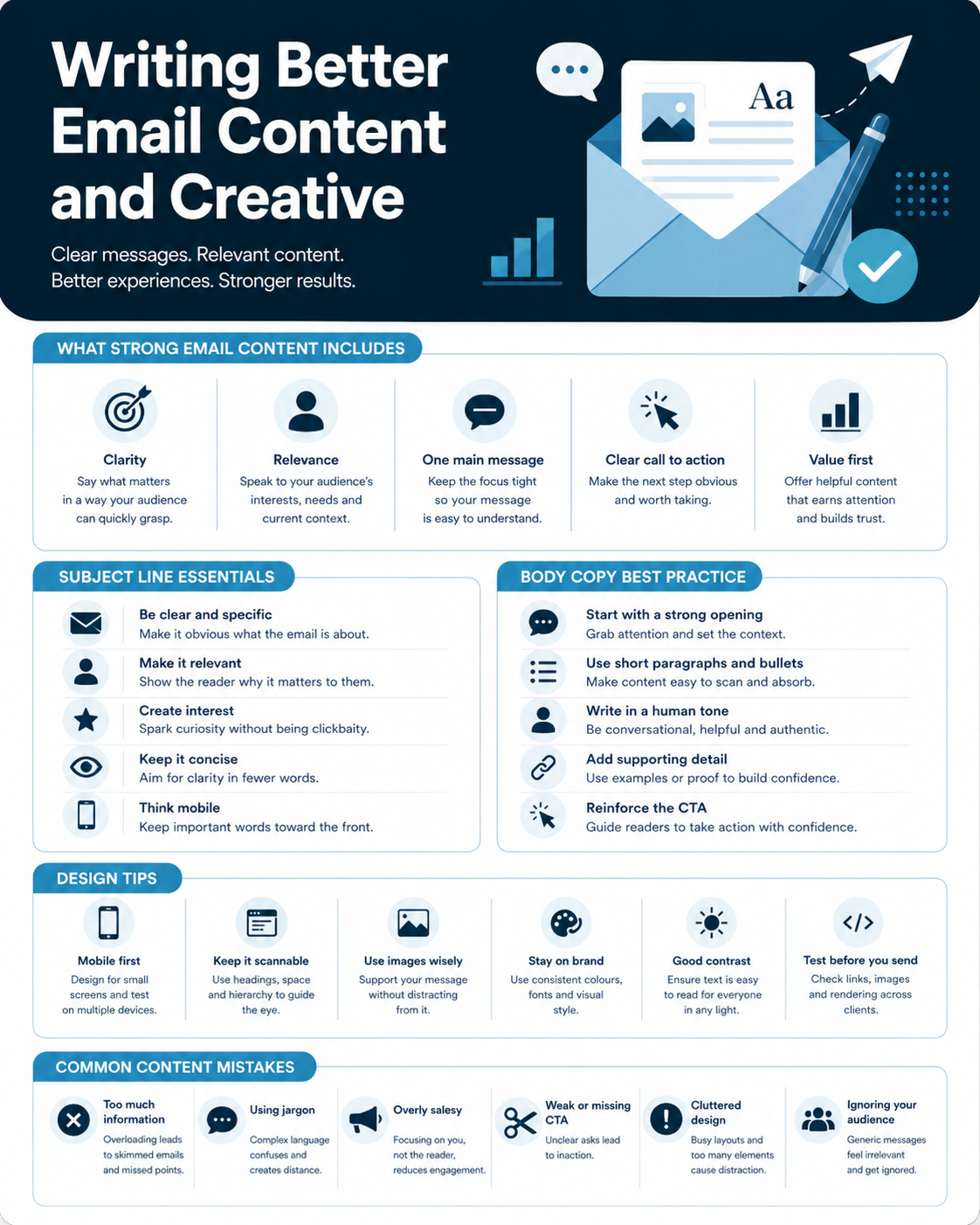
The subject line should be specific enough to set the expectation. Clickbait may create curiosity, but it usually damages trust if the content fails to match. A strong subject line is honest, concise and linked to the recipient’s likely interest. The opening sentence should confirm relevance rather than start with a generic introduction. If the campaign is segmented properly, the opening can refer to the sector, role, challenge or business situation the audience recognises.
The body copy should avoid trying to say everything. A common problem in email marketing campaigns is message overload. Businesses try to include every service, feature, proof point and qualification in one email, which leaves the recipient with no clear reason to act. Stronger campaigns choose one main message, support it with a small amount of proof and then present a clear call to action.
The tone should be professional but human. B2B buyers are not looking for theatrical language in an inbox. They want a message that respects their time, understands their context and offers something useful. This is where AccuraData’s campaign support can help. Its Email Marketing Services include email copywriting and design support, which is useful for businesses that have strong offers but need help turning those offers into focused campaign creative.
Design Emails for Scanning, Not Reading Every Word
Most recipients scan marketing emails before deciding whether to engage. That means design should support fast understanding. A strong email layout uses a clear headline, short sections, visible hierarchy, readable fonts, appropriate spacing and a call to action that stands out. The design should guide attention, not distract from the message.
Mobile display matters. Many recipients will review email on phones or tablets before returning to it later on desktop, so emails need to render clearly across devices. This affects image sizing, button spacing, line length and the amount of copy used. A design that looks polished on a large monitor can become difficult to read on a small screen if the layout is too complex.
Images should support the message rather than carry all essential information. Some email clients block images by default, and some recipients use settings that limit image loading. Important text should be included as live text where possible, not embedded only within an image. Accessibility and readability both improve when the message is understandable without relying entirely on visuals.
Design also affects trust. A campaign that looks rushed, cluttered or inconsistent with the brand can undermine the offer before the recipient reads it properly. Conversely, a clean and professional email design can make the message feel more credible. This is particularly important when contacting cold B2B audiences that have no existing relationship with the sender.
Protect Deliverability Before the Campaign Launches
Deliverability is the ability of an email to reach the inbox rather than being rejected, quarantined or filtered into spam. It is affected by technical configuration, sender reputation, list quality, content, sending volume, engagement and complaint behaviour. A campaign can have excellent copy and still fail if the sending domain has poor reputation or the list contains too many invalid addresses.
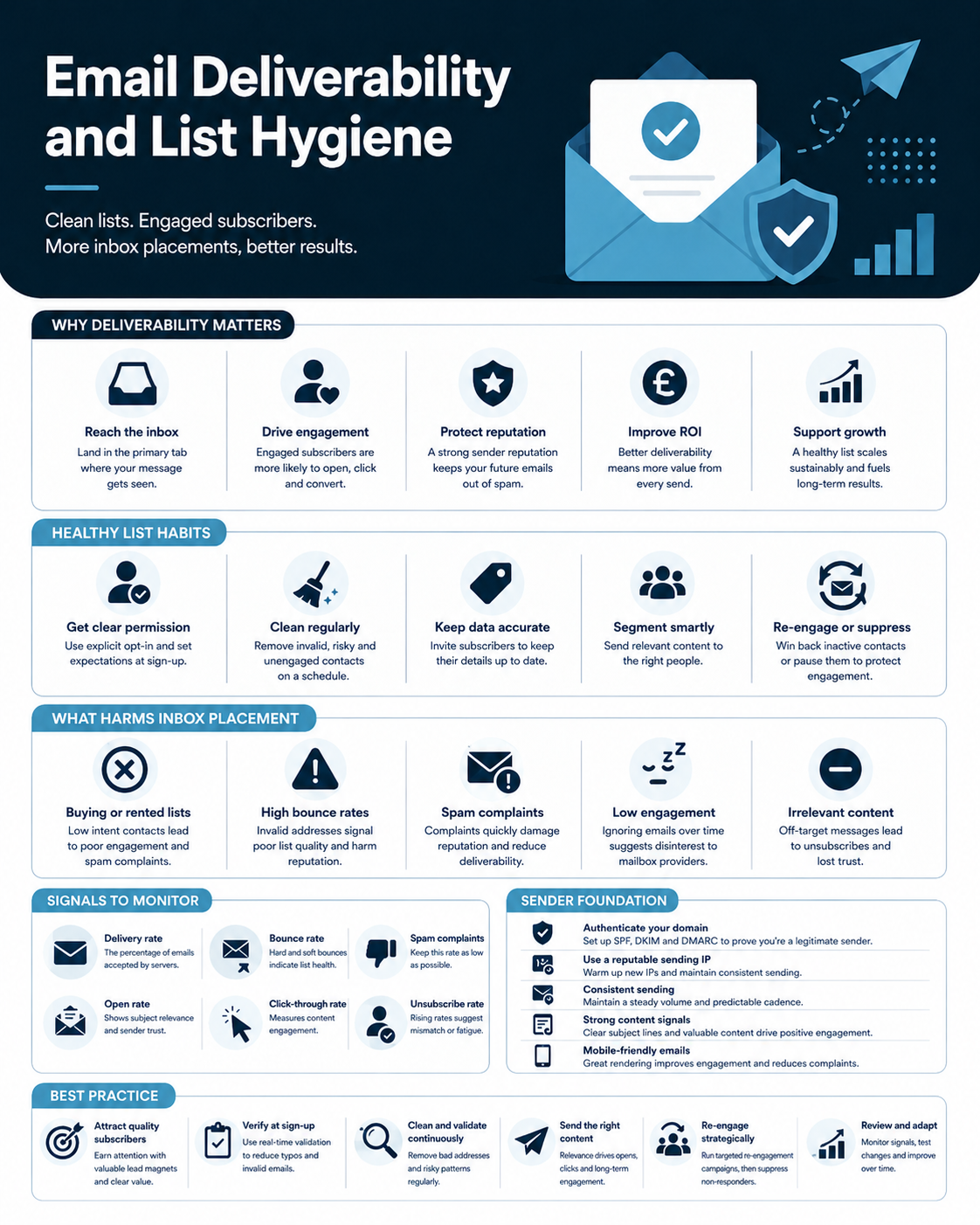
Google’s sender guidelines recommend setting up SPF, DKIM and DMARC to improve email delivery, and they warn that unauthenticated messages may be marked as spam or rejected. These authentication records help mailbox providers understand that the sender is legitimate and that messages have not been forged.
Technical authentication is only one part of deliverability. List hygiene is equally important. High bounce rates signal poor data quality, and spam complaints signal poor targeting, poor expectation management or poor relevance. If recipients ignore, delete or complain about emails, future campaigns from the same sending infrastructure may struggle. Deliverability is therefore a cumulative asset. It improves with disciplined sending and declines when campaigns are rushed, irrelevant or built on weak data.
Before launch, businesses should check the data, suppress people who have opted out, remove duplicates, segment properly, validate email addresses and review content for spam-like signals. They should also avoid sudden high-volume sends from a new or inactive domain. For businesses with old or mixed-quality databases, professional data cleansing and enrichment can reduce risk before campaign deployment.
Operate Email Marketing Campaigns with a Clear Workflow
Operating an email campaign involves more than loading data and pressing send. A controlled workflow reduces mistakes and improves repeatability. The basic workflow should include briefing, data selection, segmentation, compliance review, copywriting, creative build, technical setup, test sending, approvals, broadcast deployment, monitoring, reporting and follow-up.
The campaign brief should explain the objective, audience, offer, key message, proof points, tone, call to action, landing page and follow-up plan. It should also confirm who approves the campaign and what cannot be changed. A poor brief leads to slow production, unclear messaging and last-minute revisions.
Data selection should happen before copy and design are finalised. The audience determines what matters. If the campaign targets construction directors, the message should be different from one targeting HR managers. If the campaign targets companies in one region, the proof points and call to action may need to reflect that geography. Data and creative need to develop together.
Testing should include rendering checks, link checks, merge field checks, spelling, compliance wording, unsubscribe functionality and display on mobile. A campaign should not be judged only by how it looks in the platform editor. It should be viewed in real inboxes where possible, because email clients render HTML differently.
AccuraData’s Email Marketing Services are designed to support this operational workflow, including campaign data supply, campaign preparation, broadcast management and reporting. For businesses without internal email marketing resource, this reduces the need to coordinate multiple suppliers or stretch a small marketing team across specialist tasks.
Measure the Metrics That Actually Explain Performance
Email campaign reporting should answer a practical question: what happened, why did it happen and what should change next time? A report that lists opens and clicks without interpretation is not enough. The most useful reporting connects email metrics to campaign objectives and commercial outcomes.
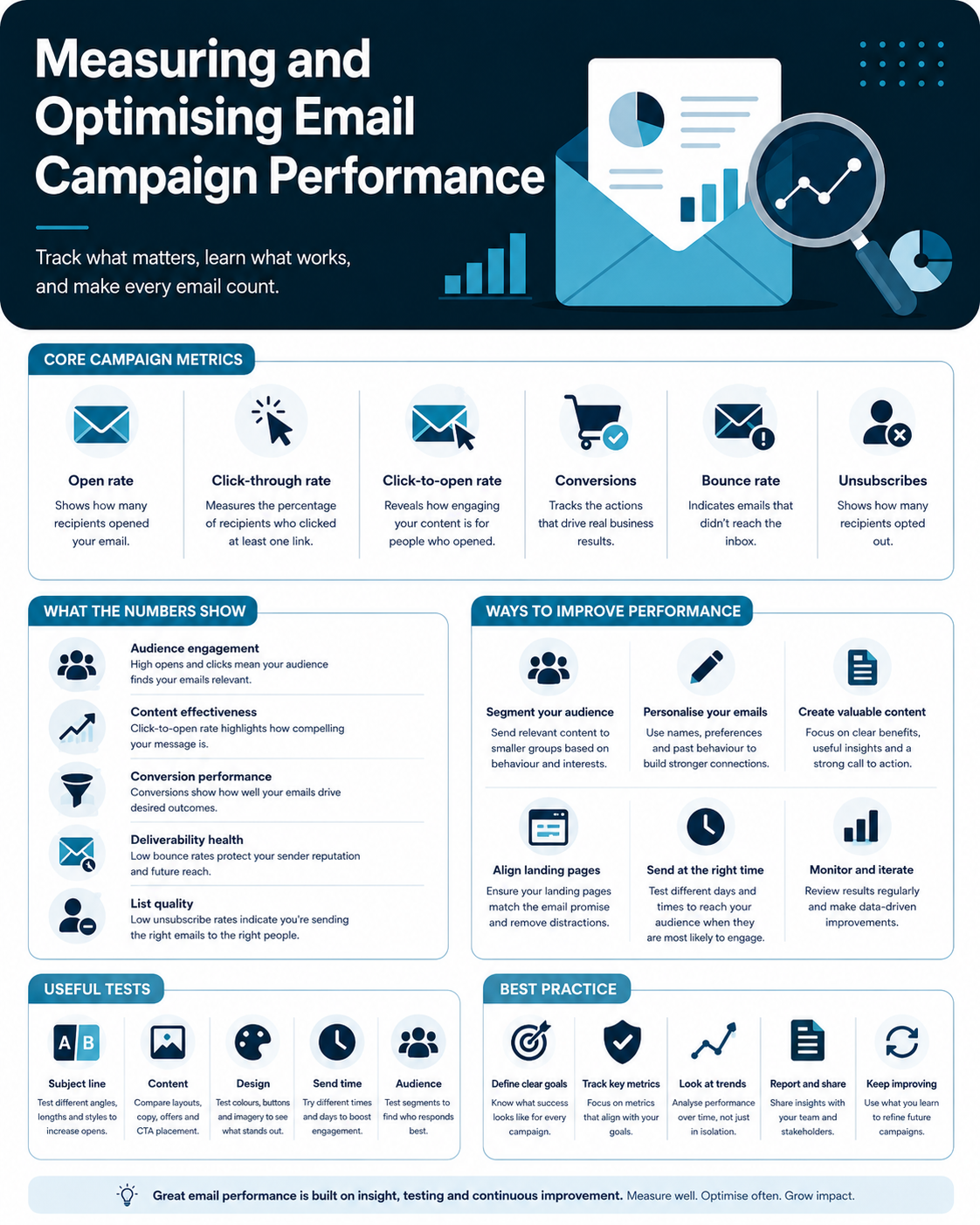
Core campaign metrics include delivery rate, bounce rate, open rate, click-through rate, click-to-open rate, unsubscribe rate, replies, conversions and follow-up outcomes. Mailchimp’s email measurement guidance identifies open rate, click-through rate, bounce rate, deliverability and business impact as important measures, and it advises using performance data to make strategic adjustments.
Open rate can still provide a directional signal, but it should not be treated as the sole measure of success. Privacy features and image loading behaviour can affect open tracking. Clicks, replies, conversions, booked meetings, form submissions and sales opportunities are usually closer to commercial value. A campaign with modest opens but strong replies may be more valuable than a campaign with high opens and no meaningful engagement.
Segment-level reporting is often more useful than whole-campaign reporting. If one sector, job role or company size band produces stronger engagement, that finding should influence future data selection and messaging. If one segment shows high bounces or unsubscribes, the data or proposition should be reviewed. Email marketing campaigns improve when each send teaches the next one.
For outsourced campaigns, reporting should be clear, usable and connected to follow-up. AccuraData’s Email Marketing Services include post-campaign reporting and warm prospect identification, which helps sales teams focus on the contacts showing the strongest engagement instead of treating every recipient equally.
Turn Campaign Results into Improvements
Improvement is the stage many businesses skip. They send a campaign, review headline figures, then move on. That limits the value of the channel. Email marketing campaigns should create learning. Every send should improve understanding of audience preference, messaging, timing, content format, landing page performance and follow-up quality.
Improvement starts by separating symptoms from causes. A low open rate may suggest weak subject lines, poor sender recognition, bad timing, irrelevant audience selection or deliverability issues. A high open rate with low clicks may suggest that the subject line created interest but the offer, copy or call to action did not carry that interest forward. A high click rate with low conversions may suggest a landing page problem rather than an email problem.
Testing helps identify the cause. Useful tests include subject line angle, opening sentence, call to action, offer type, design layout, sending time, audience segment and landing page alignment. Tests should be controlled. If too many variables change at once, the result becomes hard to interpret. Over time, small measured improvements compound into stronger campaign performance.
Improvement also includes database decisions. Contacts who bounce should be removed or corrected. People who unsubscribe should be suppressed. Contacts who engage repeatedly can be moved into higher-priority follow-up. Inactive contacts can enter a re-engagement programme before being suppressed. This is where email marketing overlaps with email database marketing, because the database becomes smarter as campaign engagement is fed back into it.
A campaign programme should therefore have a learning loop: plan, send, measure, interpret, update the data, refine the message and send again. Businesses that maintain this loop usually become more efficient because they stop repeating the same mistakes and concentrate spend on the segments and propositions that perform best.
Common Mistakes in Email Marketing Campaigns
Many email marketing campaigns fail for avoidable reasons. The first mistake is using data that has not been verified or segmented. This creates bounces, low relevance and poor reporting. The second is trying to reach too broad an audience with one generic message. Broad campaigns often look efficient because they reach more people, but they can produce low response because few recipients feel the message is meant for them.
Another mistake is making the email about the sender instead of the recipient. Lists of features, company history and internal achievements rarely create action on their own. The recipient needs to understand the practical value to them. That value might be saving time, reducing risk, increasing revenue, solving a known pain point, improving compliance or accessing specialist expertise.
A fourth mistake is weak follow-up. Email engagement is only useful if the business acts on it. If a prospect clicks a service page, replies with interest or downloads a resource, the follow-up should be timely and relevant. A campaign can generate warm signals, but those signals lose value quickly if the sales team does not know what to do next.
Compliance shortcuts are also a common problem. Poorly sourced data, missing opt-out routes, unclear sender identity and failure to maintain suppression lists all create risk. The ICO guidance on electronic mail rules confirms that organisations must not disguise or hide their identity and must provide a valid contact address for opt-outs.
The final mistake is measuring the wrong thing. A business that celebrates open rates but ignores replies, conversions, list quality, bounce rate and follow-up outcomes may optimise for attention rather than revenue. Good reporting looks at the full journey from send to sale.
When Should You Outsource Email Marketing Campaigns?
Outsourcing email marketing campaigns can make sense when the internal team lacks time, platform knowledge, data expertise, copywriting resource, design capability, compliance confidence or reporting structure. It can also make sense when a business wants to test a new market quickly without building every process from scratch.
Outsourcing does not mean handing over control of strategy. A good outsourced partner should help clarify the strategy, then manage the specialist work required to deliver it. The client should still provide commercial insight, target market understanding, offer details, brand direction and sales feedback. The outsourced team should bring campaign planning, data management, creative execution, technical delivery and reporting discipline.
The main benefit is focus. Internal sales and marketing teams often know their proposition well, but they may not have the time to clean data, build segments, write email copy, design assets, configure broadcasts, test deliverability, monitor engagement and produce reports. An outsourced partner can manage those steps while the internal team concentrates on proposition, approvals and follow-up.
Outsourcing is particularly useful for businesses that need a campaign built around high-quality data. AccuraData combines targeted data supply with campaign management through its B2B Email Data and Email Marketing Services. That combination matters because campaign quality depends on both the audience and the execution.
What to Look for in an Outsourced Email Marketing Partner
A strong outsourced email marketing partner should be able to explain how campaigns are planned, how data is selected, how compliance is handled, how creative is produced, how deliverability is protected and how results are reported. If a provider focuses only on send volume, that is a warning sign. Volume is not a strategy. A campaign should be judged by relevance, quality, compliance and measurable outcomes.
Data capability is essential. The partner should understand the difference between B2B and B2C data, know how to segment audiences, recognise the importance of suppression files and provide a clear explanation of sourcing and lawful basis. AccuraData’s B2B Email Data is built for targeted outreach, with segmentation options that help campaigns reach defined business audiences rather than generic lists.
Compliance understanding is equally important. The partner should understand that PECR and UK GDPR work together, and that B2B email campaigns still require responsible processing, even when PECR consent is not required for corporate subscribers. ICO guidance on legitimate interests highlights the importance of assessing purpose, necessity and balancing interests when relying on that lawful basis.
Operational discipline also matters. Ask how campaigns are briefed, how copy is approved, how tests are completed, how links are checked, how data is loaded, how unsubscribes are handled and how reporting is delivered. A reliable provider should be able to describe a repeatable process, not improvise every campaign.
Finally, look for a partner that understands follow-up. Email marketing campaigns should create sales opportunity, not just engagement statistics. Reporting should help the sales team identify warm prospects, understand what they clicked and decide what to do next. AccuraData’s Email Marketing Services include warm prospect identification and reporting to support follow-up activity.
How AccuraData Supports Email Marketing Campaigns
AccuraData is well-positioned for businesses that want email marketing campaigns built on accurate data and managed through a practical delivery process. The company provides UK B2B data, lead generation services, business contact databases, telemarketing data, email marketing data and data cleansing services for outbound marketing activity.
For businesses that need a targeted audience, AccuraData can supply B2B Email Data segmented by industry, company size, location, job function, seniority and other campaign criteria. This helps businesses avoid the common problem of sending one generic message to an audience that is too broad to respond.
For businesses that need campaign execution support, AccuraData’s Email Marketing Services cover campaign data supply, email copywriting, email design, broadcast management and post-campaign reporting. This makes the service suitable for businesses that want a more complete campaign solution rather than simply purchasing a list.
For businesses with existing databases, AccuraData’s data cleansing and enrichment services can help improve the quality and usability of campaign data. This is useful where a CRM has grown over time, contains duplicates, lacks segmentation fields or has not been validated recently. Clean data reduces wasted sends and gives reporting a firmer base.
AccuraData can also support wider lead generation services, which means email campaign activity can be connected to outbound sales, telemarketing and multi-channel prospecting where appropriate. This matters because email rarely operates in isolation. The strongest campaigns often use email engagement as a signal for timely and relevant sales follow-up.
A Practical Planning Framework for Email Marketing Campaigns
A useful planning framework can be simple. Start with the commercial objective, then define the audience, then build the campaign around the action you want the recipient to take. The following framework can be used before any B2B or B2C email campaign is created.
First, identify the campaign goal. This might be enquiries, consultation bookings, event registrations, guide downloads, customer reactivation, renewal conversations or sales follow-up. Second, define the audience. Include sector, role, geography, company size, purchase stage and any available behaviour data. Third, confirm the legal basis and opt-out process. Fourth, decide the message angle and offer. Fifth, write the email and design the creative. Sixth, prepare the landing destination. Seventh, test links, rendering, tracking and compliance. Eighth, send, monitor and report. Ninth, feed the learning back into the next campaign.
This structure works because it forces decisions in the right order. It prevents teams from starting with design before they know the audience. It prevents copy from being written without a measurable objective. It prevents reporting from being treated as an afterthought. Most importantly, it puts data quality and compliance at the centre of the campaign rather than bolting them on afterwards.
For organisations that lack the time or resource to manage this process internally, AccuraData’s Email Marketing Services provide a managed route through planning, delivery and reporting.
How to Improve an Underperforming Email Campaign
An underperforming campaign should be diagnosed methodically. Start with delivery. If the email did not reach the audience, creative changes will not fix the problem. Review bounces, authentication, sender reputation, spam complaints and list quality. Google’s sender guidance on SPF, DKIM and DMARC is a useful technical starting point.
Next, review audience relevance. If the data is broad, outdated or poorly segmented, the campaign may be reaching people who were never likely to respond. In that situation, rewriting the email may produce only limited improvement. The better fix is to rebuild the audience around a tighter ideal customer profile and use verified, segmented data.
Then review the subject line and opening. These elements determine whether the recipient understands the relevance quickly enough to continue. If opens are weak, test a clearer subject line. If opens are reasonable but clicks are low, review the offer, body copy, design and call to action. If clicks are strong but conversions are weak, review the landing page and follow-up process.
Finally, review the sequence. A single email may not give enough context, particularly for cold B2B audiences. A measured follow-up sequence with useful content, proof and a clear next step can improve results without relying on pressure tactics. The aim is to create familiarity, relevance and trust over time.
AccuraData can help businesses diagnose campaign weakness through data quality review, audience refinement, creative support and campaign reporting. If the issue is poor data, data cleansing and enrichment may be the first step. If the issue is execution, Email Marketing Services may be more appropriate.
The Role of Sales Follow-Up
Email marketing campaigns often create signals rather than completed sales. A click, reply, download or repeat engagement can indicate interest, but it usually needs follow-up. That follow-up might be a sales call, a personalised email, a LinkedIn connection, a meeting invitation or a tailored piece of information. The key is to act while the engagement is current.
Sales follow-up should be informed by what the person did. A recipient who clicked a pricing page should be treated differently from someone who clicked a general blog article. A recipient who opened every email in a sequence but did not click may need a different message from someone who clicked a case study. Campaign reporting becomes far more valuable when sales teams know how to interpret the signals.
The campaign should therefore define the follow-up rules before launch. Who follows up? How quickly? What qualifies a contact as warm? What message should be used? What happens to people who click but do not reply? What happens to people who reply negatively? These questions decide whether campaign engagement turns into pipeline.
This is one of the reasons outsourced email marketing can be valuable. AccuraData’s campaign reporting can help identify warm prospects for follow-up, allowing sales teams to prioritise contacts who have shown engagement rather than starting from the full list.
Email Marketing Campaigns and Multi-Channel Lead Generation
Email works best when it sits within a wider sales and marketing system. In some markets, email may introduce the offer, telephone follow-up may qualify interest and direct mail may reinforce credibility. In other markets, email may support webinar attendance, guide downloads or account-based marketing activity. The role of email should be chosen based on the customer journey, not isolated from it.
AccuraData provides lead generation services that combine targeted marketing data, audience segmentation, telemarketing support and multi-channel outreach strategies. That makes it possible to connect email campaign activity with other channels where a broader approach is commercially useful.
Multi-channel activity requires careful data management. The same contact may need to be suppressed from email, telephone or direct mail depending on consent, preferences and legal requirements. Records should be managed consistently so that opt-outs are honoured and reporting is joined up. This is another area where data quality matters. A business cannot run a responsible multi-channel campaign from a disorganised database.
For B2B organisations, a coordinated campaign might use email to introduce the proposition, telephone outreach to speak with engaged contacts and sales follow-up to convert interest into meetings. Used well, each channel strengthens the others. Used poorly, the channels create noise. The difference comes down to targeting, timing and relevance.
Final Thoughts: Better Campaigns Start Before the Send
Successful email marketing campaigns are rarely the result of one clever subject line or one polished design. They are built through careful planning, accurate data, compliant processing, relevant messaging, reliable delivery, disciplined reporting and continuous improvement. The send itself is only the visible moment in a much larger process.
The main keyword, Email Marketing Campaigns, should be understood as a complete operating discipline. Planning decides who the campaign is for and what it should achieve. Data decides whether the campaign reaches the right people. Compliance decides whether the campaign is responsible and defensible. Creative decides whether the message earns attention. Deliverability decides whether the message reaches the inbox. Reporting decides what the business learns. Improvement decides whether the next campaign performs better.
For many businesses, building this capability internally takes time. AccuraData offers a practical alternative by combining targeted B2B Email Data, campaign support through Email Marketing Services, data quality support through data cleansing and enrichment, and wider lead generation services. For organisations that want to run email marketing campaigns with stronger data, clearer process and more useful reporting, AccuraData can act as a reliable outsourced partner.
If you are planning your next email marketing campaign and want to understand what high-quality data and managed campaign support could look like for your target audience, speak to the AccuraData team.